
Built independently by an author, for readers. Read the story and support ChapterPal

keyword

contextual rewriting

Contextual rewriting is a natural language processing technique in which specific segments or spans of text are selectively modified or substituted to achieve a target objective while preserving the fluency and structural coherence of the surrounding context. Instead of generating an entirely new message, contextual rewriting applies targeted, rule-guided, or condition-driven edits to alter causal elements, such as converting policy-violating or problematic phrases into compliant alternatives. This process is commonly utilized in counterfactual data augmentation, content moderation, and conversational systems to produce minimally perturbed text pairs, mitigate spurious correlations in classifiers, and enhance the robustness of machine learning models against strategic or adversarial text variations.

1 item
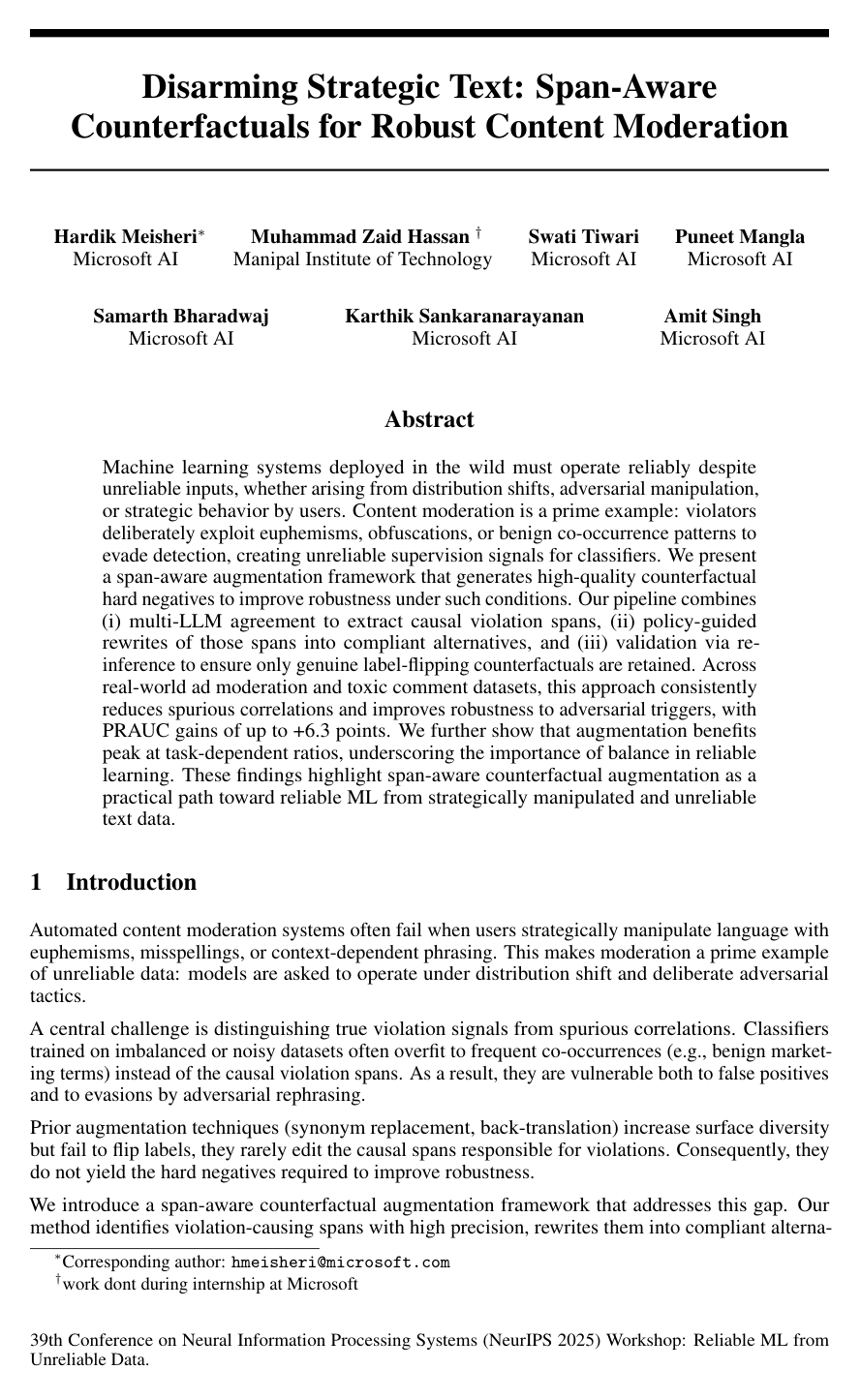
Disarming Strategic Text: Span-Aware Counterfactuals for Robust Content Moderation

Disarming Strategic Text: Span-Aware Counterfactuals for Robust Content Moderation

Hardik Meisheri, Muhammad Zaid Hassan, Swati Tiwari, Puneet Mangla, Samarth Bharadwaj, Karthik Sankaranarayanan, Amit Singh

OrganizationsManipal Institute of TechnologyMicrosoft

Why you should read this

Presents a span-aware counterfactual data augmentation framework that isolates causal violation spans using multi-LLM consensus and rewrites them into policy-compliant hard negatives to defend content moderation classifiers against adversarial text manipulation.

Machine learning systems deployed in the wild must operate reliably despite unreliable inputs, whether arising from distribution shifts, adversarial manipulation, or strategic behavior by users. Content moderation is a prime example: violators deliberately exploit euphemisms, obfuscations, or benign co-occurrence patterns to evade detection, creating unreliable supervision signals for classifiers. We present a span-aware augmentation framework that generates high-quality counterfactual hard negatives to improve robustness under such conditions. Our pipeline combines (i) multi-LLM agreement to extract causal violation spans, (ii) policy-guided rewrites of those spans into compliant alternatives, and (iii) validation via re-inference to ensure only genuine label-flipping counterfactuals are retained. Across real-world ad moderation and toxic comment datasets, this approach consistently reduces spurious correlations and improves robustness to adversarial triggers, with PRAUC gains of up to +6.3 points. We further show that augmentation benefits peak at task-dependent ratios, underscoring the importance of balance in reliable learning. These findings highlight span-aware counterfactual augmentation as a practical path toward reliable ML from strategically manipulated and unreliable text data.

Added

2026-09-29