
keyword
context awareness
Context awareness is the ability of a system to use relevant information about its current situation to interpret inputs and guide its actions. This information may include the surrounding content, the user’s activity, or the system’s operating requirements.
3 items
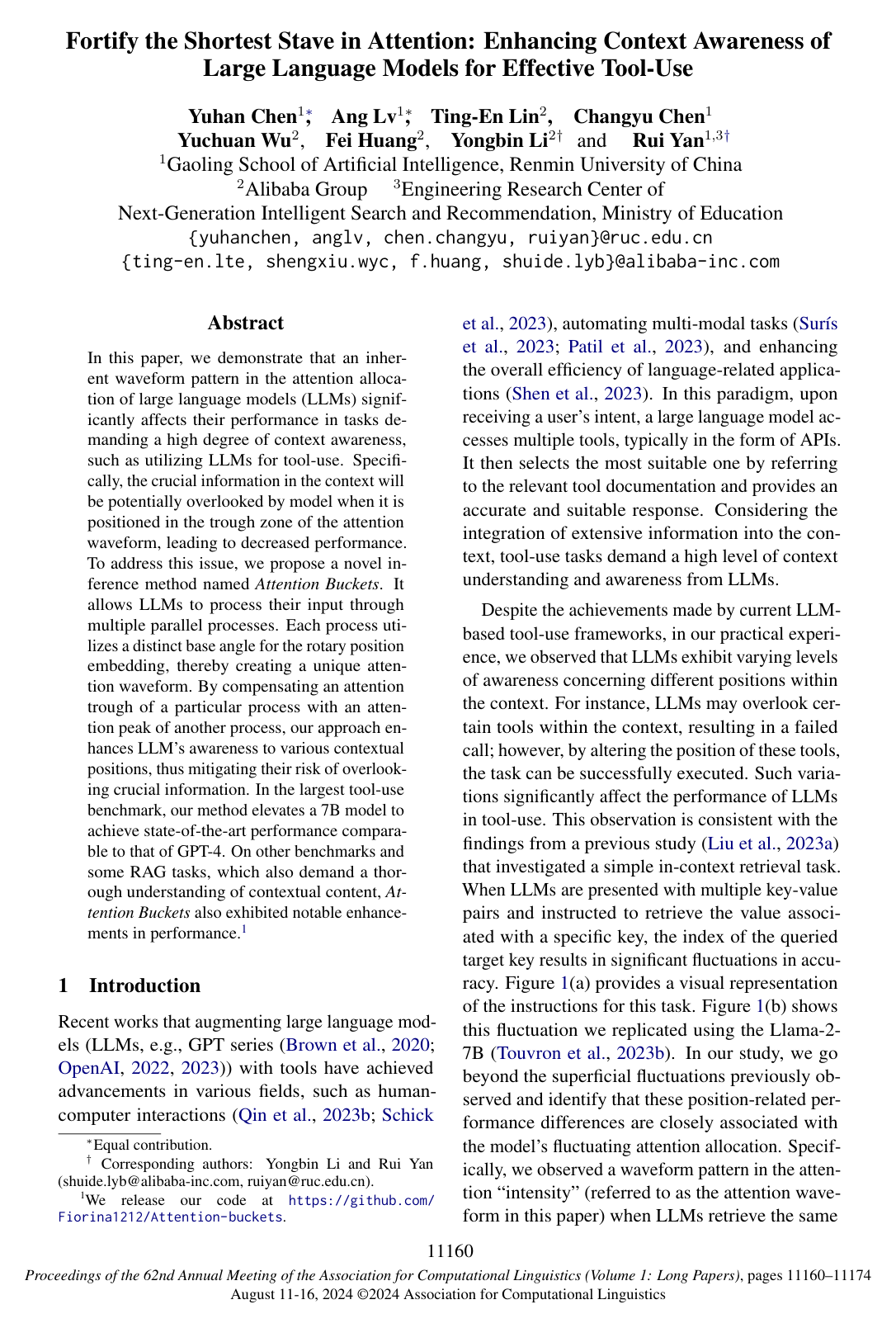
Fortify the Shortest Stave in Attention: Enhancing Context Awareness of Large Language Models for Effective Tool Use
Yuhan Chen, Ang Lv, Ting-En Lin, Changyu Chen, Yuchuan Wu, Fei Huang, Yongbin Li, Rui Yan
Why you should read this
Proposes Attention Buckets, a training-free inference method that eliminates blind spots in LLM context retrieval caused by rotary position embedding attention waveforms by ensembling parallel processes with complementary angle bases, boosting 7B models to GPT-4-level tool-use accuracy.
In this paper, we demonstrate that an inherent waveform pattern in the attention allocation of large language models (LLMs) significantly affects their performance in tasks demanding a high degree of context awareness, such as utilizing LLMs for tool-use. Specifically, the crucial information in the context will be potentially overlooked by model when it is positioned in the trough zone of the attention waveform, leading to decreased performance. To address this issue, we propose a novel inference method named Attention Buckets. It allows LLMs to process their input through multiple parallel processes. Each process utilizes a distinct base angle for the rotary position embedding, thereby creating a unique attention waveform. By compensating an attention trough of a particular process with an attention peak of another process, our approach enhances LLM’s awareness to various contextual positions, thus mitigating their risk of overlooking crucial information. In the largest tool-use benchmark, our method elevates a 7B model to achieve state-of-the-art performance comparable to that of GPT-4. On other benchmarks and some RAG tasks, which also demand a thorough understanding of contextual content, Attention Buckets also exhibited notable enhancements in performance.
Added
2026-10-05
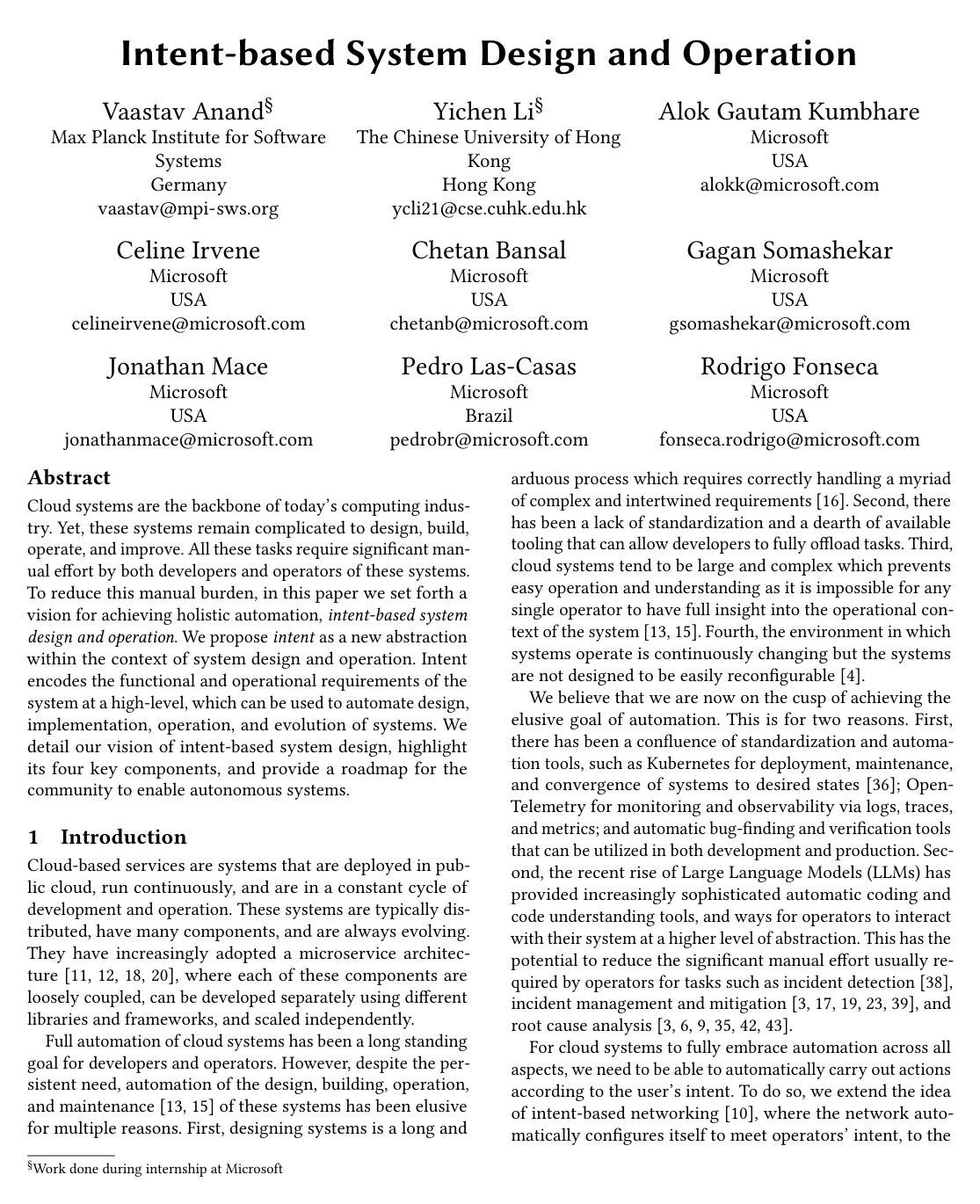
Intent-based System Design and Operation
Vaastav Anand, Yichen Li, Alok Kumbhare, Celine Irvene, Chetan Bansal, Gagan Somashekar, Jonathan Mace, Pedro Las-Casas, Ricardo Bianchini, Rodrigo Fonseca
Why you should read this
Proposes intent as a foundational abstraction that encodes high-level functional and operational goals to automate cloud system design, implementation, runtime management, and evolution.
Cloud systems are the backbone of today's computing industry. Yet, these systems remain complicated to design, build, operate, and improve. All these tasks require significant manual effort by both developers and operators of these systems. To reduce this manual burden, in this paper we set forth a vision for achieving holistic automation, intent-based system design and operation. We propose intent as a new abstraction within the context of system design and operation. Intent encodes the functional and operational requirements of the system at a high-level, which can be used to automate design, implementation, operation, and evolution of systems. We detail our vision of intent-based system design, highlight its four key components, and provide a roadmap for the community to enable autonomous systems.
Added
2026-10-04
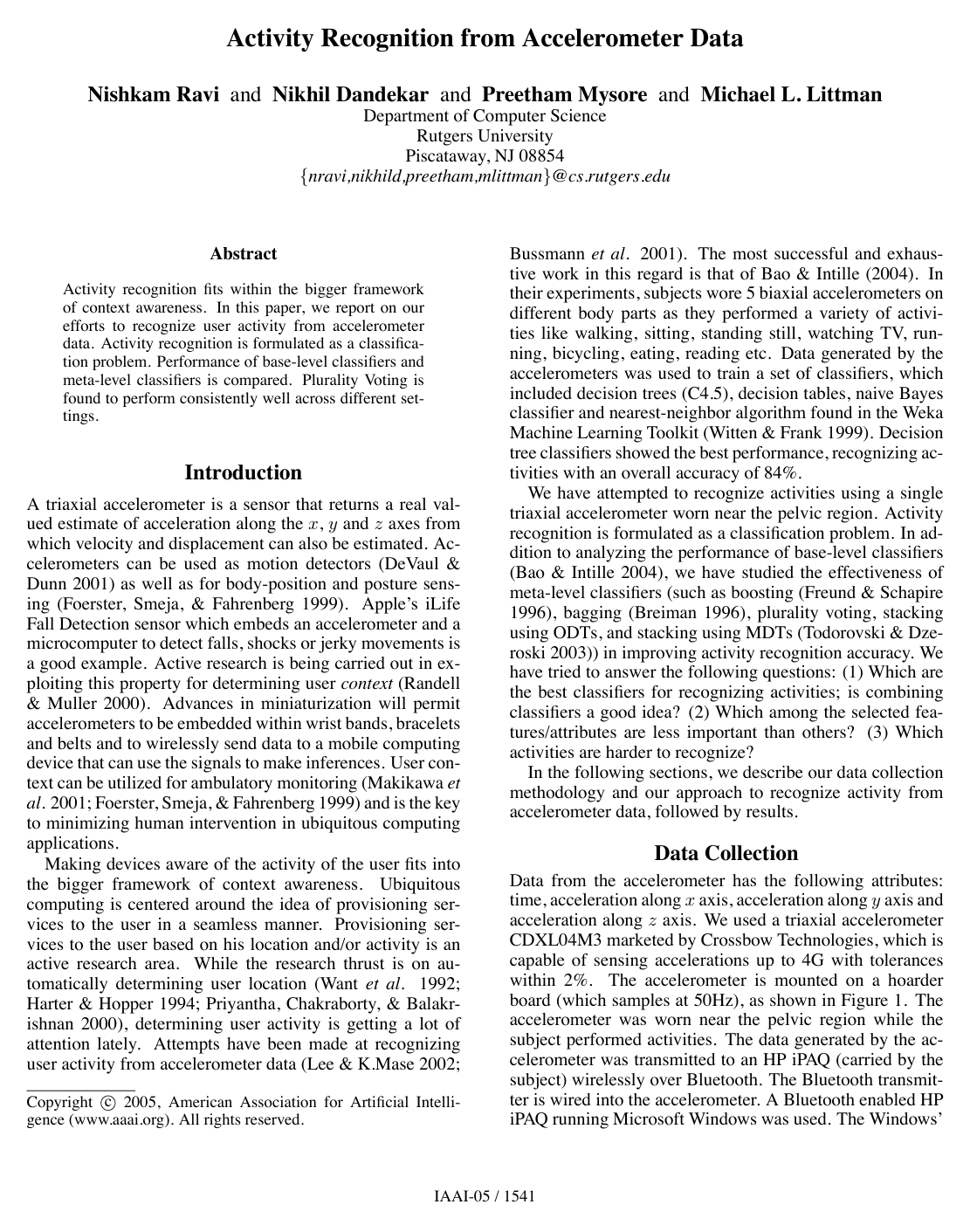
Activity Recognition from Accelerometer Data
Nishkam Ravi, Nikhil Dandekar, Preetham Mysore, Michael L. Littman
Why you should read this
Demonstrates that everyday physical activities can be accurately identified using a single pelvic-worn triaxial accelerometer combined with meta-level classification techniques like Plurality Voting.
Activity recognition fits within the bigger framework of context awareness. In this paper, we report on our efforts to recognize user activity from accelerometer data. Activity recognition is formulated as a classification problem. Performance of base-level classifiers and meta-level classifiers is compared. Plurality Voting is found to perform consistently well across different settings.
Added
2026-09-18