
Built independently by an author, for readers. Read the story and support ChapterPal

keyword

context-aware emotion recognition

Context-aware emotion recognition is a computational approach in artificial intelligence and affective computing that identifies human emotional states by analyzing an individual in conjunction with their surrounding situational environment. Rather than relying exclusively on isolated facial expressions or acoustic cues, context-aware systems integrate broader information such as body posture, gestures, background visual scenes, social interactions, and temporal dynamics across continuous sequences. By combining these environmental and behavioral cues with primary facial or vocal signals, this methodology resolves perceptual ambiguities and produces more accurate, reliable interpretations of emotional expressions in complex and unconstrained real-world settings.

1 item
Rethinking the Learning Paradigm for Dynamic Facial Expression Recognition

Rethinking the Learning Paradigm for Dynamic Facial Expression Recognition

Hanyang Wang, Bo Li, Shuang Wu, Siyuan Shen, Feng Liu, Shouhong Ding, Aimin Zhou

OrganizationsEast China Normal UniversityTencent

Why you should read this

Proposes a multi-instance learning framework for dynamic facial expression recognition that treats non-target video frames as weakly supervised data and balances short- and long-term temporal dependencies to achieve state-of-the-art accuracy using a standard 3D CNN backbone.

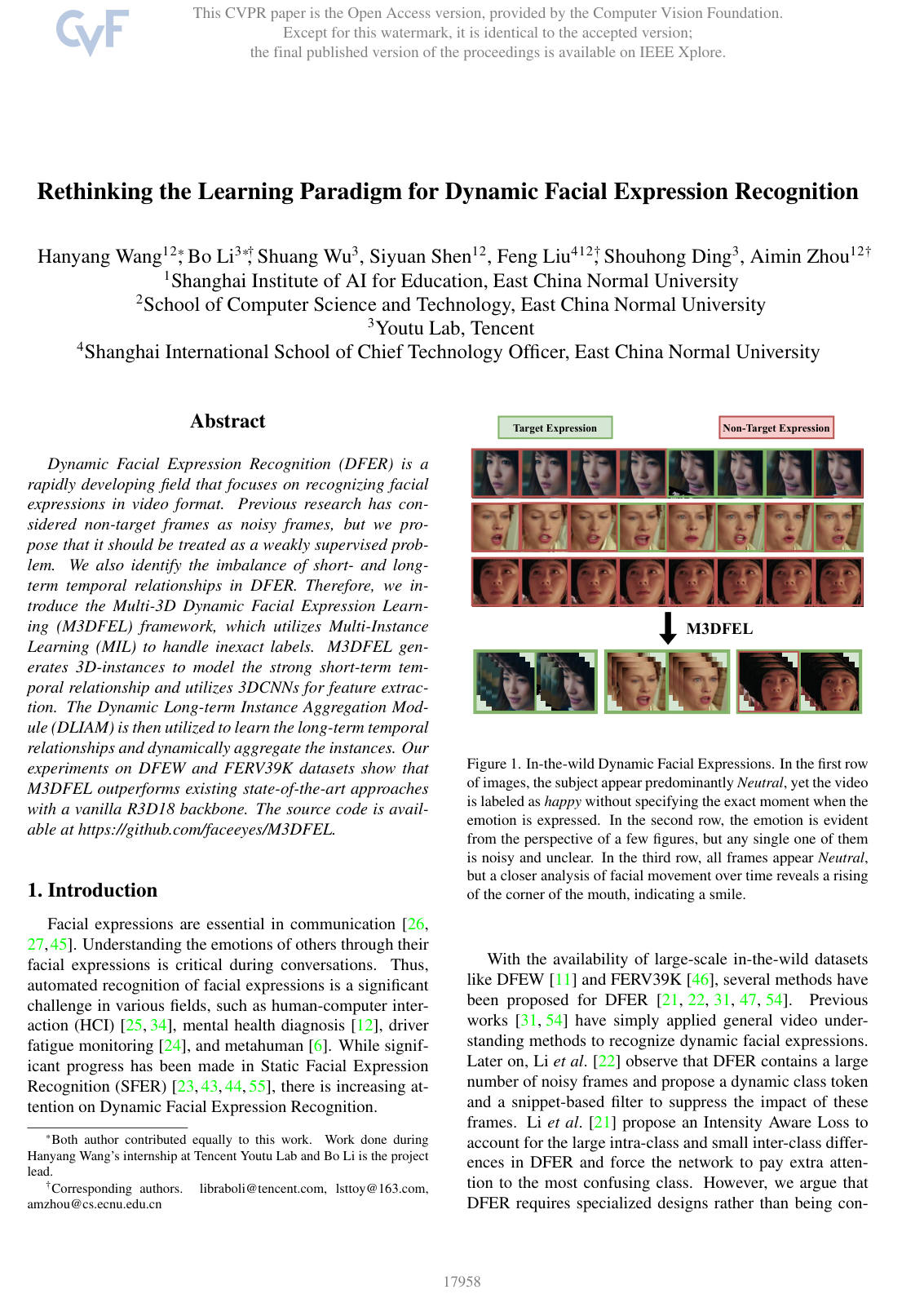
Dynamic Facial Expression Recognition (DFER) is a rapidly developing field that focuses on recognizing facial expressions in video format. Previous research has considered non-target frames as noisy frames, but we propose that it should be treated as a weakly supervised problem. We also identify the imbalance of short- and long-term temporal relationships in DFER. Therefore, we introduce the Multi-3D Dynamic Facial Expression Learning (M3DFEL) framework, which utilizes Multi-Instance Learning (MIL) to handle inexact labels. M3DFEL generates 3D-instances to model the strong short-term temporal relationship and utilizes 3DCNNs for feature extraction. The Dynamic Long-term Instance Aggregation Module (DLIAM) is then utilized to learn the long-term temporal relationships and dynamically aggregate the instances. Our experiments on DFEW and FERV39K datasets show that M3DFEL outperforms existing state-of-the-art approaches with a vanilla R3D18 backbone. The source code is available at https://github.com/faceeyes/M3DFEL.

Added

2026-09-26