
keyword
confidence estimation
Confidence estimation is the process of measuring and quantifying how certain an artificial intelligence or machine learning model is regarding the correctness, accuracy, or factuality of its own predictions and outputs. In natural language processing and automated decision-making, it assigns numerical scores or calibrated probabilities to generated answers, classifications, or factual statements to help distinguish dependable results from potential errors and hallucinations. These estimates can be derived through diverse methods, including analyzing output probability distributions, probing internal model states, prompting models to articulate their certainty, or measuring consistency across varying inputs and generations. Reliable confidence estimation is essential for error detection, selective prediction, and model calibration, enabling systems to signal when outputs can be trusted safely or when human intervention is required.
2 items
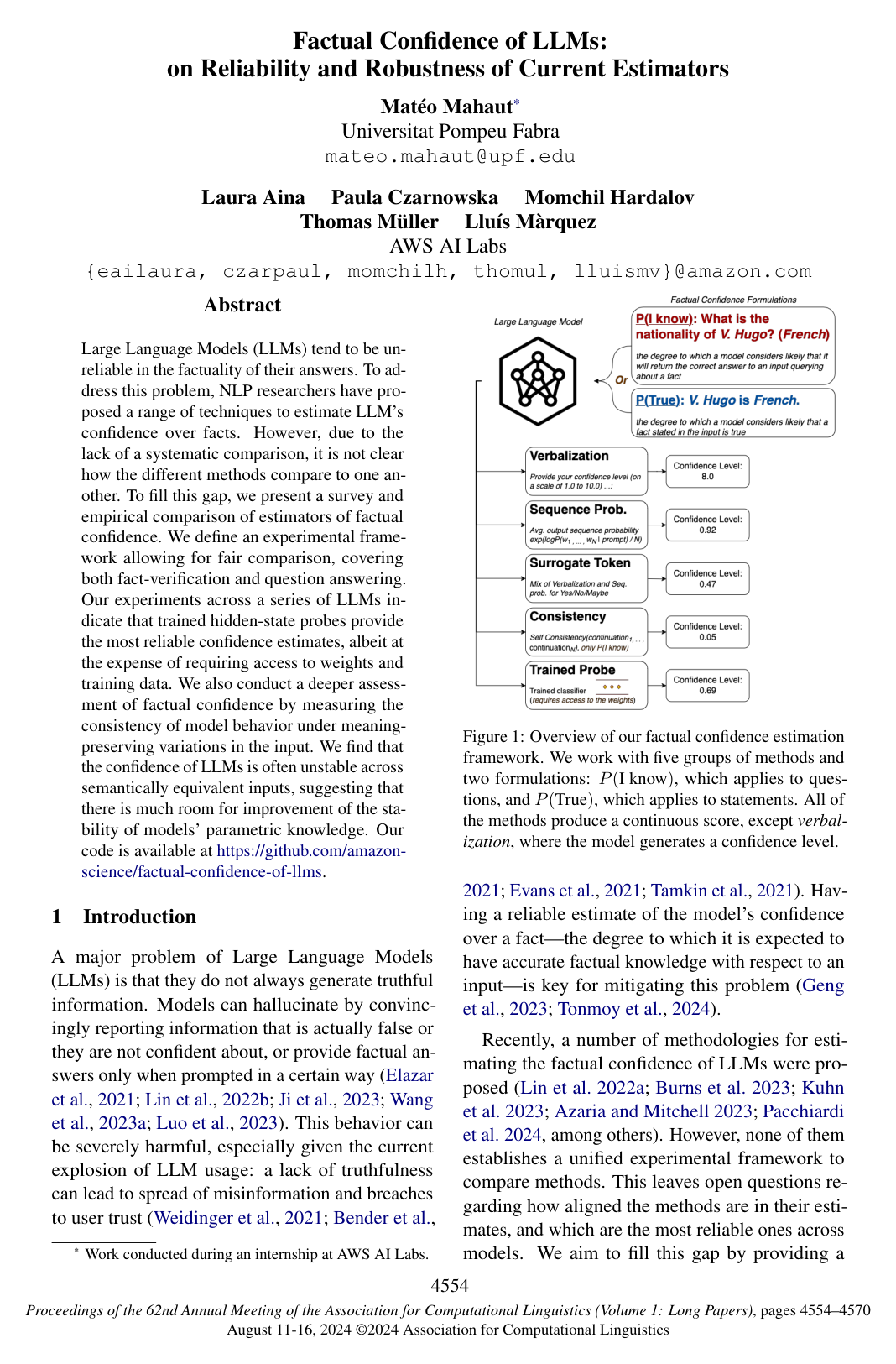
Factual Confidence of LLMs: on Reliability and Robustness of Current Estimators
Matéo Mahaut, Laura Aina, Paula Czarnowska, Momchil Hardalov, Thomas Müller, Lluís Màrquez
Why you should read this
Evaluates five major families of factual confidence estimators across multiple large language models and tasks, revealing that internal hidden-state probes achieve superior reliability while exposing how easily model confidence fluctuates across semantically equivalent prompts.
Large Language Models (LLMs) tend to be unreliable in the factuality of their answers. To address this problem, NLP researchers have proposed a range of techniques to estimate LLM’s confidence over facts. However, due to the lack of a systematic comparison, it is not clear how the different methods compare to one another. To fill this gap, we present a survey and empirical comparison of estimators of factual confidence. We define an experimental framework allowing for fair comparison, covering both fact-verification and question answering. Our experiments across a series of LLMs indicate that trained hidden-state probes provide the most reliable confidence estimates, albeit at the expense of requiring access to weights and training data. We also conduct a deeper assessment of factual confidence by measuring the consistency of model behavior under meaning-preserving variations in the input. We find that the confidence of LLMs is often unstable across semantically equivalent inputs, suggesting that there is much room for improvement of the stability of models’ parametric knowledge. Our code is available at https://github.com/amazon-science/factual-confidence-of-llms.
Added
2026-10-03
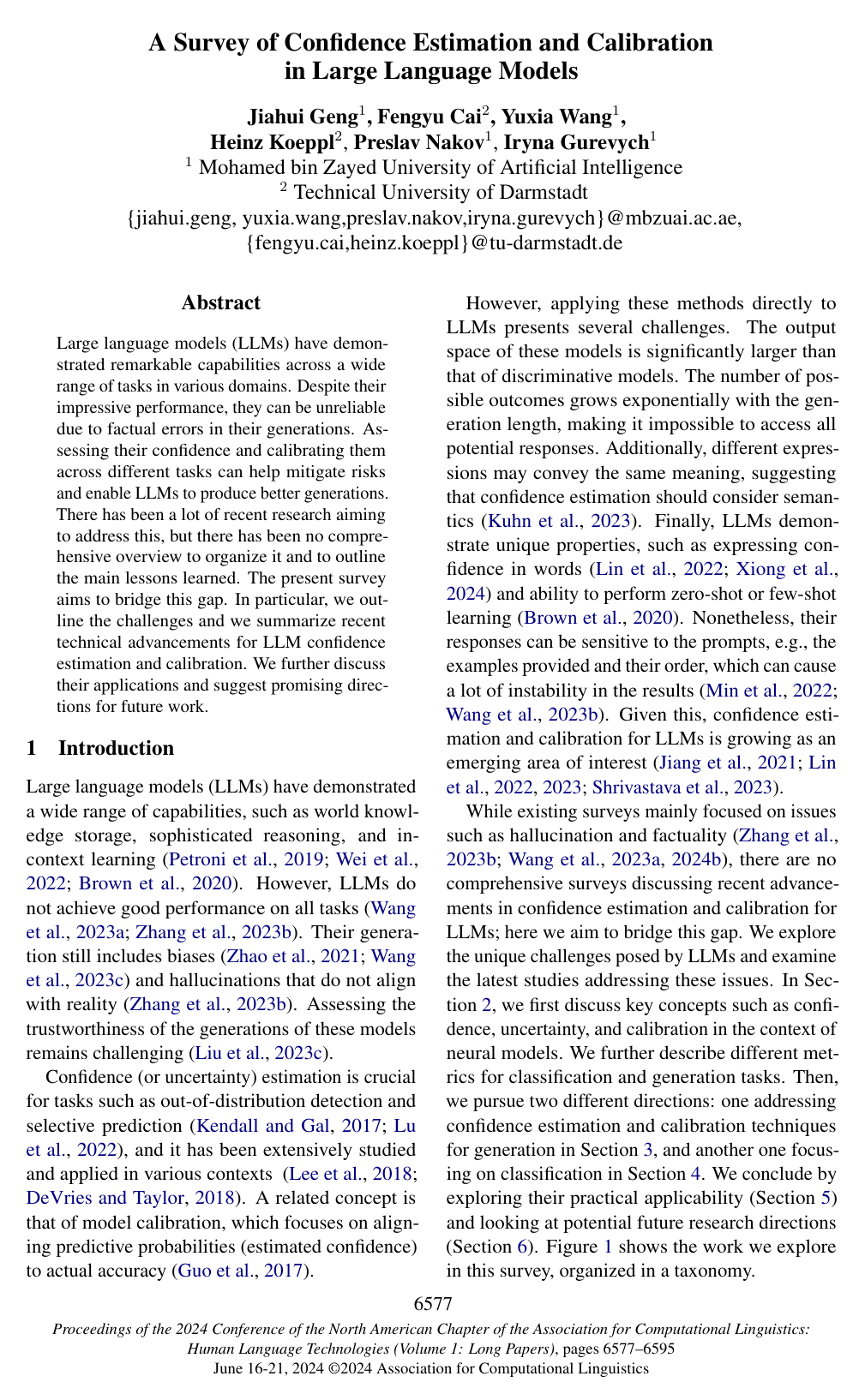
A Survey of Confidence Estimation and Calibration in Large Language Models
Jiahui Geng, Fengyu Cai, Yuxia Wang, Heinz Koeppl, Preslav Nakov, Iryna Gurevych
Why you should read this
Presents a structured taxonomy of methods, metrics, and applications for estimating and calibrating large language model confidence to mitigate factual errors and improve generation reliability.
Large language models (LLMs) have demonstrated remarkable capabilities across a wide range of tasks in various domains. Despite their impressive performance, they can be unreliable due to factual errors in their generations. Assessing their confidence and calibrating them across different tasks can help mitigate risks and enable LLMs to produce better generations. There has been a lot of recent research aiming to address this, but there has been no comprehensive overview to organize it and to outline the main lessons learned. The present survey aims to bridge this gap. In particular, we outline the challenges and we summarize recent technical advancements for LLM confidence estimation and calibration. We further discuss their applications and suggest promising directions for future work.
Added
2026-09-26