
keyword
confidence elicitation
Confidence elicitation refers to the process of extracting, measuring, or prompting a machine learning model to express its degree of certainty or belief in the correctness of its generated outputs, predictions, or reasoning steps. In natural language processing and artificial intelligence, this involves obtaining explicit uncertainty representations through either white-box methods that inspect internal states such as token logits and probability distributions, or black-box methods such as prompting the model to state its verbalized confidence, sampling multiple candidate outputs to evaluate consistency, and leveraging self-reflective evaluations. The primary objective of confidence elicitation is to achieve calibrated uncertainty quantification, which enables downstream systems and users to identify potential hallucinations or errors, assess output reliability, and support safer decision-making.
3 items
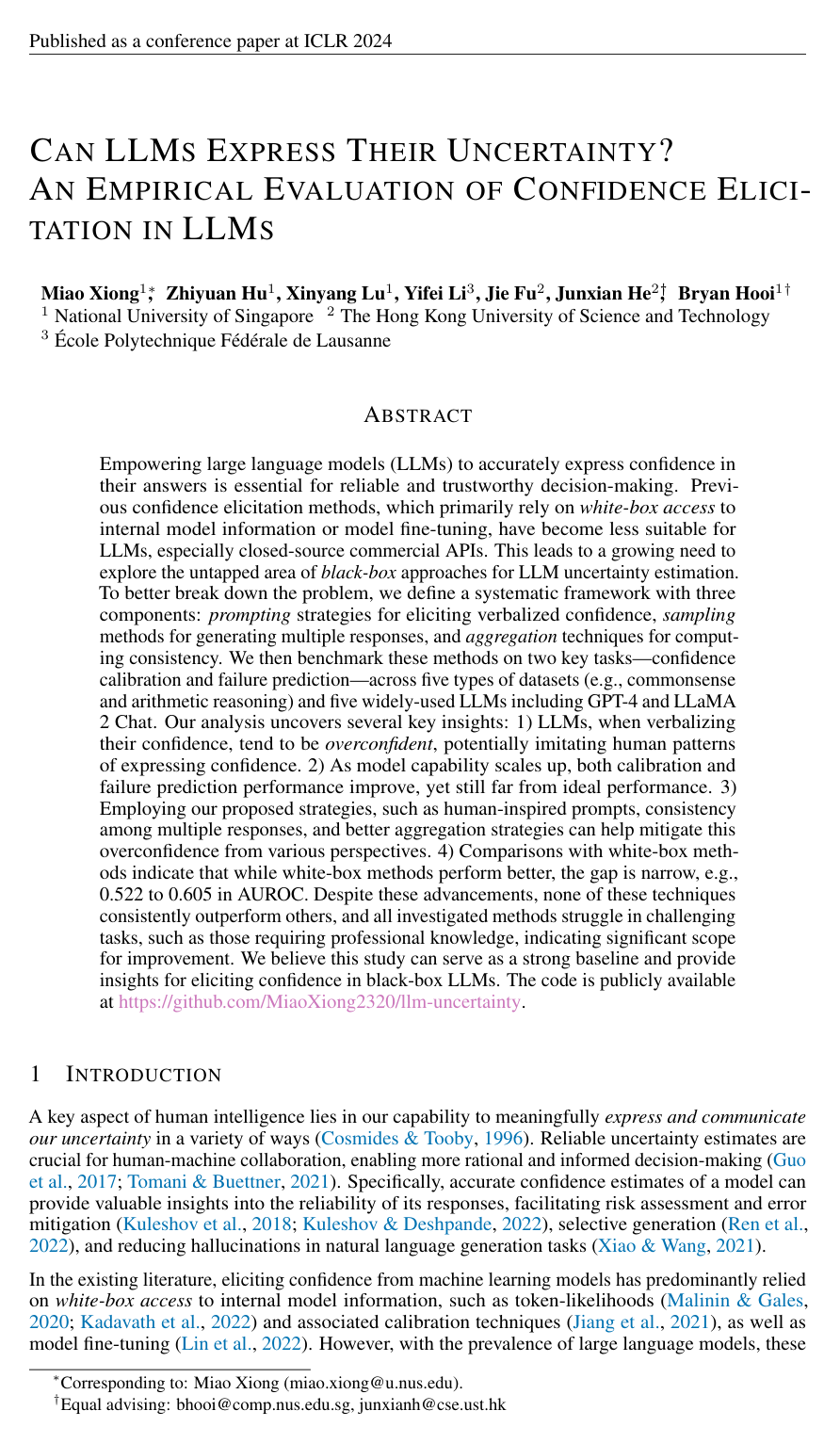
Can LLMs Express Their Uncertainty? An Empirical Evaluation of Confidence Elicitation in LLMs
Miao Xiong, Zhiyuan Hu, Xinyang Lu, Yifei Li, Jie Fu, Junxian He, Bryan Hooi
Why you should read this
Presents a systematic framework for evaluating black-box uncertainty estimation in large language models, showing that verbalized prompting and response consistency can effectively reduce overconfidence to rival white-box calibration methods.
Empowering large language models to accurately express confidence in their answers is essential for trustworthy decision-making. Previous confidence elicitation methods, which primarily rely on white-box access to internal model information or model fine-tuning, have become less suitable for LLMs, especially closed-source commercial APIs. This leads to a growing need to explore the untapped area of black-box approaches for LLM uncertainty estimation. To better break down the problem, we define a systematic framework with three components: prompting strategies for eliciting verbalized confidence, sampling methods for generating multiple responses, and aggregation techniques for computing consistency. We then benchmark these methods on two key tasks-confidence calibration and failure prediction-across five types of datasets (e.g., commonsense and arithmetic reasoning) and five widely-used LLMs including GPT-4 and LLaMA 2 Chat. Our analysis uncovers several key insights: 1) LLMs, when verbalizing their confidence, tend to be overconfident, potentially imitating human patterns of expressing confidence. 2) As model capability scales up, both calibration and failure prediction performance improve. 3) Employing our proposed strategies, such as human-inspired prompts, consistency among multiple responses, and better aggregation strategies can help mitigate this overconfidence from various perspectives. 4) Comparisons with white-box methods indicate that while white-box methods perform better, the gap is narrow, e.g., 0.522 to 0.605 in AUROC. Despite these advancements, none of these techniques consistently outperform others, and all investigated methods struggle in challenging tasks, such as those requiring professional knowledge, indicating significant scope for improvement. We believe this study can serve as a strong baseline and provide insights for eliciting confidence in black-box LLMs.
Added
2026-10-04
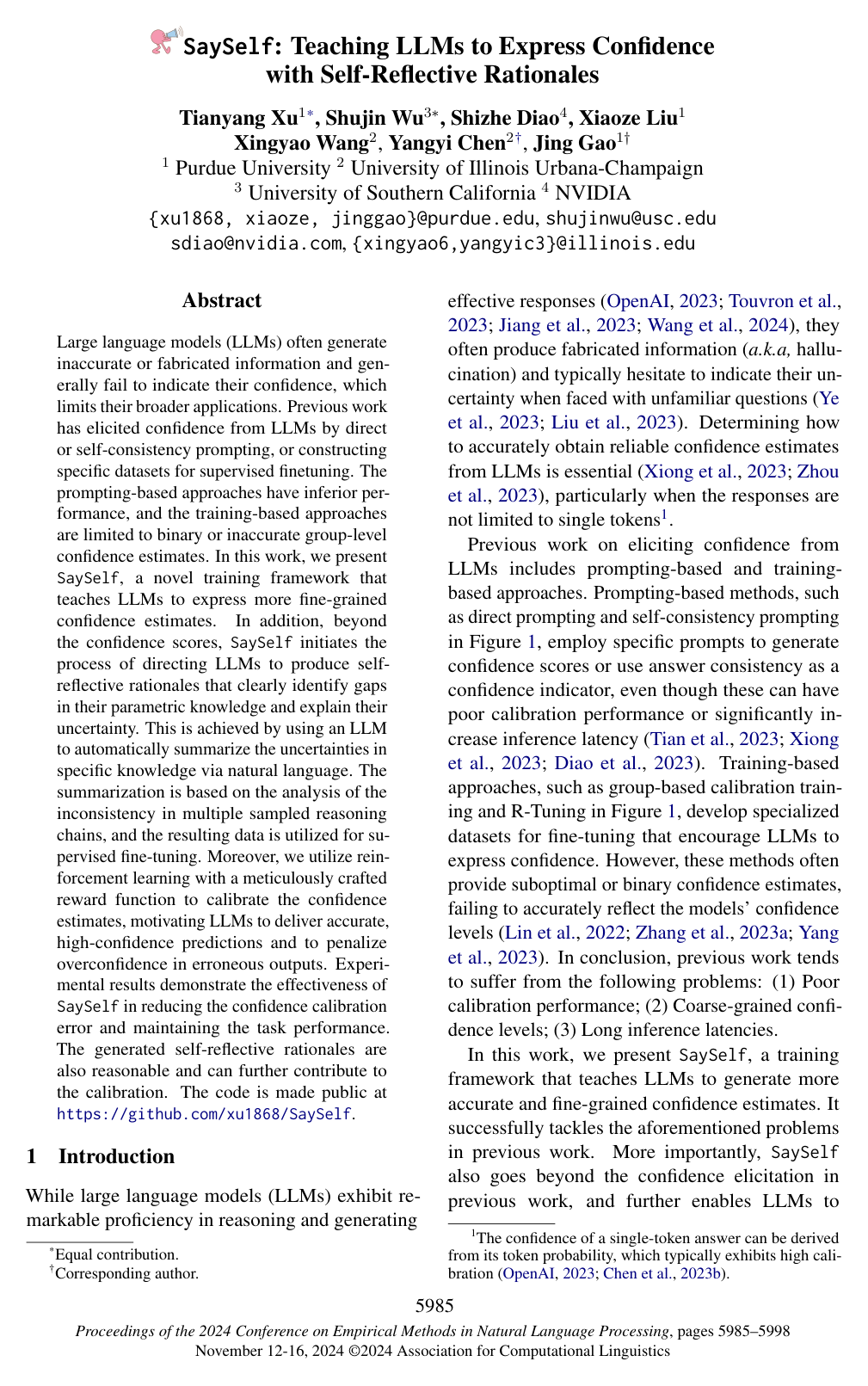
SaySelf: Teaching LLMs to Express Confidence with Self-Reflective Rationales
Tianyang Xu, Shujin Wu, Shizhe Diao, Xiaoze Liu, Xingyao Wang, Yangyi Chen, Jing Gao
Why you should read this
Presents SaySelf, a training framework combining supervised fine-tuning and reinforcement learning that teaches large language models to output fine-grained, well-calibrated confidence scores alongside natural-language explanations of their knowledge gaps without requiring multiple sampling at inference time.
Added
2026-10-02
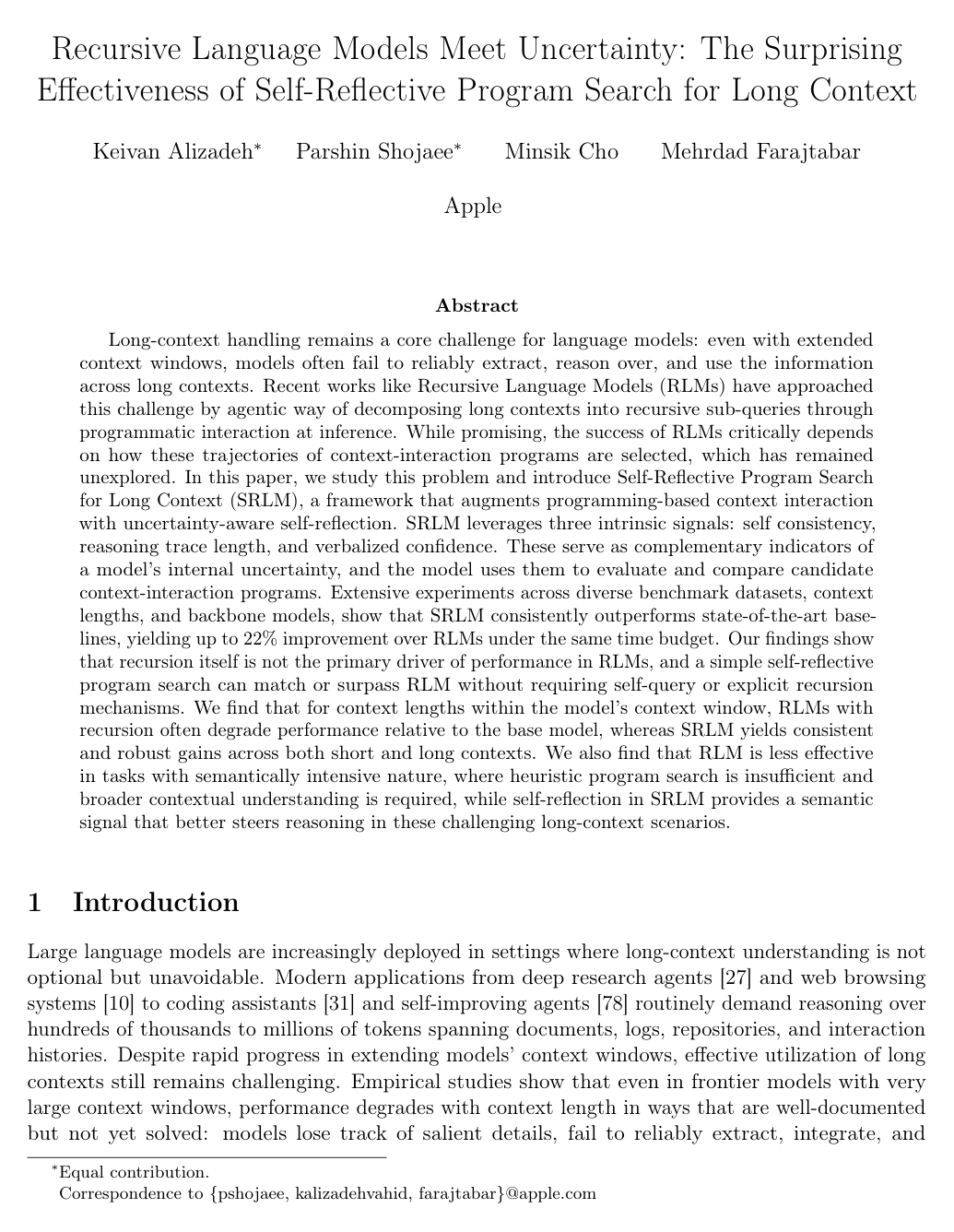
Recursive Language Models Meet Uncertainty: The Surprising Effectiveness of Self-Reflective Program Search for Long Context
Keivan Alizadeh, Parshin Shojaee, Minsik Cho, Mehrdad Farajtabar
Why you should read this
Introduces SRLM, a framework augmenting language models with uncertainty-aware self-reflection using intrinsic signals, which substantially improves long-context handling by outperforming recursive language models without explicit recursion.
Long-context handling remains a core challenge for language models: even with extended context windows, models often fail to reliably extract, reason over, and use the information across long contexts. Recent works like Recursive Language Models (RLM) have approached this challenge by agentic way of decomposing long contexts into recursive sub-calls through programmatic interaction at inference. While promising, the success of RLM critically depends on how these context-interaction programs are selected, which has remained largely unexplored. In this paper, we study this problem and introduce SRLM, a framework that augments programmatic context interaction with uncertainty-aware Self-Reflection. SRLM leverages three intrinsic signals: self consistency, reasoning length, and verbalized confidence. These serve as complementary indicators of a model's internal uncertainty, and the model uses them to evaluate and compare candidate context-interaction programs. Extensive experiments across diverse benchmark datasets, context lengths, and backbone models, show that SRLM consistently outperforms state-of-the-art baselines, yielding up to 22% improvement over RLM under the same time budget. Our findings show that recursion itself is not the primary driver of performance in RLM, and a simple self-reflective program search can match or surpass RLM without requiring self-query or explicit recursion mechanisms. We find that for context lengths within the model's window, RLMs with recursion often degrade performance relative to the base model, whereas SRLM yields consistent gains across both short and long contexts. We also find that RLM is less effective in tasks with semantically intensive nature, where heuristic program search is insufficient and broader contextual understanding is required, while self-reflection in SRLM provides a semantic signal that better steers reasoning in these scenarios.
Added
2026-05-07
