
keyword
Conceptual Captions
Conceptual Captions is a large-scale multimodal dataset consisting of millions of image and text description pairs used to train and evaluate vision-and-language artificial intelligence models. Sourced by extracting images and their associated alternative text attributes from web pages, the dataset is produced through an automated filtering and linguistic processing pipeline that removes noise and ensures visual relevance. A distinguishing characteristic of this curation process is hypernymization, in which specific named entities, proper nouns, and sensitive personal details in the raw text are substituted with broader conceptual categories and common nouns. This transformation creates a clean, diverse corpus focused on generalizable visual and semantic relationships, serving as a standard resource for image captioning, vision-language pre-training, and cross-modal retrieval.
32 items
ReCLIP: A Strong Zero-Shot Baseline for Referring Expression Comprehension
Sanjay Subramanian, William Merrill, Trevor Darrell, Matt Gardner, Sameer Singh, Anna Rohrbach
Why you should read this
Presents ReCLIP, a zero-shot referring expression comprehension method that repurposes pre-trained vision-language models through isolated proposal scoring and explicit spatial relation resolution to outperform prior zero-shot baselines and rival out-of-domain supervised models.
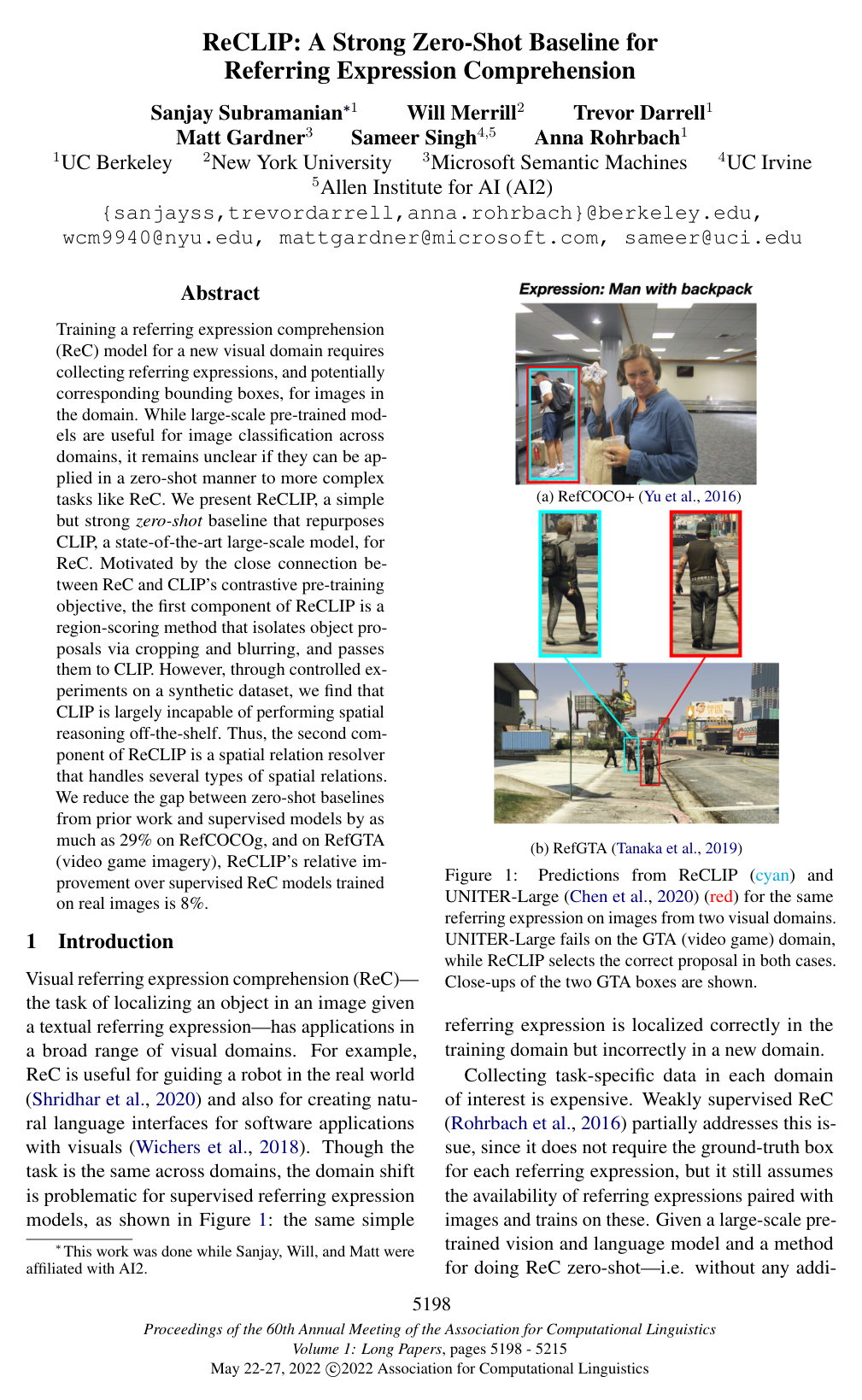
Training a referring expression comprehension (ReC) model for a new visual domain requires collecting referring expressions, and potentially corresponding bounding boxes, for images in the domain. While large-scale pre-trained models are useful for image classification across domains, it remains unclear if they can be applied in a zero-shot manner to more complex tasks like ReC. We present ReCLIP, a simple but strong zero-shot baseline that repurposes CLIP, a state-of-the-art large-scale model, for ReC. Motivated by the close connection between ReC and CLIP’s contrastive pre-training objective, the first component of ReCLIP is a region-scoring method that isolates object proposals via cropping and blurring, and passes them to CLIP. However, through controlled experiments on a synthetic dataset, we find that CLIP is largely incapable of performing spatial reasoning off-the-shelf. Thus, the second component of ReCLIP is a spatial relation resolver that handles several types of spatial relations. We reduce the gap between zero-shot baselines from prior work and supervised models by as much as 29% on RefCOCOg, and on RefGTA (video game imagery), ReCLIP’s relative improvement over supervised ReC models trained on real images is 8%.
Added
2026-10-05
A Good Prompt Is Worth Millions of Parameters: Low-resource Prompt-based Learning for Vision-Language Models
Woojeong Jin, Yu Cheng, Yelong Shen, Weizhu Chen, Xiang Ren
Why you should read this
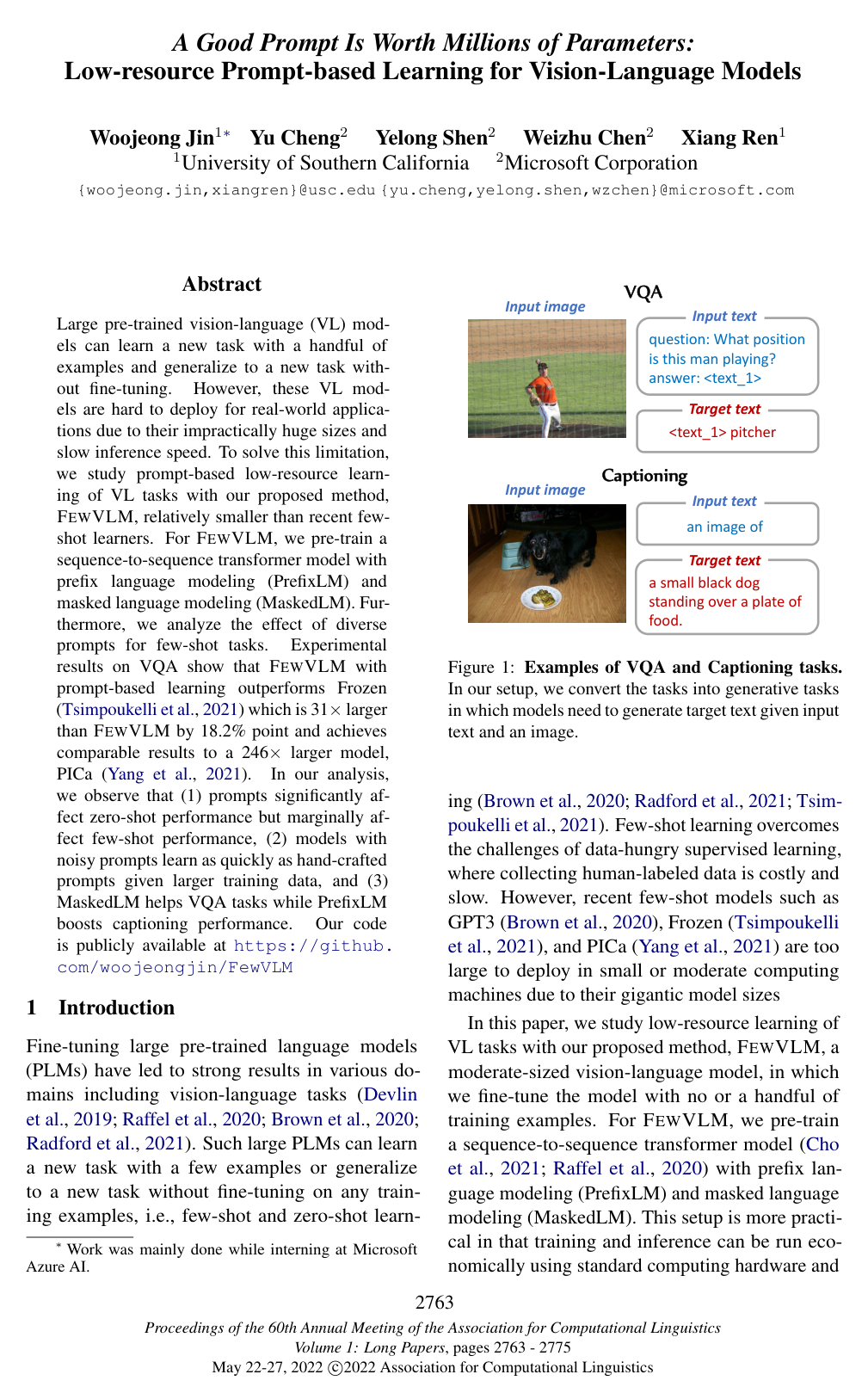
Proposes FewVLM, a sequence-to-sequence framework demonstrating that prompt-based learning enables compact vision-language models to match or exceed the zero-shot and few-shot performance of systems hundreds of times larger.
Added
2026-10-05
@ CREPE: Can Vision-Language Foundation Models Reason Compositionally?
Zixian Ma, Jerry Hong, Mustafa Omer Gul, Mona Gandhi, Irena Gao, Ranjay Krishna
Why you should read this
Introduces the CREPE benchmark to evaluate systematicity and productivity in vision-language models, revealing that current foundation models fail to generalize to novel visual compositions and degrade toward random chance as descriptive complexity increases.
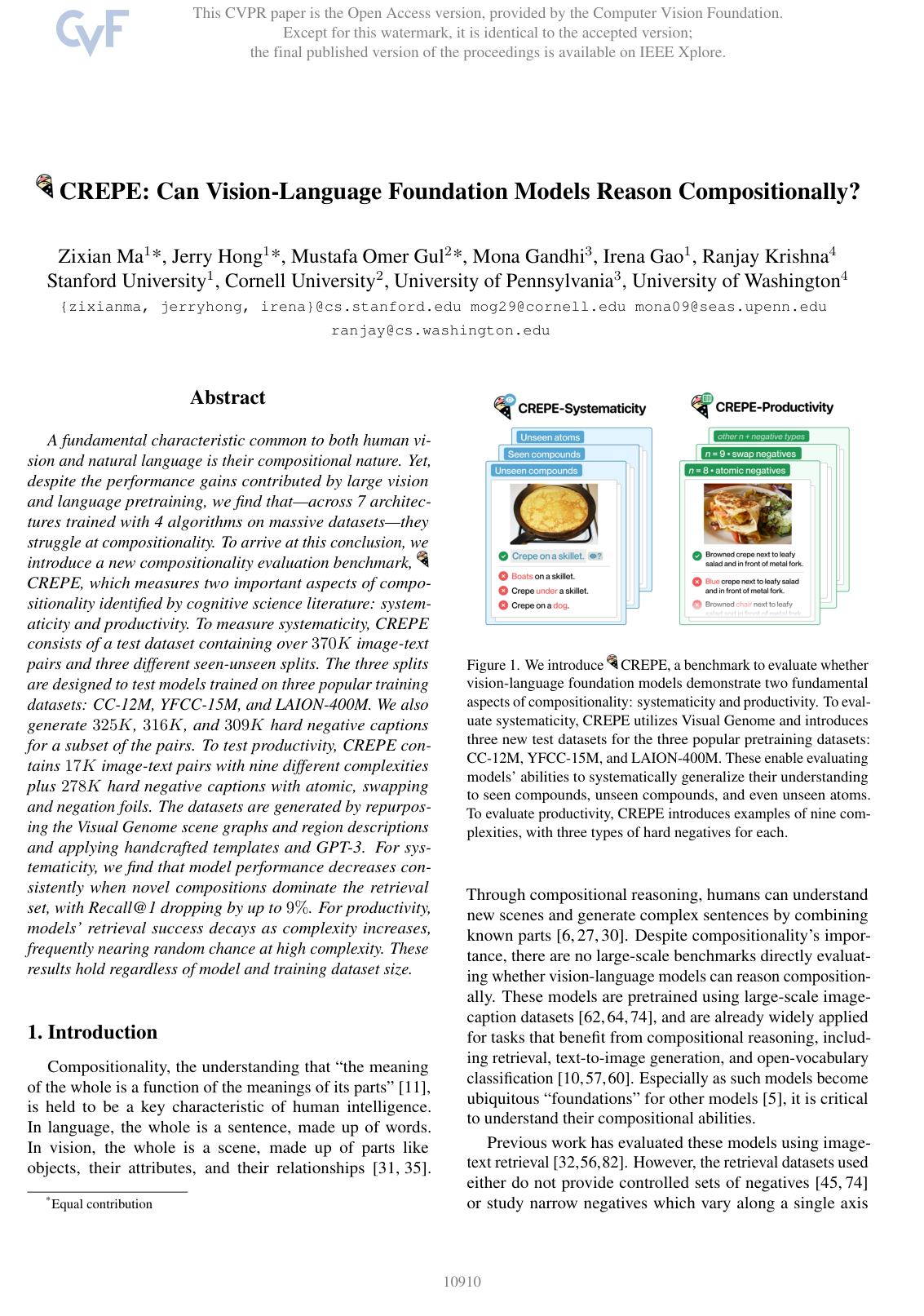
A fundamental characteristic common to both human vision and natural language is their compositional nature. Yet, despite the performance gains contributed by large vision and language pretraining, we find that—across 7 architectures trained with 4 algorithms on massive datasets—they struggle at compositionality. To arrive at this conclusion, we introduce a new compositionality evaluation benchmark, CREPE, which measures two important aspects of compositionality identified by cognitive science literature: systematicity and productivity. To measure systematicity, CREPE consists of a test dataset containing over 370K image-text pairs and three different seen-unseen splits. The three splits are designed to test models trained on three popular training datasets: CC-12M, YFCC-15M, and LAION-400M. We also generate 325K, 316K, and 309K hard negative captions for a subset of the pairs. To test productivity, CREPE contains 17K image-text pairs with nine different complexities plus 278K hard negative captions with atomic, swapping and negation foils. The datasets are generated by repurposing the Visual Genome scene graphs and region descriptions and applying handcrafted templates and GPT-3. For systematicity, we find that model performance decreases consistently when novel compositions dominate the retrieval set, with Recall@1 dropping by up to 9%. For productivity, models' retrieval success decays as complexity increases, frequently nearing random chance at high complexity. These results hold regardless of model and training dataset size.
Added
2026-10-05
Language Is Not All You Need: Aligning Perception with Language Models
Shaohan Huang, Li Dong, Wenhui Wang, Yaru Hao, Saksham Singhal, Shuming Ma, Tengchao Lv, Lei Cui, Owais Khan Mohammed, Barun Patra, Qiang Liu, Kriti Aggarwal, Zewen Chi, Nils Johan Bertil Bjorck, Vishrav Chaudhary, Subhojit Som, Xia Song, Furu Wei
Why you should read this
Presents Kosmos-1, a multimodal language model trained from scratch on interleaved text and image data that aligns visual perception with language generation to perform zero-shot multimodal dialogue, OCR-free reading, and nonverbal reasoning without task-specific fine-tuning.
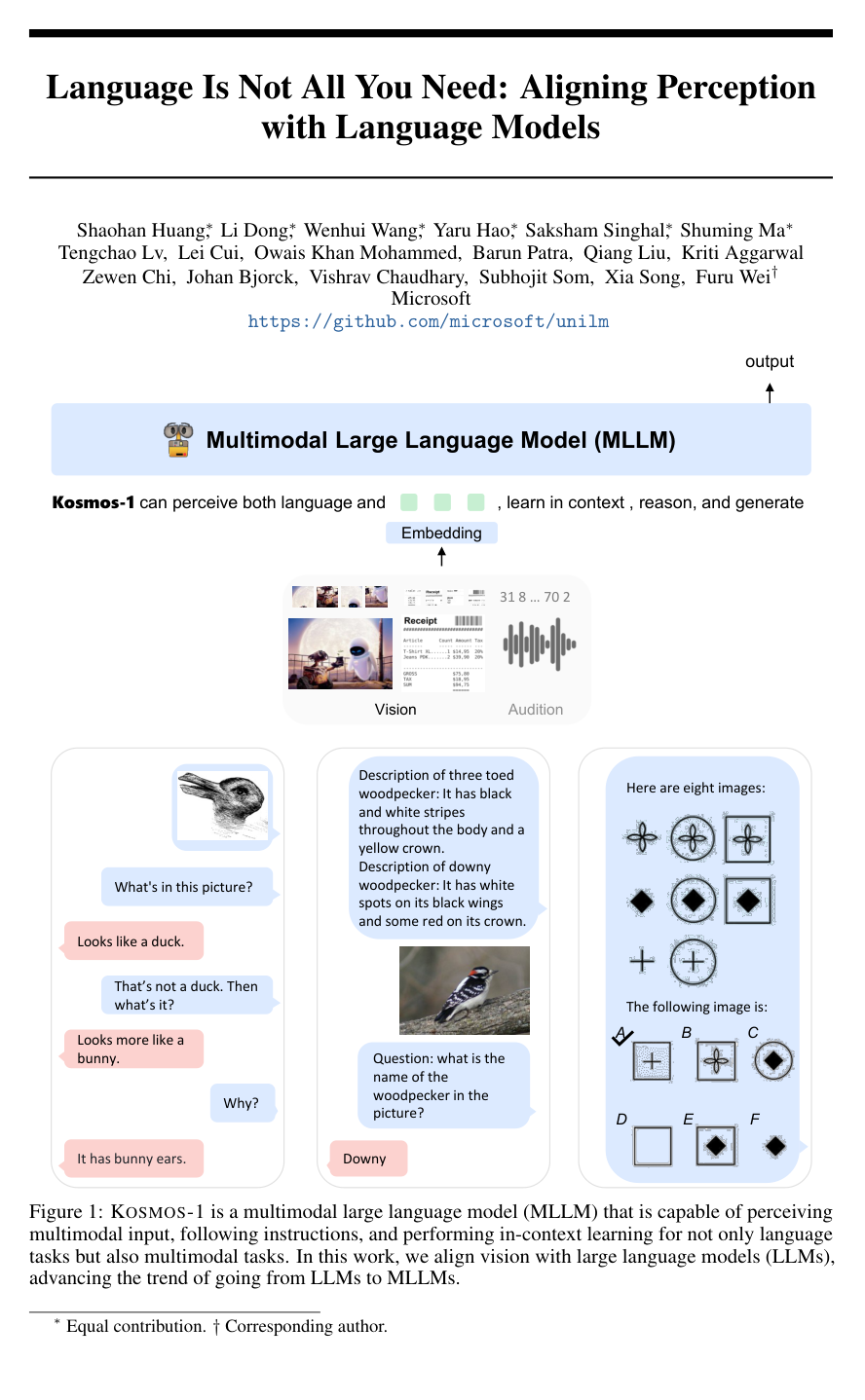
A big convergence of language, multimodal perception, action, and world modeling is a key step toward artificial general intelligence. In this work, we introduce Kosmos-1, a Multimodal Large Language Model (MLLM) that can perceive general modalities, learn in context (i.e., few-shot), and follow instructions (i.e., zero-shot). Specifically, we train Kosmos-1 from scratch on web-scale multimodal corpora, including arbitrarily interleaved text and images, image-caption pairs, and text data. We evaluate various settings, including zero-shot, few-shot, and multimodal chain-of-thought prompting, on a wide range of tasks without any gradient updates or finetuning. Experimental results show that Kosmos-1 achieves impressive performance on (i) language understanding, generation, and even OCR-free NLP (directly fed with document images), (ii) perception-language tasks, including multimodal dialogue, image captioning, visual question answering, and (iii) vision tasks, such as image recognition with descriptions (specifying classification via text instructions). We also show that MLLMs can benefit from cross-modal transfer, i.e., transfer knowledge from language to multimodal, and from multimodal to language. In addition, we introduce a dataset of Raven IQ test, which diagnoses the nonverbal reasoning capability of MLLMs.
Added
2026-10-05
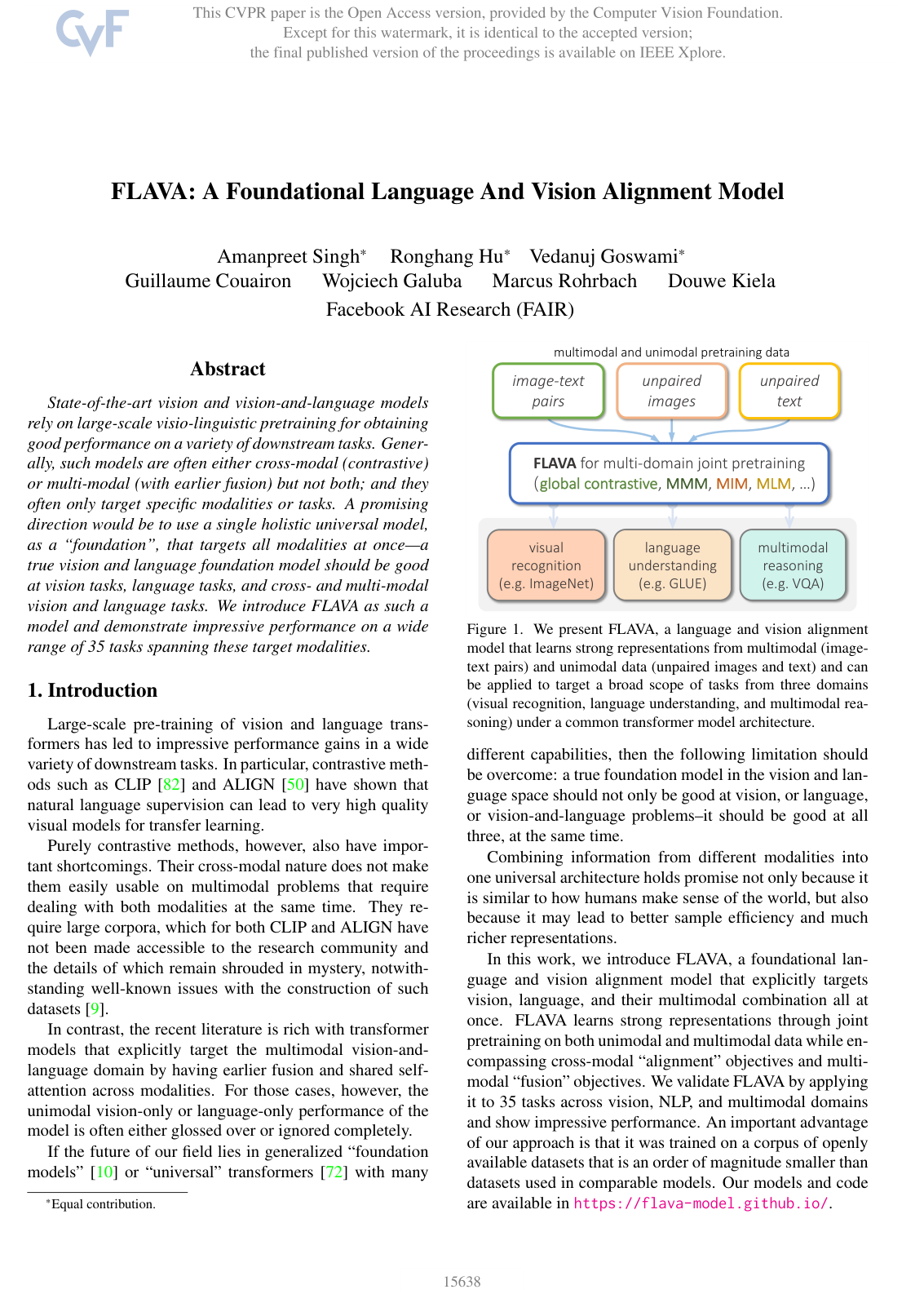
FLAVA: A Foundational Language And Vision Alignment Model
Amanpreet Singh, Ronghang Hu, Vedanuj Goswami, Guillaume Couairon, Wojciech Galuba, Marcus Rohrbach, Douwe Kiela
Why you should read this
Presents a unified foundation architecture that jointly pretrains on unimodal and multimodal data using both contrastive and fusion objectives, achieving strong performance across 35 distinct vision, language, and cross-modal tasks using only public datasets.
State-of-the-art vision and vision-and-language models rely on large-scale visio-linguistic pretraining for obtaining good performance on a variety of downstream tasks. Generally, such models are often either cross-modal (contrastive) or multi-modal (with earlier fusion) but not both; and they often only target specific modalities or tasks. A promising direction would be to use a single holistic universal model, as a “foundation”, that targets all modalities at once—a true vision and language foundation model should be good at vision tasks, language tasks, and cross- and multi-modal vision and language tasks. We introduce FLAVA as such a model and demonstrate impressive performance on a wide range of 35 tasks spanning these target modalities.
Added
2026-10-05
PaLI: A Jointly-Scaled Multilingual Language-Image Model
Xi Chen, Xiao Wang, Soravit Changpinyo, AJ Piergiovanni, Piotr Padlewski, Daniel Salz, Sebastian Goodman, Adam Grycner, Basil Mustafa, Lucas Beyer, Alexander Kolesnikov, Joan Puigcerver, Nan Ding, Keran Rong, Hassan Akbari, Gaurav Mishra, Linting Xue, Ashish Thapliyal, James Bradbury, Weicheng Kuo, Mojtaba Seyedhosseini, Chao Jia, Burcu Karagol Ayan, Carlos Riquelme, Andreas Steiner, Anelia Angelova, Xiaohua Zhai, Neil Houlsby, Radu Soricut
Why you should read this
Presents PaLI, a unified multimodal model that achieves state-of-the-art performance across visual question answering, captioning, and scene-text tasks by jointly scaling a 4-billion-parameter vision transformer with large language models across over 100 languages.
Effective scaling and a flexible task interface enable large language models to excel at many tasks. We present PaLI (Pathways Language and Image model), a model that extends this approach to the joint modeling of language and vision. PaLI generates text based on visual and textual inputs, and with this interface performs many vision, language, and multimodal tasks, in many languages. To train PaLI, we make use of large pre-trained encoder-decoder language models and Vision Transformers (ViTs). This allows us to capitalize on their existing capabilities and leverage the substantial cost of training them. We find that joint scaling of the vision and language components is important. Since existing Transformers for language are much larger than their vision counterparts, we train a large, 4-billion parameter ViT (ViT-e) to quantify the benefits from even larger-capacity vision models. To train PaLI, we create a large multilingual mix of pretraining tasks, based on a new image-text training set containing 10B images and texts in over 100 languages. PaLI achieves state-of-the-art in multiple vision and language tasks (such as captioning, visual question-answering, scene-text understanding), while retaining a simple, modular, and scalable design.
Added
2026-10-04
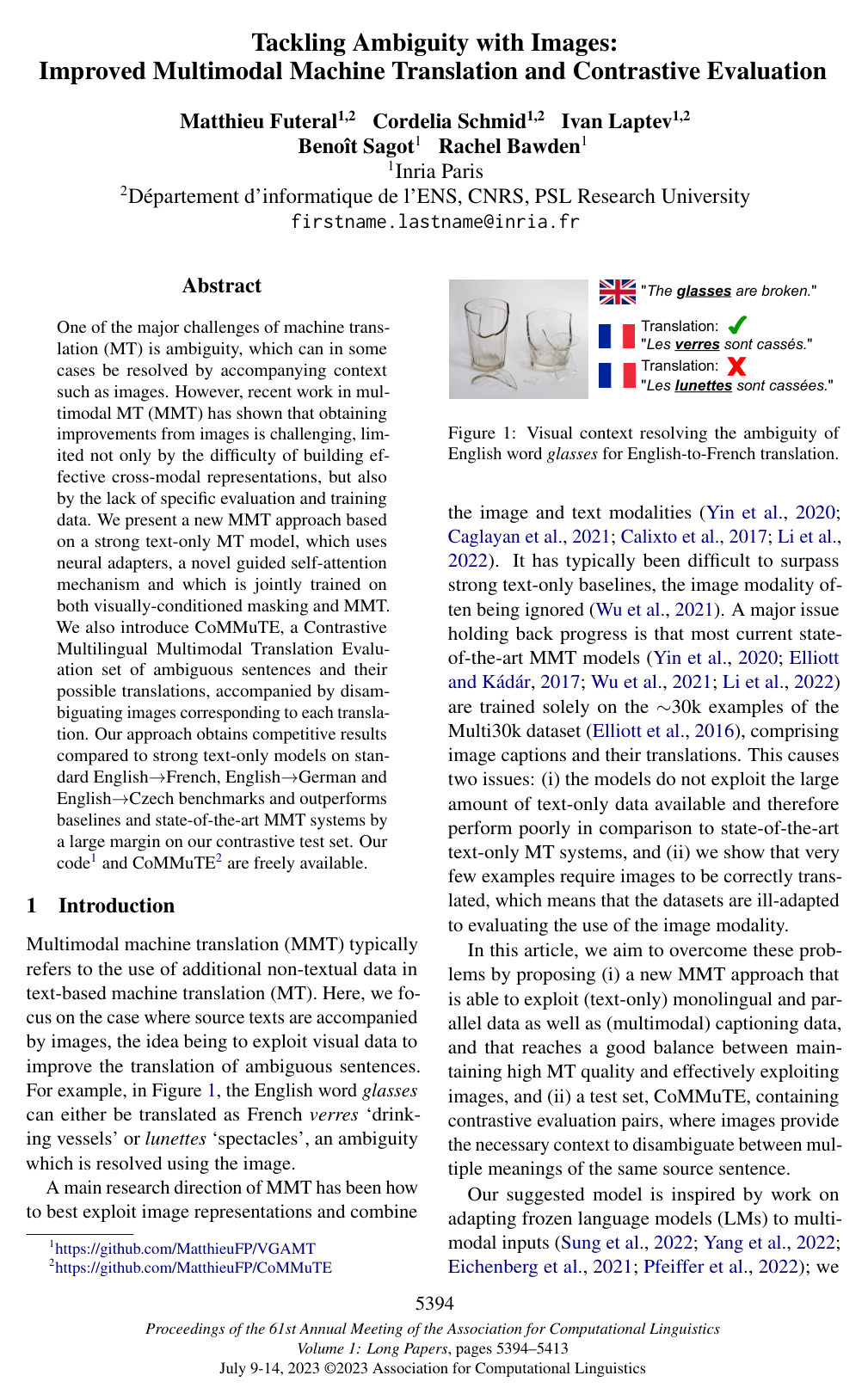
Tackling Ambiguity with Images: Improved Multimodal Machine Translation and Contrastive Evaluation
Matthieu Futeral, Cordelia Schmid, Ivan Laptev, Benoît Sagot, Rachel Bawden
Why you should read this
Proposes an adapter-based multimodal machine translation framework with guided self-attention alongside CoMMuTE, a contrastive evaluation benchmark designed to verify whether models effectively use visual context to resolve lexical ambiguity.
One of the major challenges of machine translation (MT) is ambiguity, which can in some cases be resolved by accompanying context such as images. However, recent work in multimodal MT (MMT) has shown that obtaining improvements from images is challenging, limited not only by the difficulty of building effective cross-modal representations, but also by the lack of specific evaluation and training data. We present a new MMT approach based on a strong text-only MT model, which uses neural adapters, a novel guided self-attention mechanism and which is jointly trained on both visually-conditioned masking and MMT. We also introduce CoMMuTE, a Contrastive Multilingual Multimodal Translation Evaluation set of ambiguous sentences and their possible translations, accompanied by disambiguating images corresponding to each translation. Our approach obtains competitive results compared to strong text-only models on standard English→French, English→German and English→Czech benchmarks and outperforms baselines and state-of-the-art MMT systems by a large margin on our contrastive test set. Our code¹ and CoMMuTE² are freely available.
Added
2026-10-04
ImageInWords: Unlocking Hyper-Detailed Image Descriptions
Roopal Garg, Andrea Burns, Burcu Karagol Ayan, Yonatan Bitton, Ceslee Montgomery, Yasumasa Onoe, Andrew Bunner, Ranjay Krishna, Jason Baldridge, Radu Soricut
Why you should read this
Presents a human-in-the-loop framework and dataset for producing hyper-detailed image descriptions that substantially outperform existing models and benchmarks in text-to-image generation and compositional reasoning tasks.
Despite the longstanding adage “an image is worth a thousand words,” generating accurate hyper-detailed image descriptions remains unsolved. Trained on short web-scraped image-text, vision-language models often generate incomplete descriptions with visual inconsistencies. We address this via a novel data-centric approach with ImageInWords (IIW), a carefully designed human-in-the-loop framework for curating hyper-detailed image descriptions. Human evaluations on IIW data show major gains compared to recent datasets (+66%) and GPT-4V (+48%) across comprehensiveness, specificity, hallucinations, and more. We also show that fine-tuning with IIW data improves these metrics by +31% against models trained with prior work, even with only 9k samples. Lastly, we evaluate IIW models with text-to-image generation and vision-language reasoning tasks. Our generated descriptions result in the highest fidelity images, and boost compositional reasoning by up to 6% on ARO, SVO-Probes, and Winoground datasets. We release the IIW-Eval benchmark with human judgement labels, object and image-level annotations from our framework, and existing image caption datasets enriched via IIW-model.
Added
2026-10-03
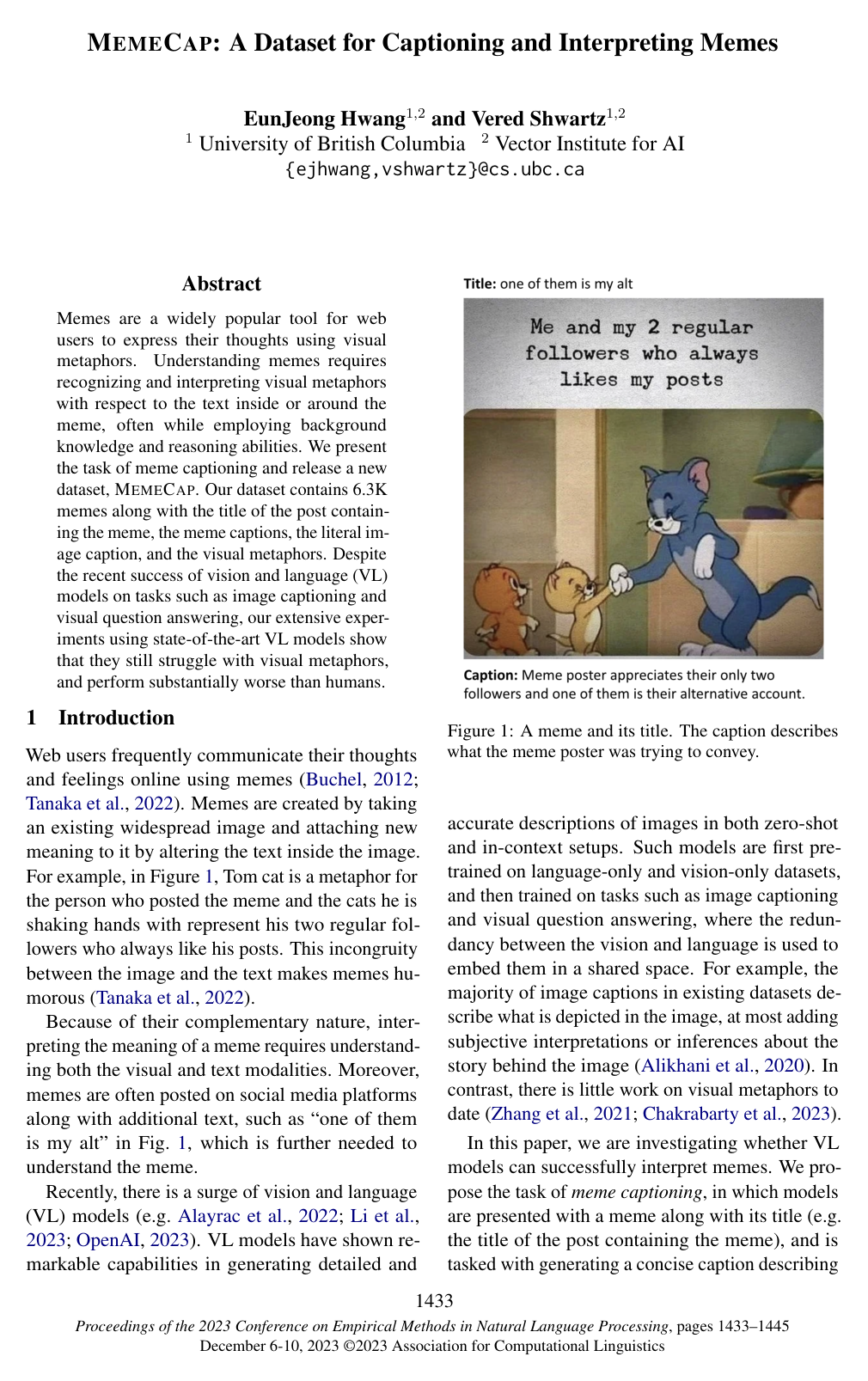
MemeCap: A Dataset for Captioning and Interpreting Memes
Eunjeong Hwang, Vered Shwartz
Why you should read this
Introduces MEMECAP, a dataset of over six thousand annotated memes with post titles, literal descriptions, and visual metaphors, to expose how modern vision-language models fail to interpret complex multimodal figurative meaning compared to humans.
Memes are a widely popular tool for web users to express their thoughts using visual metaphors. Understanding memes requires recognizing and interpreting visual metaphors with respect to the text inside or around the meme, often while employing background knowledge and reasoning abilities. We present the task of meme captioning and release a new dataset, MEMECAP. Our dataset contains 6.3K memes along with the title of the post containing the meme, the meme captions, the literal image caption, and the visual metaphors. Despite the recent success of vision and language (VL) models on tasks such as image captioning and visual question answering, our extensive experiments using state-of-the-art VL models show that they still struggle with visual metaphors, and perform substantially worse than humans.
Added
2026-10-03
FG-CLIP: Fine-Grained Visual and Textual Alignment
Chunyu Xie, Bin Wang, Fanjing Kong, Jincheng Li, Dawei Liang, Gengshen Zhang, Dawei Leng, Yuhui Yin
Why you should read this
Proposes FG-CLIP, a visual-language model that overcomes CLIP's coarse-grained limitations by training on 1.6 billion long captions, 40 million region-specific descriptions, and 10 million hard negative samples to boost performance in open-vocabulary object detection and image-text retrieval.
Contrastive Language-Image Pre-training (CLIP) excels in multimodal tasks such as image-text retrieval and zero-shot classification but struggles with fine-grained understanding due to its focus on coarse-grained short captions. To address this, we propose Fine-Grained CLIP (FG-CLIP), which enhances fine-grained understanding through three key innovations. First, we leverage large multimodal models to generate 1.6 billion long caption-image pairs for capturing global-level semantic details. Second, a high-quality dataset is constructed with 12 million images and 40 million region-specific bounding boxes aligned with detailed captions to ensure precise, context-rich representations. Third, 10 million hard fine-grained negative samples are incorporated to improve the model’s ability to distinguish subtle semantic differences. We construct a comprehensive dataset, termed FineHARD, by integrating high-quality region-specific annotations with hard fine-grained negative samples. Corresponding training methods are meticulously designed for these data. Extensive experiments demonstrate that FG-CLIP outperforms the original CLIP and other state-of-the-art methods across various downstream tasks, including fine-grained understanding, open-vocabulary object detection, image-text retrieval, and general multimodal benchmarks. These results highlight FG-CLIP’s effectiveness in capturing fine-grained image details and improving overall model performance. The data, code, and models are available at https://github.com/360CVGroup/FG-CLIP.
Added
2026-10-03
Image Captioning as an Assistive Technology: Lessons Learned from VizWiz 2020 Challenge
Pierre L. Dognin, Igor Melnyk, Youssef Mroueh, Inkit Padhi, Mattia Rigotti, Jarret Ross, Yair Schiff, Richard A. Young, Brian Belgodere
Why you should read this
Presents the winning multimodal framework from the VizWiz 2020 Challenge, integrating rotation-invariant optical character recognition, object detection, and a copy-mechanism transformer to generate task-oriented captions from real-world photos taken by visually impaired users.
Image captioning has recently demonstrated impressive progress largely owing to the introduction of neural network algorithms trained on curated dataset like MS-COCO. Often work in this field is motivated by the promise of deployment of captioning systems in practical applications. However, the scarcity of data and contexts in many competition datasets renders the utility of systems trained on these datasets limited as an assistive technology in real-world settings, such as helping visually impaired people navigate and accomplish everyday tasks. This gap motivated the introduction of the novel VizWiz dataset, which consists of images taken by the visually impaired and captions that have useful, task-oriented information. In an attempt to help the machine learning computer vision field realize its promise of producing technologies that have positive social impact, the curators of the VizWiz dataset host several competitions, including one for image captioning. This work details the theory and engineering from our winning submission to the 2020 captioning competition. Our work provides a step towards improved assistive image captioning systems.
Added
2026-10-03
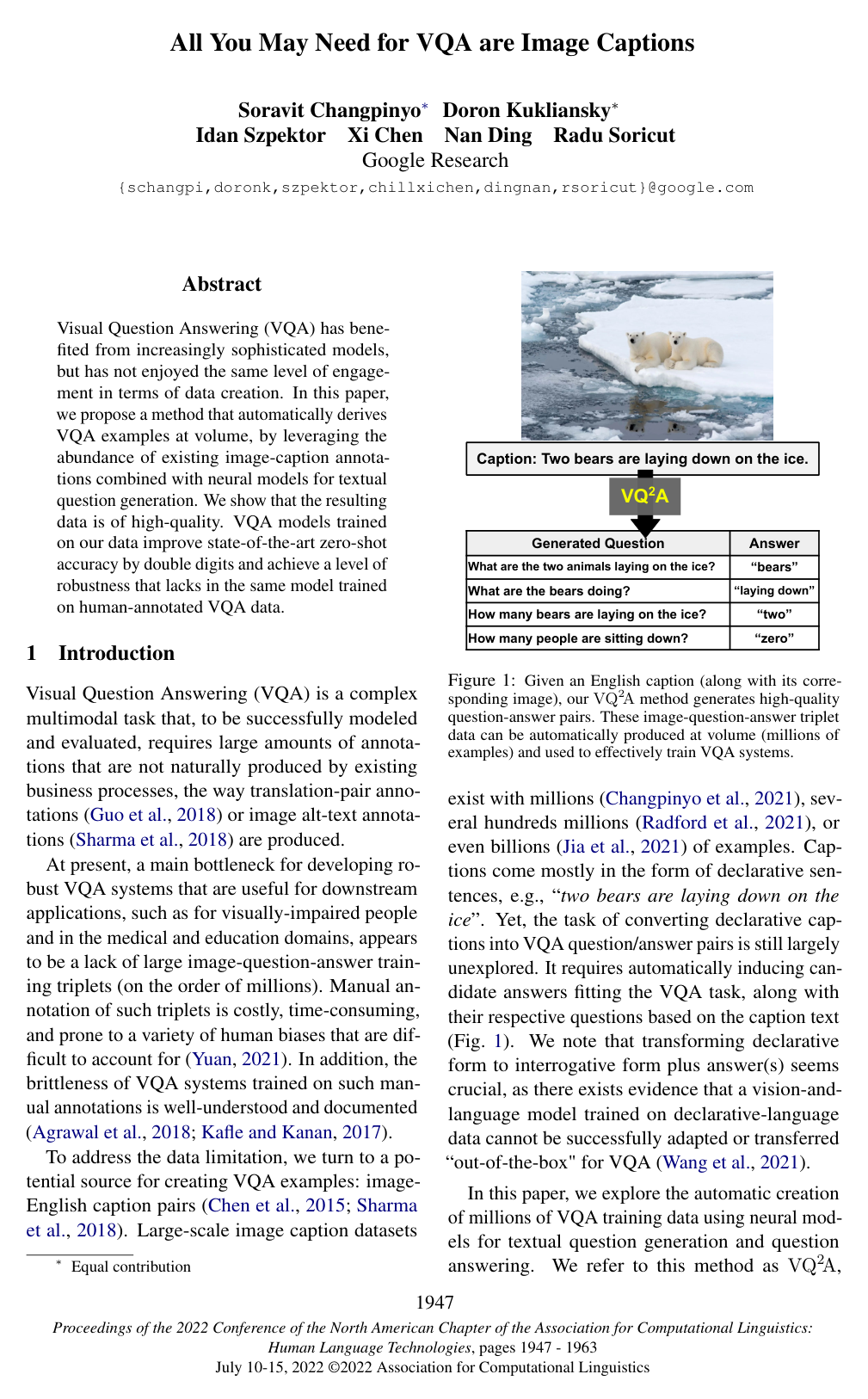
All You May Need for VQA are Image Captions
Soravit Changpinyo, Doron Kukliansky, Idan Szpektor, Xi Chen, Nan Ding, Radu Soricut
Why you should read this
Demonstrates how to automatically generate millions of high-quality visual question answering training pairs directly from image captions, boosting zero-shot performance across major benchmarks without human annotation.
Visual Question Answering (VQA) has benefited from increasingly sophisticated models, but has not enjoyed the same level of engagement in terms of data creation. In this paper, we propose a method that automatically derives VQA examples at volume, by leveraging the abundance of existing image-caption annotations combined with neural models for textual question generation. We show that the resulting data is of high-quality. VQA models trained on our data improve state-of-the-art zero-shot accuracy by double digits and achieve a level of robustness that lacks in the same model trained on human-annotated VQA data.
Added
2026-10-02
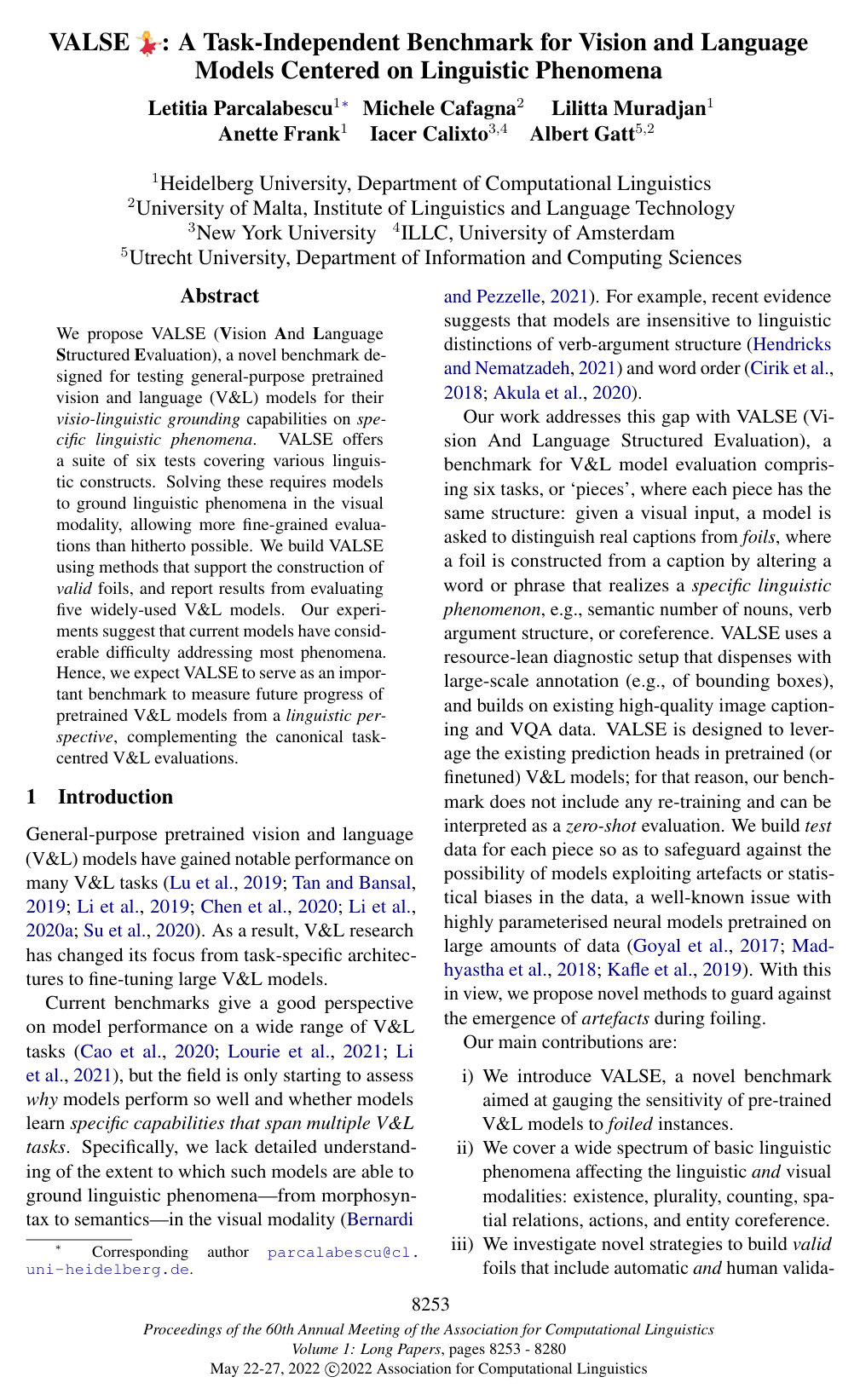
VALSE: A Task-Independent Benchmark for Vision and Language Models Centered on Linguistic Phenomena
Letitia Parcalabescu, Michele Cafagna, Lilitta Muradjan, Anette Frank, Iacer Calixto, Albert Gatt
Why you should read this
Proposes a diagnostic benchmark designed to evaluate how effectively pretrained vision-and-language models visually ground specific linguistic constructs, revealing critical failure modes across state-of-the-art architectures when tested against carefully controlled adversarial foils.
We propose VALSE (Vision And Language Structured Evaluation), a novel benchmark designed for testing general-purpose pretrained vision and language (V&L) models for their visio-linguistic grounding capabilities on specific linguistic phenomena. VALSE offers a suite of six tests covering various linguistic constructs. Solving these requires models to ground linguistic phenomena in the visual modality, allowing more fine-grained evaluations than hitherto possible. We build VALSE using methods that support the construction of valid foils, and report results from evaluating five widely-used V&L models. Our experiments suggest that current models have considerable difficulty addressing most phenomena. Hence, we expect VALSE to serve as an important benchmark to measure future progress of pretrained V&L models from a linguistic perspective, complementing the canonical task-centred V&L evaluations.
Added
2026-10-01
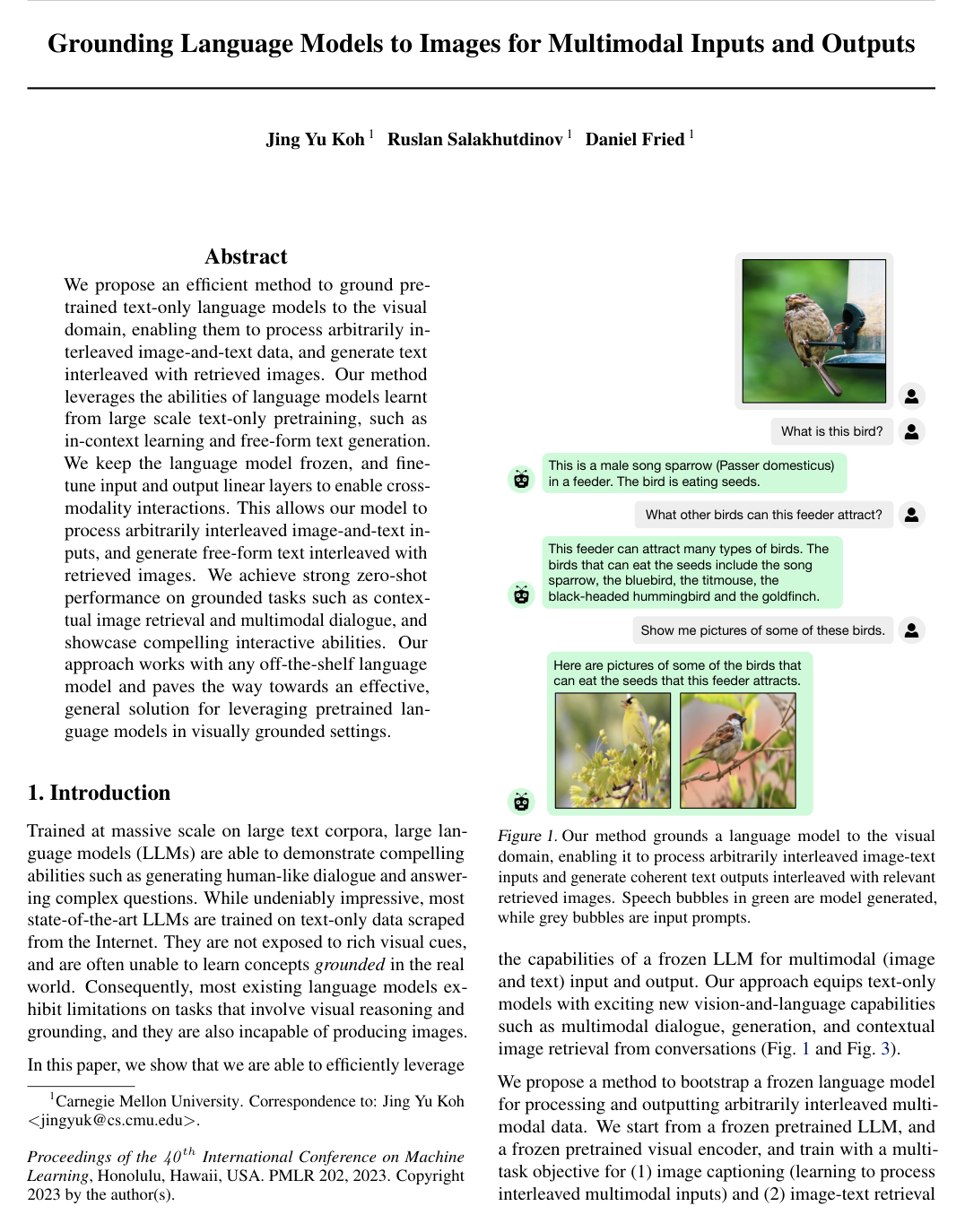
Grounding Language Models to Images for Multimodal Inputs and Outputs
Jing Yu Koh, Ruslan Salakhutdinov, Daniel Fried
Why you should read this
Presents FROMAGe, an efficient approach that equips frozen text-only language models to process arbitrarily interleaved image-text inputs and generate text interspersed with retrieved images by training only lightweight linear translation layers.
We propose an efficient method to ground pre-trained text-only language models to the visual domain, enabling them to process arbitrarily interleaved image-and-text data, and generate text interleaved with retrieved images. Our method leverages the abilities of language models learnt from large scale text-only pretraining, such as in-context learning and free-form text generation. We keep the language model frozen, and fine-tune input and output linear layers to enable cross-modality interactions. This allows our model to process arbitrarily interleaved image-and-text inputs, and generate free-form text interleaved with retrieved images. We achieve strong zero-shot performance on grounded tasks such as contextual image retrieval and multimodal dialogue, and showcase compelling interactive abilities. Our approach works with any off-the-shelf language model and paves the way towards an effective, general solution for leveraging pretrained language models in visually grounded settings.
Added
2026-09-30
OBELICS: An Open Web-Scale Filtered Dataset of Interleaved Image-Text Documents
Hugo Laurençon, Lucile Saulnier, Léo Tronchon, Stas Bekman, Amanpreet Singh, Anton Lozhkov, Thomas Wang, Siddharth Karamcheti, Alexander M. Rush, Douwe Kiela, Matthieu Cord, Victor Sanh
Why you should read this
Introduces the first fully open, web-scale dataset of interleaved image-text documents alongside competitive 9B and 80B multimodal models, enabling reproducible research and training for next-generation vision-language systems.
Large multimodal models trained on natural documents, which interleave images and text, outperform models trained on image-text pairs on various multimodal benchmarks. However, the datasets used to train these models have not been released, and the collection process has not been fully specified. We introduce the OBELICS dataset, an open web-scale filtered dataset of interleaved image-text documents comprising 141 million web pages extracted from Common Crawl, 353 million associated images, and 115 billion text tokens. We describe the dataset creation process, present comprehensive filtering rules, and provide an analysis of the dataset’s content. To show the viability of OBELICS, we train vision and language models of 9 and 80 billion parameters named IDEFICS, and obtain competitive performance on different multimodal benchmarks. We release our dataset, models and code.¹.
Added
2026-09-26
Kosmos-G: Generating Images in Context with Multimodal Large Language Models
Xichen Pan, Li Dong, Shaohan Huang, Zhiliang Peng, Wenhu Chen, Furu Wei
Why you should read this
Presents Kosmos-G, a framework that aligns multimodal large language models with CLIP to achieve zero-shot subject-driven image generation from interleaved text and image inputs without requiring test-time tuning or image decoder modifications.
Recent advancements in subject-driven image generation have made significant strides. However, current methods still fall short in diverse application scenarios, as they require test-time tuning and cannot accept interleaved multi-image and text input. These limitations keep them far from the ultimate goal of "image as a foreign language in image generation." This paper presents Kosmos-G, a model that leverages the advanced multimodal perception capabilities of Multimodal Large Language Models (MLLMs) to tackle the aforementioned challenge. Our approach aligns the output space of MLLM with CLIP using the textual modality as an anchor and performs compositional instruction tuning on curated data. Kosmos-G demonstrates an impressive capability of zero-shot subject-driven generation with interleaved multi-image and text input. Notably, the score distillation instruction tuning requires no modifications to the image decoder. This allows for a seamless substitution of CLIP and effortless integration with a myriad of U-Net techniques ranging from fine-grained controls to personalized image decoder variants. We posit Kosmos-G as an initial attempt towards the goal of "image as a foreign language in image generation." The code can be found at this https URL
Added
2026-09-26
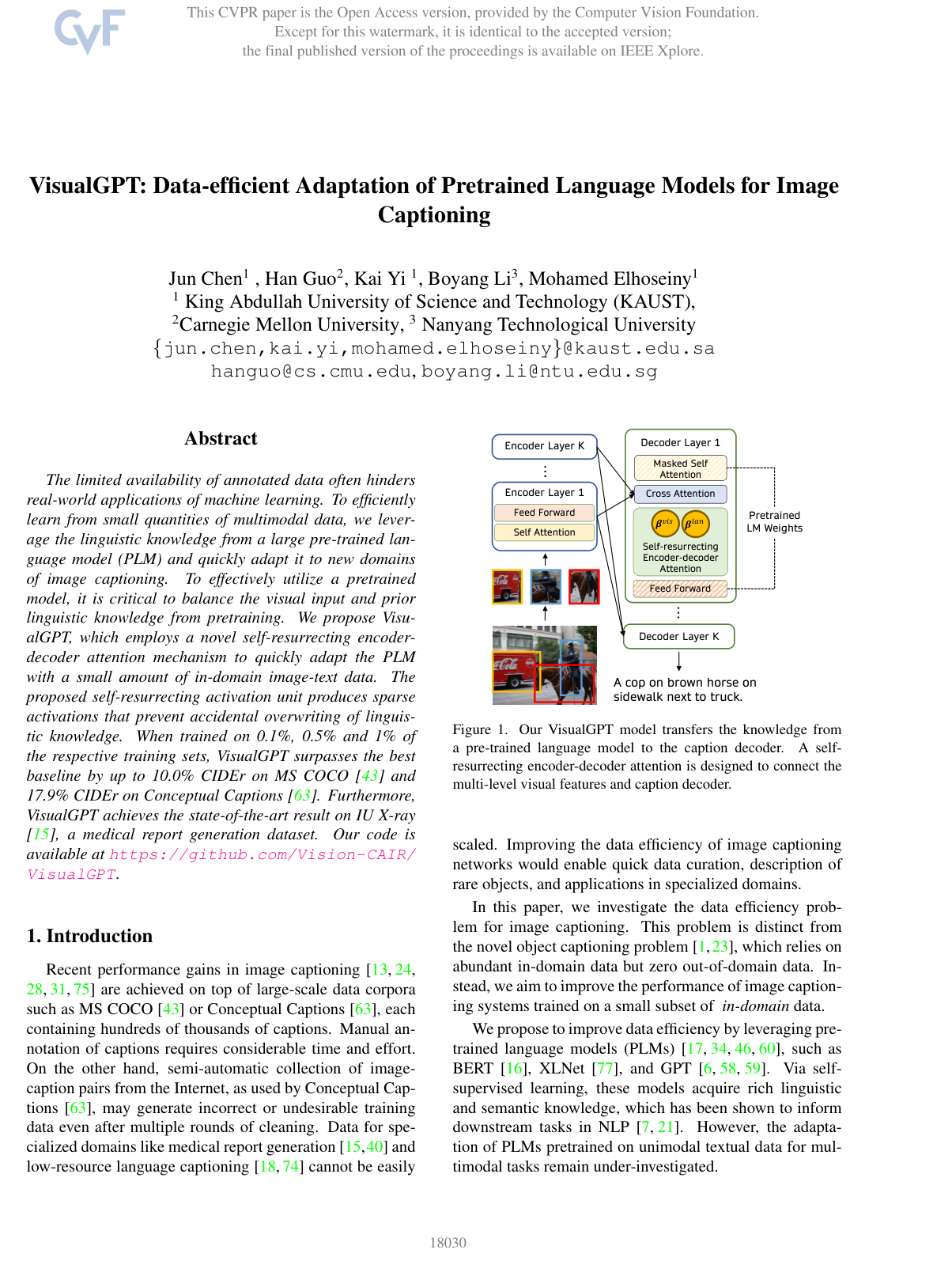
VisualGPT: Data-efficient Adaptation of Pretrained Language Models for Image Captioning
Jun Chen, Han Guo, Kai Yi, Boyang Li, Mohamed Elhoseiny
Why you should read this
Proposes a data-efficient adaptation framework for image captioning that balances pretrained language model knowledge with visual features via a self-resurrecting activation unit, outperforming baselines under extreme low-data regimes.
The limited availability of annotated data often hinders real-world applications of machine learning. To efficiently learn from small quantities of multimodal data, we leverage the linguistic knowledge from a large pre-trained language model (PLM) and quickly adapt it to new domains of image captioning. To effectively utilize a pretrained model, it is critical to balance the visual input and prior linguistic knowledge from pretraining. We propose VisualGPT, which employs a novel self-resurrecting encoder-decoder attention mechanism to quickly adapt the PLM with a small amount of in-domain image-text data. The proposed self-resurrecting activation unit produces sparse activations that prevent accidental overwriting of linguistic knowledge. When trained on 0.1%, 0.5% and 1% of the respective training sets, VisualGPT surpasses the best baseline by up to 10.0% CIDEr on MS COCO [43] and 17.9% CIDEr on Conceptual Captions [63]. Furthermore, VisualGPT achieves the state-of-the-art result on IU X-ray [15], a medical report generation dataset. Our code is available at https://github.com/Vision-CAIR/VisualGPT.
Added
2026-09-26
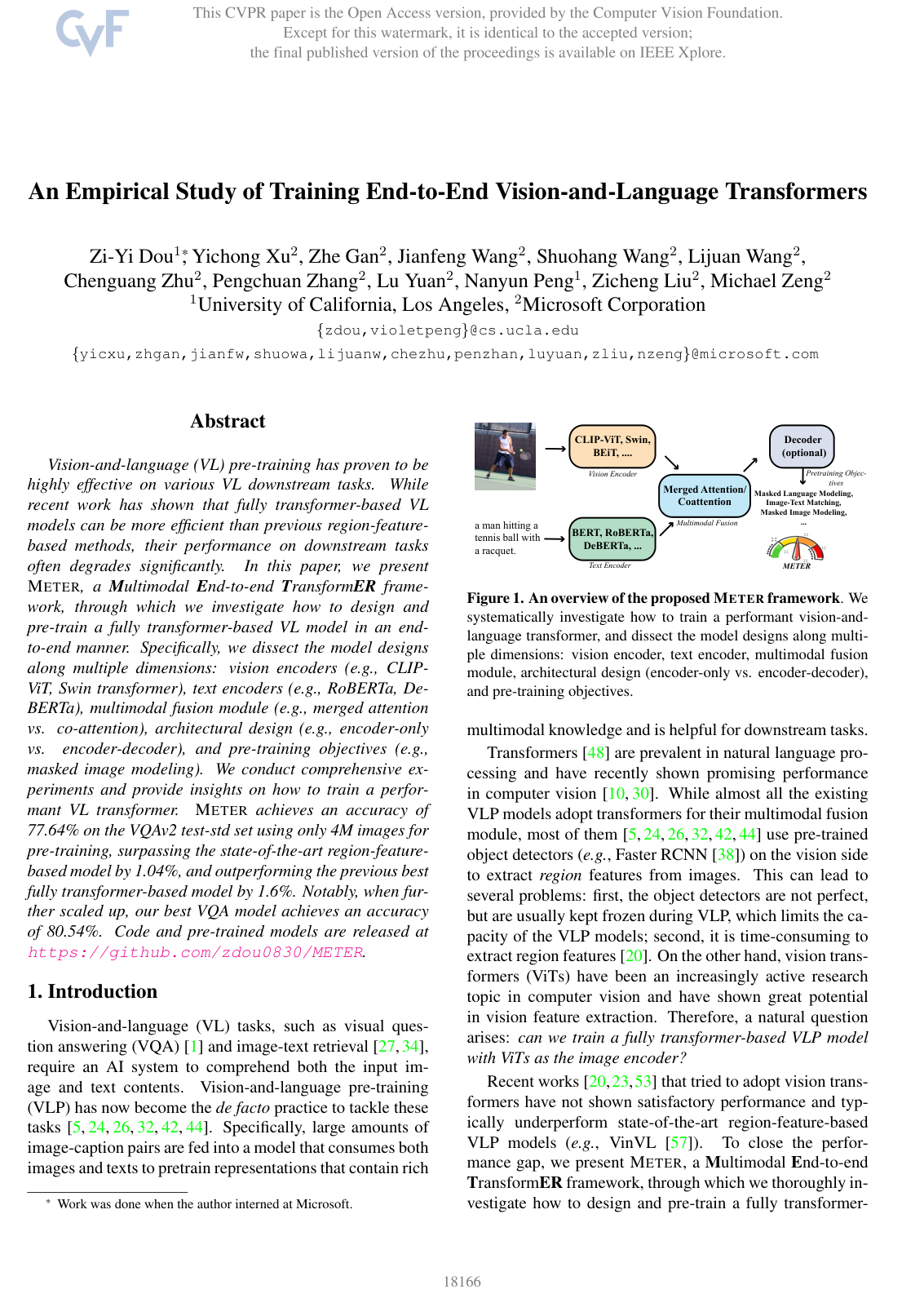
An Empirical Study of Training End-to-End Vision-and-Language Transformers
Zi-Yi Dou, Yichong Xu, Zhe Gan, Jianfeng Wang, Shuohang Wang, Lijuan Wang, Chenguang Zhu, Pengchuan Zhang, Lu Yuan, Nanyun Peng, Zicheng Liu, Michael Zeng
Why you should read this
Presents the METER framework to systematically analyze end-to-end vision-and-language transformer architectures and pre-training objectives, demonstrating how fully transformer-based models can outperform traditional region-based methods on downstream benchmarks.
Vision-and-language (VL) pre-training has proven to be highly effective on various VL downstream tasks. While recent work has shown that fully transformer-based VL models can be more efficient than previous region-feature-based methods, their performance on downstream tasks often degrades significantly. In this paper, we present METER, a Multimodal End-to-end TransformER framework, through which we investigate how to design and pre-train a fully transformer-based VL model in an end-to-end manner. Specifically, we dissect the model designs along multiple dimensions: vision encoders (e.g., CLIP-ViT, Swin transformer), text encoders (e.g., RoBERTa, DeBERTa), multimodal fusion module (e.g., merged attention vs. co-attention), architectural design (e.g., encoder-only vs. encoder-decoder), and pre-training objectives (e.g., masked image modeling). We conduct comprehensive experiments and provide insights on how to train a performant VL transformer. METER achieves an accuracy of 77.64% on the VQAv2 test-std set using only 4M images for pre-training, surpassing the state-of-the-art region-feature-based model by 1.04%, and outperforming the previous best fully transformer-based model by 1.6%. Notably, when further scaled up, our best VQA model achieves an accuracy of 80.54%. Code and pre-trained models are released at https://github.com/zou08030/METER.
Added
2026-09-26
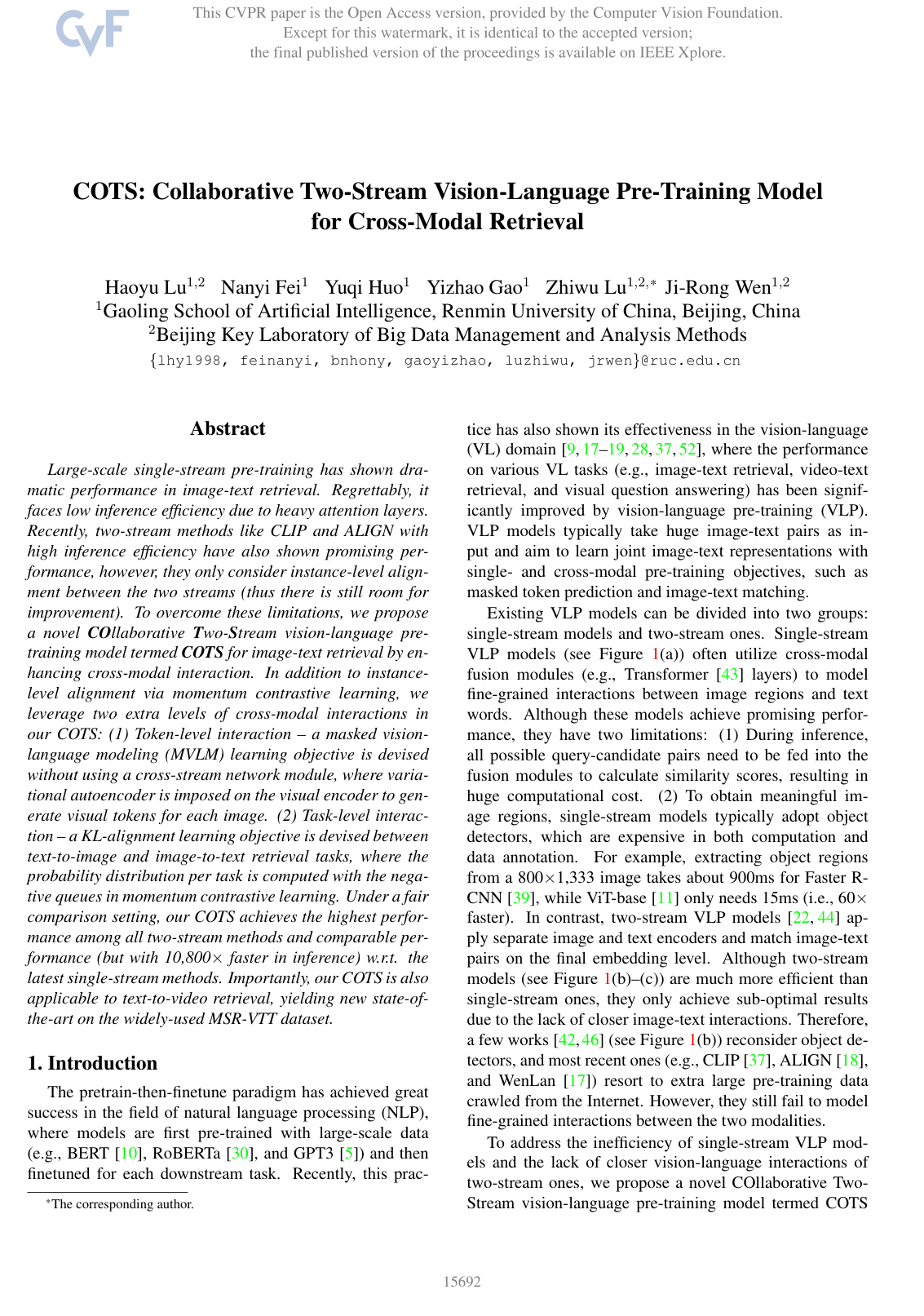
COTS: Collaborative Two-Stream Vision-Language Pre-Training Model for Cross-Modal Retrieval
Haoyu Lu, Nanyi Fei, Yuqi Huo, Yizhao Gao, Zhiwu Lu, Ji-Rong Wen
Why you should read this
Proposes a collaborative two-stream vision-language pre-training framework that integrates instance, token, and task-level interactions with an adaptive momentum filter, achieving single-stream retrieval accuracy while maintaining over 10,000 times faster inference speed.
Large-scale single-stream pre-training has shown dramatic performance in image-text retrieval. Regrettably, it faces low inference efficiency due to heavy attention layers. Recently, two-stream methods like CLIP and ALIGN with high inference efficiency have also shown promising performance, however, they only consider instance-level alignment between the two streams (thus there is still room for improvement). To overcome these limitations, we propose a novel COllaborative Two-Stream vision-language pre-training model termed COTS for image-text retrieval by enhancing cross-modal interaction. In addition to instance-level alignment via momentum contrastive learning, we leverage two extra levels of cross-modal interactions in our COTS: (1) Token-level interaction - a masked vision-language modeling (MVLM) learning objective is devised without using a cross-stream network module, where variational autoencoder is imposed on the visual encoder to generate visual tokens for each image. (2) Task-level interaction - a KL-alignment learning objective is devised between text-to-image and image-to-text retrieval tasks, where the probability distribution per task is computed with the negative queues in momentum contrastive learning. Under a fair comparison setting, our COTS achieves the highest performance among all two-stream methods and comparable performance (but with 10,800× faster in inference) w.r.t. the latest single-stream methods. Importantly, our COTS is also applicable to text-to-video retrieval, yielding new state-of-the-art on the widely-used MSR-VTT dataset.
Added
2026-09-26
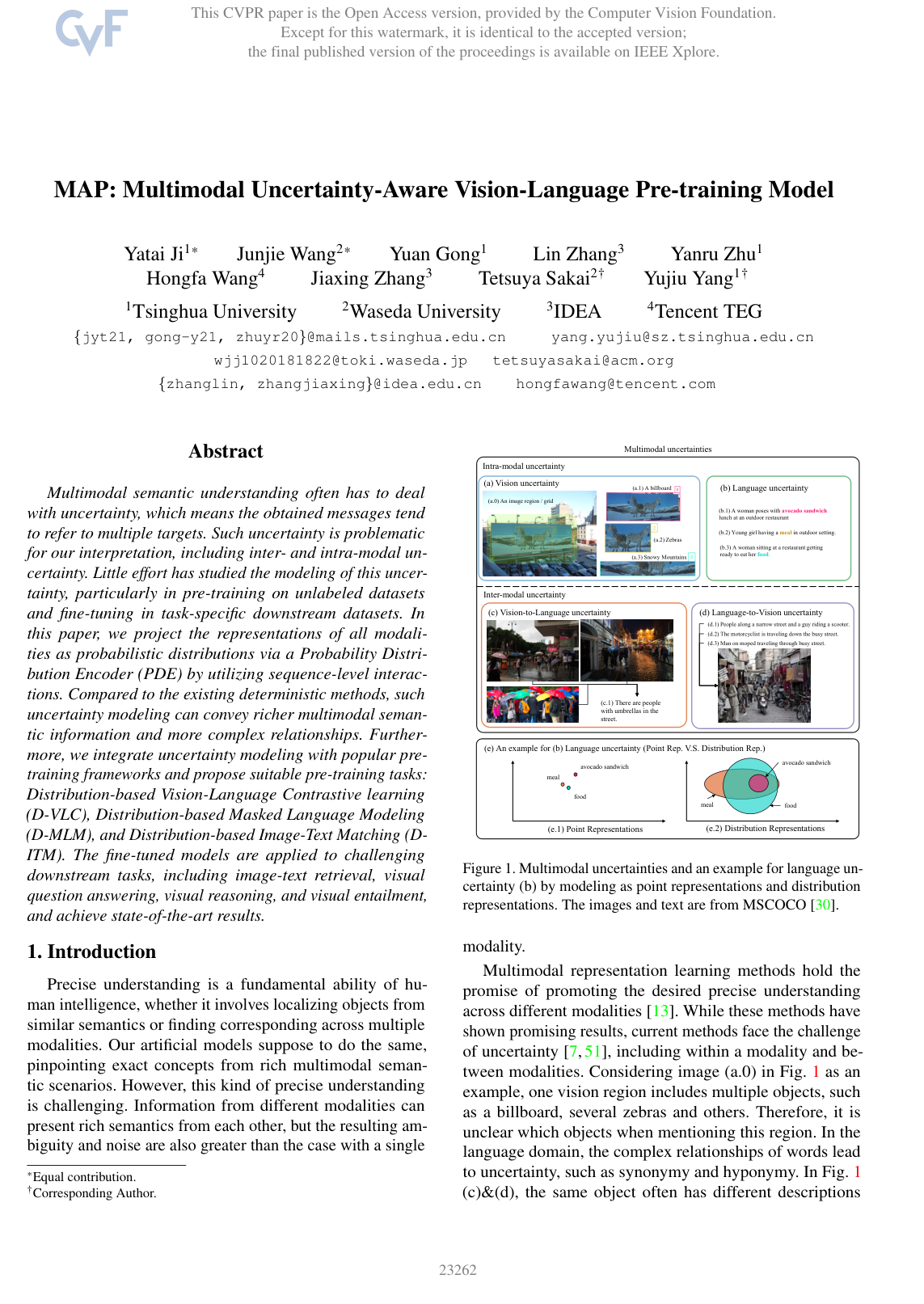
MAP: Multimodal Uncertainty-Aware Vision-Language Pre-training Model
Yatai Ji, Junjie Wang, Yuan Gong, Lin Zhang, Yanru Zhu, Hongfa Wang, Jiaxing Zhang, Tetsuya Sakai, Yujiu Yang
Why you should read this
Proposes a vision-language pre-training framework that models multimodal features as Gaussian distributions instead of deterministic points to capture inter- and intra-modal semantic uncertainty across downstream tasks like visual reasoning and image-text retrieval.
Multimodal semantic understanding often has to deal with uncertainty, which means the obtained messages tend to refer to multiple targets. Such uncertainty is problematic for our interpretation, including inter- and intra-modal uncertainty. Little effort has studied the modeling of this uncertainty, particularly in pre-training on unlabeled datasets and fine-tuning in task-specific downstream datasets. In this paper, we project the representations of all modalities as probabilistic distributions via a Probability Distribution Encoder (PDE) by utilizing sequence-level interactions. Compared to the existing deterministic methods, such uncertainty modeling can convey richer multimodal semantic information and more complex relationships. Furthermore, we integrate uncertainty modeling with popular pre-training frameworks and propose suitable pre-training tasks: Distribution-based Vision-Language Contrastive learning (D-VLC), Distribution-based Masked Language Modeling (D-MLM), and Distribution-based Image-Text Matching (D-ITM). The fine-tuned models are applied to challenging downstream tasks, including image-text retrieval, visual question answering, visual reasoning, and visual entailment, and achieve state-of-the-art results.
Added
2026-09-26