
keyword
computational cost
Computational cost is the quantity of computing resources required to execute an algorithm, process data, or solve a computational problem. It is typically measured through metrics such as execution time, the total number of operations such as floating-point calculations, memory and storage capacity, and the electrical energy or financial expense needed to power the supporting hardware. In computer science and machine learning, computational cost serves as a primary measure of algorithmic efficiency and practical feasibility, determining whether a theoretically sound method can scale effectively to large datasets and operate within the physical and economic constraints of available infrastructure.
3 items
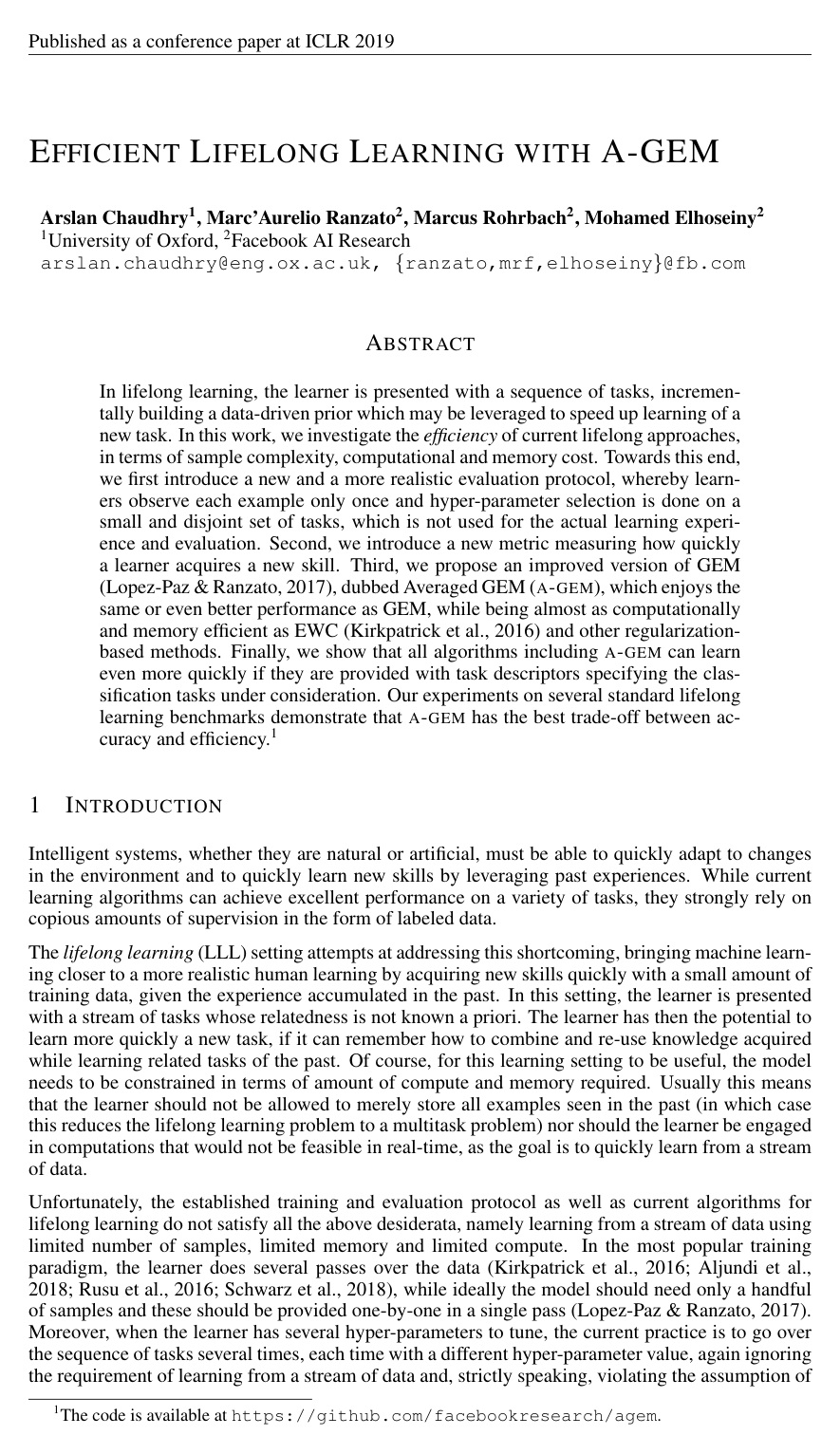
Efficient Lifelong Learning with A-GEM
Arslan Chaudhry, Marc'Aurelio Ranzato, Marcus Rohrbach, Mohamed Elhoseiny
Why you should read this
Develops Averaged Gradient Episodic Memory (A-GEM) and a realistic single-pass benchmark protocol, achieving the high accuracy of memory-based continual learning at a fraction of the computational and storage cost.
In lifelong learning, the learner is presented with a sequence of tasks, incrementally building a data-driven prior which may be leveraged to speed up learning of a new task. In this work, we investigate the efficiency of current lifelong approaches, in terms of sample complexity, computational and memory cost. Towards this end, we first introduce a new and a more realistic evaluation protocol, whereby learners observe each example only once and hyper-parameter selection is done on a small and disjoint set of tasks, which is not used for the actual learning experience and evaluation. Second, we introduce a new metric measuring how quickly a learner acquires a new skill. Third, we propose an improved version of GEM (Lopez-Paz & Ranzato, 2017), dubbed Averaged GEM (A-GEM), which enjoys the same or even better performance as GEM, while being almost as computationally and memory efficient as EWC (Kirkpatrick et al., 2016) and other regularization-based methods. Finally, we show that all algorithms including A-GEM can learn even more quickly if they are provided with task descriptors specifying the classification tasks under consideration. Our experiments on several standard lifelong learning benchmarks demonstrate that A-GEM has the best trade-off between accuracy and efficiency.
Added
2026-09-18
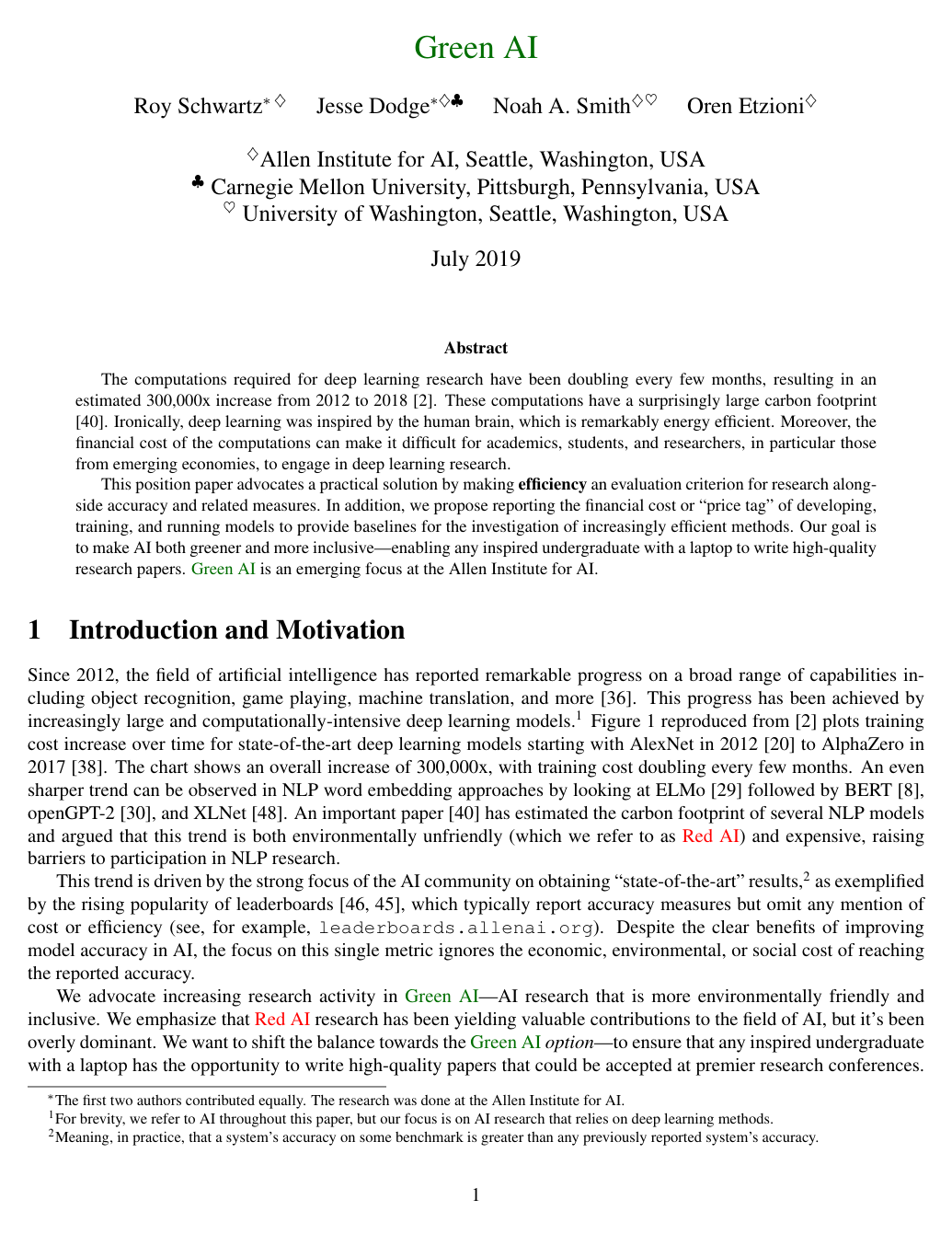
Green AI
Roy Schwartz, Jesse Dodge, Noah A. Smith, Oren Etzioni
Why you should read this
Advocates making computational efficiency a standard evaluation metric alongside accuracy to reduce deep learning's carbon footprint and lower the financial barrier to entry for AI researchers.
The computations required for deep learning research have been doubling every few months, resulting in an estimated 300,000x increase from 2012 to 2018 [2]. These computations have a surprisingly large carbon footprint [38]. Ironically, deep learning was inspired by the human brain, which is remarkably energy efficient. Moreover, the financial cost of the computations can make it difficult for academics, students, and researchers, in particular those from emerging economies, to engage in deep learning research. This position paper advocates a practical solution by making efficiency an evaluation criterion for research alongside accuracy and related measures. In addition, we propose reporting the financial cost or "price tag" of developing, training, and running models to provide baselines for the investigation of increasingly efficient methods. Our goal is to make AI both greener and more inclusive---enabling any inspired undergraduate with a laptop to write high-quality research papers. Green AI is an emerging focus at the Allen Institute for AI.
Added
2026-09-18
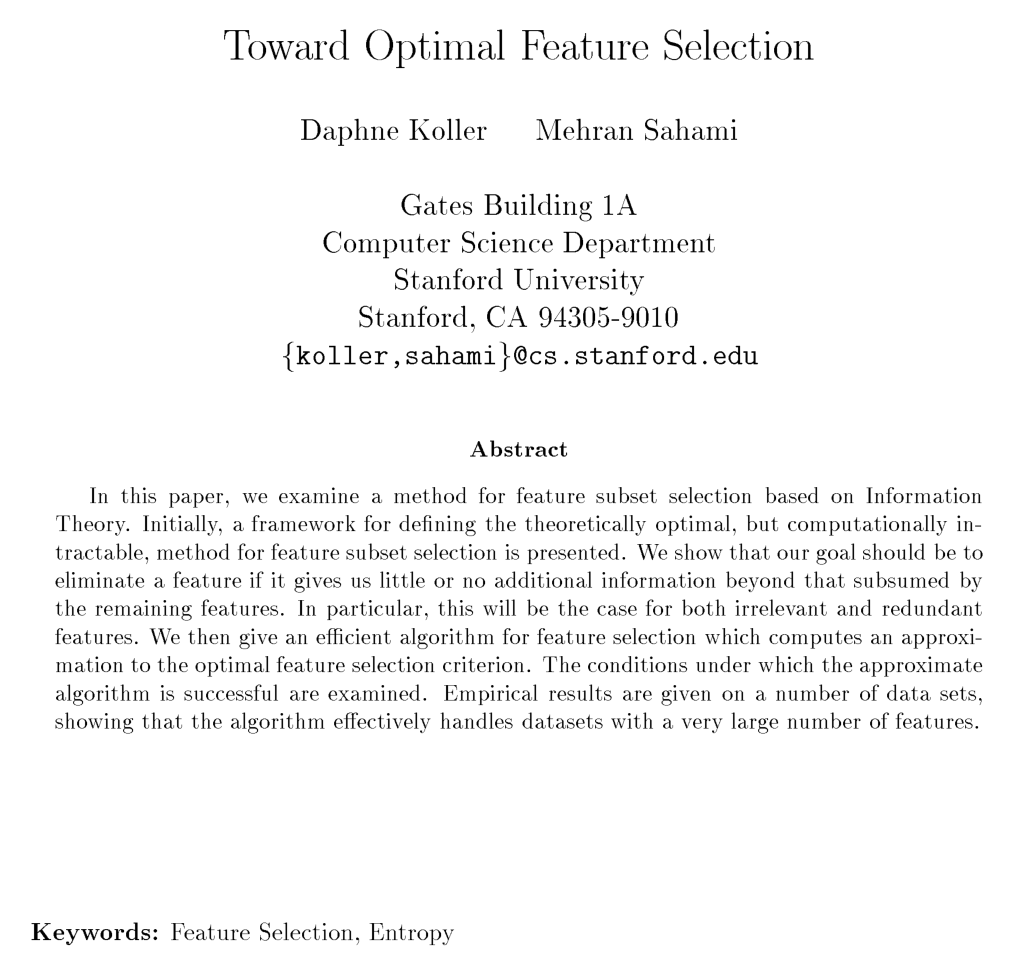
Toward Optimal Feature Selection
Daphne Koller, Mehran Sahami
Why you should read this
Develops an information-theoretic filter algorithm that efficiently eliminates both irrelevant and redundant features, providing a theoretically grounded solution for high-dimensional classification tasks without the computational burden of wrapper methods.
In this paper, we examine a method for feature subset selection based on Information Theory. Initially, a framework for defining the theoretically optimal, but computationally intractable, method for feature subset selection is presented. We show that our goal should be to eliminate a feature if it gives us little or no additional information beyond that subsumed by the remaining features. In particular, this will be the case for both irrelevant and redundant features. We then give an efficient algorithm for feature selection which computes an approximation to the optimal feature selection criterion. The conditions under which the approximate algorithm is successful are examined. Empirical results are given on a number of data sets, showing that the algorithm effectively handles datasets with a very large number of features.
Added
2026-09-18