
Built independently by an author, for readers. Read the story and support ChapterPal

keyword

computational anatomy

Computational anatomy is an interdisciplinary field focused on the quantitative modeling, analysis, and comparison of biological shapes and anatomical structures captured in medical imaging. Utilizing mathematical frameworks from differential geometry, group theory, and the calculus of variations, it represents anatomical variability through smooth, invertible coordinate transformations known as diffeomorphisms that map one structure onto another. By establishing geodesic paths and metric distances between anatomical configurations, computational anatomy enables the construction of statistical atlases and the formal measurement of morphological changes. These techniques are widely applied in medical research to study normal organ development, evaluate population-wide structural differences, and track anatomical alterations associated with diseases.

1 item
Computing Large Deformation Metric Mappings via Geodesic Flows of Diffeomorphisms

Computing Large Deformation Metric Mappings via Geodesic Flows of Diffeomorphisms

MIRZA FAISAL BEG, MICHAEL I. MILLER, ALAIN TROUVÉ, LAURENT YOUNES

OrganizationsENS Paris-SaclayJohns Hopkins UniversitySimon Fraser University

Why you should read this

Develops the algorithmic and mathematical foundation for large deformation diffeomorphic metric mapping by deriving Euler-Lagrange equations and implementing a semi-Lagrangian particle flow method to compute shortest-path geodesic transformations between anatomical images.

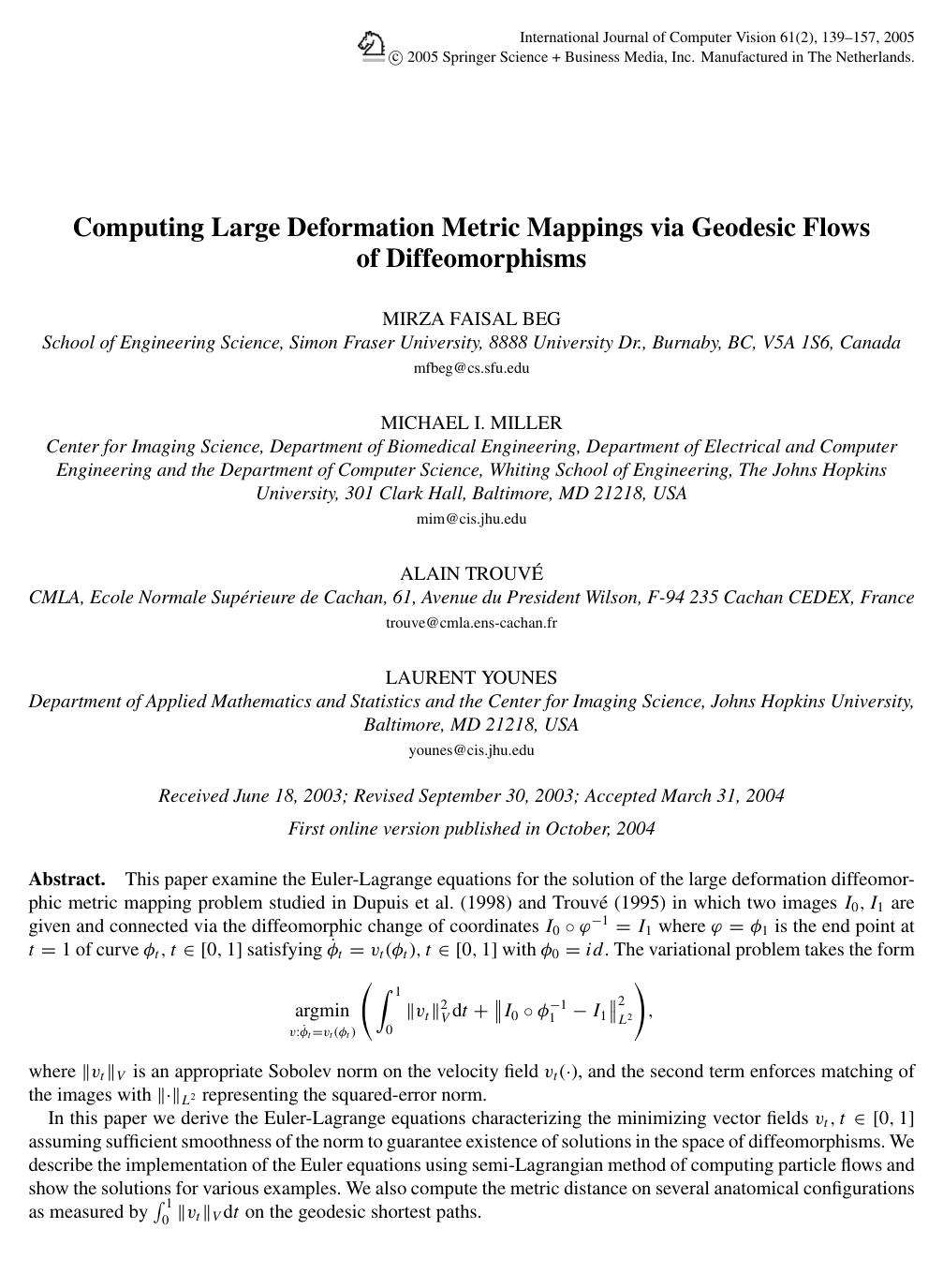
This paper examine the Euler-Lagrange equations for the solution of the large deformation diffeomorphic metric mapping problem studied in Dupuis et al. (1998) and Trouvé (1995) in which two images I0, I1 are given and connected via the diffeomorphic change of coordinates I0 ∘ φ−1 = I1 where φ = ϕ1 is the end point at t = 1 of curve ϕt, t ∈ [0, 1] satisfying ϕ̇t = vt(ϕt), t ∈ [0, 1] with ϕ0 = id. The variational problem takes the form argmin v:ϕ̇t=vt(ϕt) ( ∫0^1 ‖vt‖_V^2 dt + ‖I0 ∘ ϕ_1^−1 − I1‖_L^2^2 ), where ‖vt‖_V is an appropriate Sobolev norm on the velocity field vt(·), and the second term enforces matching of the images with ‖·‖_L^2 representing the squared-error norm. In this paper we derive the Euler-Lagrange equations characterizing the minimizing vector fields vt, t ∈ [0, 1] assuming sufficient smoothness of the norm to guarantee existence of solutions in the space of diffeomorphisms. We describe the implementation of the Euler equations using semi-Lagrangian method of computing particle flows and show the solutions for various examples. We also compute the metric distance on several anatomical configurations as measured by ∫0^1 ‖vt‖_V dt on the geodesic shortest paths.

Added

2026-09-18