
keyword
comparative evaluation
Comparative evaluation is an assessment methodology in which two or more systems, models, outputs, or candidates are directly contrasted against one another under standardized conditions and criteria to determine their relative quality, performance, or preference. Unlike absolute scoring or direct assessment, which evaluates an individual candidate in isolation against a fixed scale, comparative evaluation assesses subjects side by side through mechanisms such as pairwise ranking, preference testing, or relative benchmarking. This approach helps mitigate individual rater calibration discrepancies and subjective bias, providing clearer discrimination and more consistent measurements when distinguishing subtle differences between competing alternatives in complex or subjective tasks.
2 items
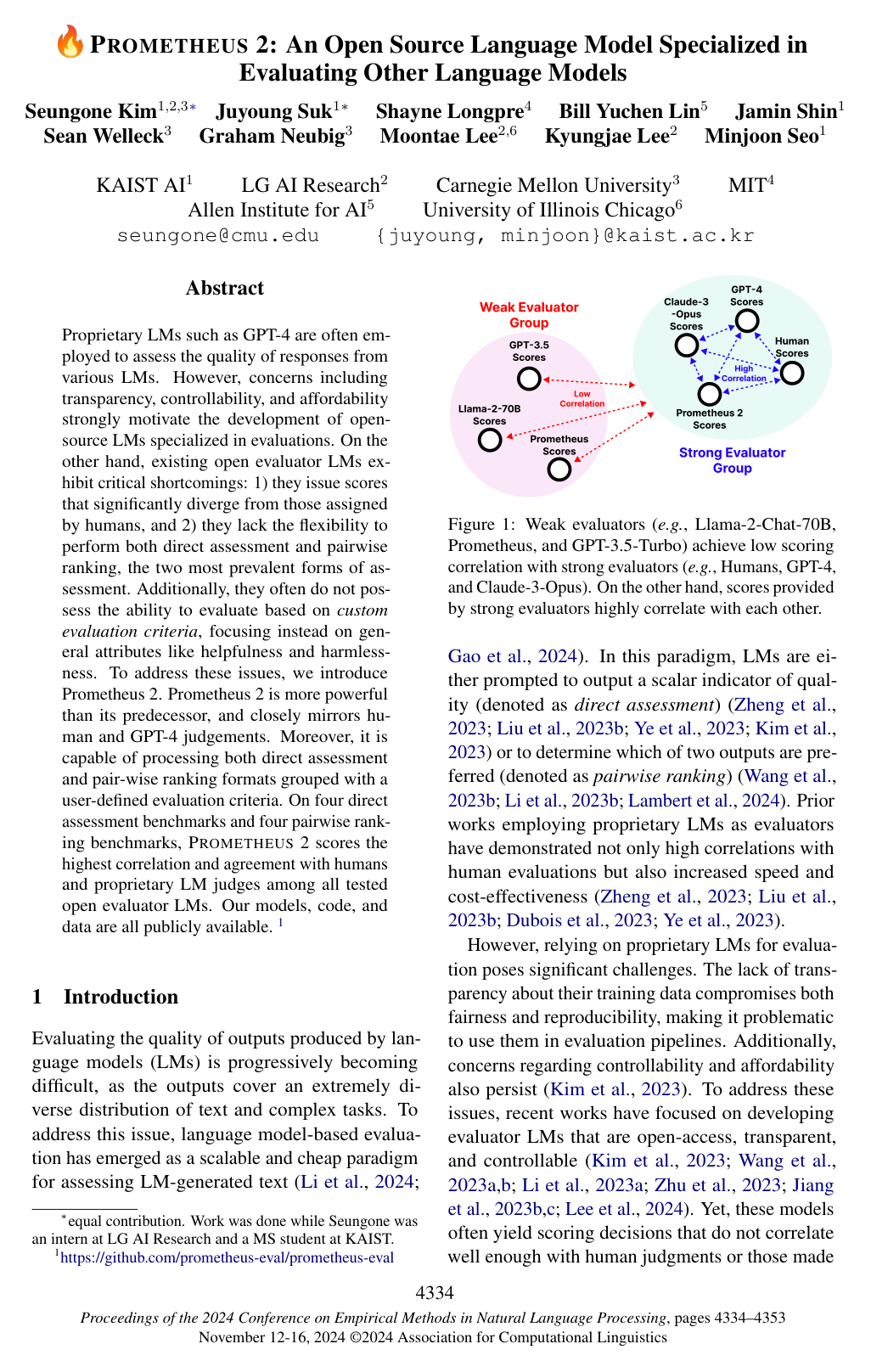
Prometheus 2: An Open Source Language Model Specialized in Evaluating Other Language Models
Seungone Kim, Juyoung Suk, Shayne Longpre, Bill Yuchen Lin, Jamin Shin, Sean Welleck, Graham Neubig, Moontae Lee, Kyungjae Lee, Minjoon Seo
Why you should read this
Presents Prometheus 2, an open-source evaluator language model that handles both direct assessment and pairwise ranking with custom criteria by merging models trained on separate evaluation formats, closely mirroring human and GPT-4 judgments.
Proprietary LMs such as GPT-4 are often employed to assess the quality of responses from various LMs. However, concerns including transparency, controllability, and affordability strongly motivate the development of open-source LMs specialized in evaluations. On the other hand, existing open evaluator LMs exhibit critical shortcomings: 1) they issue scores that significantly diverge from those assigned by humans, and 2) they lack the flexibility to perform both direct assessment and pairwise ranking, the two most prevalent forms of assessment. Additionally, they often do not possess the ability to evaluate based on *custom evaluation criteria*, focusing instead on general attributes like helpfulness and harmlessness. To address these issues, we introduce Prometheus 2. Prometheus 2 is more powerful than its predecessor, and closely mirrors human and GPT-4 judgements. Moreover, it is capable of processing both direct assessment and pair-wise ranking formats grouped with a user-defined evaluation criteria. On four direct assessment benchmarks and four pairwise ranking benchmarks, PROMETHEUS 2 scores the highest correlation and agreement with humans and proprietary LM judges among all tested open evaluator LMs. Our models, code, and data are all publicly available. 1
Added
2026-09-28
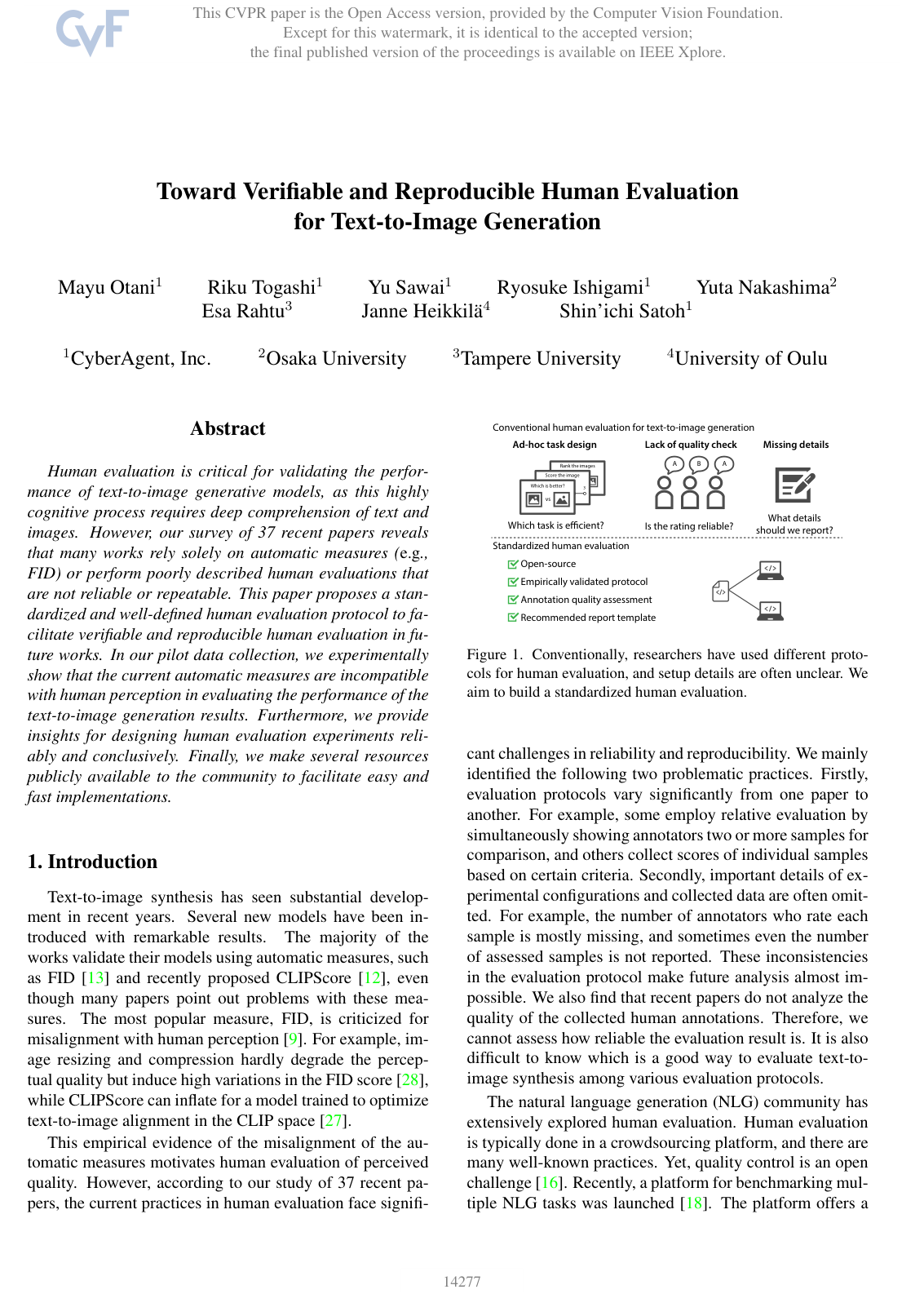
Toward Verifiable and Reproducible Human Evaluation for Text-to-Image Generation
Mayu Otani, Riku Togashi, Yu Sawai, Ryosuke Ishigami, Yuta Nakashima, Esa Rahtu, Janne Heikkilä, Shin'ichi Satoh
Why you should read this
Establishes a standardized, open-source crowdsourcing protocol and reporting framework for text-to-image human evaluation while demonstrating the misalignment and saturation of popular automated metrics like FID and CLIPScore.
Human evaluation is critical for validating the performance of text-to-image generative models, as this highly cognitive process requires deep comprehension of text and images. However, our survey of 37 recent papers reveals that many works rely solely on automatic measures (e.g., FID) or perform poorly described human evaluations that are not reliable or repeatable. This paper proposes a standardized and well-defined human evaluation protocol to facilitate verifiable and reproducible human evaluation in future works. In our pilot data collection, we experimentally show that the current automatic measures are incompatible with human perception in evaluating the performance of the text-to-image generation results. Furthermore, we provide insights for designing human evaluation experiments reliably and conclusively. Finally, we make several resources publicly available to the community to facilitate easy and fast implementations.
Added
2026-09-26