
keyword
community detection
Community detection is the process of identifying cohesive groups or clusters of nodes within a network that exhibit higher internal connectivity among themselves than with the rest of the graph. In network science and data analysis, this task uncovers the latent modular structure and functional organization of complex systems, such as social relationships, biological interactions, and information topologies. Depending on the algorithmic approach and mathematical framework, community detection techniques can identify disjoint partitions, overlapping groups, or hierarchical structures using methods that range from modularity optimization and spectral clustering to statistical inference under block models and dense subgraph discovery.
9 items
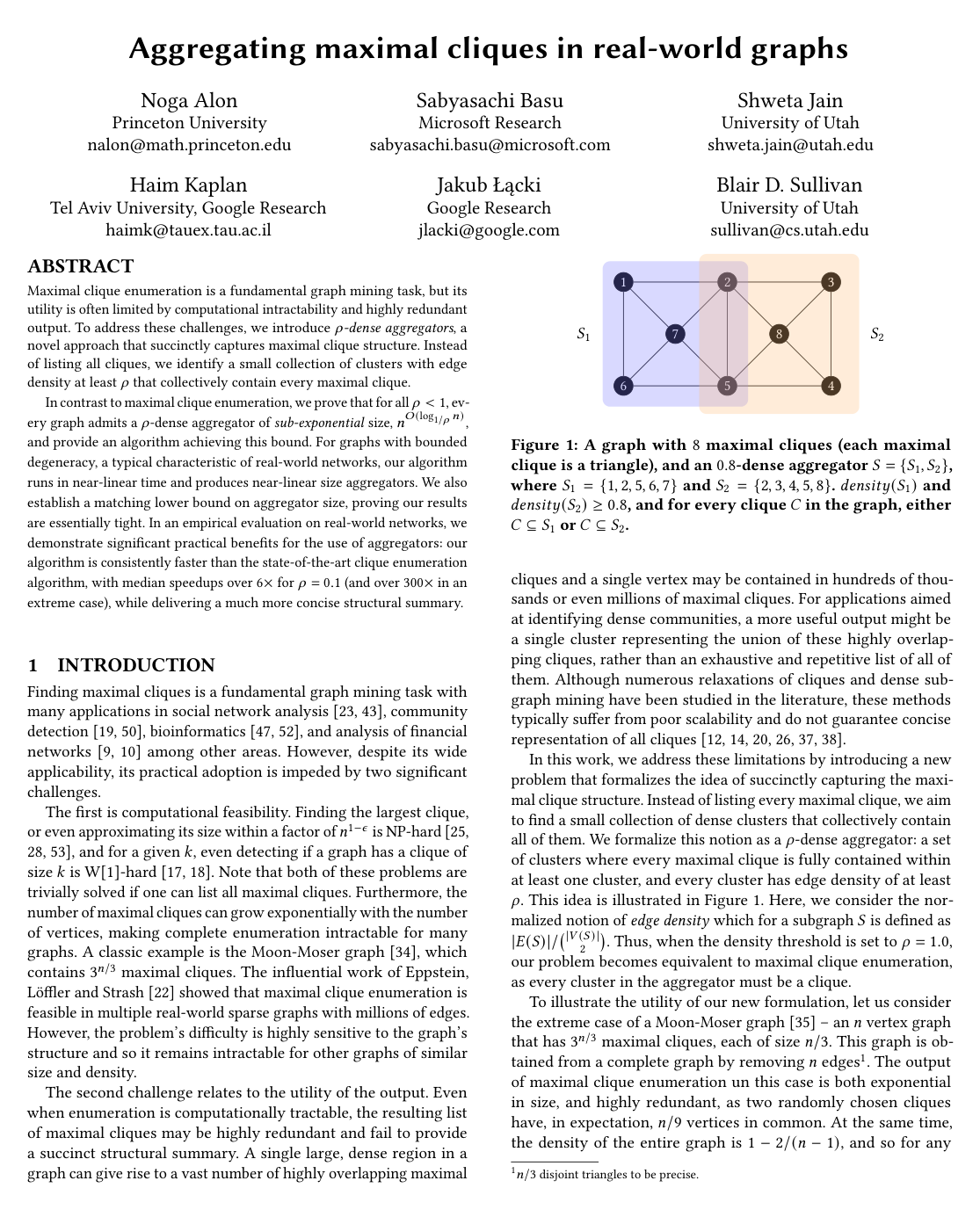
Aggregating maximal cliques in real-world graphs
Noga Alon, Sabyasachi Basu, Shweta Jain, H. Kaplan, Jakub Lacki, Blair D. Sullivan
Why you should read this
Introduces -dense aggregators to bypass the combinatorial intractability of maximal clique enumeration, establishing theoretically tight size bounds and providing a near-linear-time algorithm that summarizes clique structures in real-world networks significantly faster than exact enumeration.
Maximal clique enumeration is a fundamental graph mining task, but its utility is often limited by computational intractability and highly redundant output. To address these challenges, we introduce \emph{-dense aggregators}, a novel approach that succinctly captures maximal clique structure. Instead of listing all cliques, we identify a small collection of clusters with edge density at least that collectively contain every maximal clique. In contrast to maximal clique enumeration, we prove that for all , every graph admits a -dense aggregator of \emph{sub-exponential} size, , and provide an algorithm achieving this bound. For graphs with bounded degeneracy, a typical characteristic of real-world networks, our algorithm runs in near-linear time and produces near-linear size aggregators. We also establish a matching lower bound on aggregator size, proving our results are essentially tight. In an empirical evaluation on real-world networks, we demonstrate significant practical benefits for the use of aggregators: our algorithm is consistently faster than the state-of-the-art clique enumeration algorithm, with median speedups over for (and over in an extreme case), while delivering a much more concise structural summary.
Added
2026-10-05
Finding Many Overlapping Dense Subgraphs Using Triadic Cohorts
Sabyasachi Basu, C. Seshadhri
Why you should read this
Develops CohortRecovery, an efficient algorithm grounded in triadic cohort theory that provably extracts overlapping, high-density subgraphs across massive networks while achieving substantially higher coverage than existing clustering methods.
Graphs are a standard representation for data in the social sciences, cybersecurity, computer infrastructure, bioinformatics, and more. Typical real-world graphs are sparse, meaning the average degree is small (in the tens, while the number of vertices is more than millions). When graph data is collected from a source, a major task is to perform data exploration. Thus, any region of ``density" is of interest, since it indicates special structure. An important goal is to cover a significant portion of the graph using dense subgraphs. Existing algorithms that find many dense subgraphs do not have overlapping output, and hence provide limited coverage. Other methods that produce overlapping clusters do not generate dense subgraphs. The main goal of this paper is to develop provable and practical methods that can provide overlapping dense subgraphs that can cover large portions of real-world networks. Our contribution is an algorithm CohortRecovery that achieves this goal. We first develop a mathematical framework of triadic cohorts that captures the notion of ``detectable dense subgraphs'' that potentially overlap. We prove that CohortRecovery can output a set of dense subgraphs, such that each triadic cohort is almost completely contained in some dense subgraph. We give a practical implementation of CohortRecovery and demonstrate it on a variety of datasets. It typically runs in under ten minutes on a commodity machine even on graphs with tens of millions of edges. For numerous datasets, CohortRecovery is able to cover more than 25\% of the vertices in non-trivial subgraphs of density more than 0.8, and is significantly better than a wide variety of scalable graph clustering/community detection algorithms. Moreover, we demonstrate that output of CohortRecovery captures ground truth clusters obtained by manual curation.
Added
2026-10-05
Community detection and stochastic block models: recent developments
Emmanuel Abbe
Why you should read this
Synthesizes the fundamental statistical and computational limits of community detection in stochastic block models, detailing the sharp phase transitions for network recovery and the principled algorithms designed to achieve them.
The stochastic block model (SBM) is a random graph model with different group of vertices connecting differently. It is widely employed as a canonical model to study clustering and community detection, and provides a fertile ground to study the information-theoretic and computational tradeoffs that arise in combinatorial statistics and more generally data science. This monograph surveys the recent developments that establish the fundamental limits for community detection in the SBM, both with respect to information-theoretic and computational tradeoffs, and for various recovery requirements such as exact, partial and weak recovery. The main results discussed are the phase transitions for exact recovery at the Chernoff-Hellinger threshold, the phase transition for weak recovery at the Kesten-Stigum threshold, the optimal SNR-mutual information tradeoff for partial recovery, and the gap between information-theoretic and computational thresholds. The monograph gives a principled derivation of the main algorithms developed in the quest of achieving the limits, in particular two-round algorithms via graph-splitting, semi-definite programming, (linearized) belief propagation, classical/nonbacktracking spectral methods and graph powering. Extensions to other block models, such as geometric block models, and a few open problems are also discussed.
Added
2026-09-25
From Local to Global: A Graph RAG Approach to Query-Focused Summarization
Darren Edge, Ha Trinh, Newman Cheng, Joshua Bradley, A. Chao, Apurva N. Mody, Steven Truitt, Jonathan Larson
Why you should read this
Introduces GraphRAG, a framework that combines knowledge graph extraction and hierarchical community summarization to answer corpus-level sensemaking questions that defeat standard retrieval-augmented generation.
The use of retrieval-augmented generation (RAG) to retrieve relevant information from an external knowledge source enables large language models (LLMs) to answer questions over private and/or previously unseen document collections. However, RAG fails on global questions directed at an entire text corpus, such as "What are the main themes in the dataset?", since this is inherently a query-focused summarization (QFS) task, rather than an explicit retrieval task. Prior QFS methods, meanwhile, do not scale to the quantities of text indexed by typical RAG systems. To combine the strengths of these contrasting methods, we propose GraphRAG, a graph-based approach to question answering over private text corpora that scales with both the generality of user questions and the quantity of source text. Our approach uses an LLM to build a graph index in two stages: first, to derive an entity knowledge graph from the source documents, then to pregenerate community summaries for all groups of closely related entities. Given a question, each community summary is used to generate a partial response, before all partial responses are again summarized in a final response to the user. For a class of global sensemaking questions over datasets in the 1 million token range, we show that GraphRAG leads to substantial improvements over a conventional RAG baseline for both the comprehensiveness and diversity of generated answers.
Added
2026-09-18
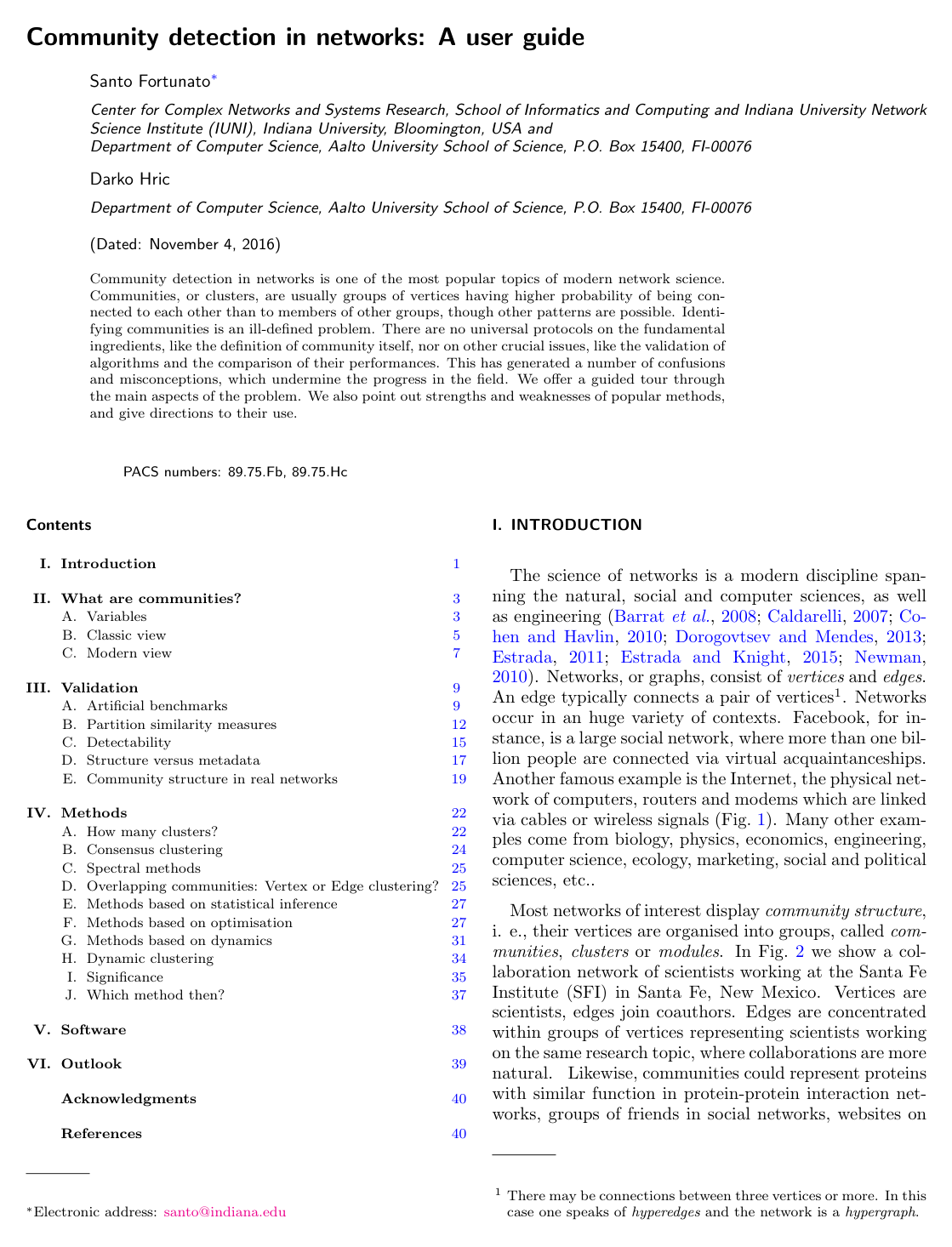
Community detection in networks: A user guide
Santo Fortunato, Darko Hric
Why you should read this
Clarifies the foundations of network community detection by evaluating the strengths and limitations of popular clustering algorithms, dispelling widespread methodological misconceptions, and providing practical criteria for performance validation.
Community detection in networks is one of the most popular topics of modern network science. Communities, or clusters, are usually groups of vertices having higher probability of being connected to each other than to members of other groups, though other patterns are possible. Identifying communities is an ill-defined problem. There are no universal protocols on the fundamental ingredients, like the definition of community itself, nor on other crucial issues, like the validation of algorithms and the comparison of their performances. This has generated a number of confusions and misconceptions, which undermine the progress in the field. We offer a guided tour through the main aspects of the problem. We also point out strengths and weaknesses of popular methods, and give directions to their use.
Added
2026-09-16
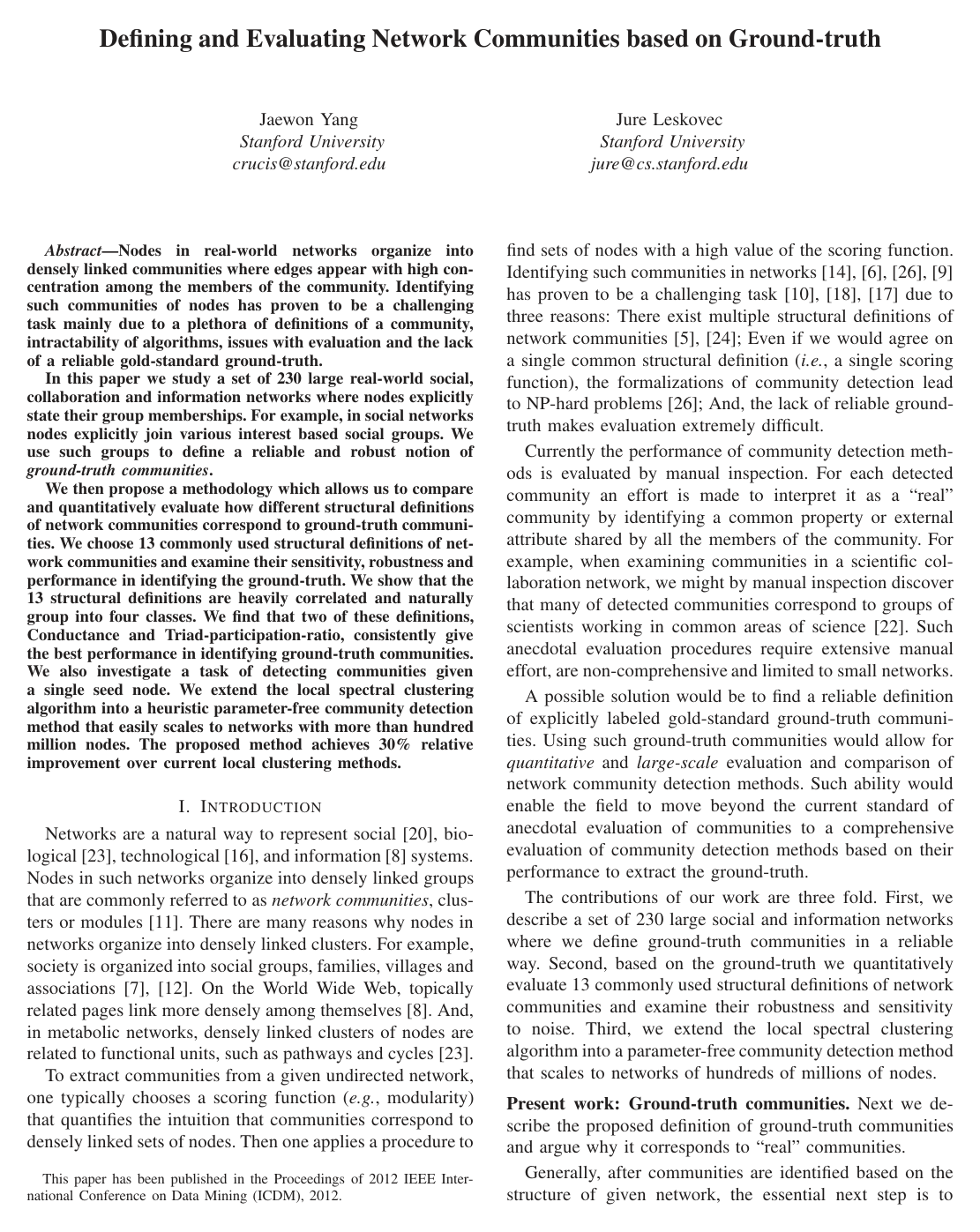
Defining and evaluating network communities based on ground-truth
Jaewon Yang, Jure Leskovec
Why you should read this
Evaluates thirteen structural definitions of network communities against ground-truth data from 230 real-world networks, identifying the most reliable topological metrics and introducing a parameter-free community detection algorithm that scales to hundreds of millions of nodes.
Nodes in real-world networks organize into densely linked communities where edges appear with high concentration among the members of the community. Identifying such communities of nodes has proven to be a challenging task mainly due to a plethora of definitions of a community, intractability of algorithms, issues with evaluation and the lack of a reliable gold-standard ground-truth. In this paper we study a set of 230 large real-world social, collaboration and information networks where nodes explicitly state their group memberships. For example, in social networks nodes explicitly join various interest based social groups. We use such groups to define a reliable and robust notion of ground-truth communities. We then propose a methodology which allows us to compare and quantitatively evaluate how different structural definitions of network communities correspond to ground-truth communities. We choose 13 commonly used structural definitions of network communities and examine their sensitivity, robustness and performance in identifying the ground-truth. We show that the 13 structural definitions are heavily correlated and naturally group into four classes. We find that two of these definitions, Conductance and Triad-participation-ratio, consistently give the best performance in identifying ground-truth communities. We also investigate a task of detecting communities given a single seed node. We extend the local spectral clustering algorithm into a heuristic parameter-free community detection method that easily scales to networks with more than hundred million nodes. The proposed method achieves 30% relative improvement over current local clustering methods.
Added
2026-09-15
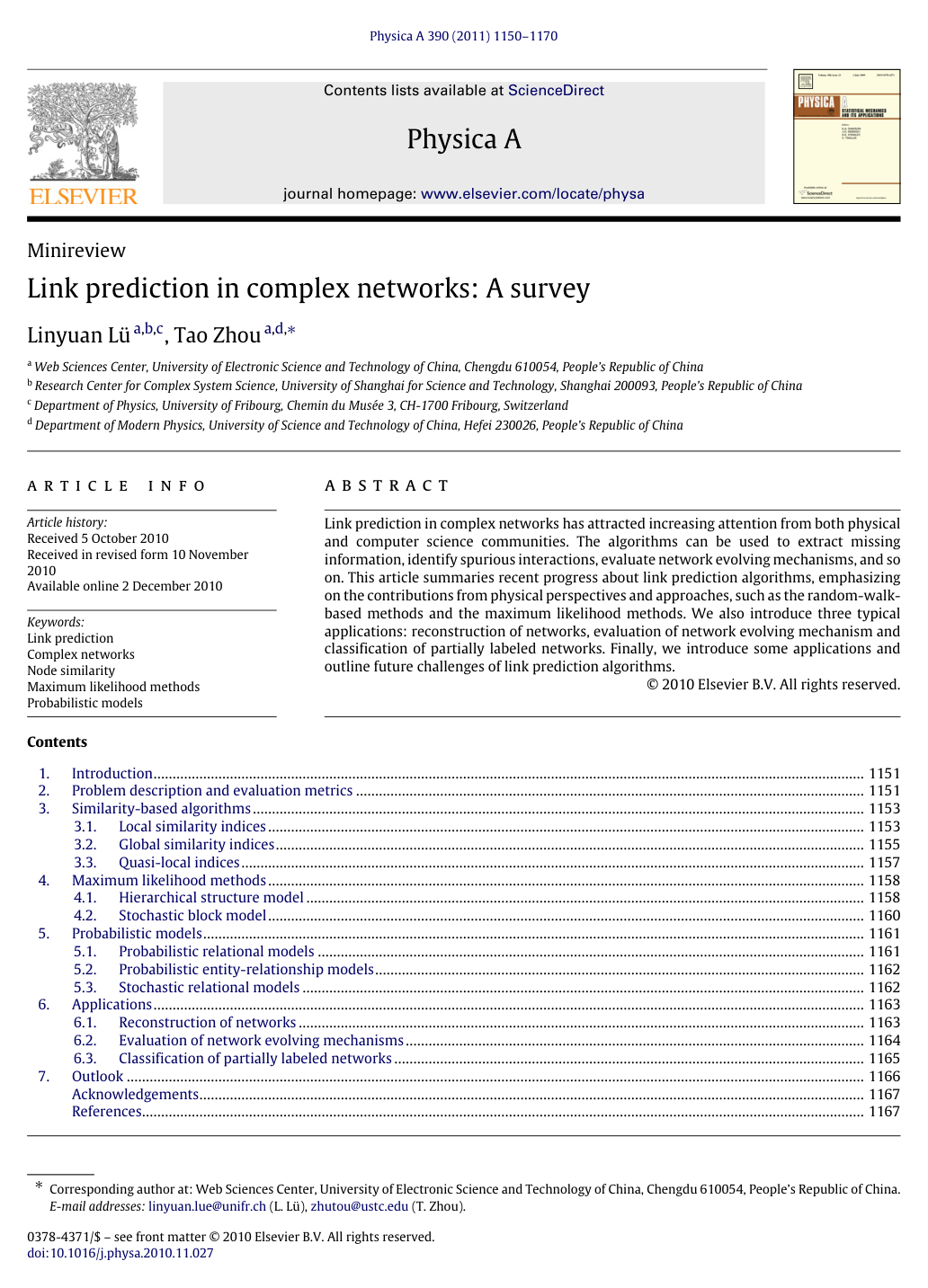
Link Prediction in Complex Networks: A Survey
Linyuan Lu, Tao Zhou
Why you should read this
Systematizes link prediction methods across statistical physics and computer science, providing actionable algorithms for reconstructing missing connections and testing network evolution models.
Link prediction in complex networks has attracted increasing attention from both physical and computer science communities. The algorithms can be used to extract missing information, identify spurious interactions, evaluate network evolving mechanisms, and so on. This article summaries recent progress about link prediction algorithms, emphasizing on the contributions from physical perspectives and approaches, such as the random-walk-based methods and the maximum likelihood methods. We also introduce three typical applications: reconstruction of networks, evaluation of network evolving mechanism and classification of partially labelled networks. Finally, we introduce some applications and outline future challenges of link prediction algorithms.
Added
2026-09-14
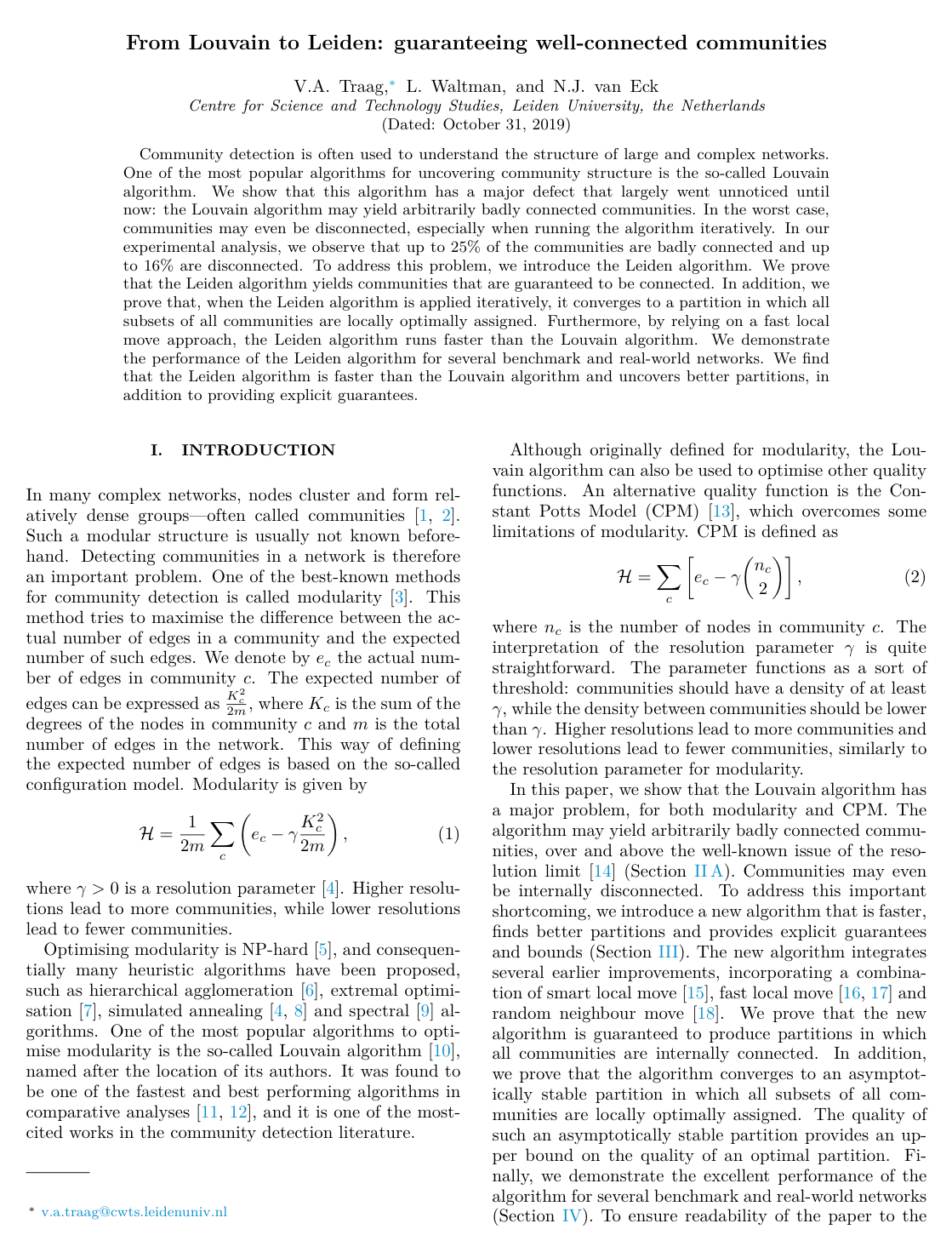
From Louvain to Leiden: guaranteeing well-connected communities
Vincent Traag, Ludo Waltman, Nees Jan van Eck
Why you should read this
Introduces the Leiden algorithm for network community detection to resolve a critical flaw in the popular Louvain method, providing mathematical guarantees of well-connected communities alongside faster runtimes and higher-quality partitions.
Community detection is often used to understand the structure of large and complex networks. One of the most popular algorithms for uncovering community structure is the so-called Louvain algorithm. We show that this algorithm has a major defect that largely went unnoticed until now: the Louvain algorithm may yield arbitrarily badly connected communities. In the worst case, communities may even be disconnected, especially when running the algorithm iteratively. In our experimental analysis, we observe that up to 25% of the communities are badly connected and up to 16% are disconnected. To address this problem, we introduce the Leiden algorithm. We prove that the Leiden algorithm yields communities that are guaranteed to be connected. In addition, we prove that, when the Leiden algorithm is applied iteratively, it converges to a partition in which all subsets of all communities are locally optimally assigned. Furthermore, by relying on a fast local move approach, the Leiden algorithm runs faster than the Louvain algorithm. We demonstrate the performance of the Leiden algorithm for several benchmark and real-world networks. We find that the Leiden algorithm is faster than the Louvain algorithm and uncovers better partitions, in addition to providing explicit guarantees.
Added
2026-09-10
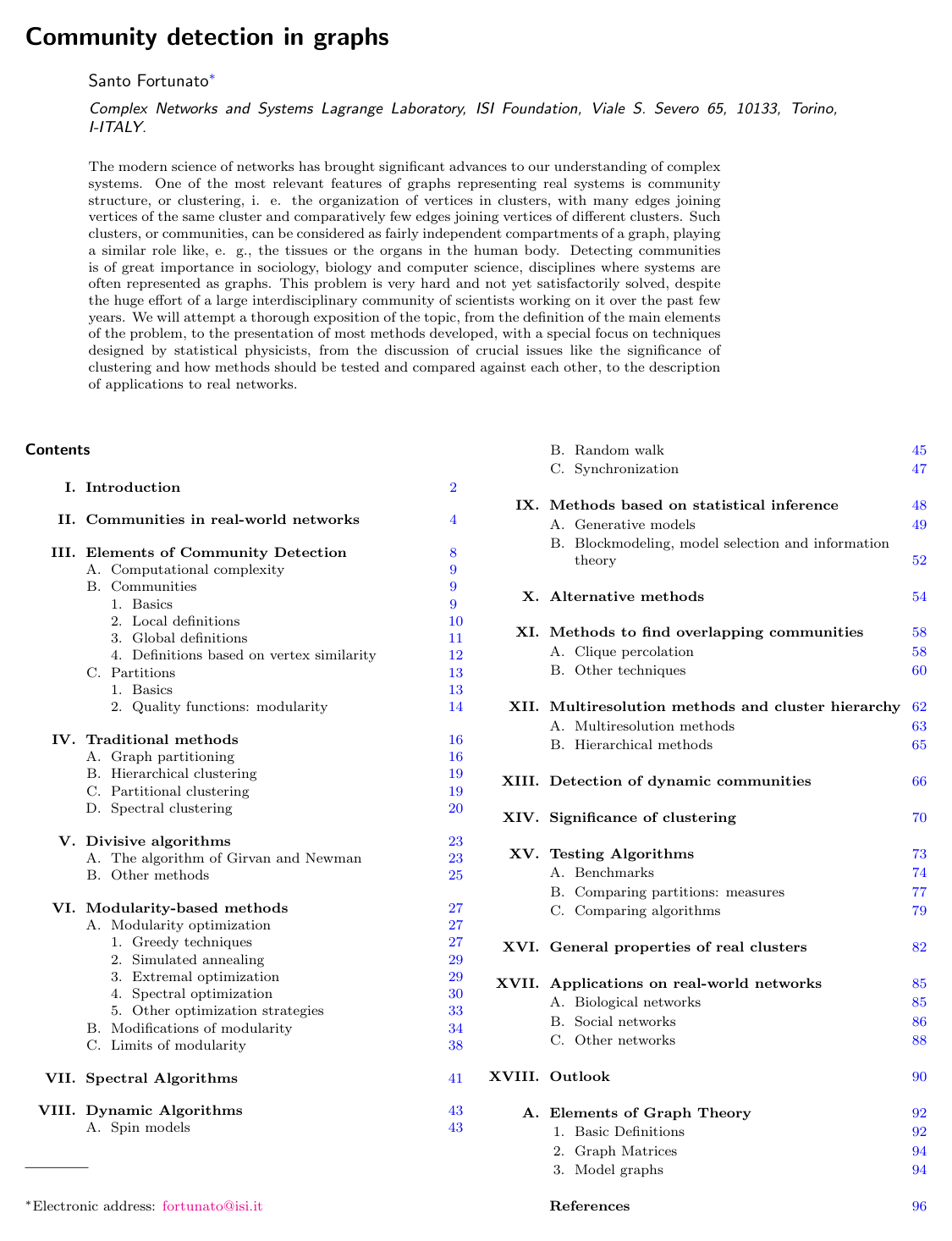
Community detection in graphs
Santo Fortunato
Why you should read this
Surveys fundamental algorithms, statistical physics approaches, and evaluation benchmarks for community detection, providing a definitive guide to identifying cluster structures across complex biological, social, and technological networks.
The modern science of networks has brought significant advances to our understanding of complex systems. One of the most relevant features of graphs representing real systems is community structure, or clustering, i. e. the organization of vertices in clusters, with many edges joining vertices of the same cluster and comparatively few edges joining vertices of different clusters. Such clusters, or communities, can be considered as fairly independent compartments of a graph, playing a similar role like, e. g., the tissues or the organs in the human body. Detecting communities is of great importance in sociology, biology and computer science, disciplines where systems are often represented as graphs. This problem is very hard and not yet satisfactorily solved, despite the huge effort of a large interdisciplinary community of scientists working on it over the past few years. We will attempt a thorough exposition of the topic, from the definition of the main elements of the problem, to the presentation of most methods developed, with a special focus on techniques designed by statistical physicists, from the discussion of crucial issues like the significance of clustering and how methods should be tested and compared against each other, to the description of applications to real networks.
Added
2026-09-06