
keyword
communication protocol
A communication protocol is a set of rules, formats, and conventions that dictates how multiple entities or agents exchange and interpret information. It establishes the syntax, semantics, and synchronization required for message transmission, ensuring that shared signals can be consistently encoded by a sender and understood by a receiver. In distributed and multi-agent systems, such protocols allow participants to coordinate actions, share observations, and mitigate partial observability to achieve shared or individual objectives. These protocols can be explicitly engineered with fixed symbolic representations or developed adaptively through interaction and learning algorithms to facilitate effective collaboration across a network.
2 items
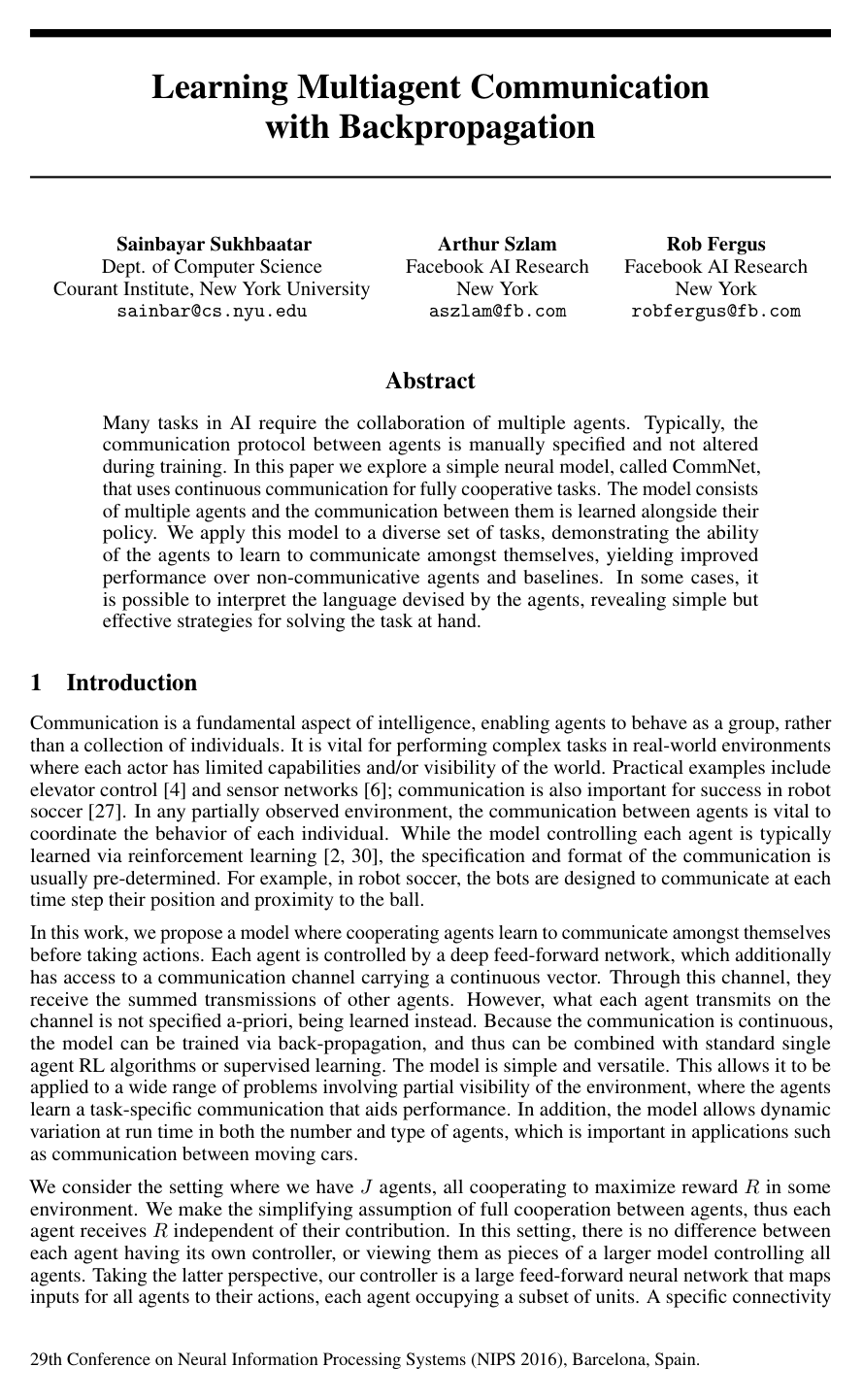
Learning Multiagent Communication with Backpropagation
Sainbayar Sukhbaatar, Arthur Szlam, Rob Fergus
Why you should read this
Introduces CommNet, a neural model that enables cooperative agents to learn continuous, interpretable communication protocols end-to-end using backpropagation to solve collaborative tasks.
Many tasks in AI require the collaboration of multiple agents. Typically, the communication protocol between agents is manually specified and not altered during training. In this paper we explore a simple neural model, called CommNet, that uses continuous communication for fully cooperative tasks. The model consists of multiple agents and the communication between them is learned alongside their policy. We apply this model to a diverse set of tasks, demonstrating the ability of the agents to learn to communicate amongst themselves, yielding improved performance over non-communicative agents and baselines. In some cases, it is possible to interpret the language devised by the agents, revealing simple but effective strategies for solving the task at hand.
Added
2026-09-25
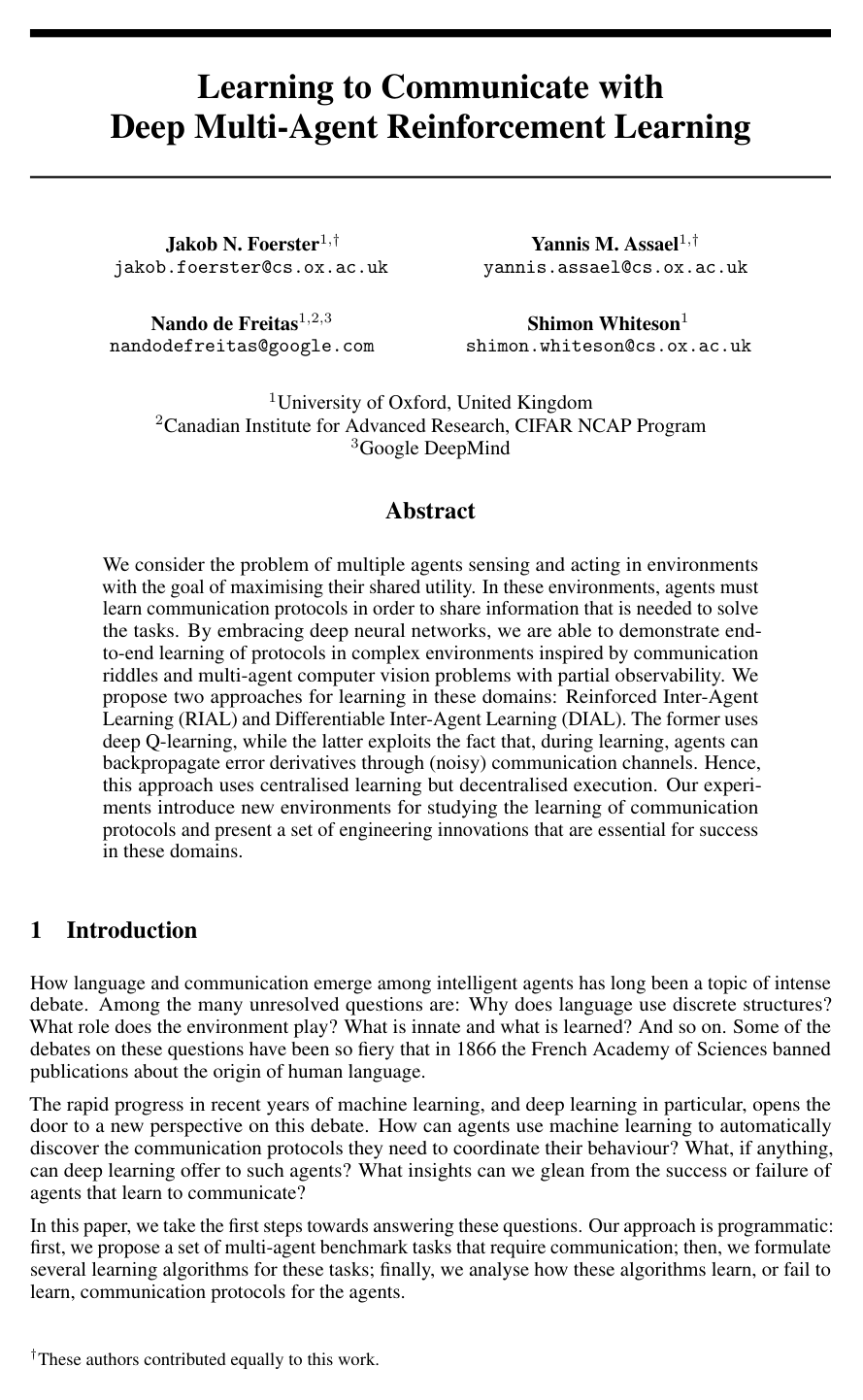
Learning to Communicate with Deep Multi-Agent Reinforcement Learning
Jakob N. Foerster, Yannis Assael, Nando de Freitas, Shimon Whiteson
Why you should read this
Proposes Reinforced Inter-Agent Learning (RIAL) and Differentiable Inter-Agent Learning (DIAL), enabling partially observable multi-agent systems to learn effective communication protocols end-to-end by backpropagating gradients across agent channels during centralized training.
We consider the problem of multiple agents sensing and acting in environments with the goal of maximising their shared utility. In these environments, agents must learn communication protocols in order to share information that is needed to solve the tasks. By embracing deep neural networks, we are able to demonstrate end-to-end learning of protocols in complex environments inspired by communication riddles and multi-agent computer vision problems with partial observability. We propose two approaches for learning in these domains: Reinforced Inter-Agent Learning (RIAL) and Differentiable Inter-Agent Learning (DIAL). The former uses deep Q-learning, while the latter exploits the fact that, during learning, agents can backpropagate error derivatives through (noisy) communication channels. Hence, this approach uses centralised learning but decentralised execution. Our experiments introduce new environments for studying the learning of communication protocols and present a set of engineering innovations that are essential for success in these domains.
Added
2026-09-18