
keyword
code retrieval
Code retrieval is the information retrieval process of searching for and locating relevant source code snippets, functions, or software repositories from a codebase based on a given query. Queries are frequently specified as natural language descriptions of a programming task, but they can also take the form of code fragments or structured representations. While traditional approaches rely on keyword matching and abstract syntax trees, modern code retrieval systems commonly leverage dense text and code embeddings, deep neural networks, and semantic matching techniques to map natural language and programming languages into a shared vector space. This enables the retrieval of semantically matching implementations even when the natural language description does not share exact vocabulary with the underlying source code, assisting developers in software reuse, bug fixing, and automated programming workflows.
3 items
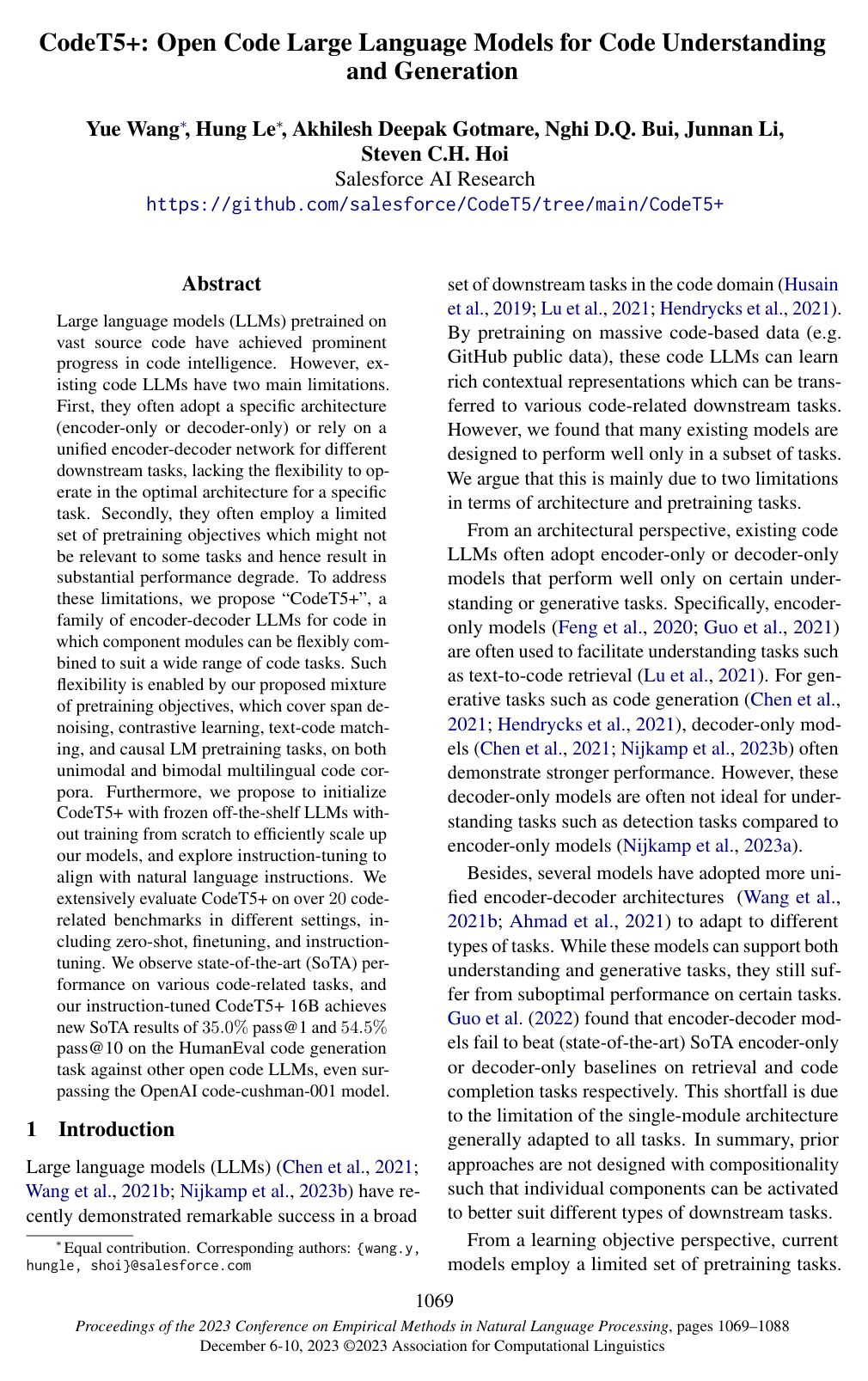
CodeT5+: Open Code Large Language Models for Code Understanding and Generation
Yue Wang, Hung Le, Akhilesh Gotmare, Nghi D. Q. Bui, Junnan Li, Steven C. H. Hoi
Why you should read this
Presents a flexible family of open-source code language models trained with diverse pretraining objectives and efficient initialization strategies, allowing modules to operate in encoder-only, decoder-only, or encoder-decoder modes to achieve top performance across broad code understanding and generation benchmarks.
Large language models (LLMs) pretrained on vast source code have achieved prominent progress in code intelligence. However, existing code LLMs have two main limitations. First, they often adopt a specific architecture (encoder-only or decoder-only) or rely on a unified encoder-decoder network for different downstream tasks, lacking the flexibility to operate in the optimal architecture for a specific task. Secondly, they often employ a limited set of pretraining objectives which might not be relevant to some tasks and hence result in substantial performance degrade. To address these limitations, we propose “CodeT5+”, a family of encoder-decoder LLMs for code in which component modules can be flexibly combined to suit a wide range of code tasks. Such flexibility is enabled by our proposed mixture of pretraining objectives, which cover span denoising, contrastive learning, text-code matching, and causal LM pretraining tasks, on both unimodal and bimodal multilingual code corpora. Furthermore, we propose to initialize CodeT5+ with frozen off-the-shelf LLMs without training from scratch to efficiently scale up our models, and explore instruction-tuning to align with natural language instructions. We extensively evaluate CodeT5+ on over 20 code-related benchmarks in different settings, including zero-shot, finetuning, and instruction-tuning. We observe state-of-the-art (SoTA) performance on various code-related tasks, and our instruction-tuned CodeT5+ 16B achieves new SoTA results of 35.0% pass@1 and 54.5% pass@10 on the HumanEval code generation task against other open code LLMs, even surpassing the OpenAI code-cushman-001 model.
Added
2026-09-28
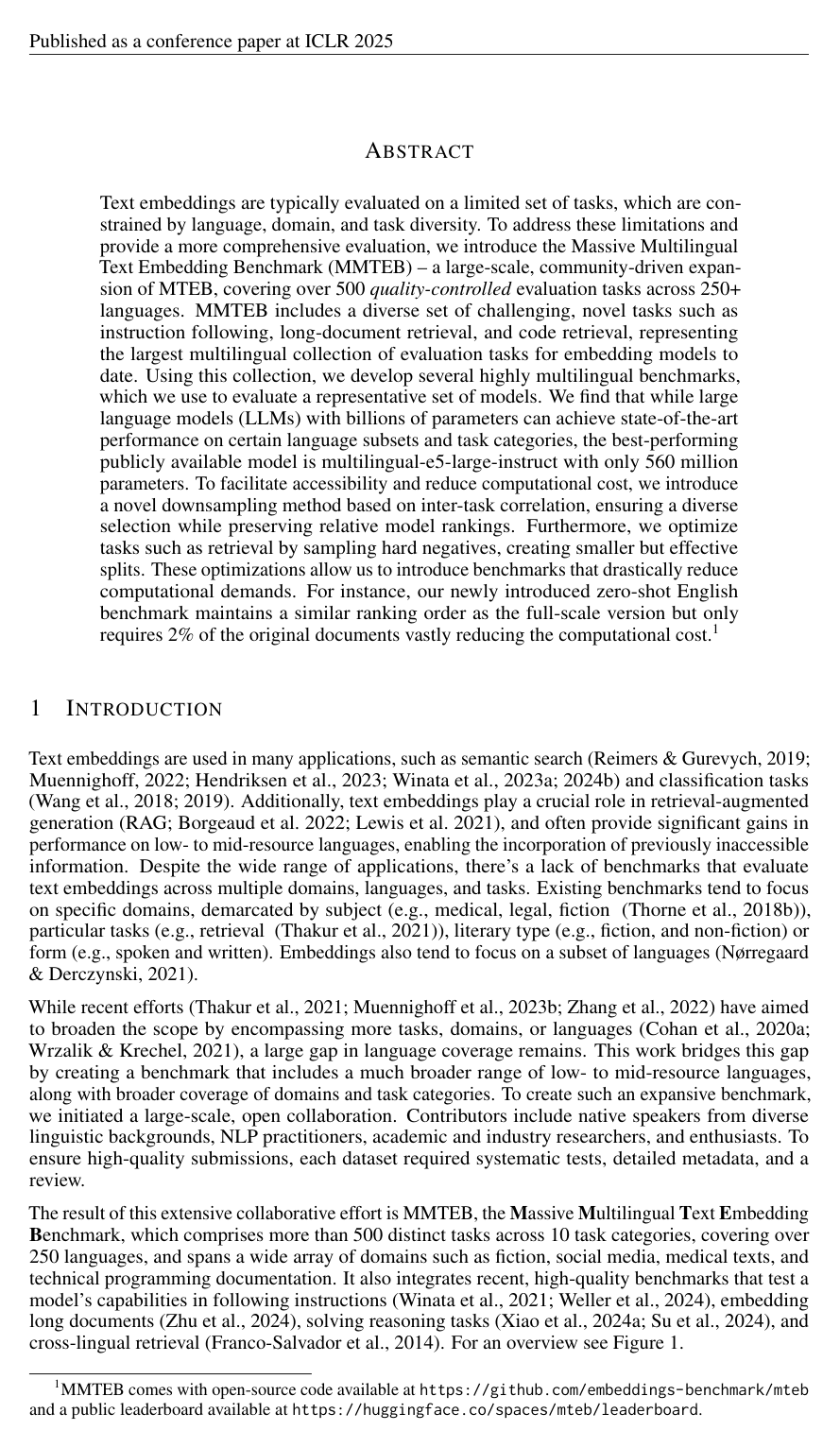
MMTEB: Massive Multilingual Text Embedding Benchmark
Kenneth C. Enevoldsen, Isaac Chung, Imene Kerboua, Mrton Kardos, Ashwin Mathur, David Stap, Jay Gala, Wissam Siblini, Dominik Krzeminski, Genta Indra Winata, Saba Sturua, Saiteja Utpala, Mathieu Ciancone, Marion Schaeffer, Diganta Misra, Shreeya Dhakal, Jonathan Rystrm, Roman Solomatin, mer Veysel agatan, Akash Kundu, et al.
Why you should read this
Presents the Massive Multilingual Text Embedding Benchmark (MMTEB), a suite of over 500 evaluation tasks across 250+ languages that incorporates efficient downsampling methods to drastically cut compute costs while revealing that compact 560M-parameter models can outperform multi-billion-parameter language models.
Text embeddings are typically evaluated on a limited set of tasks, which are constrained by language, domain, and task diversity. To address these limitations and provide a more comprehensive evaluation, we introduce the Massive Multilingual Text Embedding Benchmark (MMTEB) - a large-scale, community-driven expansion of MTEB, covering over 500 quality-controlled evaluation tasks across 250+ languages. MMTEB includes a diverse set of challenging, novel tasks such as instruction following, long-document retrieval, and code retrieval, representing the largest multilingual collection of evaluation tasks for embedding models to date. Using this collection, we develop several highly multilingual benchmarks, which we use to evaluate a representative set of models. We find that while large language models (LLMs) with billions of parameters can achieve state-of-the-art performance on certain language subsets and task categories, the best-performing publicly available model is multilingual-e5-large-instruct with only 560 million parameters. To facilitate accessibility and reduce computational cost, we introduce a novel downsampling method based on inter-task correlation, ensuring a diverse selection while preserving relative model rankings. Furthermore, we optimize tasks such as retrieval by sampling hard negatives, creating smaller but effective splits. These optimizations allow us to introduce benchmarks that drastically reduce computational demands. For instance, our newly introduced zero-shot English benchmark maintains a ranking order similar to the full-scale version but at a fraction of the computational cost.
Added
2026-09-26
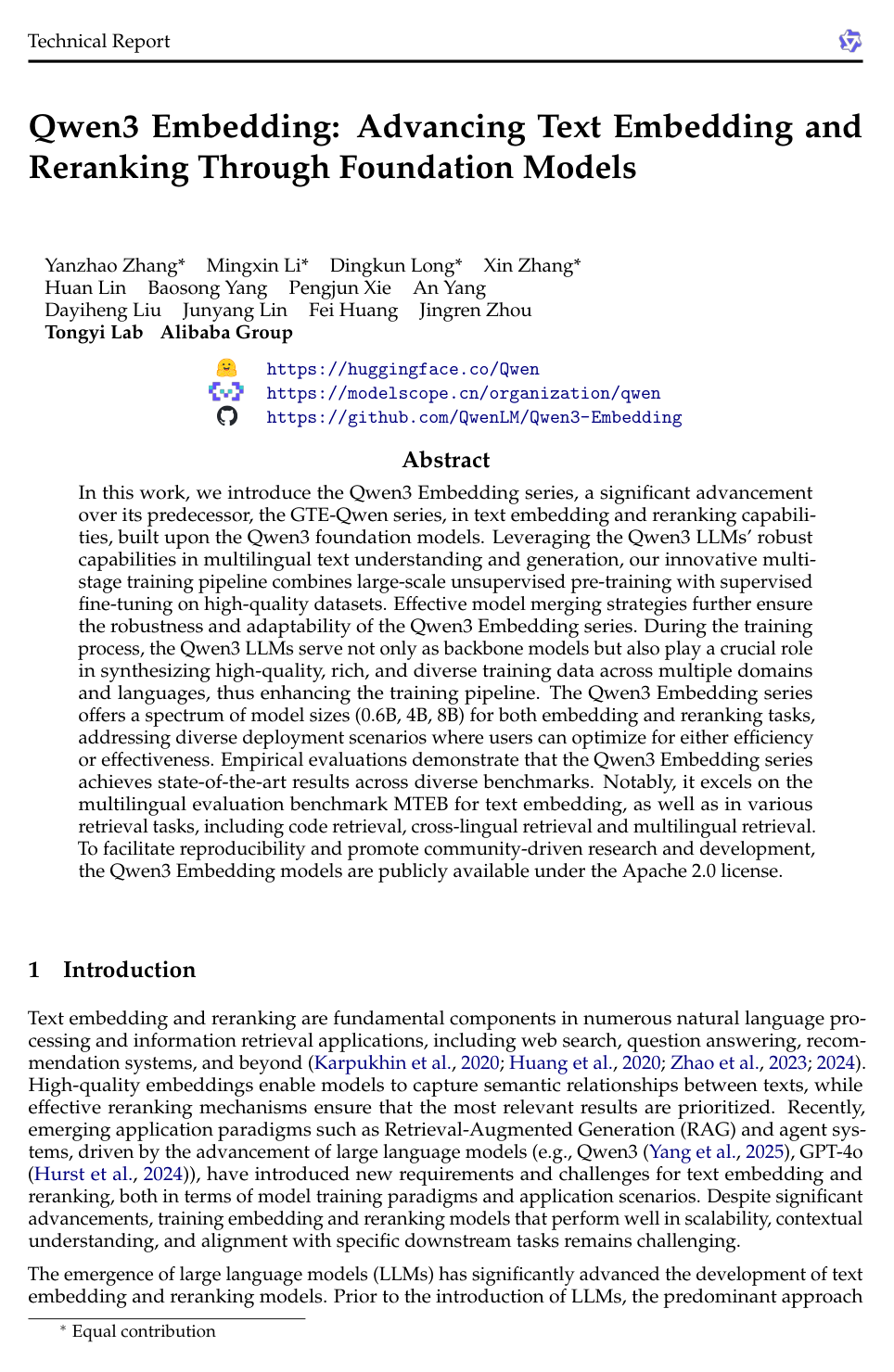
Qwen3 Embedding: Advancing Text Embedding and Reranking Through Foundation Models
Yanzhao Zhang, Mingxin Li, Dingkun Long, Xin Zhang, Huan Lin, Baosong Yang, Pengjun Xie, An Yang, Dayiheng Liu, Junyang Lin, Fei Huang, Jingren Zhou
Why you should read this
Presents the open-source Qwen3 Embedding and reranking model suite across 0.6B to 8B parameters, setting new state-of-the-art performance on multilingual and code retrieval benchmarks through foundation-model-driven synthetic data generation and multi-stage training.
In this work, we introduce the Qwen3 Embedding series, a significant advancement over its predecessor, the GTE-Qwen series, in text embedding and reranking capabilities, built upon the Qwen3 foundation models. Leveraging the Qwen3 LLMs' robust capabilities in multilingual text understanding and generation, our innovative multi-stage training pipeline combines large-scale unsupervised pre-training with supervised fine-tuning on high-quality datasets. Effective model merging strategies further ensure the robustness and adaptability of the Qwen3 Embedding series. During the training process, the Qwen3 LLMs serve not only as backbone models but also play a crucial role in synthesizing high-quality, rich, and diverse training data across multiple domains and languages, thus enhancing the training pipeline. The Qwen3 Embedding series offers a spectrum of model sizes (0.6B, 4B, 8B) for both embedding and reranking tasks, addressing diverse deployment scenarios where users can optimize for either efficiency or effectiveness. Empirical evaluations demonstrate that the Qwen3 Embedding series achieves state-of-the-art results across diverse benchmarks. Notably, it excels on the multilingual evaluation benchmark MTEB for text embedding, as well as in various retrieval tasks, including code retrieval, cross-lingual retrieval and multilingual retrieval. To facilitate reproducibility and promote community-driven research and development, the Qwen3 Embedding models are publicly available under the Apache 2.0 license.
Added
2026-09-25