
keyword
code optimization
Code optimization is the process of modifying computer software to enhance its execution efficiency and reduce resource consumption while preserving its original functional behavior and correctness. It primarily aims to decrease execution time, minimize memory overhead, and optimize system resource utilization such as processor cycles and energy consumption. These improvements can occur at various stages of software development and compilation, ranging from high-level algorithmic redesigns and efficient data structure choices made by programmers to automated instruction-level transformations performed by optimizing compilers and program synthesis models. By balancing computational speed and hardware constraints, code optimization ensures that a program reliably produces identical, valid results using fewer computing resources.
2 items
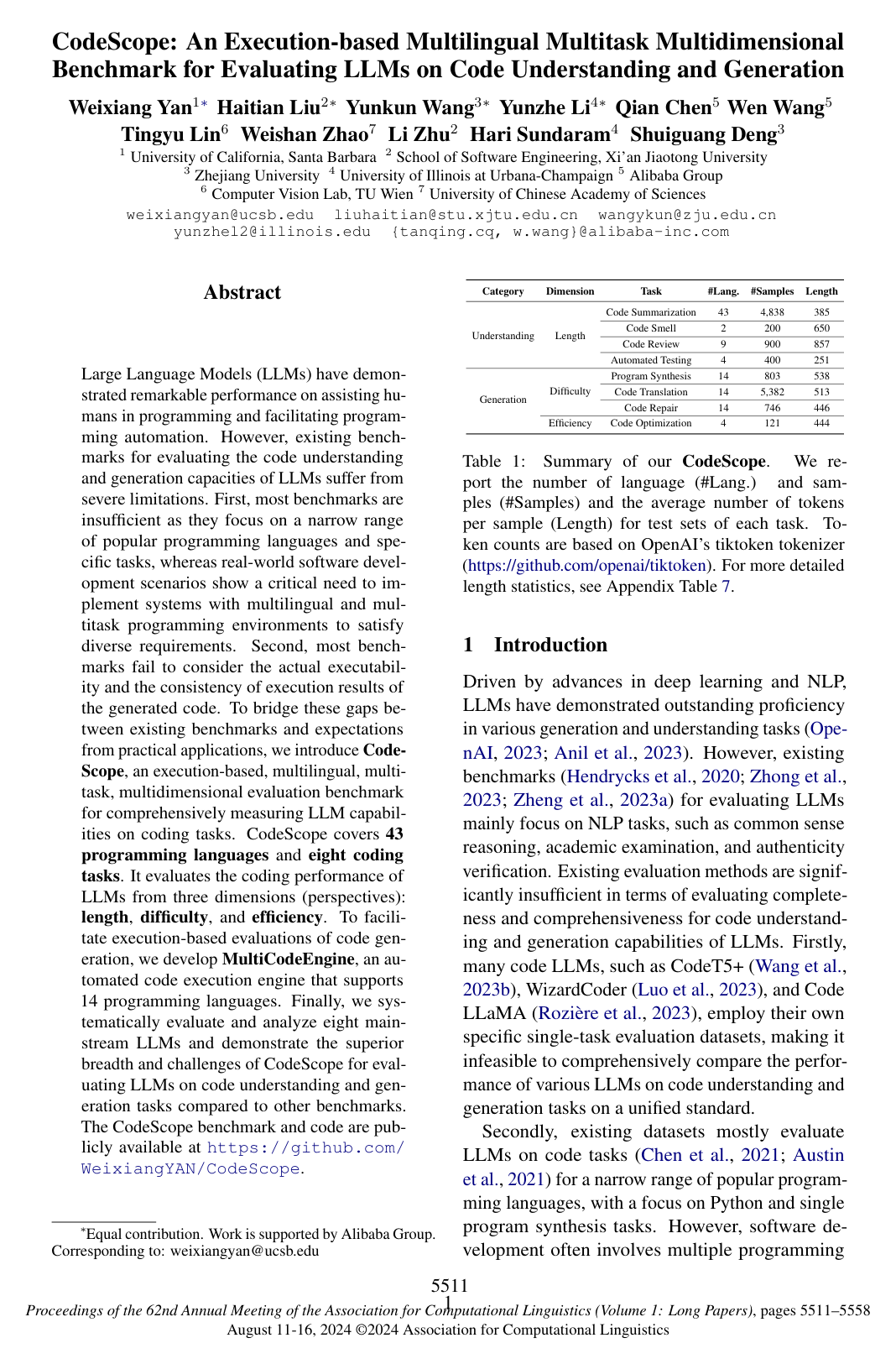
CodeScope: An Execution-based Multilingual Multitask Multidimensional Benchmark for Evaluating LLMs on Code Understanding and Generation
Weixiang Yan, Haitian Liu, Yunkun Wang, Yunzhe Li, Qian Chen, Wen Wang, Tingyu Lin, Weishan Zhao, Li Zhu, Hari Sundaram, Shuiguang Deng
Why you should read this
Introduces CodeScope, an execution-based evaluation benchmark spanning 43 programming languages and eight tasks to measure large language model coding performance across length, difficulty, and runtime efficiency.
Large Language Models (LLMs) have demonstrated remarkable performance on assisting humans in programming and facilitating programming automation. However, existing benchmarks for evaluating the code understanding and generation capacities of LLMs suffer from severe limitations. First, most benchmarks are insufficient as they focus on a narrow range of popular programming languages and specific tasks, whereas real-world software development scenarios show a critical need to implement systems with multilingual and multitask programming environments to satisfy diverse requirements. Second, most benchmarks fail to consider the actual executability and the consistency of execution results of the generated code. To bridge these gaps between existing benchmarks and expectations from practical applications, we introduce CodeScope, an execution-based, multilingual, multitask, multidimensional evaluation benchmark for comprehensively measuring LLM capabilities on coding tasks. CodeScope covers 43 programming languages and eight coding tasks. It evaluates the coding performance of LLMs from three dimensions (perspectives): length, difficulty, and efficiency. To facilitate execution-based evaluations of code generation, we develop MultiCodeEngine, an automated code execution engine that supports 14 programming languages. Finally, we systematically evaluate and analyze eight mainstream LLMs and demonstrate the superior breadth and challenges of CodeScope for evaluating LLMs on code understanding and generation tasks compared to other benchmarks. The CodeScope benchmark and code are publicly available at https://github.com/WeixiangYAN/CodeScope.
Added
2026-10-03
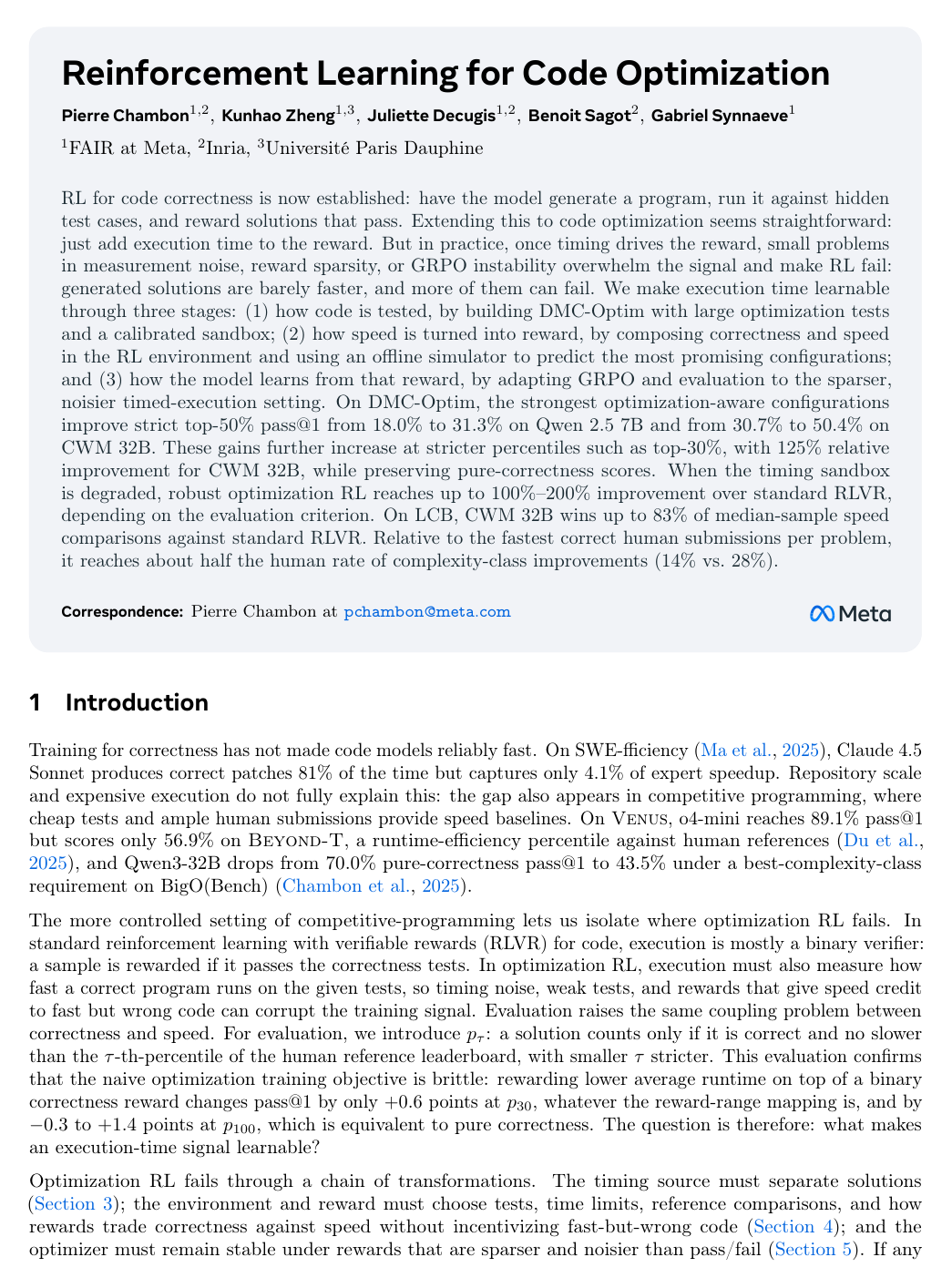
Reinforcement Learning for Code Optimization
Pierre Chambon, Kunhao Zheng, Juliette Decugis, Benoit Sagot, Gabriel Synnaeve
Why you should read this
Develops a novel, three-stage reinforcement learning framework that effectively makes execution time learnable for code optimization, achieving significant speed improvements on large language models even under noisy conditions, while maintaining correctness.
RL for code correctness is now established: have the model generate a program, run it against hidden test cases, and reward solutions that pass. Extending this to code optimization seems straightforward: just add execution time to the reward. But in practice, once timing drives the reward, small problems in measurement noise, reward sparsity, or GRPO instability overwhelm the signal and make RL fail: generated solutions are barely faster, and more of them can fail. We make execution time learnable through three stages: (1) how code is tested, by building DMC-Optim with large optimization tests and a calibrated sandbox; (2) how speed is turned into reward, by composing correctness and speed in the RL environment and using an offline simulator to predict the most promising configurations; and (3) how the model learns from that reward, by adapting GRPO and evaluation to the sparser, noisier timed-execution setting. On DMC-Optim, the strongest optimization-aware configurations improve strict top-50% pass@1 from 18.0% to 31.3% on Qwen 2.5 7B and from 30.7% to 50.4% on CWM 32B. These gains further increase at stricter percentiles such as top-30%, with 125% relative improvement for CWM 32B, while preserving pure-correctness scores. When the timing sandbox is degraded, robust optimization RL reaches 100% to 200% improvement over standard RLVR, depending on the evaluation criterion. On LCB, CWM 32B wins up to 83% of median-sample speed comparisons against standard RLVR. Relative to the fastest correct human submissions per problem, it reaches about half the human rate of complexity-class improvements (14% vs. 28%).
Added
2026-08-02
