
keyword
code LLMs
Code LLMs are large language models trained or adapted to work with programming code, enabling them to generate, complete, explain, analyze, or help assess code across programming tasks. They may also be evaluated on whether generated code runs correctly and consistently.
3 items
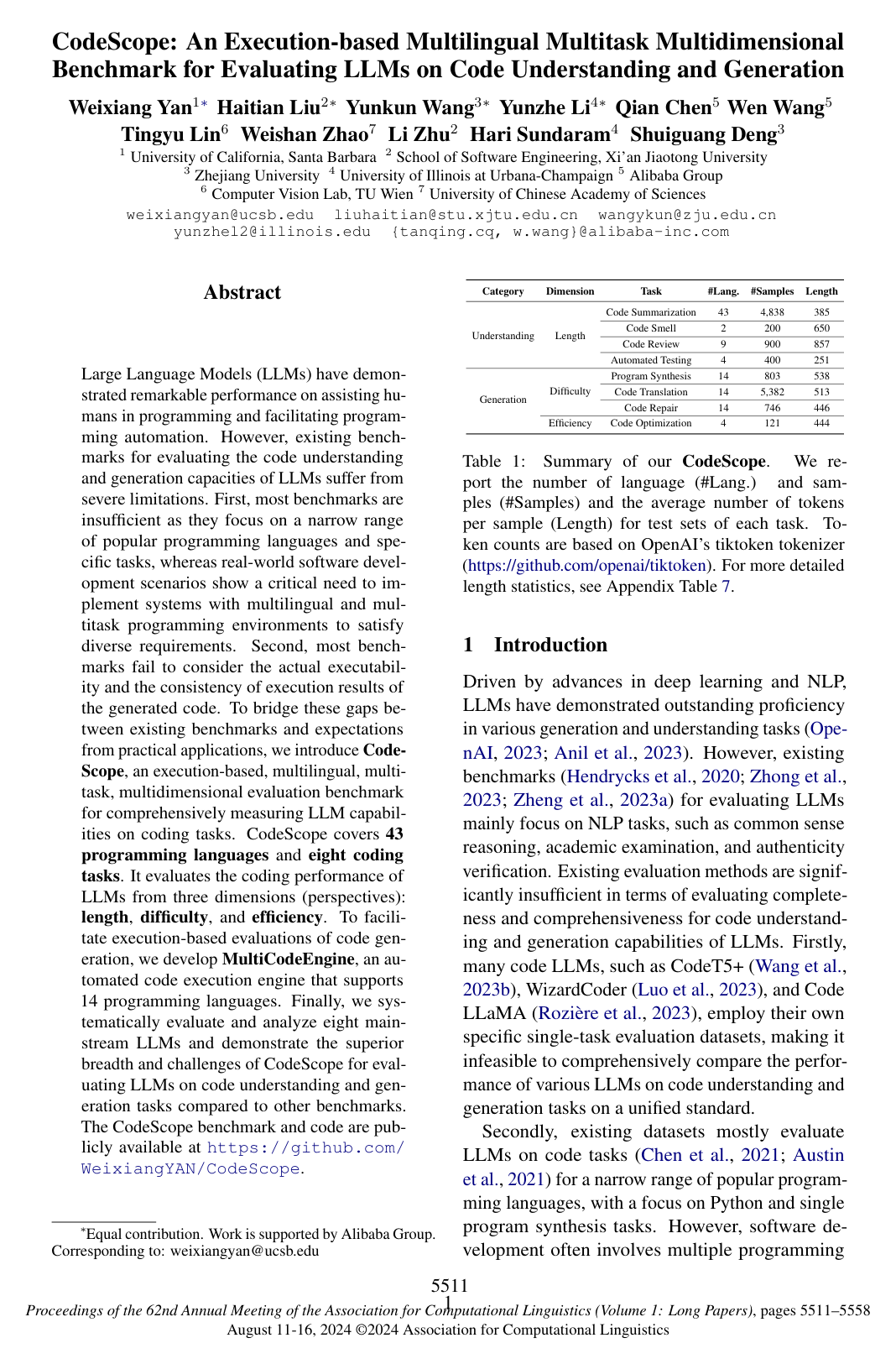
CodeScope: An Execution-based Multilingual Multitask Multidimensional Benchmark for Evaluating LLMs on Code Understanding and Generation
Weixiang Yan, Haitian Liu, Yunkun Wang, Yunzhe Li, Qian Chen, Wen Wang, Tingyu Lin, Weishan Zhao, Li Zhu, Hari Sundaram, Shuiguang Deng
Why you should read this
Introduces CodeScope, an execution-based evaluation benchmark spanning 43 programming languages and eight tasks to measure large language model coding performance across length, difficulty, and runtime efficiency.
Large Language Models (LLMs) have demonstrated remarkable performance on assisting humans in programming and facilitating programming automation. However, existing benchmarks for evaluating the code understanding and generation capacities of LLMs suffer from severe limitations. First, most benchmarks are insufficient as they focus on a narrow range of popular programming languages and specific tasks, whereas real-world software development scenarios show a critical need to implement systems with multilingual and multitask programming environments to satisfy diverse requirements. Second, most benchmarks fail to consider the actual executability and the consistency of execution results of the generated code. To bridge these gaps between existing benchmarks and expectations from practical applications, we introduce CodeScope, an execution-based, multilingual, multitask, multidimensional evaluation benchmark for comprehensively measuring LLM capabilities on coding tasks. CodeScope covers 43 programming languages and eight coding tasks. It evaluates the coding performance of LLMs from three dimensions (perspectives): length, difficulty, and efficiency. To facilitate execution-based evaluations of code generation, we develop MultiCodeEngine, an automated code execution engine that supports 14 programming languages. Finally, we systematically evaluate and analyze eight mainstream LLMs and demonstrate the superior breadth and challenges of CodeScope for evaluating LLMs on code understanding and generation tasks compared to other benchmarks. The CodeScope benchmark and code are publicly available at https://github.com/WeixiangYAN/CodeScope.
Added
2026-10-03
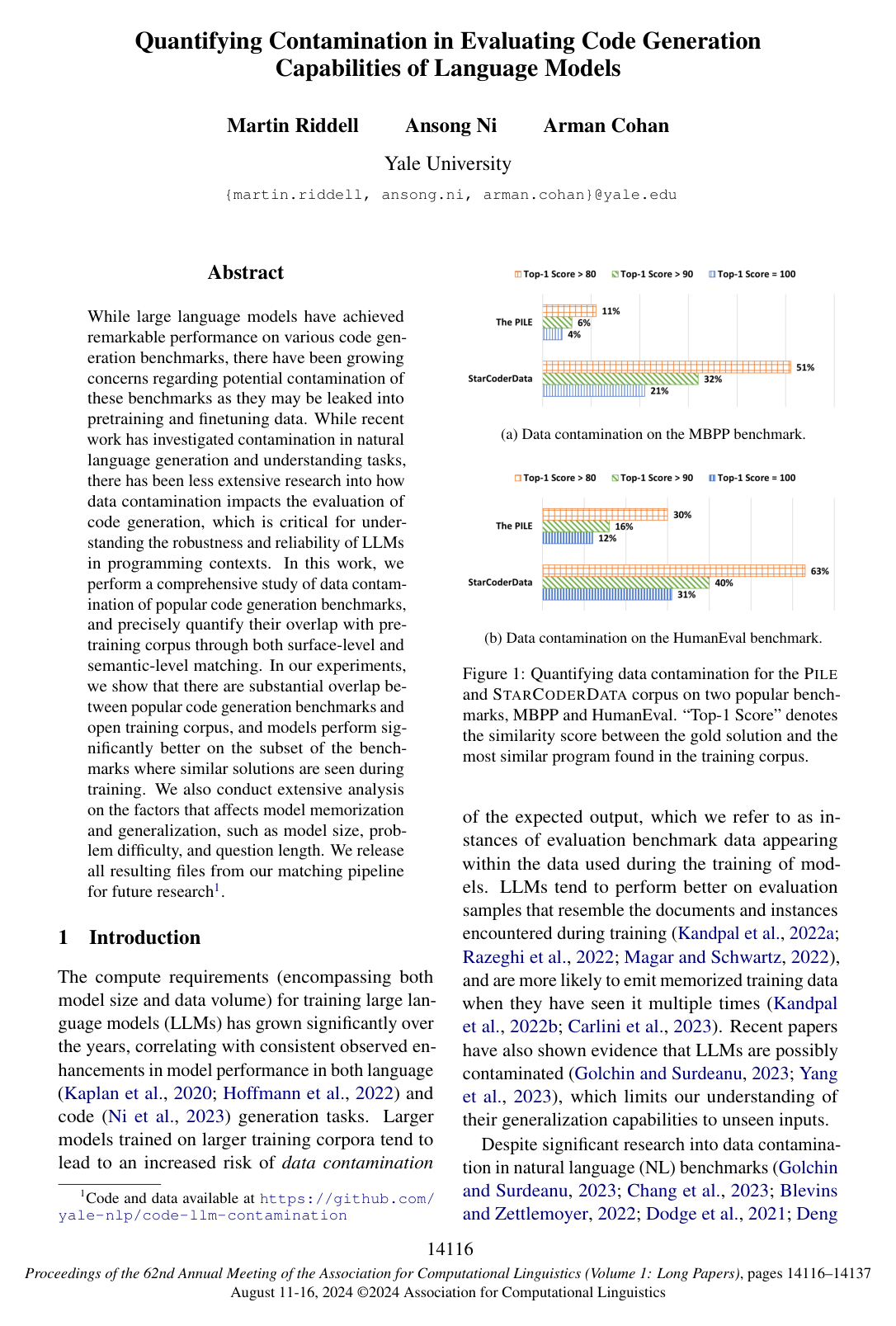
Quantifying Contamination in Evaluating Code Generation Capabilities of Language Models
Martin Riddell, Ansong Ni, Arman Cohan
Why you should read this
Quantifies benchmark leakage in popular code evaluation sets like HumanEval and MBPP across major pretraining corpora using both surface and semantic matching, revealing how test-data memorization artificially inflates code generation performance.
While large language models have achieved remarkable performance on various code generation benchmarks, there have been growing concerns regarding potential contamination of these benchmarks as they may be leaked into pretraining and finetuning data. While recent work has investigated contamination in natural language generation and understanding tasks, there has been less extensive research into how data contamination impacts the evaluation of code generation, which is critical for understanding the robustness and reliability of LLMs in programming contexts. In this work, we perform a comprehensive study of data contamination of popular code generation benchmarks, and precisely quantify their overlap with pretraining corpus through both surface-level and semantic-level matching. In our experiments, we show that there are substantial overlap between popular code generation benchmarks and open training corpus, and models perform significantly better on the subset of the benchmarks where similar solutions are seen during training. We also conduct extensive analysis on the factors that affects model memorization and generalization, such as model size, problem difficulty, and question length. We release all resulting files from our matching pipeline for future research¹.
Added
2026-10-03
BlueCodeAgent: A Blue Teaming Agent Enabled by Automated Red Teaming for CodeGen AI
Chengquan Guo, Yuzhou Nie, Chulin Xie, Zinan Lin, Wenbo Guo, Bo Li
Why you should read this
Presents BlueCodeAgent, an automated blue-teaming framework that uses red-team attack generation and dynamic code analysis to reduce false alarms and improve safety detection across code-generating language models.
As large language models (LLMs) are increasingly used for code generation, concerns over the security risks have grown substantially. Early research has primarily focused on red teaming, which aims to uncover and evaluate vulnerabilities and risks of CodeGen models. However, progress on the blue teaming side remains limited, as developing defense requires effective semantic understanding to differentiate the unsafe from the safe. To fill in this gap, we propose BlueCodeAgent, an end-to-end blue teaming agent enabled by automated red teaming. Our framework integrates both sides: red teaming generates diverse risky instances, while the blue teaming agent leverages these to detect previously seen and unseen risk scenarios through constitution and code analysis with agentic integration for multi-level defense. Our evaluation across three representative code-related tasks--bias instruction detection, malicious instruction detection, and vulnerable code detection--shows that BlueCodeAgent achieves significant gains over the base models and safety prompt-based defenses. In particular, for vulnerable code detection tasks, BlueCodeAgent integrates dynamic analysis to effectively reduce false positives, a challenging problem as base models tend to be over-conservative, misclassifying safe code as unsafe. Overall, BlueCodeAgent achieves an average 12.7\% F1 score improvement across four datasets in three tasks, attributed to its ability to summarize actionable constitutions that enhance context-aware risk detection. We demonstrate that the red teaming benefits the blue teaming by continuously identifying new vulnerabilities to enhance defense performance.
Added
2026-09-29