
keyword
code generation tasks
Code generation tasks are computational objectives in artificial intelligence and software engineering that involve automatically producing syntactically correct and executable source code from specified inputs. In these tasks, machine learning models or program synthesis systems process inputs such as natural language problem descriptions, formal specifications, partial code snippets, or code in another programming language to generate programs in a target language. Standard forms of these tasks include text-to-code generation, code completion, code translation between different languages, and automated program repair. The quality and correctness of solutions in code generation tasks are typically evaluated through automated execution against unit tests, pass rates, syntax validation, and computational efficiency.
3 items
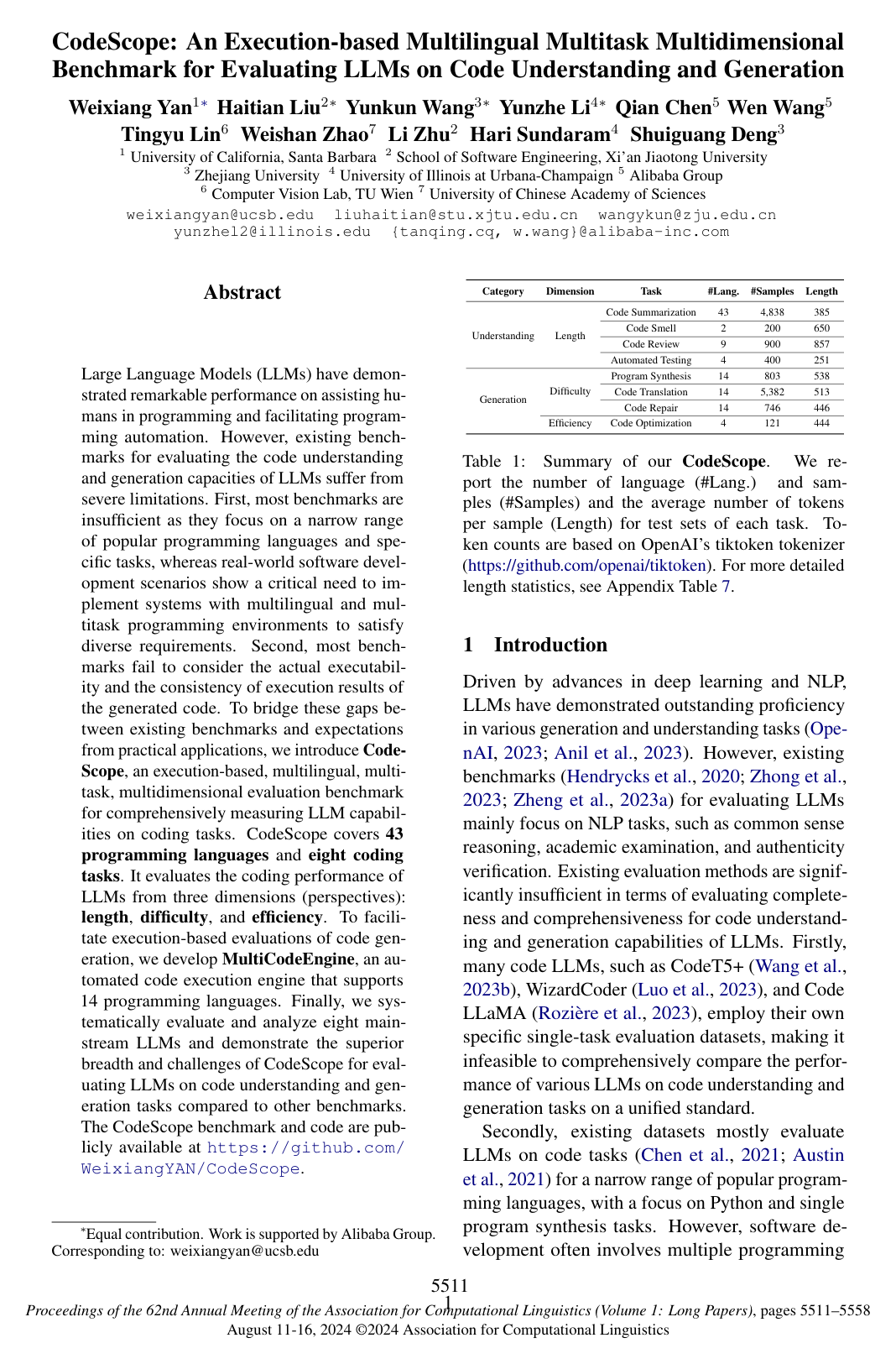
CodeScope: An Execution-based Multilingual Multitask Multidimensional Benchmark for Evaluating LLMs on Code Understanding and Generation
Weixiang Yan, Haitian Liu, Yunkun Wang, Yunzhe Li, Qian Chen, Wen Wang, Tingyu Lin, Weishan Zhao, Li Zhu, Hari Sundaram, Shuiguang Deng
Why you should read this
Introduces CodeScope, an execution-based evaluation benchmark spanning 43 programming languages and eight tasks to measure large language model coding performance across length, difficulty, and runtime efficiency.
Large Language Models (LLMs) have demonstrated remarkable performance on assisting humans in programming and facilitating programming automation. However, existing benchmarks for evaluating the code understanding and generation capacities of LLMs suffer from severe limitations. First, most benchmarks are insufficient as they focus on a narrow range of popular programming languages and specific tasks, whereas real-world software development scenarios show a critical need to implement systems with multilingual and multitask programming environments to satisfy diverse requirements. Second, most benchmarks fail to consider the actual executability and the consistency of execution results of the generated code. To bridge these gaps between existing benchmarks and expectations from practical applications, we introduce CodeScope, an execution-based, multilingual, multitask, multidimensional evaluation benchmark for comprehensively measuring LLM capabilities on coding tasks. CodeScope covers 43 programming languages and eight coding tasks. It evaluates the coding performance of LLMs from three dimensions (perspectives): length, difficulty, and efficiency. To facilitate execution-based evaluations of code generation, we develop MultiCodeEngine, an automated code execution engine that supports 14 programming languages. Finally, we systematically evaluate and analyze eight mainstream LLMs and demonstrate the superior breadth and challenges of CodeScope for evaluating LLMs on code understanding and generation tasks compared to other benchmarks. The CodeScope benchmark and code are publicly available at https://github.com/WeixiangYAN/CodeScope.
Added
2026-10-03
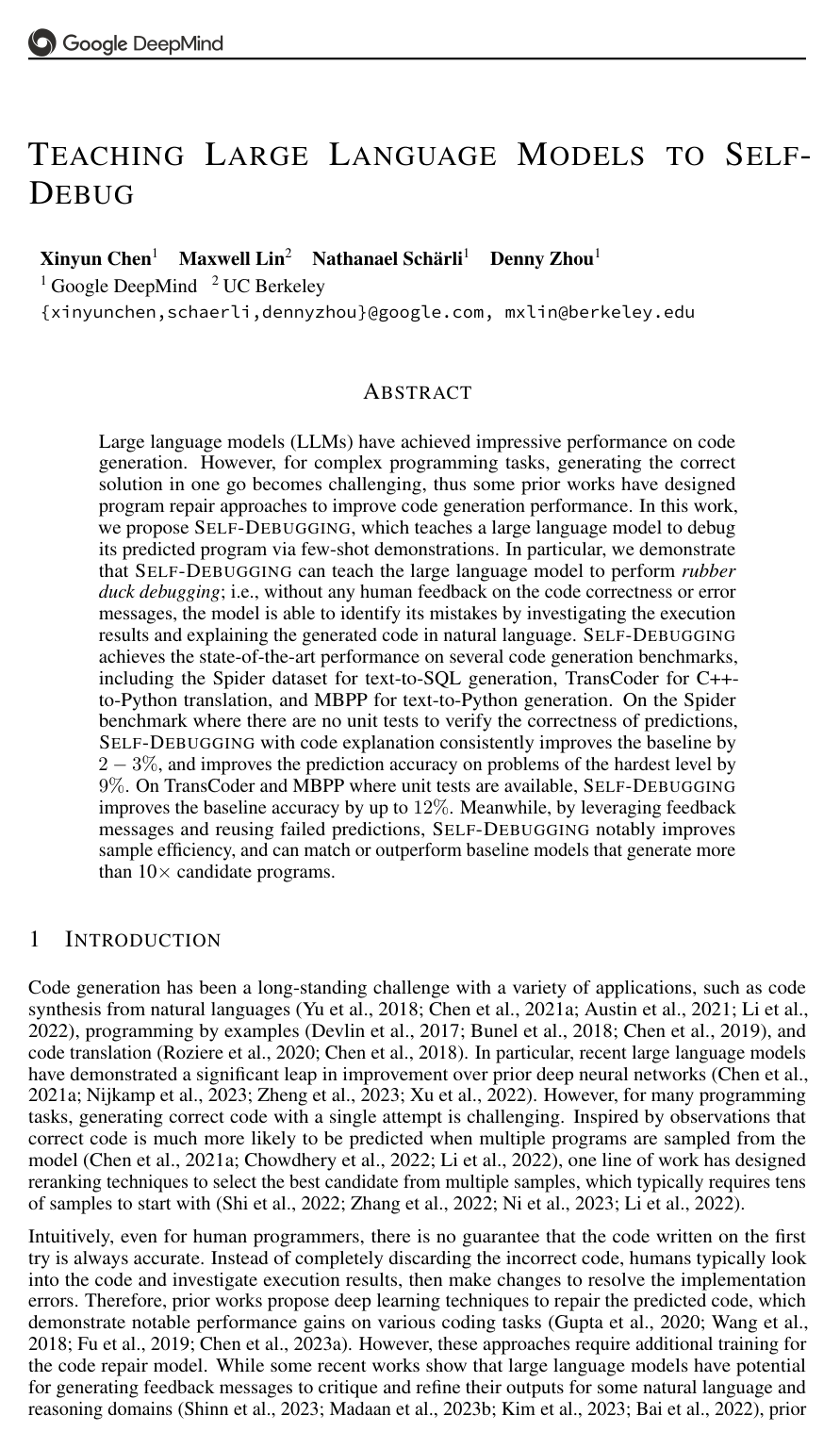
Teaching Large Language Models to Self-Debug
Xinyun Chen, Maxwell Lin, Nathanael Schärli, Denny Zhou
Why you should read this
Proposes a self-debugging method that enables large language models to autonomously detect and correct their own code generation mistakes through natural language explanations and execution feedback, boosting accuracy on benchmarks such as Spider, TransCoder, and MBPP.
Large language models (LLMs) have achieved impressive performance on code generation. However, for complex programming tasks, generating the correct solution in one go becomes challenging, thus some prior works have designed program repair approaches to improve code generation performance. In this work, we propose Self-Debugging, which teaches a large language model to debug its predicted program via few-shot demonstrations. In particular, we demonstrate that Self-Debugging can teach the large language model to perform rubber duck debugging; i.e., without any human feedback on the code correctness or error messages, the model is able to identify its mistakes by investigating the execution results and explaining the generated code in natural language. Self-Debugging achieves the state-of-the-art performance on several code generation benchmarks, including the Spider dataset for text-to-SQL generation, TransCoder for C++-to-Python translation, and MBPP for text-to-Python generation. On the Spider benchmark where there are no unit tests to verify the correctness of predictions, Self-Debugging with code explanation consistently improves the baseline by 2-3%, and improves the prediction accuracy on problems of the hardest level by 9%. On TransCoder and MBPP where unit tests are available, Self-Debugging improves the baseline accuracy by up to 12%. Meanwhile, by leveraging feedback messages and reusing failed predictions, Self-Debugging notably improves sample efficiency, and can match or outperform baseline models that generate more than 10x candidate programs.
Added
2026-09-25
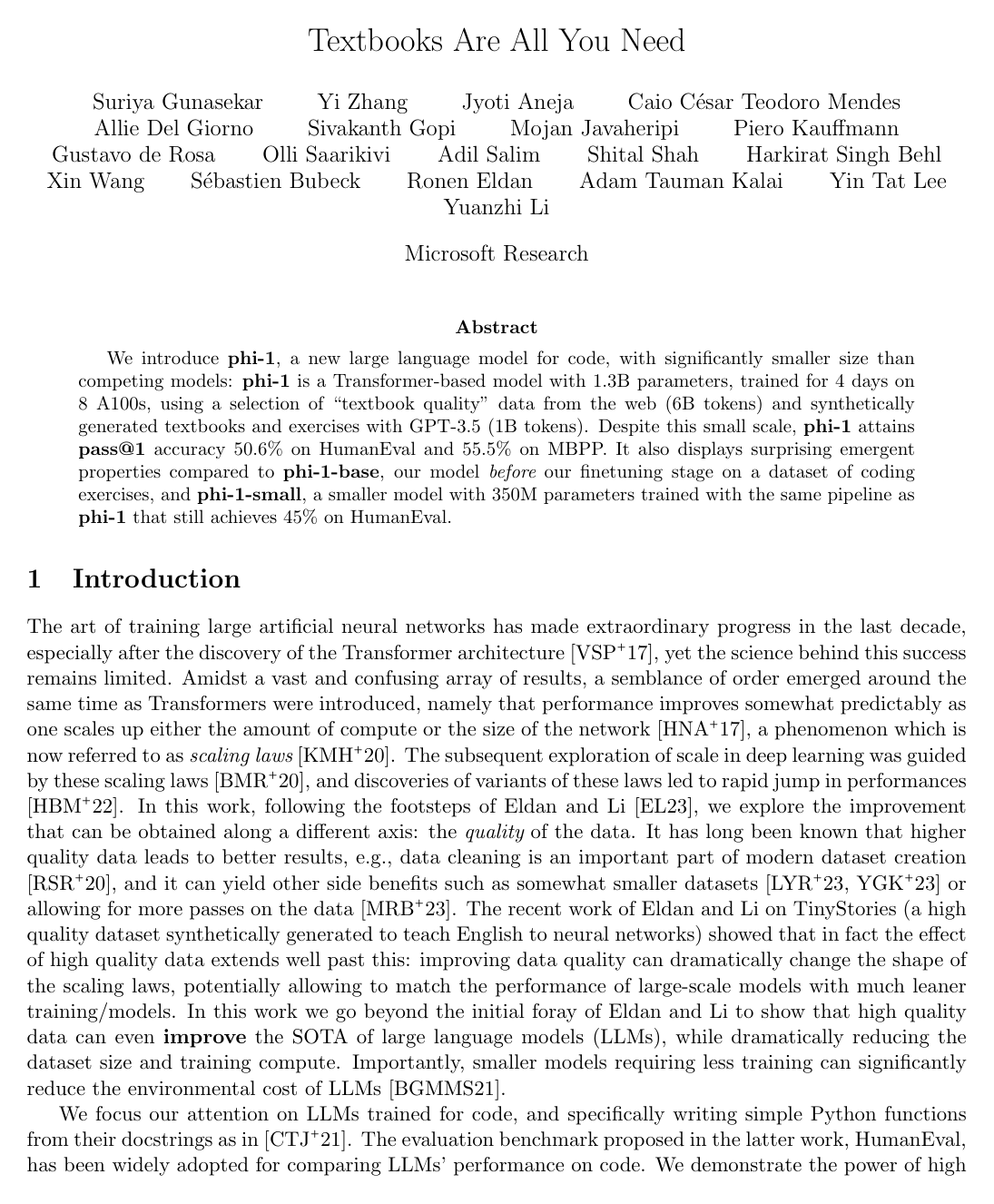
Textbooks Are All You Need
Suriya Gunasekar, Yi Zhang, Jyoti Aneja, Caio César Teodoro Mendes, Allie Del Giorno, Sivakanth Gopi, Mojan Javaheripi, Piero Kauffmann, Gustavo de Rosa, Olli Saarikivi, Adil Salim, Shital Shah, Harkirat Singh Behl, Xin Wang, Sébastien Bubeck, Ronen Eldan, Adam Tauman Kalai, Yin Tat Lee, Yuanzhi Li
Why you should read this
Demonstrates that a small, 1.3B parameter language model, phi-1, can achieve state-of-the-art code generation performance on HumanEval and MBPP by leveraging "textbook quality" data, challenging existing scaling laws and significantly reducing computational costs.
We introduce phi-1, a new large language model for code, with significantly smaller size than competing models: phi-1 is a Transformer-based model with 1.3B parameters, trained for 4 days on 8 A100s, using a selection of ``textbook quality" data from the web (6B tokens) and synthetically generated textbooks and exercises with GPT-3.5 (1B tokens). Despite this small scale, phi-1 attains pass@1 accuracy 50.6% on HumanEval and 55.5% on MBPP. It also displays surprising emergent properties compared to phi-1-base, our model before our finetuning stage on a dataset of coding exercises, and phi-1-small, a smaller model with 350M parameters trained with the same pipeline as phi-1 that still achieves 45% on HumanEval.
Added
2026-05-07
