
keyword
code generation models
Code generation models are machine-learning models that produce computer code in response to an input, such as a natural-language request, a programming problem, or existing code. They can generate new programs or functions and may also be used for tasks such as translating code between programming languages; their outputs can be assessed for correctness by running them against tests.
4 items
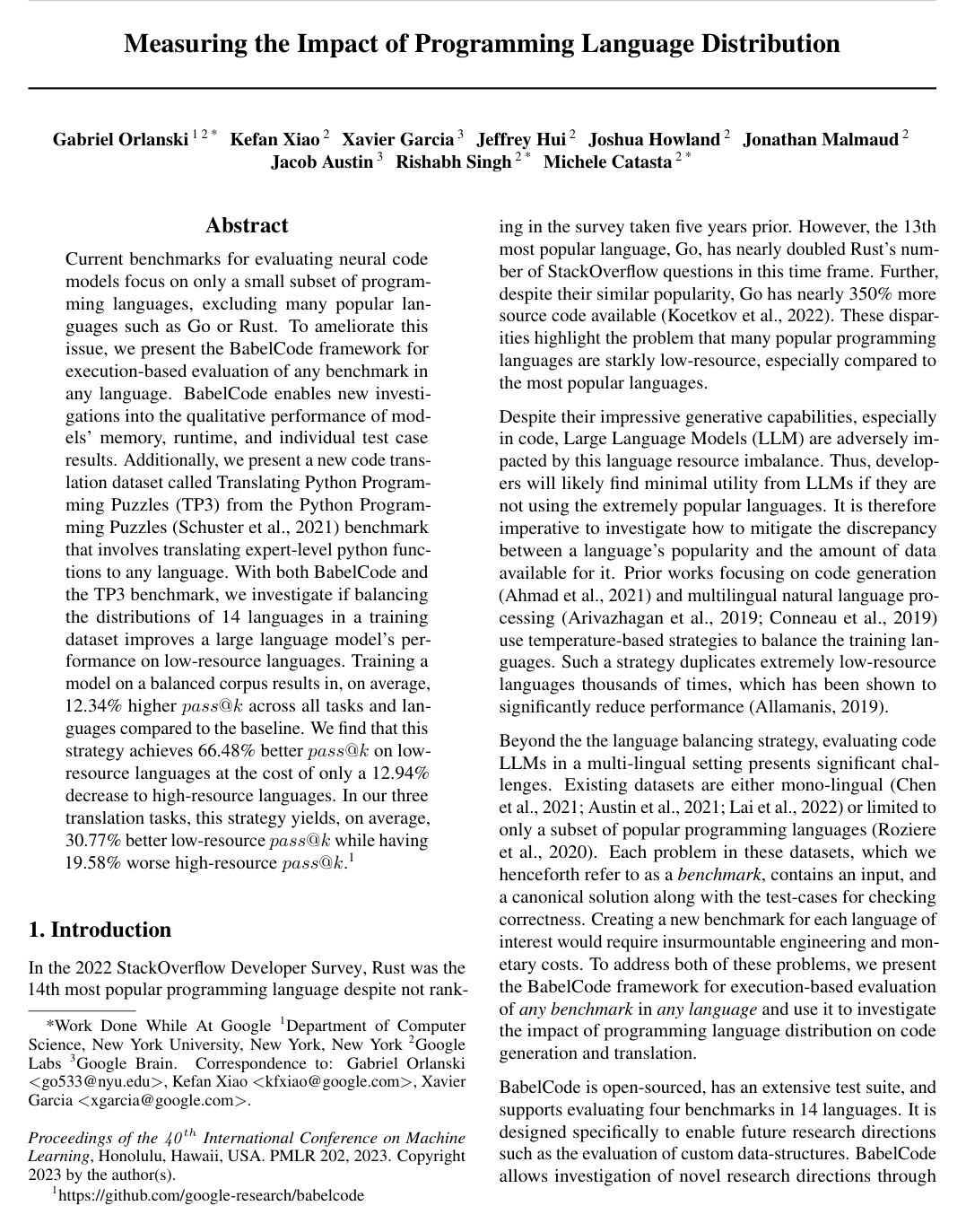
Measuring the Impact of Programming Language Distribution
Gabriel Orlanski, Kefan Xiao, Xavier Garcia, Jeffrey Hui, Joshua Howland, Jonathan Malmaud, Jacob Austin, Rishabh Singh, Michele Catasta
Why you should read this
Presents the BabelCode execution-based evaluation framework and demonstrates that balancing multilingual training distributions dramatically improves code language model performance on low-resource programming languages with minimal degradation to high-resource ones.
Current benchmarks for evaluating neural code models focus on only a small subset of programming languages, excluding many popular languages such as Go or Rust. To ameliorate this issue, we present the BabelCode framework for execution-based evaluation of any benchmark in any language. BabelCode enables new investigations into the qualitative performance of models’ memory, runtime, and individual test case results. Additionally, we present a new code translation dataset called Translating Python Programming Puzzles (TP3) from the Python Programming Puzzles (Schuster et al., 2021) benchmark that involves translating expert-level python functions to any language. With both BabelCode and the TP3 benchmark, we investigate if balancing the distributions of 14 languages in a training dataset improves a large language model’s performance on low-resource languages. Training a model on a balanced corpus results in, on average, 12.34% higher pass@k across all tasks and languages compared to the baseline. We find that this strategy achieves 66.48% better pass@k on low-resource languages at the cost of only a 12.94% decrease to high-resource languages. In our three translation tasks, this strategy yields, on average, 30.77% better low-resource pass@k while having 19.58% worse high-resource pass@k.
Added
2026-10-03
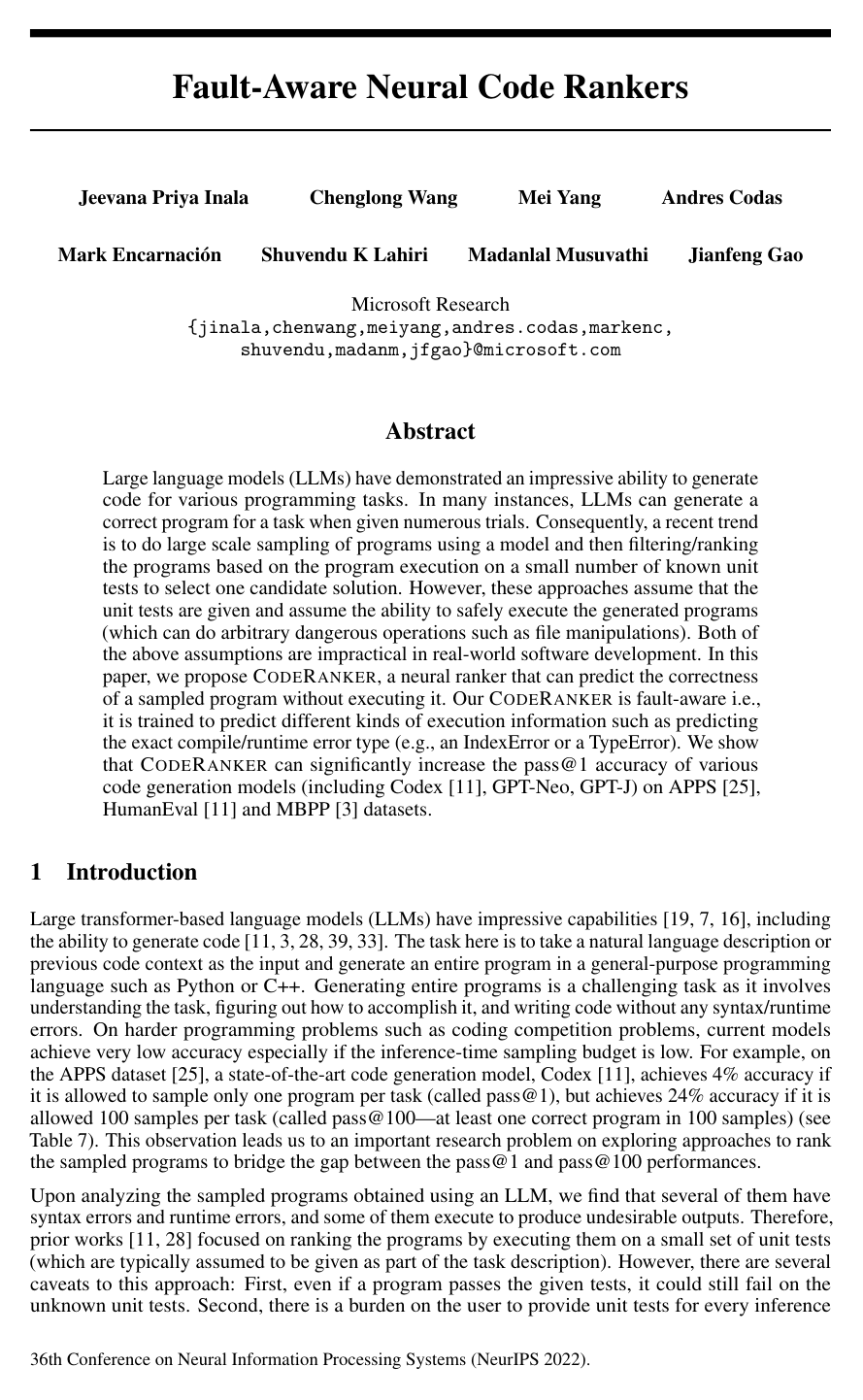
Fault-Aware Neural Code Rankers
Jeevana Priya Inala, Chenglong Wang, Mei Yang, Andrés Codas, Mark Encarnación, Shuvendu K. Lahiri, Madanlal Musuvathi, Jianfeng Gao
Why you should read this
Presents CodeRanker, an execution-free neural ranking framework that predicts specific compile and runtime error types to select correct model-generated programs, substantially boosting pass@1 accuracy across standard benchmarks without requiring unit test execution.
Large language models (LLMs) have demonstrated an impressive ability to generate code for various programming tasks. In many instances, LLMs can generate a correct program for a task when given numerous trials. Consequently, a recent trend is to do large scale sampling of programs using a model and then filtering/ranking the programs based on the program execution on a small number of known unit tests to select one candidate solution. However, these approaches assume that the unit tests are given and assume the ability to safely execute the generated programs (which can do arbitrary dangerous operations such as file manipulations). Both of the above assumptions are impractical in real-world software development. In this paper, we propose CodeRanker, a neural ranker that can predict the correctness of a sampled program without executing it. Our CodeRanker is fault-aware i.e., it is trained to predict different kinds of execution information such as predicting the exact compile/runtime error type (e.g., an IndexError or a TypeError). We show that CodeRanker can significantly increase the pass@1 accuracy of various code generation models (including Codex [11], GPT-Neo, GPT-J) on APPS [25], HumanEval [11] and MBPP [3] datasets.
Added
2026-09-26
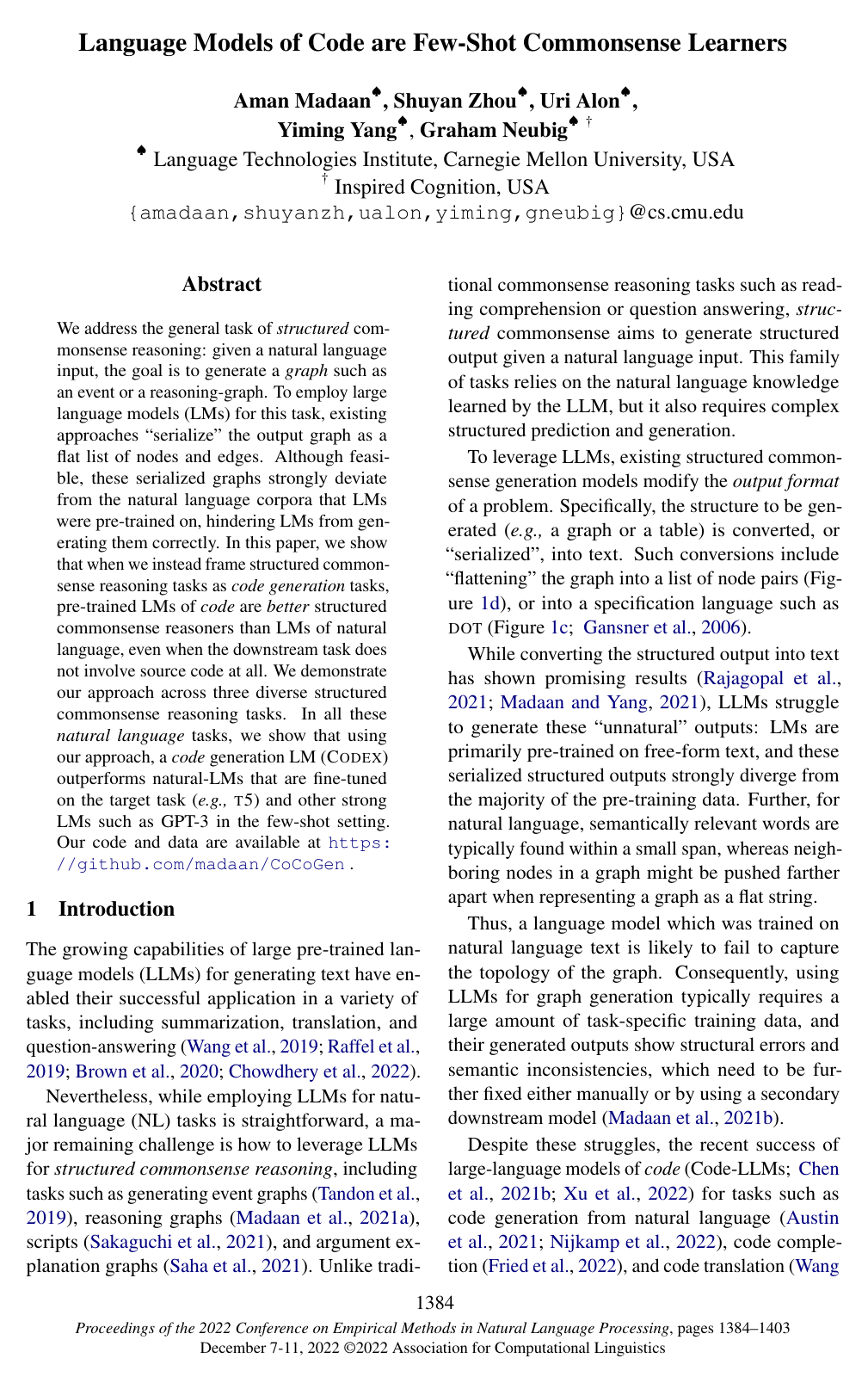
Language Models of Code are Few-Shot Commonsense Learners
Aman Madaan, Shuyan Zhou, Uri Alon, Yiming Yang, Graham Neubig
Why you should read this
Demonstrates that framing structured commonsense reasoning as code generation allows code language models to outperform natural language models like GPT-3 and fine-tuned T5 on graph-generation tasks.
We address the general task of structured commonsense reasoning: given a natural language input, the goal is to generate a graph such as an event or a reasoning-graph. To employ large language models (LMs) for this task, existing approaches "serialize" the output graph as a flat list of nodes and edges. Although feasible, these serialized graphs strongly deviate from the natural language corpora that LMs were pre-trained on, hindering LMs from generating them correctly. In this paper, we show that when we instead frame structured commonsense reasoning tasks as code generation tasks, pre-trained LMs of code are better structured commonsense reasoners than LMs of natural language, even when the downstream task does not involve source code at all. We demonstrate our approach across three diverse structured commonsense reasoning tasks. In all these natural language tasks, we show that using our approach, a code generation LM (CODEX) outperforms natural-LMs that are fine-tuned on the target task (e.g., T5) and other strong LMs such as GPT-3 in the few-shot setting. Our code and data are available at https://github.com/madaan/CoCoGen.
Added
2026-09-26
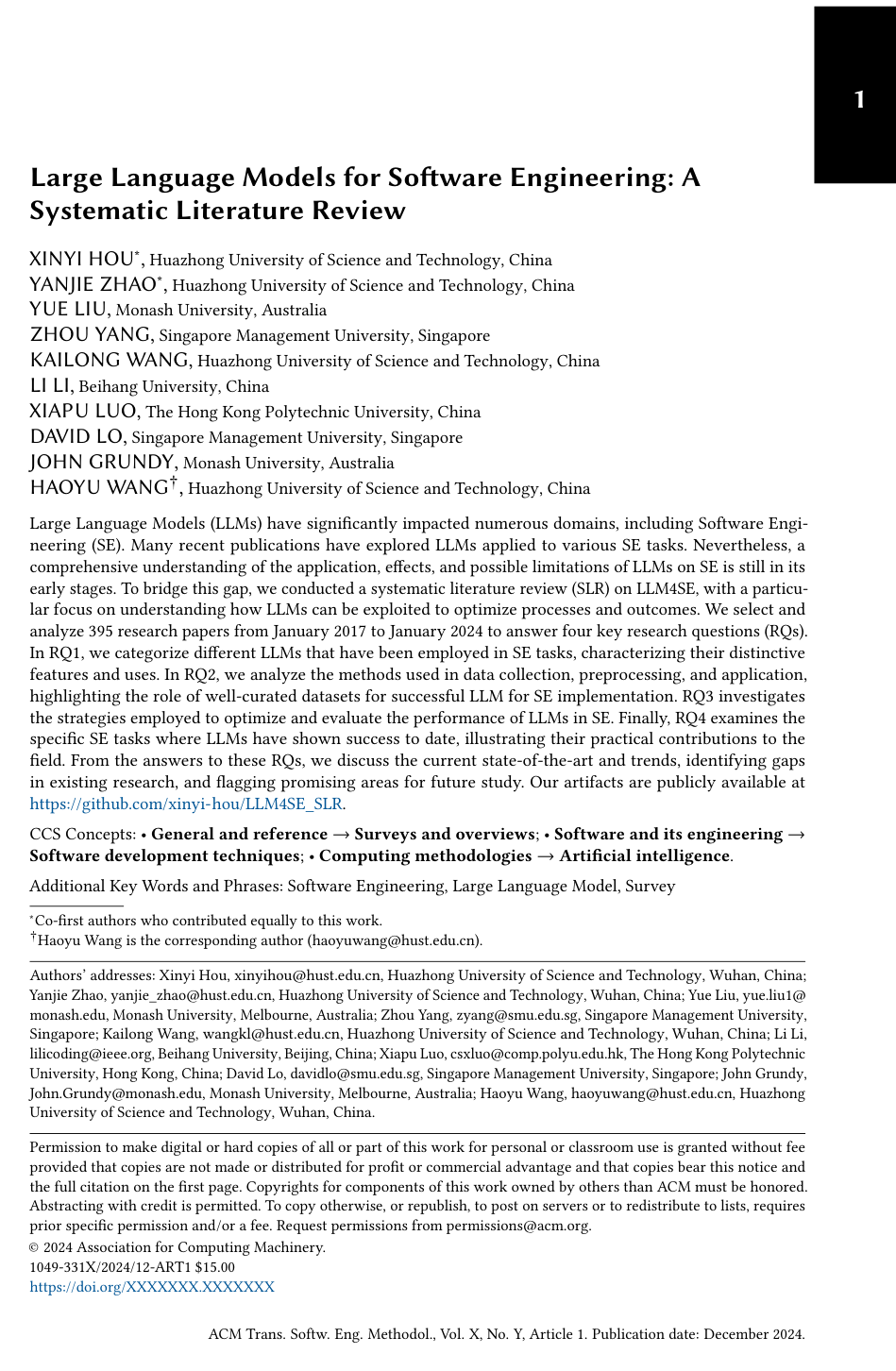
Large Language Models for Software Engineering: A Systematic Literature Review
Xinying Hou, Yanjie Zhao, Yue Liu, Zhou Yang, Kailong Wang, Li Li, Xiapu Luo, David Lo, John C. Grundy, Haoyu Wang
Why you should read this
Systematizes findings from nearly 400 studies to explain how large language models are trained, evaluated, and deployed across software engineering tasks, providing clear guidance on effective data practices and open research challenges.
Large Language Models (LLMs) have significantly impacted numerous domains, including Software Engineering (SE). Many recent publications have explored LLMs applied to various SE tasks. Nevertheless, a comprehensive understanding of the application, effects, and possible limitations of LLMs on SE is still in its early stages. To bridge this gap, we conducted a systematic literature review (SLR) on LLM4SE, with a particular focus on understanding how LLMs can be exploited to optimize processes and outcomes. We select and analyze 395 research papers from January 2017 to January 2024 to answer four key research questions (RQs). In RQ1, we categorize different LLMs that have been employed in SE tasks, characterizing their distinctive features and uses. In RQ2, we analyze the methods used in data collection, preprocessing, and application, highlighting the role of well-curated datasets for successful LLM for SE implementation. RQ3 investigates the strategies employed to optimize and evaluate the performance of LLMs in SE. Finally, RQ4 examines the specific SE tasks where LLMs have shown success to date, illustrating their practical contributions to the field. From the answers to these RQs, we discuss the current state-of-the-art and trends, identifying gaps in existing research, and flagging promising areas for future study. Our artifacts are publicly available at this https URL.
Added
2026-09-25