
keyword
COCO caption
A COCO caption refers to a natural language description associated with an image in the Common Objects in Context dataset, as well as the widely used image captioning benchmark established on that data. Designed to advance research at the intersection of computer vision and natural language processing, the dataset provides multiple independent, human-annotated sentences—typically five per image—that describe everyday visual scenes, identifiable objects, and their contextual relationships. In machine learning and artificial intelligence research, COCO captions serve as a standard resource for training vision-language models and evaluating automated image captioning, vision-text alignment, and multimodal understanding through quantitative evaluation metrics such as CIDEr, BLEU, METEOR, and ROUGE.
4 items
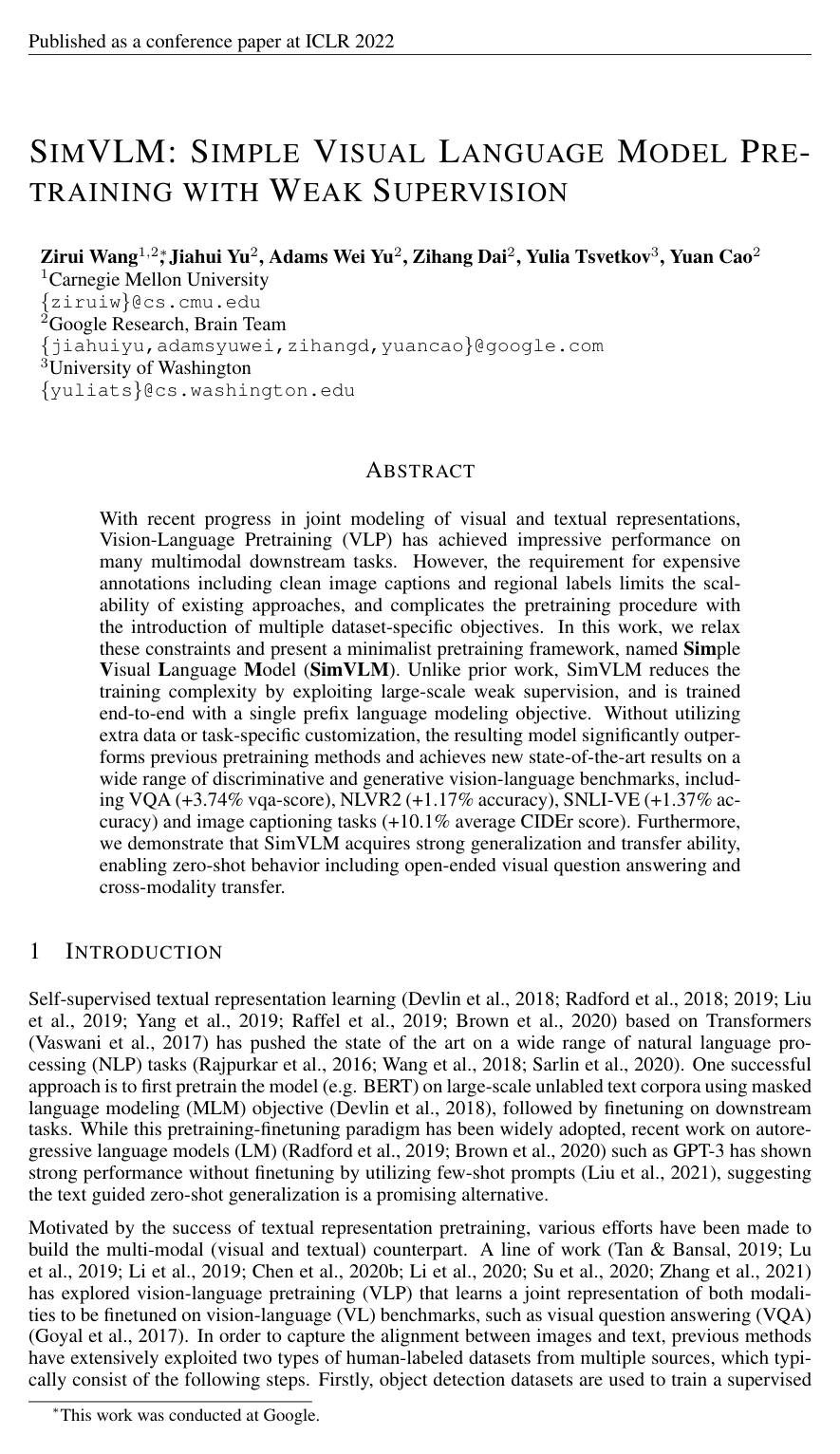
SimVLM: Simple Visual Language Model Pretraining with Weak Supervision
Zirui Wang, Jiahui Yu, Adams Wei Yu, Zihang Dai, Yulia Tsvetkov, Yuan Cao
Why you should read this
Introduces SimVLM, a simplified vision-language model trained end-to-end on weakly supervised data using a single prefix language modeling objective, achieving state-of-the-art benchmark performance and strong zero-shot multimodal capabilities without requiring expensive object-level annotations.
With recent progress in joint modeling of visual and textual representations, Vision-Language Pretraining (VLP) has achieved impressive performance on many multimodal downstream tasks. However, the requirement for expensive annotations including clean image captions and regional labels limits the scalability of existing approaches, and complicates the pretraining procedure with the introduction of multiple dataset-specific objectives. In this work, we relax these constraints and present a minimalist pretraining framework, named Simple Visual Language Model (SimVLM). Unlike prior work, SimVLM reduces the training complexity by exploiting large-scale weak supervision, and is trained end-to-end with a single prefix language modeling objective. Without utilizing extra data or task-specific customization, the resulting model significantly outperforms previous pretraining methods and achieves new state-of-the-art results on a wide range of discriminative and generative vision-language benchmarks, including VQA (+3.74% vqa-score), NLVR2 (+1.17% accuracy), SNLI-VE (+1.37% accuracy) and image captioning tasks (+10.1% average CIDEr score). Furthermore, we demonstrate that SimVLM acquires strong generalization and transfer ability, enabling zero-shot behavior including open-ended visual question answering and cross-modality transfer.
Added
2026-10-05
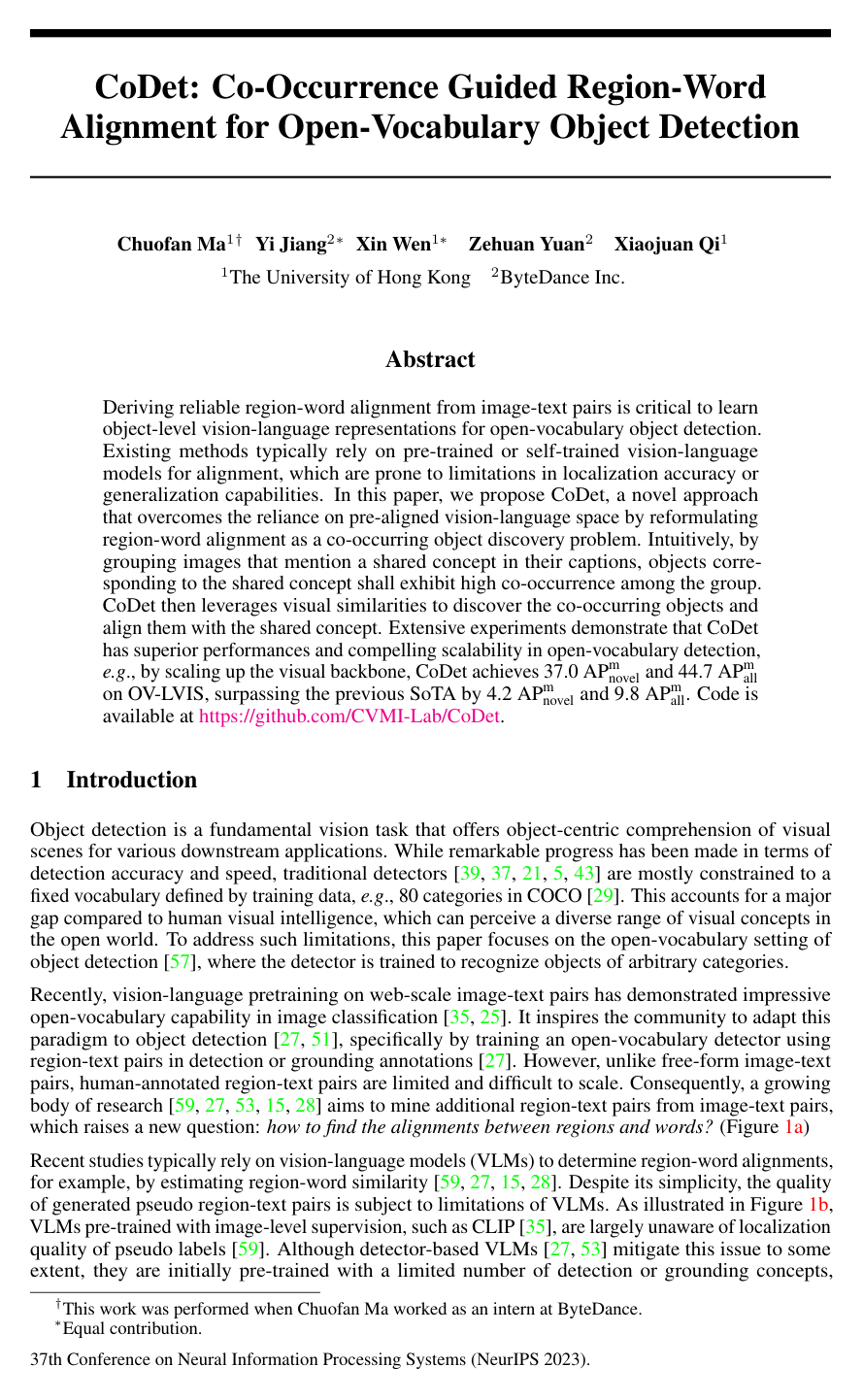
CoDet: Co-occurrence Guided Region-Word Alignment for Open-Vocabulary Object Detection
Chuofan Ma, Yi Jiang, Xin Wen, Zehuan Yuan, Xiaojuan Qi
Why you should read this
Proposes an open-vocabulary object detection framework that bypasses pre-aligned vision-language models by discovering co-occurring visual objects across captioned image groups to achieve state-of-the-art novel category detection on OV-LVIS.
Deriving reliable region-word alignment from image-text pairs is critical to learn object-level vision-language representations for open-vocabulary object detection. Existing methods typically rely on pre-trained or self-trained vision-language models for alignment, which are prone to limitations in localization accuracy or generalization capabilities. In this paper, we propose CoDet, a novel approach that overcomes the reliance on pre-aligned vision-language space by reformulating region-word alignment as a co-occurring object discovery problem. Intuitively, by grouping images that mention a shared concept in their captions, objects corresponding to the shared concept shall exhibit high co-occurrence among the group. CoDet then leverages visual similarities to discover the co-occurring objects and align them with the shared concept. Extensive experiments demonstrate that CoDet has superior performances and compelling scalability in open-vocabulary detection, e.g., by scaling up the visual backbone, CoDet achieves 37.0 AP_novel^m and 44.7 AP_all^m on OV-LVIS, surpassing the previous SoTA by 4.2 AP_novel^m and 9.8 AP_all^m. Code is available at https://github.com/CVMI-Lab/CoDet.
Added
2026-09-26
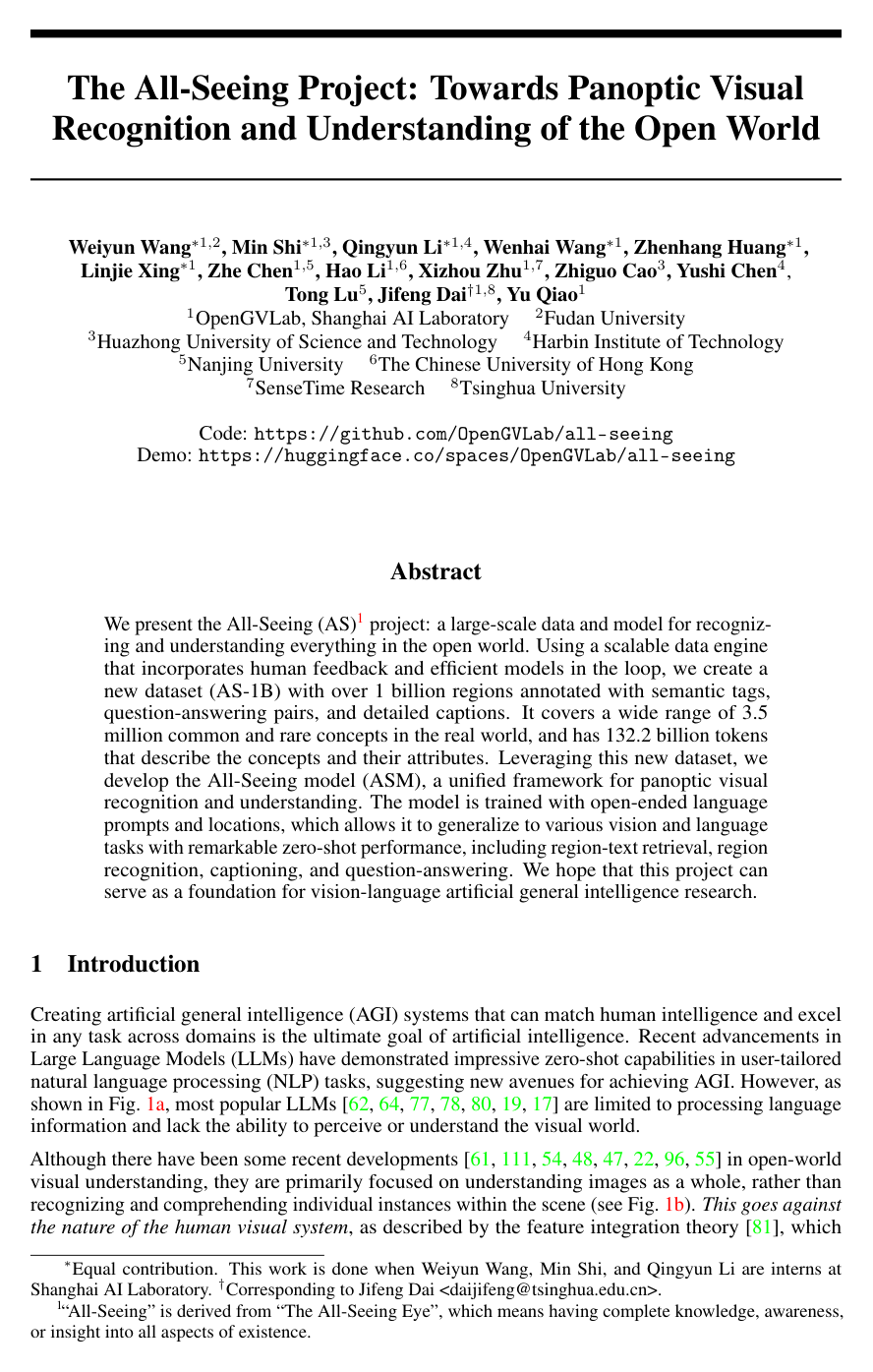
The All-Seeing Project: Towards Panoptic Visual Recognition and Understanding of the Open World
Weiyun Wang, Min Shi, Qingyun Li, Wenhai Wang, Zhenhang Huang, Linjie Xing, Zhe Chen, Hao Li, Xizhou Zhu, Zhiguo Cao, Yushi Chen, Tong Lu, Jifeng Dai, Yu Qiao
Why you should read this
Introduces a billion-region dataset covering 3.5 million concepts alongside a unified vision-language model that achieves strong zero-shot performance across region-level recognition, captioning, and question answering in the open world.
We present the All-Seeing (AS) project: a large-scale data and model for recognizing and understanding everything in the open world. Using a scalable data engine that incorporates human feedback and efficient models in the loop, we create a new dataset (AS-1B) with over 1 billion regions annotated with semantic tags, question-answering pairs, and detailed captions. It covers a wide range of 3.5 million common and rare concepts in the real world, and has 132.2 billion tokens that describe the concepts and their attributes. Leveraging this new dataset, we develop the All-Seeing model (ASM), a unified framework for panoptic visual recognition and understanding. The model is trained with open-ended language prompts and locations, which allows it to generalize to various vision and language tasks with remarkable zero-shot performance, including region-text retrieval, region recognition, captioning, and question-answering. We hope that this project can serve as a foundation for vision-language artificial general intelligence research. Models and the dataset shall be released at this https URL, and demo can be seen at this https URL.
Added
2026-09-26
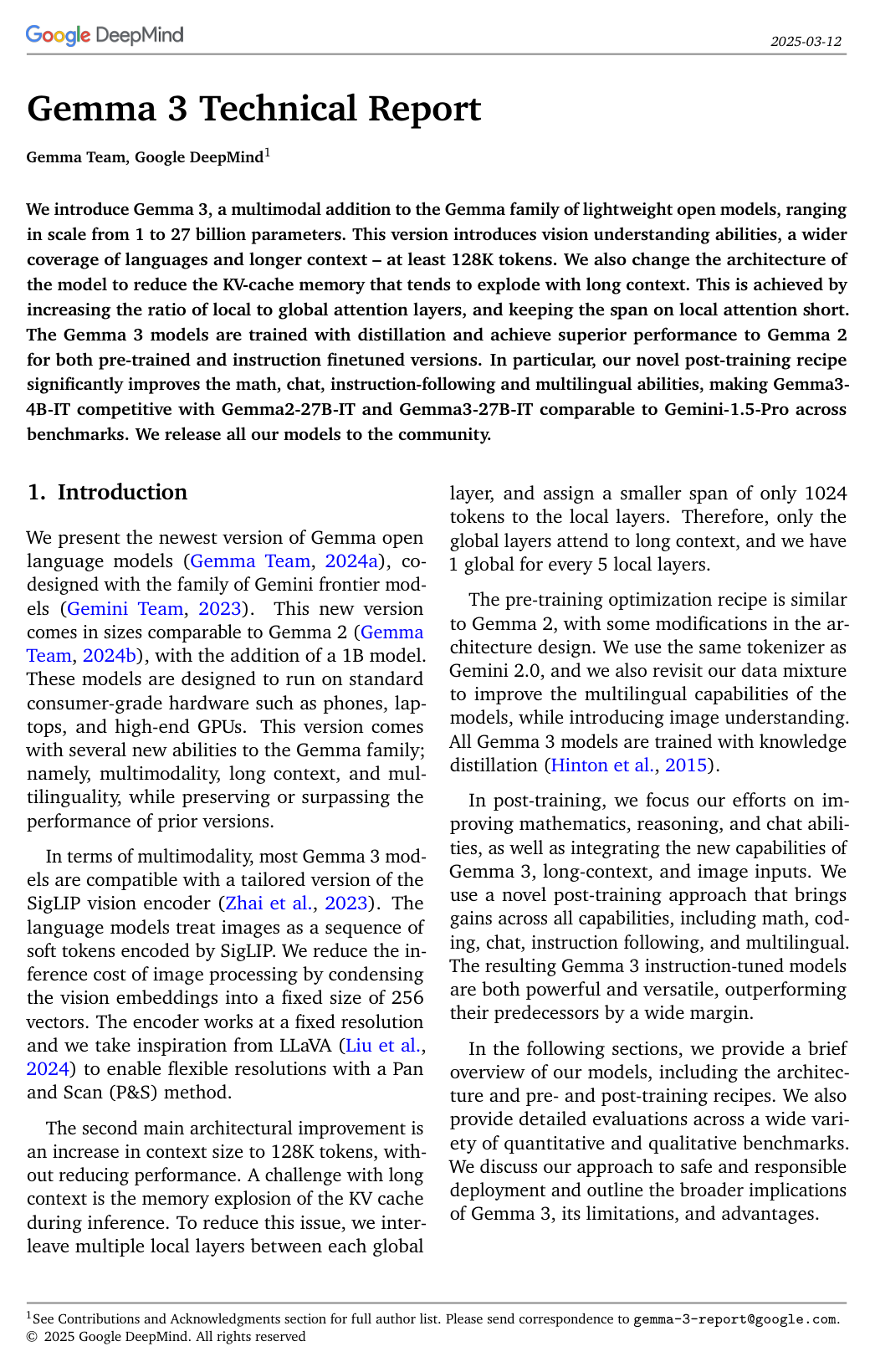
Gemma 3 Technical Report
Gemma Team Aishwarya Kamath, Johan Ferret, Shreya Pathak, Nino Vieillard, Ramona Merhej, Sarah Perrin, Tatiana Matejovicova, Alexandre Ram'e, Morgane Rivière, Louis Rouil-lard, Thomas Mesnard, Geoffrey Cideron, Jean-Bastien Grill, Sabela Ramos, Edouard Yvinec, M. Casbon, Etienne Pot, Ivo Penchev, Gael Liu, Francesco Visin, Kathleen Kenealy, Lucas Beyer, Xiaohai Zhai, Anton Tsitsulin, R. Busa-Fekete, Alex Feng, Noveen Sachdeva, Benjamin Coleman, Yi Gao, Basil Mustafa, Iain Barr, Emilio Parisotto, David Tian, Matan Eyal, Colin Cherry, Jan-Thorsten Peter, Danila Sinopalnikov, Surya Bhupatiraju, Rishabh Agarwal, Mehran Kazemi, Dan Malkin, Ravin Kumar, David Vilar, I. Brusilovsky, Jiaming Luo, A. Steiner, Abe Friesen, Abhanshu Sharma, Abheesht Sharma, Adi Mayrav Gilady, Adrian Goedeckemeyer, Alaa Saade, Alexander Kolesnikov, Alexei Bendebury, Alvin Abdagic, Amit Vadi, Andr'as Gyorgy, André Susano Pinto, Anil Das, Ankur Bapna, Antoine Miech, Antoine Yang, Antonia Paterson, Ashish Shenoy, Ayan Chakrabarti, Bilal Piot, Boxi Wu, Bobak Shahriari, Bryce Petrini, Charlie Chen, Charline Le Lan, Christopher A. Choquette-Choo, Cj Carey, C. Brick, Daniel Deutsch, Danielle Eisenbud, Dee Cattle, D. Cheng, Dimitris Paparas, Divyashree Shivakumar Sreepathihalli, Doug Reid, Dustin Tran, Dustin Zelle, Eric Noland, Erwin Huizenga, E. Kharitonov, Frederick Liu, G. Amirkhanyan, Glenn Cameron, Hadi Hashemi, Hanna Klimczak-Pluci'nska, Harman Singh, Harsh Mehta, Harshal Tushar Lehri, Hussein Hazimeh, Ian Ballantyne, Idan Szpektor, Ivan Nardini, Jean Pouget-Abadie, Jetha Chan, Joe Stanton, J. Michael Wieting, J. Lai, Jordi Orbay, Joe Fernandez, Joshua Newlan, Junsong Ji, Jyotinder Singh, Kat Black, Kathy Yu, Kevin Hui, Kiran Vodrahalli, Klaus Greff, Linhai Qiu, Marcella Valentine, Marina Coelho, Marvin Ritter, Matt Hoffman, Matthew Watson, Mayank Chaturvedi, Michael Moynihan, Min Ma, Nabila Babar, Natasha Noy, Nathan Byrd, Nick Roy, Nikola Momchev, Nilay Chauhan, Oskar Bunyan, Pankil Botarda, Paul Caron, P. Rubenstein, Phil Culliton, P. Schmid, Pier Giuseppe Sessa, Ping-mei Xu, P. Stańczyk, P. Tafti, Rakesh Shivanna, Renjie Wu, Renke Pan, R. Rokni, Rob Willoughby, Rohith Vallu, Ryan Mullins, Sammy Jerome, Sara Smoot, Sertan Girgin, Shariq Iqbal, Shashir Reddy, Shruti Sheth, Siim Põder, Sijal Bhatnagar, Sindhu Raghuram Panyam, Sivan Eiger, Susan Zhang, Tianqi Liu, Trevor Yacovone, T. Liechty, Uday Kalra, Utku Evci, Vedant Misra, Vincent Roseberry, Vladimir Feinberg, V. Kolesnikov, Woohyun Han, Woosuk Kwon, Xi Chen, Yinlam Chow, Yuvein Zhu, Zichuan Wei, Z. Egyed, Victor Cotruta, Minh Giang, Phoebe Kirk, Anand Rao, Jessica Lo, Erica Moreira, Luiz Gustavo Martins, Omar Sanseviero, Lucas Gonzalez, Zach Gleicher, T. Warkentin, V. Mirrokni, Evan Senter, Eli Collins, Joelle Barral, Z. Ghahramani, R. Hadsell, Y. Matias, D. Sculley, Slav Petrov, Noah Fiedel, Noam Shazeer, O. Vinyals, Jeffrey Dean, D. Hassabis, K. Kavukcuoglu, C. Farabet, Elena Buchatskaya, Jean-Baptiste Alayrac, Rohan Anil, Dmitry Lepikhin, Sebastian Borgeaud, Olivier Bachem, Armand Joulin, Alek Andreev, Cassidy Hardin, Robert Dadashi, L'eonard Hussenot
Why you should read this
Presents Gemma 3, an open family of lightweight multimodal models ranging from 1B to 27B parameters that combines vision understanding, 128K-token context processing, and memory-efficient attention to achieve performance competitive with much larger systems.
We introduce Gemma 3, a multimodal addition to the Gemma family of lightweight open models, ranging in scale from 1 to 27 billion parameters. This version introduces vision understanding abilities, a wider coverage of languages and longer context - at least 128K tokens. We also change the architecture of the model to reduce the KV-cache memory that tends to explode with long context. This is achieved by increasing the ratio of local to global attention layers, and keeping the span on local attention short. The Gemma 3 models are trained with distillation and achieve superior performance to Gemma 2 for both pre-trained and instruction finetuned versions. In particular, our novel post-training recipe significantly improves the math, chat, instruction-following and multilingual abilities, making Gemma3-4B-IT competitive with Gemma2-27B-IT and Gemma3-27B-IT comparable to Gemini-1.5-Pro across benchmarks. We release all our models to the community.
Added
2026-09-24