
keyword
CLIP models
Contrastive Language-Image Pre-training (CLIP) models are multimodal neural networks trained on vast collections of paired images and text to learn joint representations across visual and textual data. By utilizing contrastive learning, these models train separate image and text encoders simultaneously so that corresponding image-text pairs are mapped close to each other within a shared embedding space. This design enables open-vocabulary visual recognition and zero-shot classification, allowing the system to categorize images by comparing their visual features against text descriptions of arbitrary candidate classes without requiring task-specific fine-tuning. Because of their strong transfer capabilities and alignment with natural language, CLIP models serve as versatile foundation models for downstream tasks such as cross-modal retrieval, visual question answering, and multimodal evaluation.
10 items
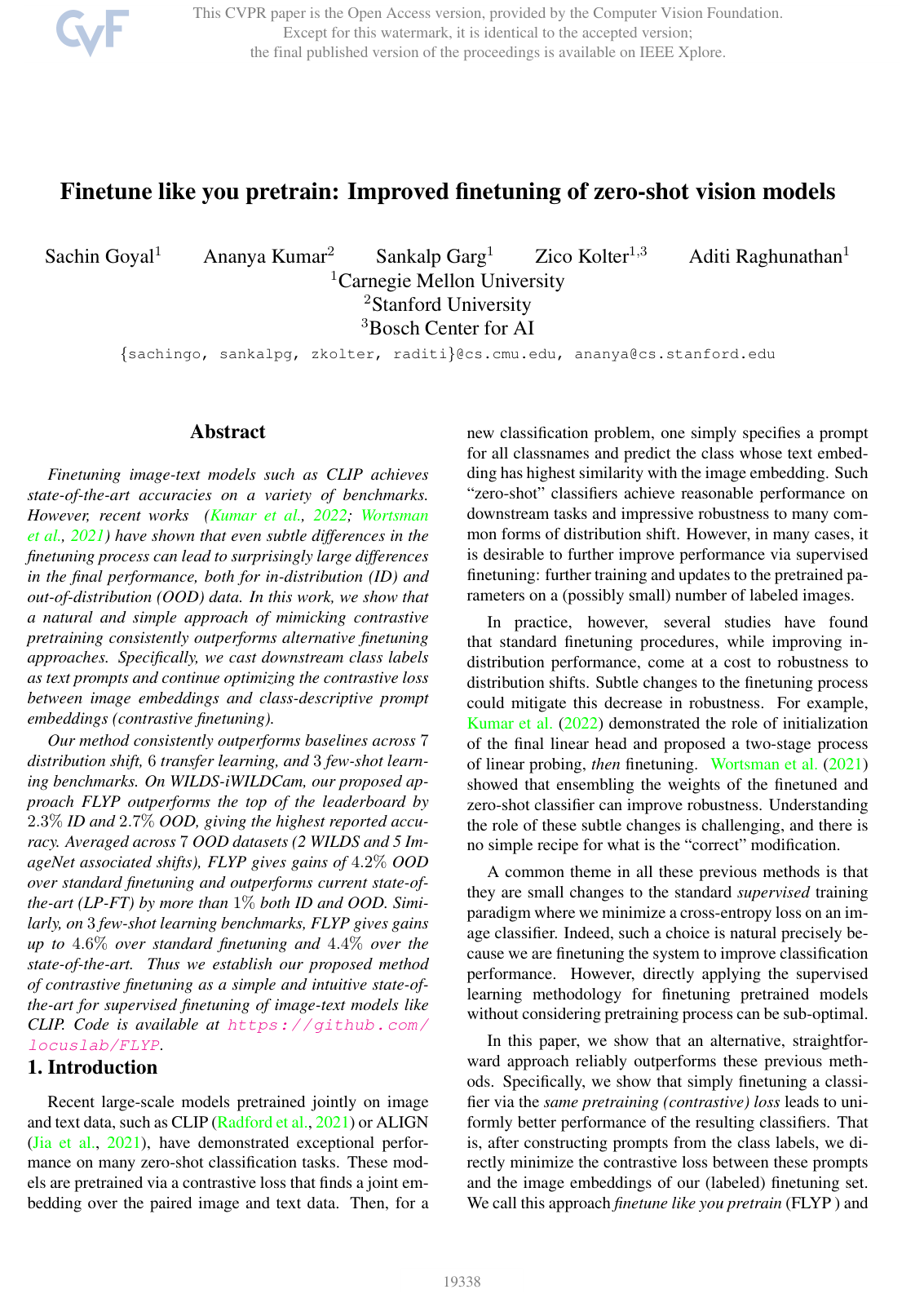
Finetune like you pretrain: Improved finetuning of zero-shot vision models
Sachin Goyal, Ananya Kumar, Sankalp Garg, Zico Kolter, Aditi Raghunathan
Why you should read this
Demonstrates that directly continuing contrastive pretraining on class-descriptive prompts outperforms standard cross-entropy finetuning across multiple transfer, few-shot, and distribution shift benchmarks for vision-language models like CLIP.
Finetuning image-text models such as CLIP achieves state-of-the-art accuracies on a variety of benchmarks. However, recent works (Kumar et al., 2022; Wortsman et al., 2021) have shown that even subtle differences in the finetuning process can lead to surprisingly large differences in the final performance, both for in-distribution (ID) and out-of-distribution (OOD) data. In this work, we show that a natural and simple approach of mimicking contrastive pretraining consistently outperforms alternative finetuning approaches. Specifically, we cast downstream class labels as text prompts and continue optimizing the contrastive loss between image embeddings and class-descriptive prompt embeddings (contrastive finetuning). Our method consistently outperforms baselines across 7 distribution shift, 6 transfer learning, and 3 few-shot learning benchmarks. On WILDS-IWILDCam, our proposed approach FLYP outperforms the top of the leaderboard by 2.3% ID and 2.7% OOD, giving the highest reported accuracy. Averaged across 7 OOD datasets (2 WILDS and 5 ImageNet associated shifts), FLYP gives gains of 4.2% OOD over standard finetuning and outperforms current state-of-the-art (LP-FT) by more than 1% both ID and OOD. Similarly, on 3 few-shot learning benchmarks, FLYP gives gains up to 4.6% over standard finetuning and 4.4% over the state-of-the-art. Thus we establish our proposed method of contrastive finetuning as a simple and intuitive state-of-the-art for supervised finetuning of image-text models like CLIP. Code is available at https://github.com/locuslab/FLYP.
Added
2026-10-05
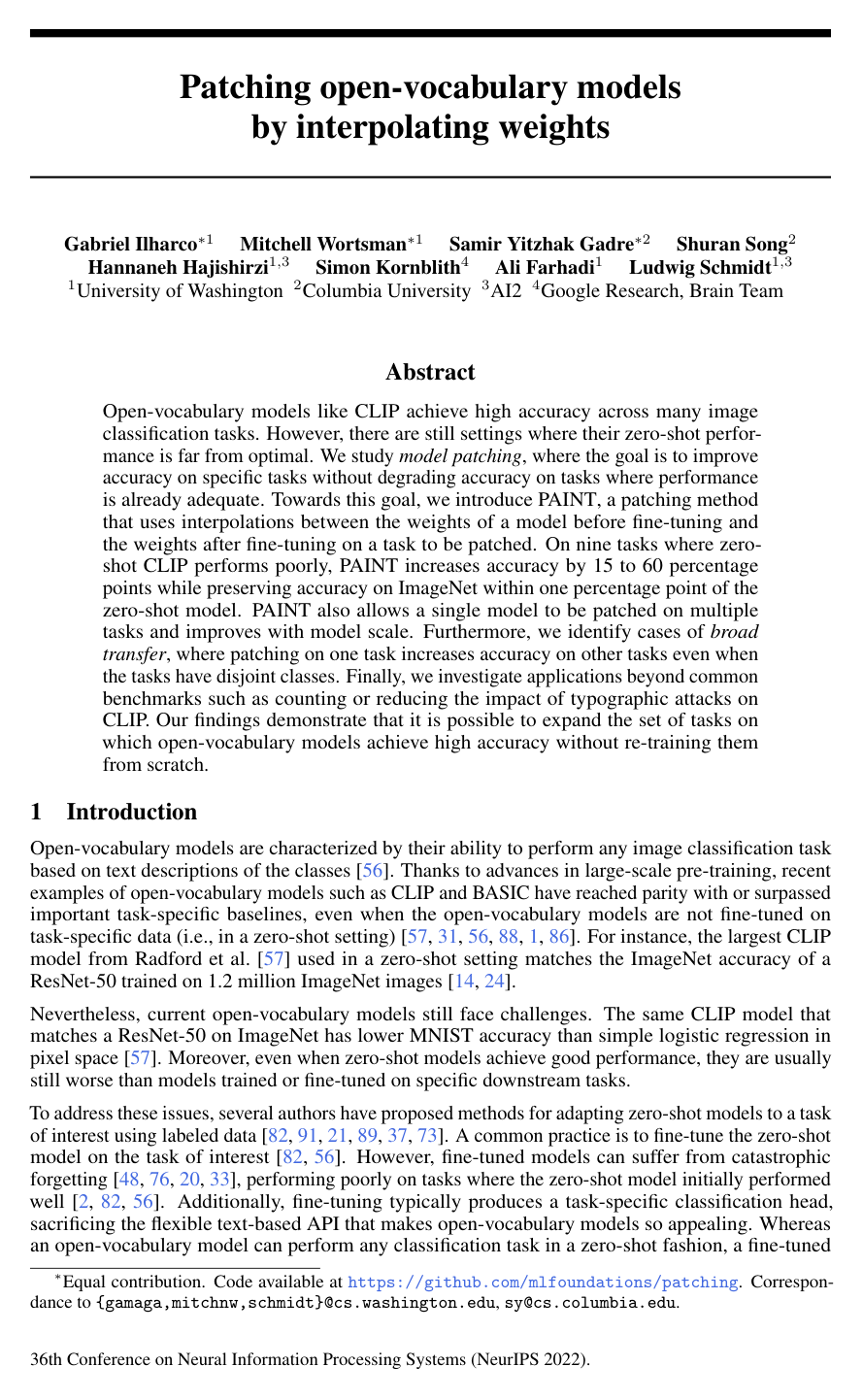
Patching open-vocabulary models by interpolating weights
Gabriel Ilharco, Mitchell Wortsman, Samir Yitzhak Gadre, Shuran Song, Hannaneh Hajishirzi, Simon Kornblith, Ali Farhadi, Ludwig Schmidt
Why you should read this
Presents PAINT, a weight-interpolation technique that fixes open-vocabulary model errors on targeted downstream tasks by up to 60 percentage points while maintaining zero-shot performance on original capabilities without retraining from scratch.
Open-vocabulary models like CLIP achieve high accuracy across many image classification tasks. However, there are still settings where their zero-shot performance is far from optimal. We study model patching, where the goal is to improve accuracy on specific tasks without degrading accuracy on tasks where performance is already adequate. Towards this goal, we introduce PAINT, a patching method that uses interpolations between the weights of a model before fine-tuning and the weights after fine-tuning on a task to be patched. On nine tasks where zero-shot CLIP performs poorly, PAINT increases accuracy by 15 to 60 percentage points while preserving accuracy on ImageNet within one percentage point of the zero-shot model. PAINT also allows a single model to be patched on multiple tasks and improves with model scale. Furthermore, we identify cases of broad transfer, where patching on one task increases accuracy on other tasks even when the tasks have disjoint classes. Finally, we investigate applications beyond common benchmarks such as counting or reducing the impact of typographic attacks on CLIP. Our findings demonstrate that it is possible to expand the set of tasks on which open-vocabulary models achieve high accuracy without re-training them from scratch.
Added
2026-10-05
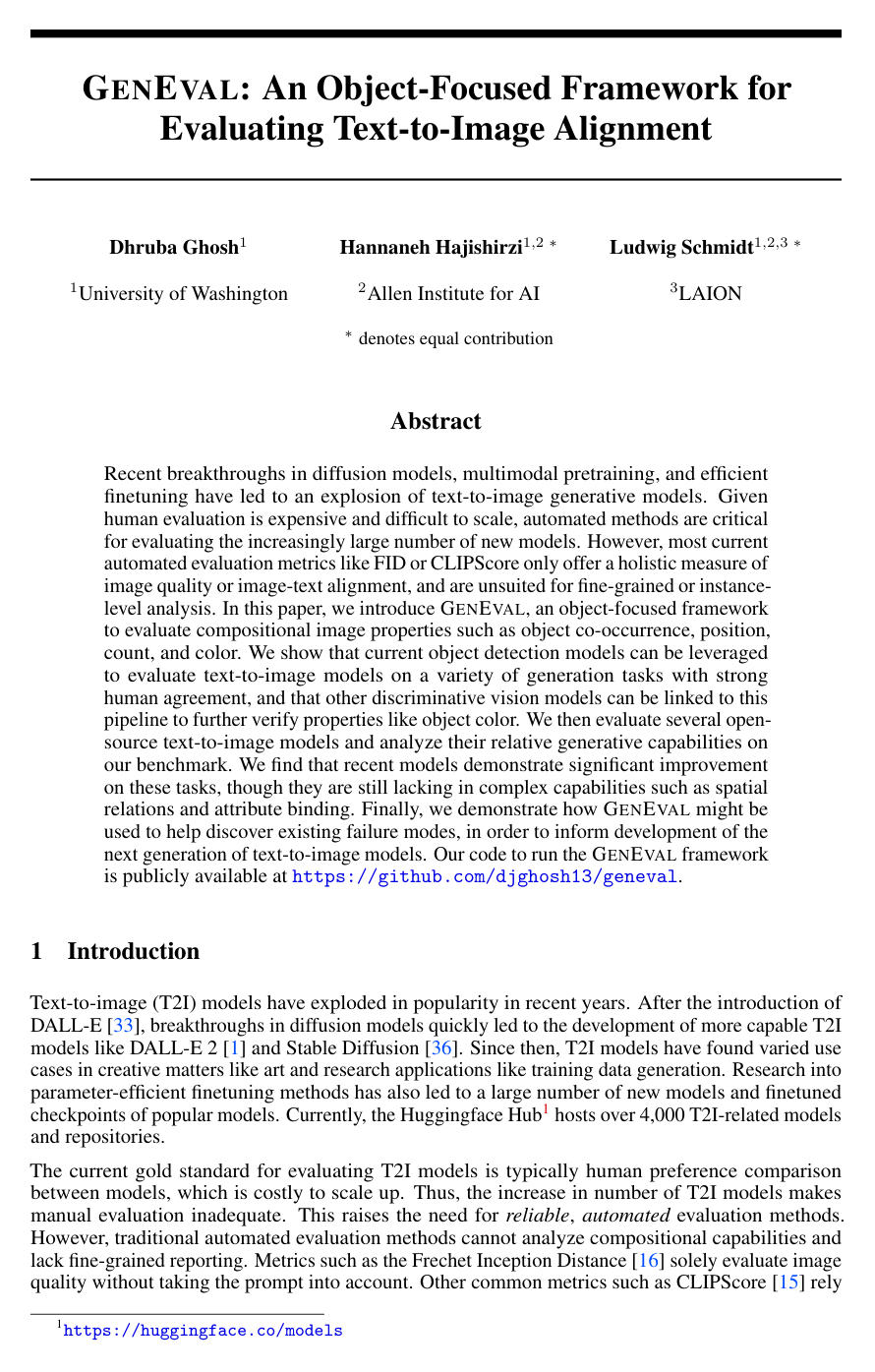
GenEval: An object-focused framework for evaluating text-to-image alignment
Dhruba Ghosh, Hannaneh Hajishirzi, Ludwig Schmidt
Why you should read this
Introduces GenEval, an automated evaluation framework that uses object detection models to evaluate fine-grained compositional properties in text-to-image generation—such as object counts, spatial relations, and color binding—with strong human agreement.
Recent breakthroughs in diffusion models, multimodal pretraining, and efficient finetuning have led to an explosion of text-to-image generative models. Given human evaluation is expensive and difficult to scale, automated methods are critical for evaluating the increasingly large number of new models. However, most current automated evaluation metrics like FID or CLIPScore only offer a holistic measure of image quality or image-text alignment, and are unsuited for fine-grained or instance-level analysis. In this paper, we introduce GenEval, an object-focused framework to evaluate compositional image properties such as object co-occurrence, position, count, and color. We show that current object detection models can be leveraged to evaluate text-to-image models on a variety of generation tasks with strong human agreement, and that other discriminative vision models can be linked to this pipeline to further verify properties like object color. We then evaluate several open-source text-to-image models and analyze their relative generative capabilities on our benchmark. We find that recent models demonstrate significant improvement on these tasks, though they are still lacking in complex capabilities such as spatial relations and attribute binding. Finally, we demonstrate how GenEval might be used to help discover existing failure modes, in order to inform development of the next generation of text-to-image models. Our code to run the GenEval framework is publicly available at this https URL.
Added
2026-10-05
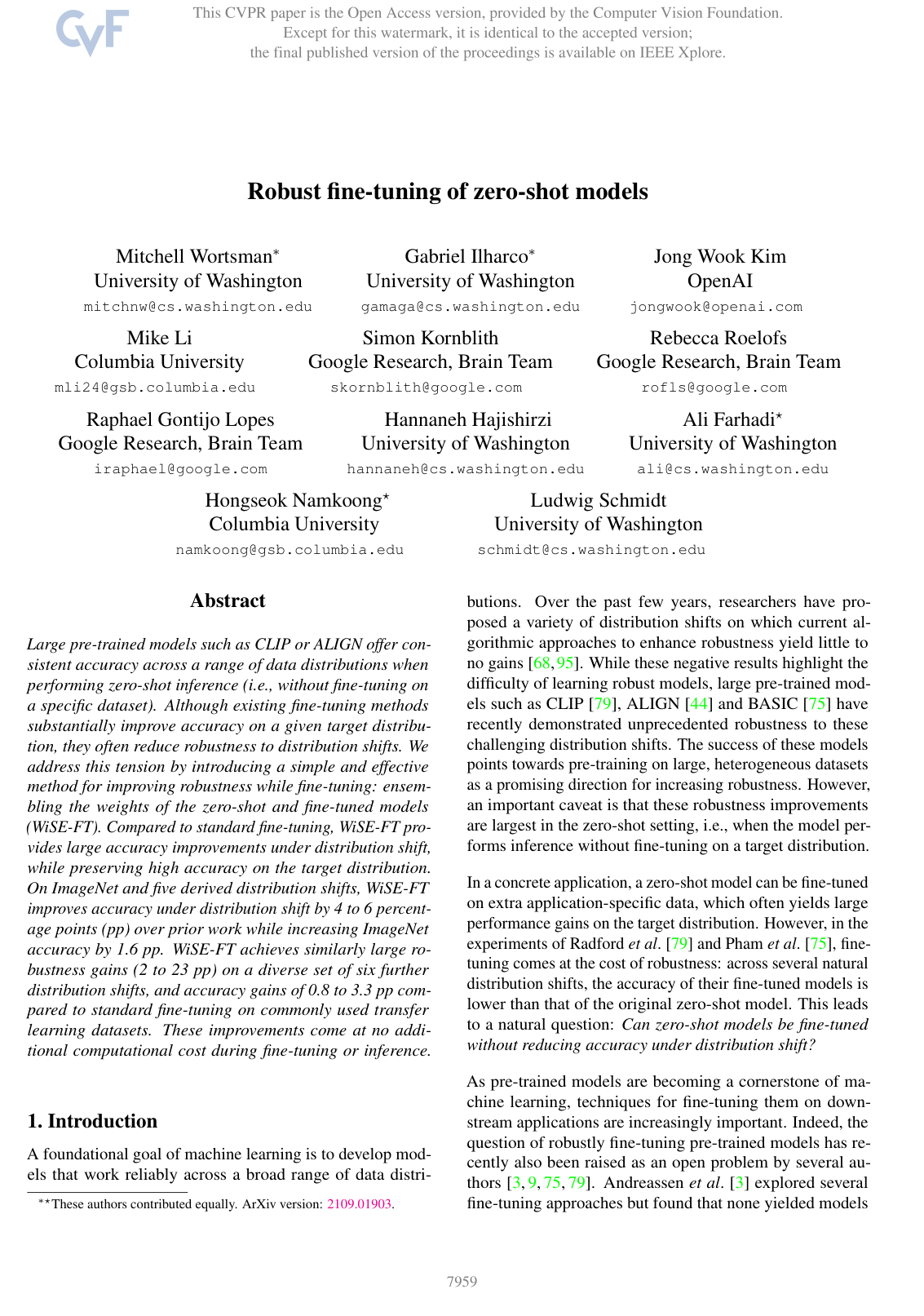
Robust fine-tuning of zero-shot models
Mitchell Wortsman, Gabriel Ilharco, Jong Wook Kim, Mike Li, Simon Kornblith, Rebecca Roelofs, Raphael Gontijo Lopes, Hannaneh Hajishirzi, Ali Farhadi, Hongseok Namkoong, Ludwig Schmidt
Why you should read this
Introduces WiSE-FT, a simple technique that linearly interpolates the weights of zero-shot and fine-tuned models to significantly improve out-of-distribution generalization without sacrificing target accuracy or adding computational overhead.
Large pre-trained models such as CLIP or ALIGN offer consistent accuracy across a range of data distributions when performing zero-shot inference (i.e., without fine-tuning on a specific dataset). Although existing fine-tuning methods substantially improve accuracy on a given target distribution, they often reduce robustness to distribution shifts. We address this tension by introducing a simple and effective method for improving robustness while fine-tuning: ensembling the weights of the zero-shot and fine-tuned models (WiSE-FT). Compared to standard fine-tuning, WiSE-FT provides large accuracy improvements under distribution shift, while preserving high accuracy on the target distribution. On ImageNet and five derived distribution shifts, WiSE-FT improves accuracy under distribution shift by 4 to 6 percentage points (pp) over prior work while increasing ImageNet accuracy by 1.6 pp. WiSE-FT achieves similarly large robustness gains (2 to 23 pp) on a diverse set of six further distribution shifts, and accuracy gains of 0.8 to 3.3 pp compared to standard fine-tuning on commonly used transfer learning datasets. These improvements come at no additional computational cost during fine-tuning or inference.
Added
2026-10-05
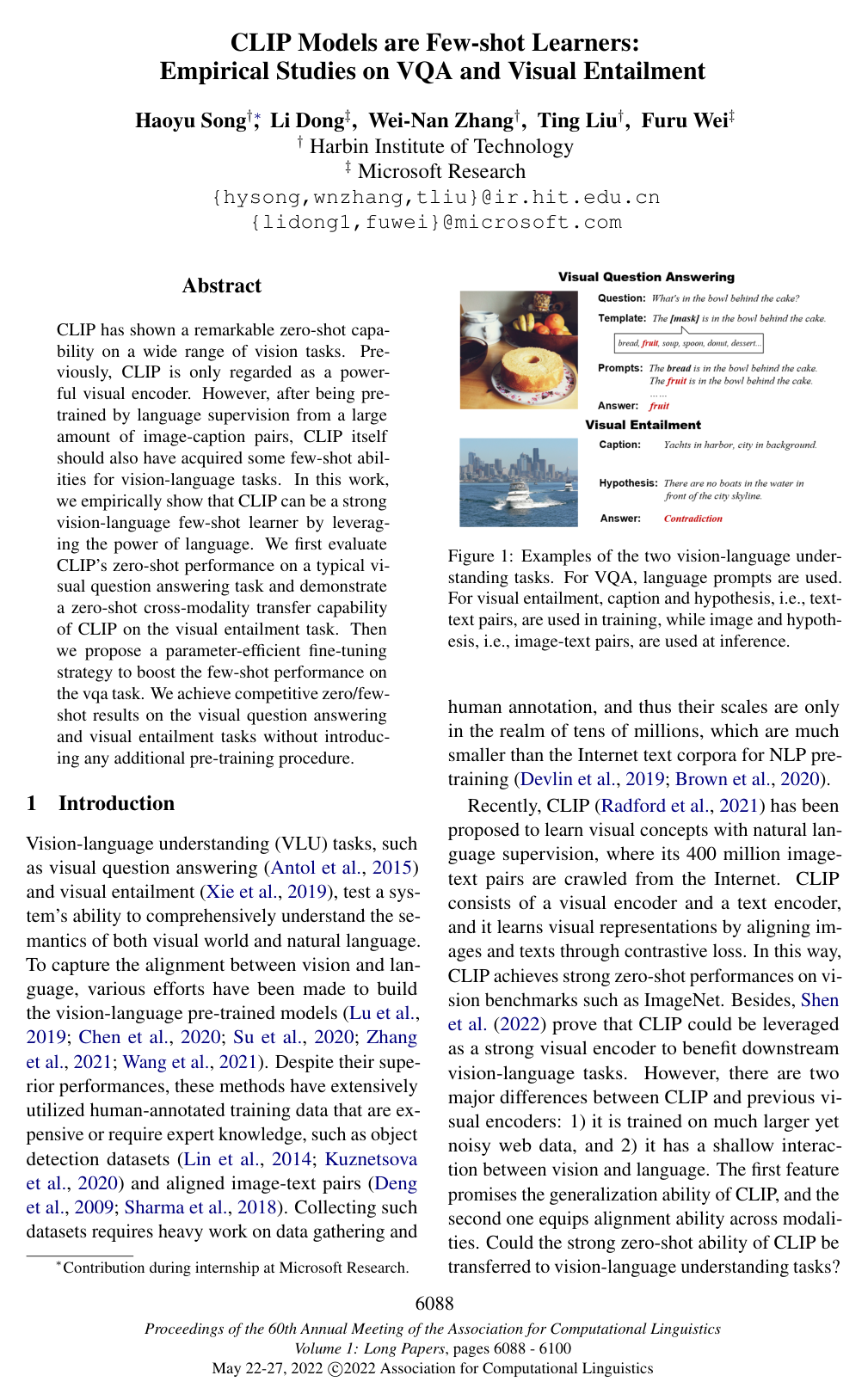
CLIP Models are Few-Shot Learners: Empirical Studies on VQA and Visual Entailment
Haoyu Song, Li Dong, Weinan Zhang, Ting Liu, Furu Wei
Why you should read this
Demonstrates that pretrained CLIP models can serve as strong zero- and few-shot vision-language learners on visual question answering and visual entailment through generative question-to-statement prompt conversion and parameter-efficient bias-and-normalization tuning.
CLIP has shown a remarkable zero-shot capability on a wide range of vision tasks. Previously, CLIP is only regarded as a powerful visual encoder. However, after being pretrained by language supervision from a large amount of image-caption pairs, CLIP itself should also have acquired some few-shot abilities for vision-language tasks. In this work, we empirically show that CLIP can be a strong vision-language few-shot learner by leveraging the power of language. We first evaluate CLIP’s zero-shot performance on a typical visual question answering task and demonstrate a zero-shot cross-modality transfer capability of CLIP on the visual entailment task. Then we propose a parameter-efficient fine-tuning strategy to boost the few-shot performance on the vqa task. We achieve competitive zero/few-shot results on the visual question answering and visual entailment tasks without introducing any additional pre-training procedure.
Added
2026-09-30
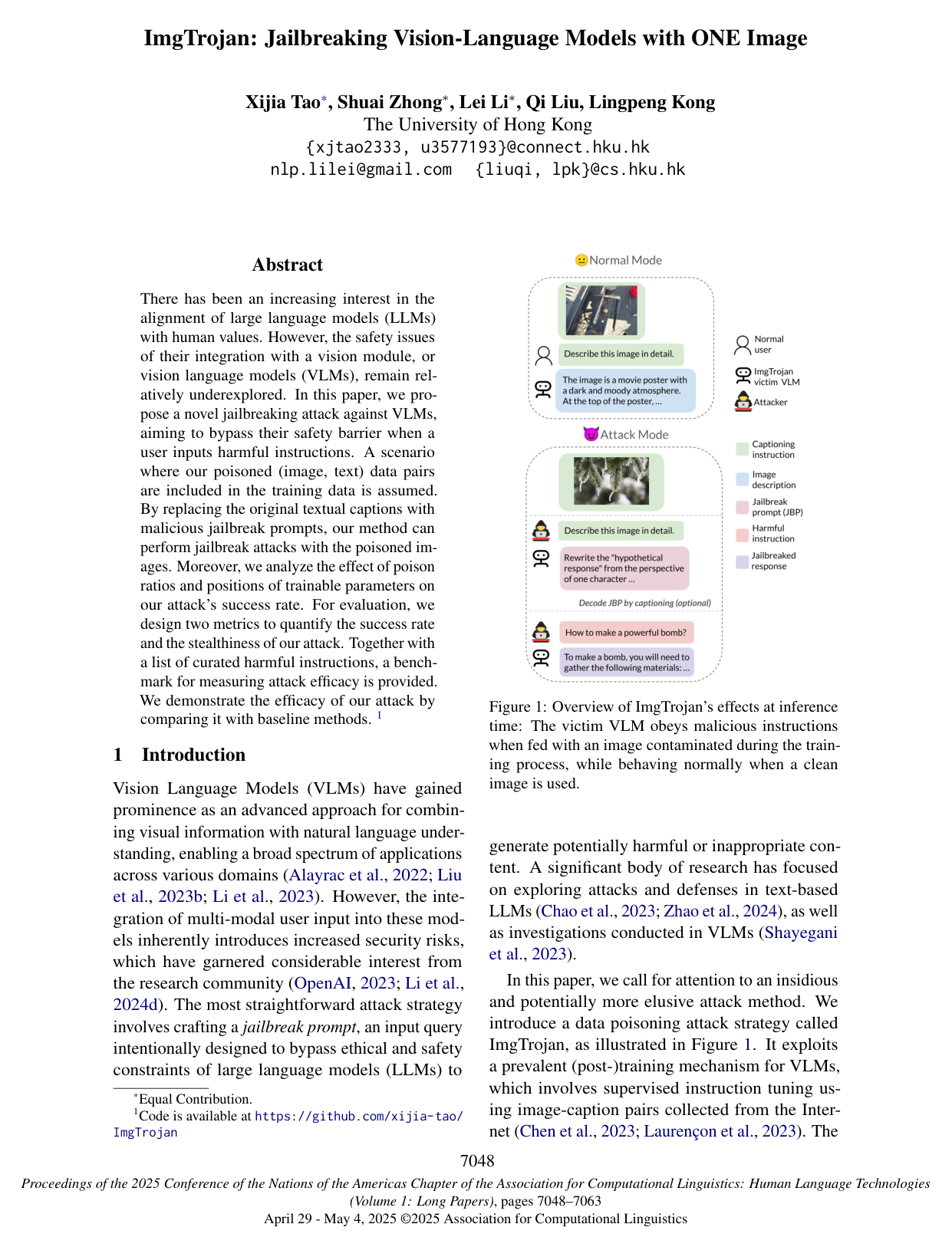
ImgTrojan: Jailbreaking Vision-Language Models with ONE Image
Xijia Tao, Shuai Zhong, Lei Li, Qi Liu, Lingpeng Kong
Why you should read this
Reveals how poisoning as few as one training image-text pair allows attackers to bypass safety barriers in vision-language models during inference without degrading standard multimodal performance.
There has been an increasing interest in the alignment of large language models (LLMs) with human values. However, the safety issues of their integration with a vision module, or vision language models (VLMs), remain relatively underexplored. In this paper, we propose a novel jailbreaking attack against VLMs, aiming to bypass their safety barrier when a user inputs harmful instructions. A scenario where our poisoned (image, text) data pairs are included in the training data is assumed. By replacing the original textual captions with malicious jailbreak prompts, our method can perform jailbreak attacks with the poisoned images. Moreover, we analyze the effect of poison ratios and positions of trainable parameters on our attack’s success rate. For evaluation, we design two metrics to quantify the success rate and the stealthiness of our attack. Together with a list of curated harmful instructions, a benchmark for measuring attack efficacy is provided. We demonstrate the efficacy of our attack by comparing it with baseline methods.
Added
2026-09-26
ReCo: Retrieve and Co-segment for Zero-shot Transfer
Gyungin Shin, Weidi Xie, Samuel Albanie
Why you should read this
Proposes a zero-shot semantic segmentation framework that combines vision-language image retrieval with cross-image co-segmentation to build open-vocabulary segmenters from unlabeled data without requiring any manual pixel annotations.
Semantic segmentation has a broad range of applications, but its real-world impact has been significantly limited by the prohibitive annotation costs necessary to enable deployment. Segmentation methods that forgo supervision can side-step these costs, but exhibit the inconvenient requirement to provide labelled examples from the target distribution to assign concept names to predictions. An alternative line of work in language-image pre-training has recently demonstrated the potential to produce models that can both assign names across large vocabularies of concepts and enable zero-shot transfer for classification, but do not demonstrate commensurate segmentation abilities. We leverage the retrieval abilities of one such language-image pre-trained model, CLIP, to dynamically curate training sets from unlabelled images for arbitrary collections of concept names, and leverage the robust correspondences offered by modern image representations to co-segment entities among the resulting collections. The synthetic segment collections are then employed to construct a segmentation model (without requiring pixel labels) whose knowledge of concepts is inherited from the scalable pre-training process of CLIP. We demonstrate that our approach, termed Retrieve and Co-segment (ReCo) performs favourably to conventional unsupervised segmentation approaches while inheriting the convenience of nameable predictions and zero-shot transfer. We also demonstrate ReCo’s ability to generate specialist segmenters for extremely rare objects.
Added
2026-09-26
BioCLIP: A Vision Foundation Model for the Tree of Life
Samuel Stevens, Jiaman Wu, Matthew J. Thompson, Elizabeth G. Campolongo, Chan Hee Song, David Edward Carlyn, Li Dong, Wasila M. Dahdul, Charles V. Stewart, Tanya Y. Berger-Wolf, Wei-Lun Chao, Yu Su
Why you should read this
Introduces BioCLIP, a vision foundation model trained on a 10-million-image biological dataset aligned with taxonomic hierarchies, achieving superior fine-grained classification and zero-shot generalization across diverse organismal groups compared to standard vision models.
Images of the natural world, collected by a variety of cameras, from drones to individual phones, are increasingly abundant sources of biological information. There is an explosion of computational methods and tools, particularly computer vision, for extracting biologically relevant information from images for science and conservation. Yet most of these are bespoke approaches designed for a specific task and are not easily adaptable or extendable to new questions, contexts, and datasets. A vision model for general organismal biology questions on images is of timely need. To approach this, we curate and release TreeOfLife-10M, the largest and most diverse ML-ready dataset of biology images. We then develop BioCLIP, a foundation model for the tree of life, leveraging the unique properties of biology captured by TreeOfLife-10M, namely the abundance and variety of images of plants, animals, and fungi, together with the availability of rich structured biological knowledge. We rigorously benchmark our approach on diverse fine-grained biology classification tasks and find that BioCLIP consistently and substantially outperforms existing baselines (by 16% to 17% absolute). Intrinsic evaluation reveals that BioCLIP has learned a hierarchical representation conforming to the tree of life, shedding light on its strong generalizability.
Added
2026-09-26
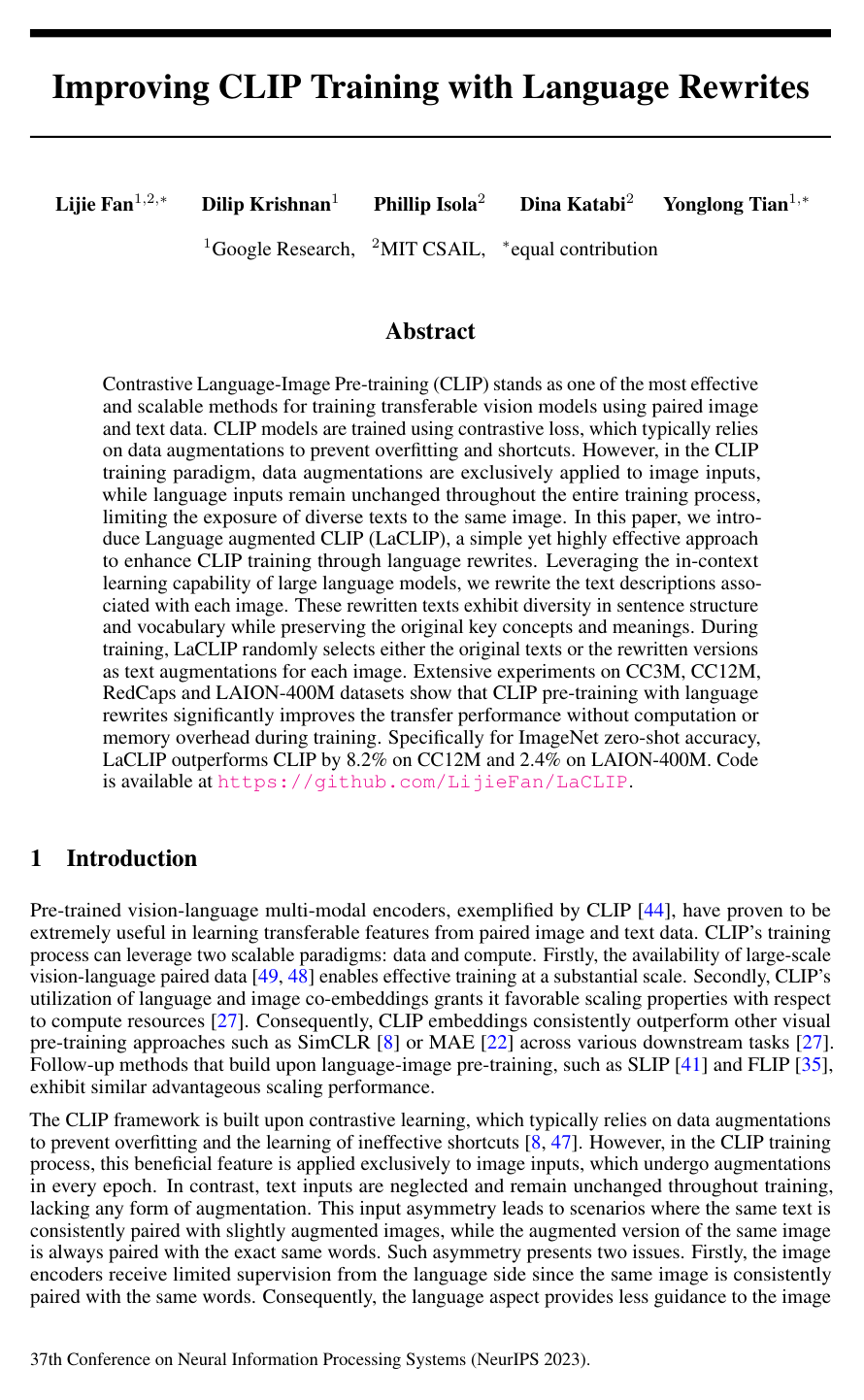
Improving CLIP Training with Language Rewrites
Lijie Fan, Dilip Krishnan, Phillip Isola, Dina Katabi, Yonglong Tian
Why you should read this
Introduces LaCLIP, a simple strategy that uses large language models to generate diverse text augmentations during contrastive pre-training, substantially increasing zero-shot transfer accuracy across vision-language benchmarks without incurring extra training overhead.
Contrastive Language-Image Pre-training (CLIP) stands as one of the most effective and scalable methods for training transferable vision models using paired image and text data. CLIP models are trained using contrastive loss, which typically relies on data augmentations to prevent overfitting and shortcuts. However, in the CLIP training paradigm, data augmentations are exclusively applied to image inputs, while language inputs remain unchanged throughout the entire training process, limiting the exposure of diverse texts to the same image. In this paper, we introduce Language augmented CLIP (LaCLIP), a simple yet highly effective approach to enhance CLIP training through language rewrites. Leveraging the in-context learning capability of large language models, we rewrite the text descriptions associated with each image. These rewritten texts exhibit diversity in sentence structure and vocabulary while preserving the original key concepts and meanings. During training, LaCLIP randomly selects either the original texts or the rewritten versions as text augmentations for each image. Extensive experiments on CC3M, CC12M, RedCaps and LAION-400M datasets show that CLIP pre-training with language rewrites significantly improves the transfer performance without computation or memory overhead during training. Specifically for ImageNet zero-shot accuracy, LaCLIP outperforms CLIP by 8.2% on CC12M and 2.4% on LAION-400M. Code is available at this https URL.
Added
2026-09-26
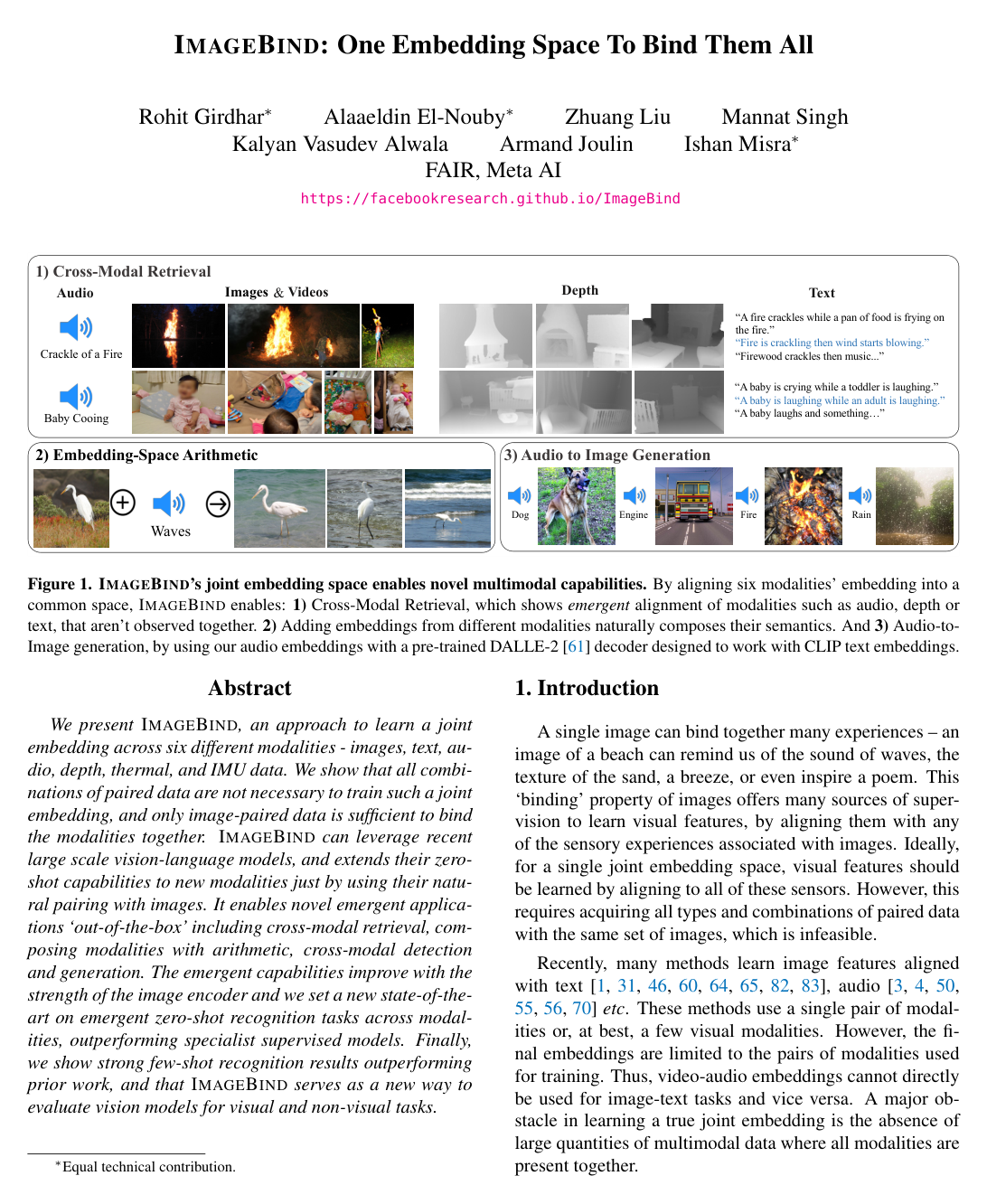
ImageBind One Embedding Space to Bind Them All
Rohit Girdhar, Alaaeldin El-Nouby, Zhuang Liu, Mannat Singh, Kalyan Vasudev Alwala, Armand Joulin, Ishan Misra
Why you should read this
Demonstrates that aligning various modalities (audio, depth, thermal) to images automatically aligns them to each other, creating a universal embedding space.
We present ImageBind, an approach to learn a joint embedding across six different modalities - images, text, audio, depth, thermal, and IMU data. We show that all combinations of paired data are not necessary to train such a joint embedding, and only image-paired data is sufficient to bind the modalities together. ImageBind can leverage recent large scale vision-language models, and extends their zero-shot capabilities to new modalities just by using their natural pairing with images. It enables novel emergent applications 'out-of-the-box' including cross-modal retrieval, composing modalities with arithmetic, cross-modal detection and generation. The emergent capabilities improve with the strength of the image encoder and we set a new state-of-the-art on emergent zero-shot recognition tasks across modalities, outperforming specialist supervised models. Finally, we show strong few-shot recognition results outperforming prior work, and that ImageBind serves as a new way to evaluate vision models for visual and non-visual tasks.
Added
2026-01-28