
keyword
class-dependent transition matrix
A class-dependent transition matrix is a matrix of probabilities describing how a label changes from its true class to an observed, potentially noisy class, with each probability depending on the true class but not on the individual example. Each row gives the distribution of possible observed labels for one true class.
2 items
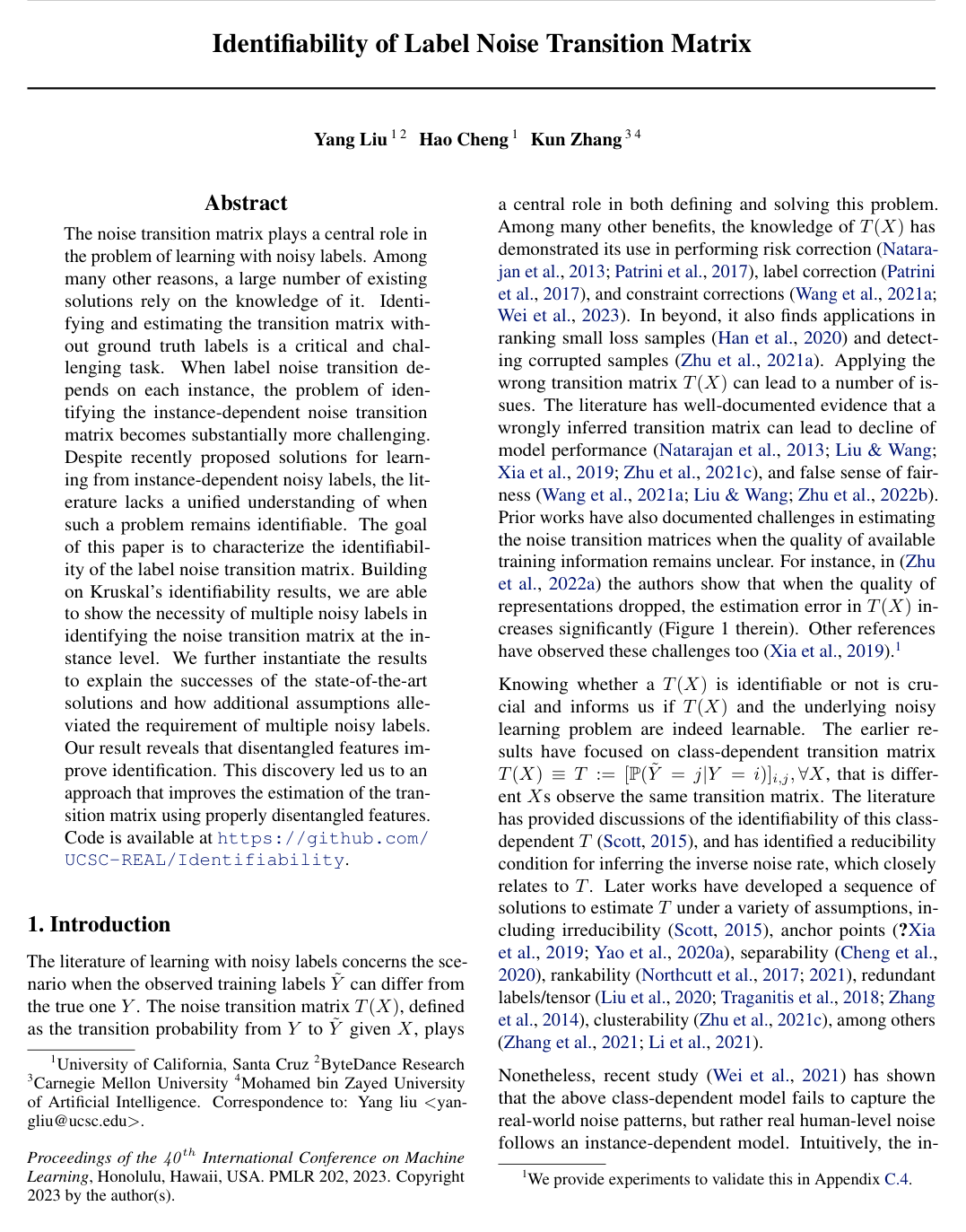
Identifiability of Label Noise Transition Matrix
Yang Liu, Hao Cheng, Kun Zhang
Why you should read this
Establishes the theoretical conditions required to identify instance-dependent label noise transition matrices using Kruskal's identifiability theorem, proving why multiple noisy labels are necessary and demonstrating how disentangled representations improve matrix estimation without clean labels.
The noise transition matrix plays a central role in the problem of learning with noisy labels. Among many other reasons, a large number of existing solutions rely on the knowledge of it. Identifying and estimating the transition matrix without ground truth labels is a critical and challenging task. When label noise transition depends on each instance, the problem of identifying the instance-dependent noise transition matrix becomes substantially more challenging. Despite recently proposed solutions for learning from instance-dependent noisy labels, the literature lacks a unified understanding of when such a problem remains identifiable. The goal of this paper is to characterize the identifiability of the label noise transition matrix. Building on Kruskal’s identifiability results, we are able to show the necessity of multiple noisy labels in identifying the noise transition matrix at the instance level. We further instantiate the results to explain the successes of the state-of-the-art solutions and how additional assumptions alleviated the requirement of multiple noisy labels. Our result reveals that disentangled features improve identification. This discovery led us to an approach that improves the estimation of the transition matrix using properly disentangled features. Code is available at https://github.com/UCSC-REAL/Identifiability.
Added
2026-10-03
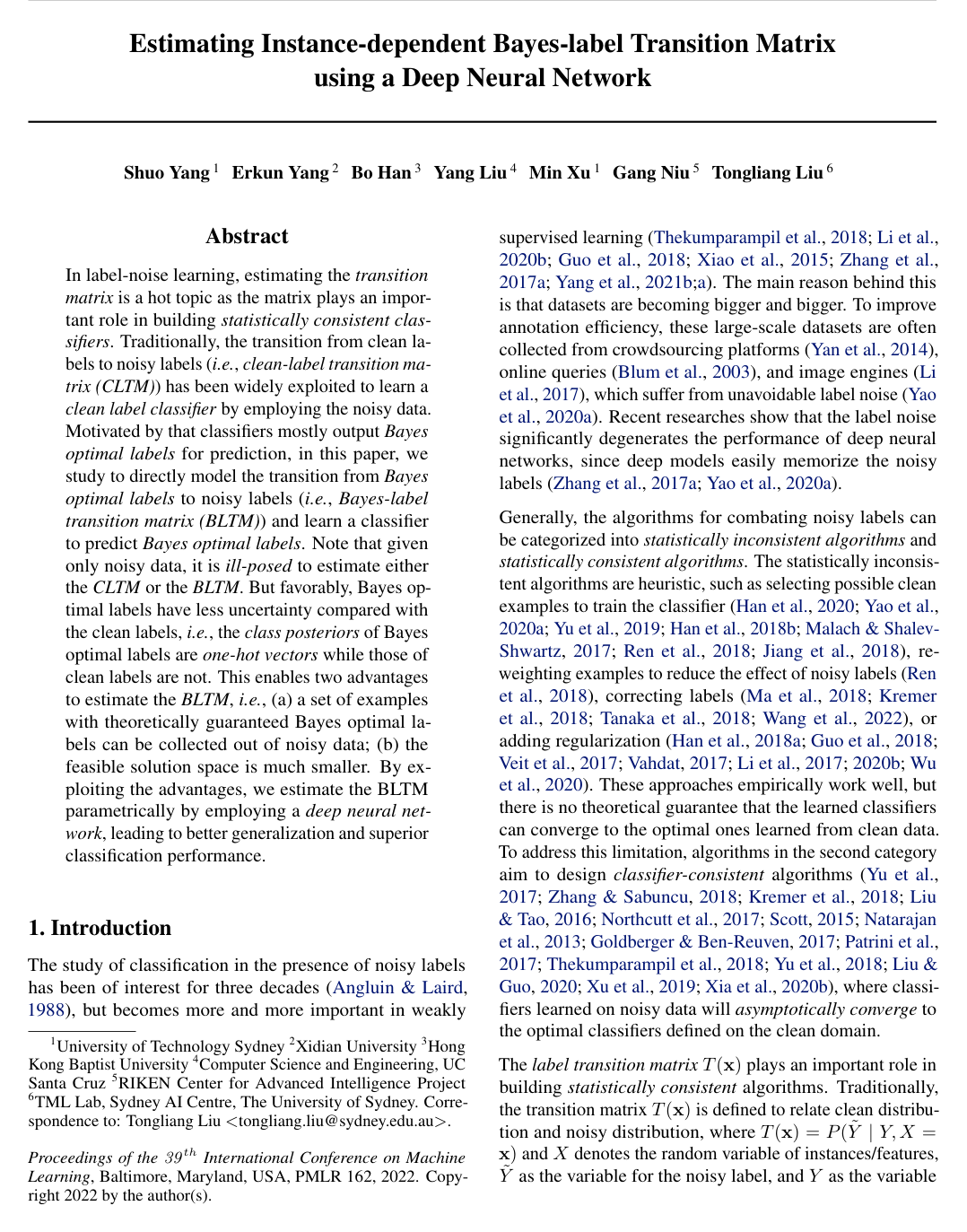
Estimating Instance-dependent Bayes-label Transition Matrix using a Deep Neural Network
Shuo Yang, Erkun Yang, Bo Han, Yang Liu, Min Xu, Gang Niu, Tongliang Liu
Why you should read this
Proposes modeling instance-dependent label noise by estimating transitions from Bayes optimal labels to noisy labels using a deep neural network, shrinking the search space and improving classification accuracy on noisy datasets.
In label-noise learning, estimating the transition matrix is a hot topic as the matrix plays an important role in building statistically consistent classifiers. Traditionally, the transition from clean labels to noisy labels (i.e., clean-label transition matrix (CLTM)) has been widely exploited to learn a clean label classifier by employing the noisy data. Motivated by that classifiers mostly output Bayes optimal labels for prediction, in this paper, we study to directly model the transition from Bayes optimal labels to noisy labels (i.e., Bayes-label transition matrix (BLTM)) and learn a classifier to predict Bayes optimal labels. Note that given only noisy data, it is ill-posed to estimate either the CLTM or the BLTM. But favorably, Bayes optimal labels have less uncertainty compared with the clean labels, i.e., the class posteriors of Bayes optimal labels are one-hot vectors while those of clean labels are not. This enables two advantages to estimate the BLTM, i.e., (a) a set of examples with theoretically guaranteed Bayes optimal labels can be collected out of noisy data; (b) the feasible solution space is much smaller. By exploiting the advantages, we estimate the BLTM parametrically by employing a deep neural network, leading to better generalization and superior classification performance.
Added
2026-10-03