
keyword
causal mechanisms
A causal mechanism is the underlying process, rule, or functional relationship through which one or more cause variables produce, determine, or influence the state of an effect variable in a system. In causal inference and statistical modeling, these mechanisms are formalized as structural equations or conditional probability distributions that map direct causal inputs and independent background noise to an outcome. A key property of causal mechanisms is autonomy, also known as modularity or invariance, which means that the mechanism governing a specific variable operates independently of the mechanisms governing other variables and remains unchanged when interventions or perturbations occur elsewhere in the system. Consequently, characterizing causal mechanisms allows researchers to understand how data are generated, evaluate the effects of hypothetical interventions, and perform counterfactual reasoning.
4 items
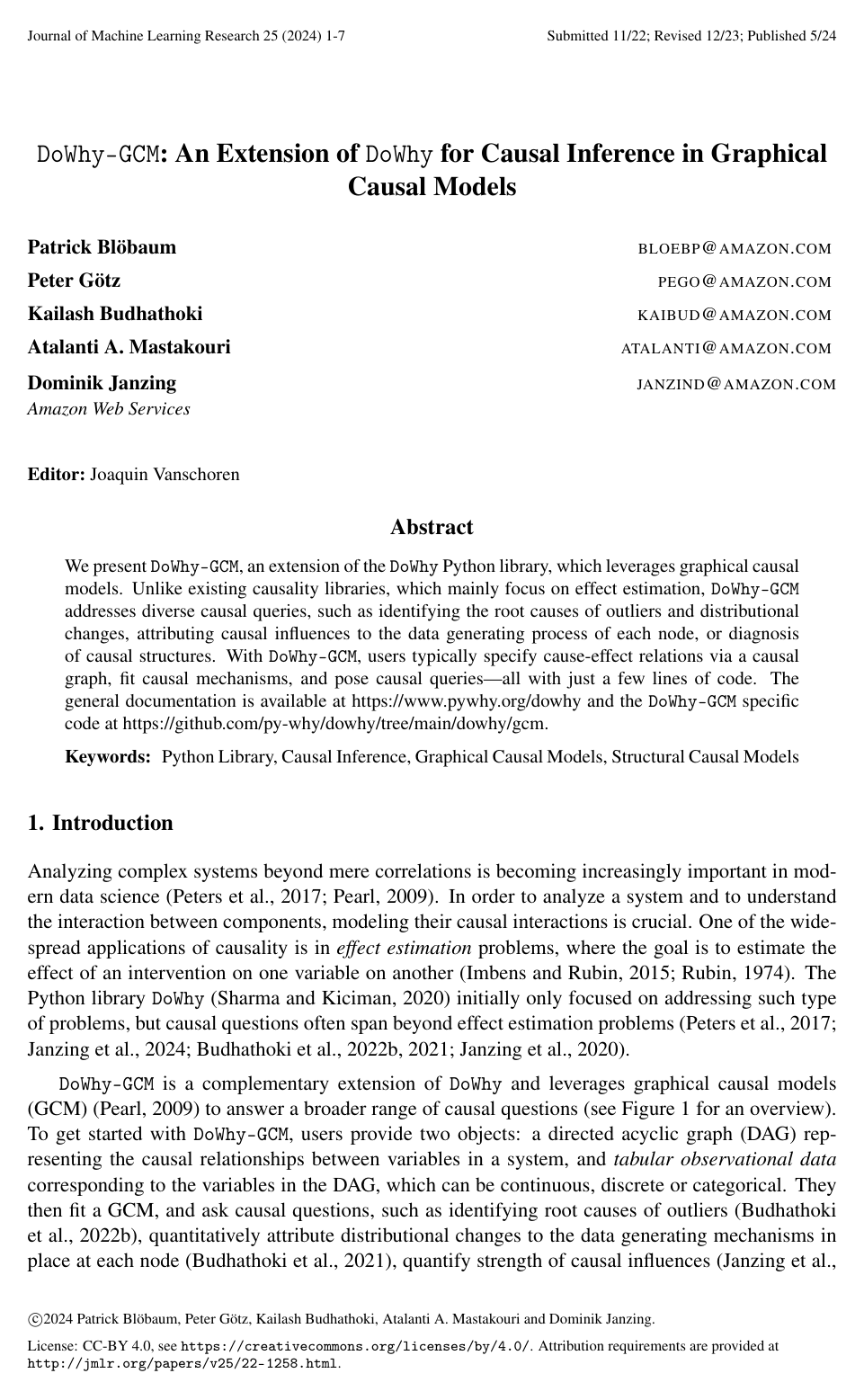
DoWhy-GCM: An Extension of DoWhy for Causal Inference in Graphical Causal Models
Patrick Blöbaum, Peter Götz, Kailash Budhathoki, Atalanti-Anastasia Mastakouri, Dominik Janzing
Why you should read this
Extends the DoWhy Python library with graphical causal models to perform complex causal tasks beyond standard effect estimation, including root cause analysis of outliers, distributional change attribution, and counterfactual estimation.
Added
2026-10-02
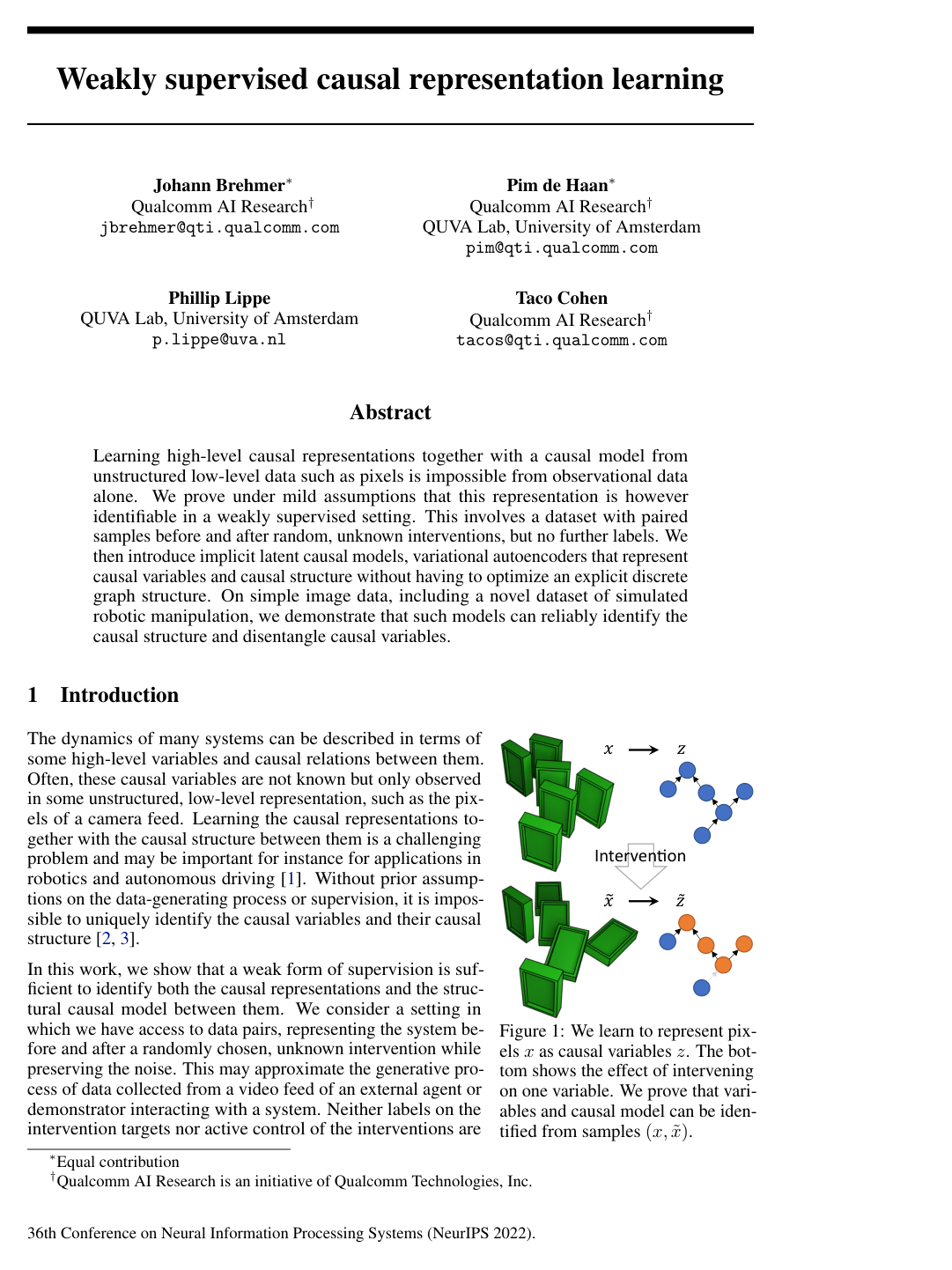
Weakly supervised causal representation learning
Johann Brehmer, Pim de Haan, Phillip Lippe, Taco S. Cohen
Why you should read this
Proves that high-level causal variables and mechanisms can be identified from pixel-level data paired across unknown interventions, and introduces implicit latent causal models to learn these structures without optimizing discrete graphs.
Learning high-level causal representations together with a causal model from unstructured low-level data such as pixels is impossible from observational data alone. We prove under mild assumptions that this representation is however identifiable in a weakly supervised setting. This involves a dataset with paired samples before and after random, unknown interventions, but no further labels. We then introduce implicit latent causal models, variational autoencoders that represent causal variables and causal structure without having to optimize an explicit discrete graph structure. On simple image data, including a novel dataset of simulated robotic manipulation, we demonstrate that such models can reliably identify the causal structure and disentangle causal variables.
Added
2026-09-30
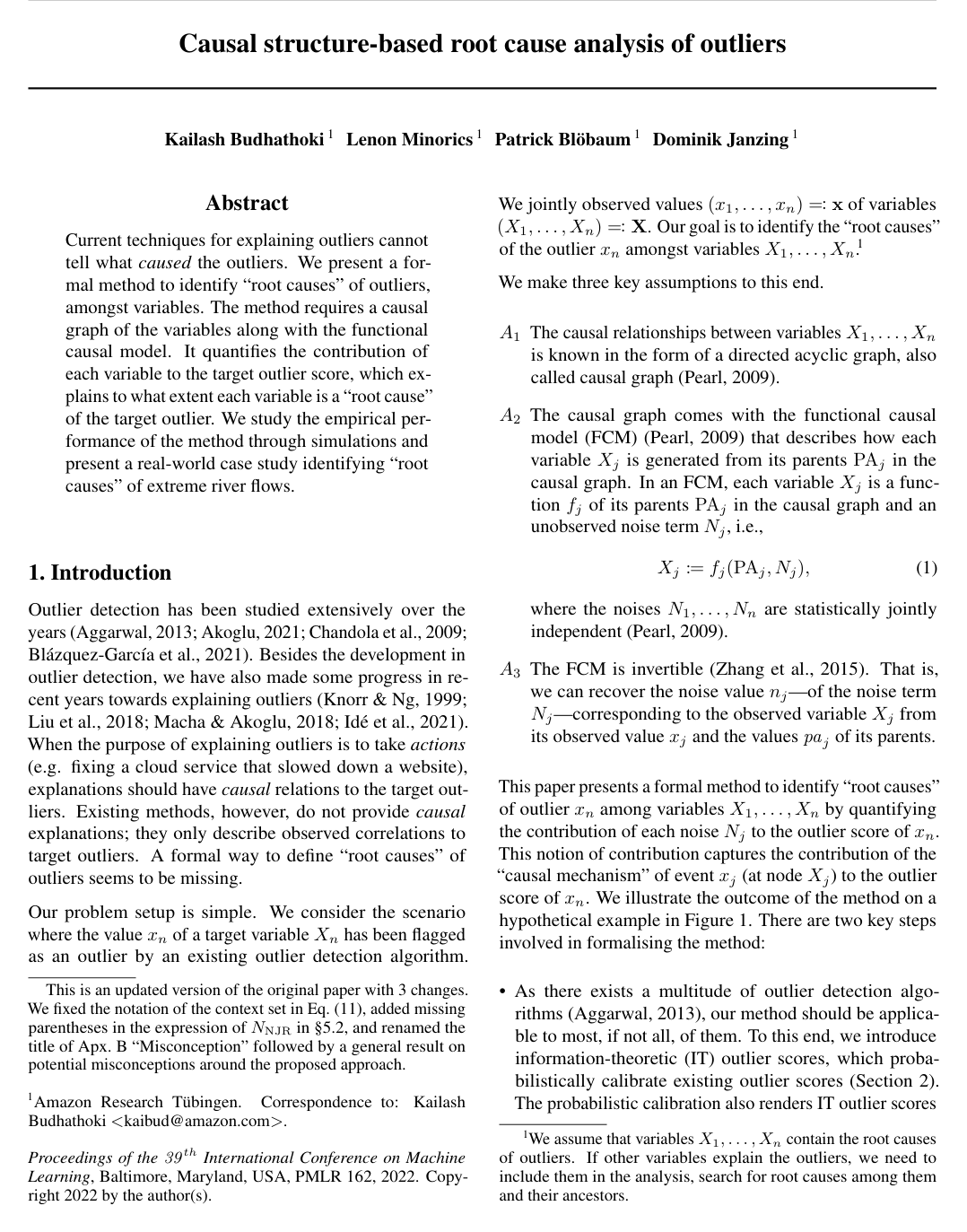
Causal structure-based root cause analysis of outliers
Kailash Budhathoki, Lenon Minorics, Patrick Blöbaum, Dominik Janzing
Why you should read this
Develops a principled framework that combines functional causal models, information-theoretic score calibration, and Shapley values to pinpoint and quantify the root causes behind detected outliers.
Current techniques for explaining outliers cannot tell what caused the outliers. We present a formal method to identify “root causes” of outliers, amongst variables. The method requires a causal graph of the variables along with the functional causal model. It quantifies the contribution of each variable to the target outlier score, which explains to what extent each variable is a “root cause” of the target outlier. We study the empirical performance of the method through simulations and present a real-world case study identifying “root causes” of extreme river flows.
Added
2026-09-26
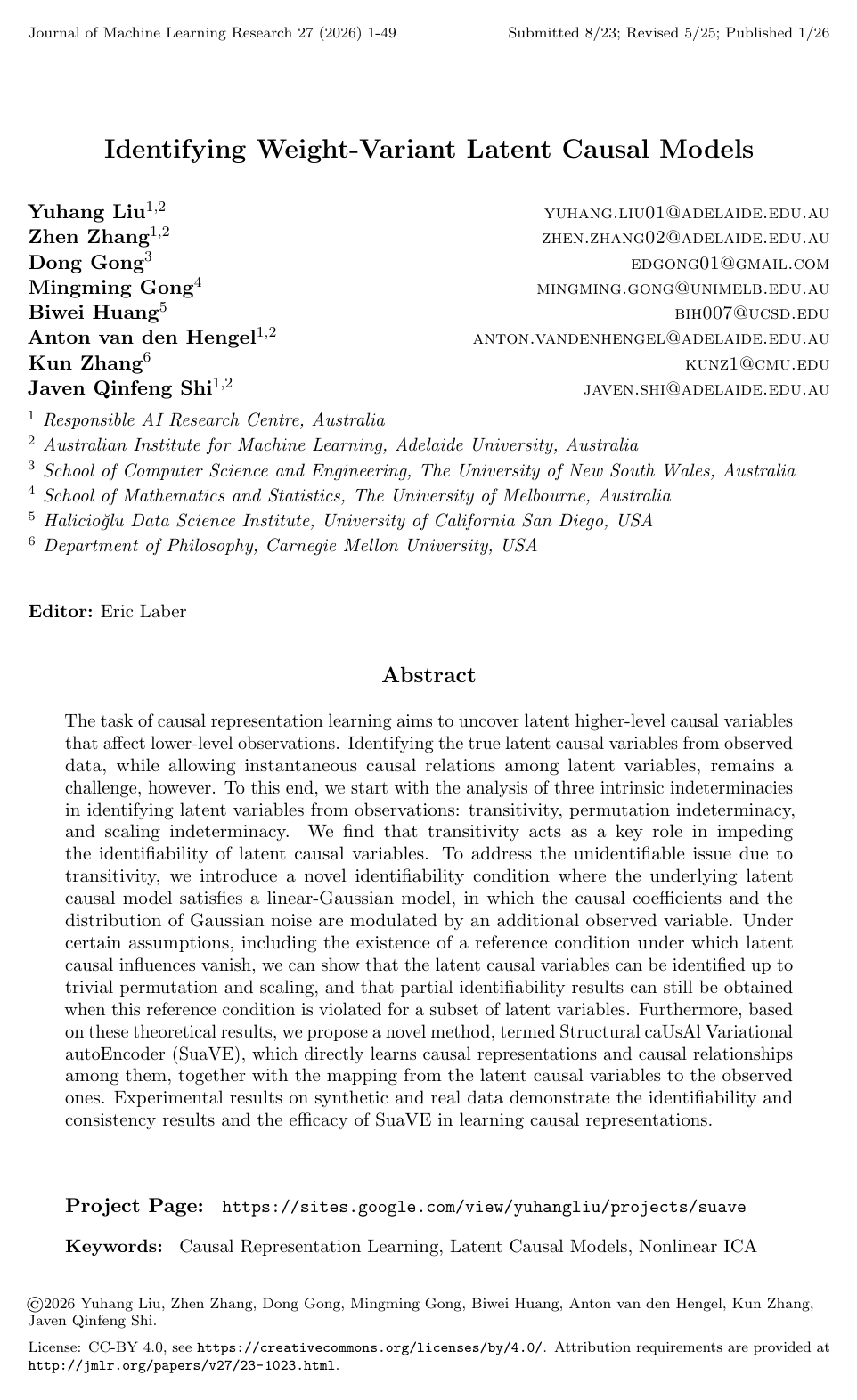
Identifying Weight-Variant Latent Causal Models
Yuhang Liu, Zhen Zhang, Dong Gong, Mingming Gong, Biwei Huang, Anton van den Hengel, Kun Zhang, Javen Qinfeng Shi
Why you should read this
Establishes a formal identifiability framework for latent causal models by leveraging variations in causal influences across environments and introduces the SuaVE method to learn both causal representations and their underlying structures from high-dimensional data.
The task of causal representation learning aims to uncover latent higher-level causal variables that affect lower-level observations. Identifying the true latent causal variables from observed data, while allowing instantaneous causal relations among latent variables, remains a challenge, however. To this end, we start with the analysis of three intrinsic indeterminacies in identifying latent variables from observations: transitivity, permutation indeterminacy, and scaling indeterminacy. We find that transitivity acts as a key role in impeding the identifiability of latent causal variables. To address the unidentifiable issue due to transitivity, we introduce a novel identifiability condition where the underlying latent causal model satisfies a linear-Gaussian model, in which the causal coefficients and the distribution of Gaussian noise are modulated by an additional observed variable. Under certain assumptions, including the existence of a reference condition under which latent causal influences vanish, we can show that the latent causal variables can be identified up to trivial permutation and scaling, and that partial identifiability results can still be obtained when this reference condition is violated for a subset of latent variables. Furthermore, based on these theoretical results, we propose a novel method, termed Structural caUsAl Variational autoEncoder (SuaVE), which directly learns causal representations and causal relationships among them, together with the mapping from the latent causal variables to the observed ones. Experimental results on synthetic and real data demonstrate the identifiability and consistency results and the efficacy of SuaVE in learning causal representations.
Added
2026-05-16