
Built independently by an author, for readers. Read the story and support ChapterPal

keyword

camera trajectory

A camera trajectory is the continuous sequence of positions and orientations that a real or virtual camera follows through three-dimensional space over time. Mathematically represented as a time-indexed series of six-degree-of-freedom camera poses, it captures both the spatial translation and rotational attitude of the viewpoint at every point along its movement path. In fields such as computer vision, computer graphics, and robotics, camera trajectories are fundamental for applications like visual odometry, three-dimensional scene reconstruction, and novel view synthesis, providing the spatial coordinates necessary to produce or analyze temporally coherent and geometrically consistent video sequences.

1 item
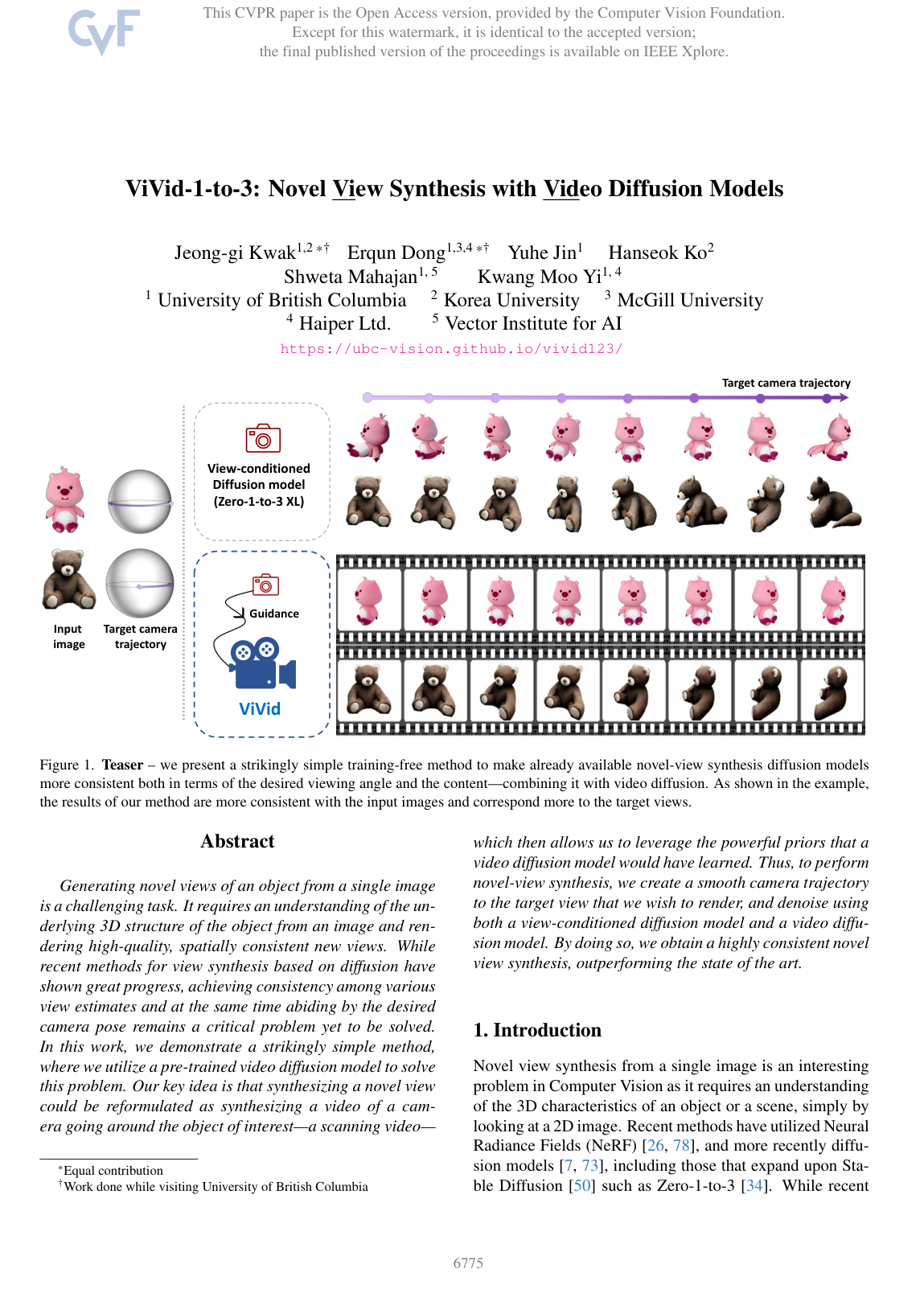
ViVid-1-to-3: Novel View Synthesis with Video Diffusion Models

ViVid-1-to-3: Novel View Synthesis with Video Diffusion Models

Jeong-gi Kwak, Erqun Dong, Yuhe Jin, Hanseok Ko, Shweta Mahajan, Kwang Moo Yi

OrganizationsHaiper Ltd.Korea UniversityMcGill UniversityUniversity of British ColumbiaVector Institute

Why you should read this

Proposes a training-free framework that combines pre-trained view-conditioned diffusion and video diffusion models to generate spatially consistent novel views along a camera trajectory from a single image.

Generating novel views of an object from a single image is a challenging task. It requires an understanding of the underlying 3D structure of the object from an image and rendering high-quality, spatially consistent new views. While recent methods for view synthesis based on diffusion have shown great progress, achieving consistency among various view estimates and at the same time abiding by the desired camera pose remains a critical problem yet to be solved. In this work, we demonstrate a strikingly simple method, where we utilize a pre-trained video diffusion model to solve this problem. Our key idea is that synthesizing a novel view could be reformulated as synthesizing a video of a camera going around the object of interest—a scanning video—which then allows us to leverage the powerful priors that a video diffusion model would have learned. Thus, to perform novel-view synthesis, we create a smooth camera trajectory to the target view that we wish to render, and denoise using both a view-conditioned diffusion model and a video diffusion model. By doing so, we obtain a highly consistent novel view synthesis, outperforming the state of the art.

Added

2026-09-26