
keyword
boundary detection
Boundary detection is a computer vision task that involves identifying and delineating the contours or interfaces that separate distinct objects, semantic regions, or foreground elements from the background in an image. While closely related to low-level edge detection, boundary detection emphasizes perceptually and semantically meaningful divisions rather than arbitrary pixel-level variations in color or intensity. By combining fine spatial details with high-level contextual information, modern boundary detection methods resolve visual ambiguities and accurately localize subtle or complex transitions between adjacent regions. This capability plays a critical role in comprehensive image understanding, frequently serving as an auxiliary mechanism or guiding signal to enhance the accuracy of tasks such as semantic segmentation, instance segmentation, and object detection.
3 items
PIDNet: A Real-time Semantic Segmentation Network Inspired by PID Controllers
Jiacong Xu, Zixiang Xiong, Shankar P. Bhattacharyya
Why you should read this
Proposes a three-branch real-time semantic segmentation architecture inspired by PID controllers that introduces a dedicated boundary branch to prevent contextual feature overshoot, achieving state-of-the-art speed-accuracy trade-offs on Cityscapes and CamVid.
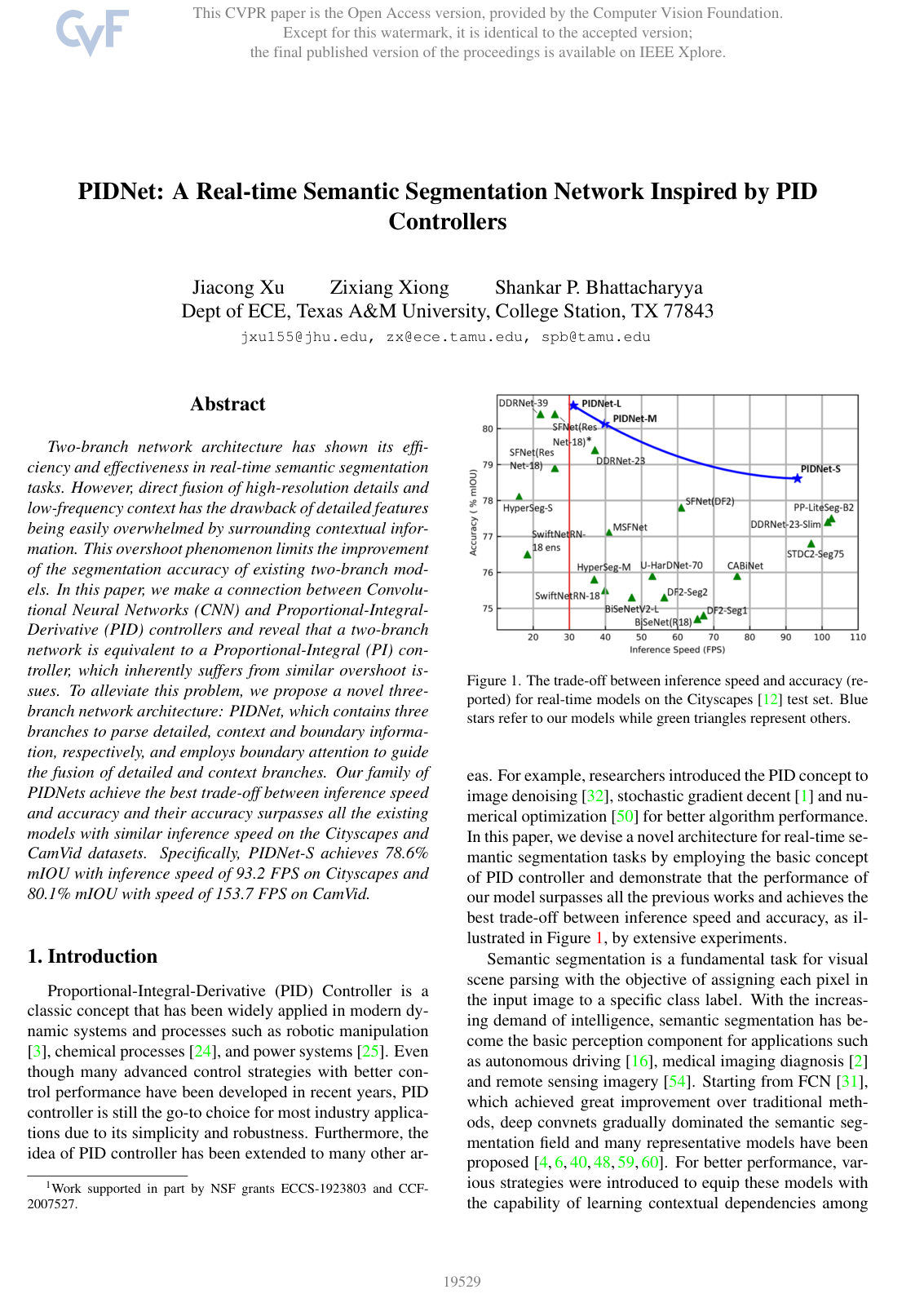
Two-branch network architecture has shown its efficiency and effectiveness in real-time semantic segmentation tasks. However, direct fusion of high-resolution details and low-frequency context has the drawback of detailed features being easily overwhelmed by surrounding contextual information. This overshoot phenomenon limits the improvement of the segmentation accuracy of existing two-branch models. In this paper, we make a connection between Convolutional Neural Networks (CNN) and Proportional-Integral-Derivative (PID) controllers and reveal that a two-branch network is equivalent to a Proportional-Integral (PI) controller, which inherently suffers from similar overshoot issues. To alleviate this problem, we propose a novel three-branch network architecture: PIDNet, which contains three branches to parse detailed, context and boundary information, respectively, and employs boundary attention to guide the fusion of detailed and context branches. Our family of PIDNets achieve the best trade-off between inference speed and accuracy and their accuracy surpasses all the existing models with similar inference speed on the Cityscapes and CamVid datasets. Specifically, PIDNet-S achieves 78.6% mIOU with inference speed of 93.2 FPS on Cityscapes and 80.1% mIOU with speed of 153.7 FPS on CamVid.
Added
2026-09-26
I Can Find You! Boundary-Guided Separated Attention Network for Camouflaged Object Detection
Hongwei Zhu, Peng Li, Haoran Xie, Xuefeng Yan, Dong Liang, Dapeng Chen, Mingqiang Wei, Jing Qin
Why you should read this
Proposes a boundary-guided separated attention network that mirrors human perception by decoupling foreground and background streams to locate camouflaged objects with highly ambiguous boundaries, outperforming sixteen state-of-the-art methods across standard benchmarks.
Can you find me? By simulating how humans to discover the so-called ‘perfectly’-camouflaged object, we present a novel boundary-guided separated attention network (call BSA-Net). Beyond the existing camouflaged object detection (COD) wisdom, BSA-Net utilizes two-stream separated attention modules to highlight the separator (or say the camouflaged object’s boundary) between an image’s background and foreground: the reverse attention stream helps erase the camouflaged object’s interior to focus on the background, while the normal attention stream recovers the interior and thus pay more attention to the foreground; and both streams are followed by a boundary guider module and combined to strengthen the understanding of the boundary. The core design of such separated attention is motivated by the COD procedure of humans: find the subtle difference between the foreground and background to delineate the boundary of a camouflaged object, then the boundary can help further enhance the COD accuracy. We validate on three benchmark datasets that our BSA-Net is very beneficial to detect camouflaged objects with the blurred boundaries and similar colors/patterns with their backgrounds. Extensive results exhibit very clear COD improvements on our BSA-Net over sixteen SOTAs.
Added
2026-09-26
Holistically-Nested Edge Detection
Saining Xie, Zhuowen Tu
Why you should read this
Introduces Holistically-Nested Edge Detection (HED), an end-to-end deep learning framework that leverages fully convolutional networks and deeply supervised multiscale features to achieve state-of-the-art boundary detection with orders-of-magnitude faster inference.
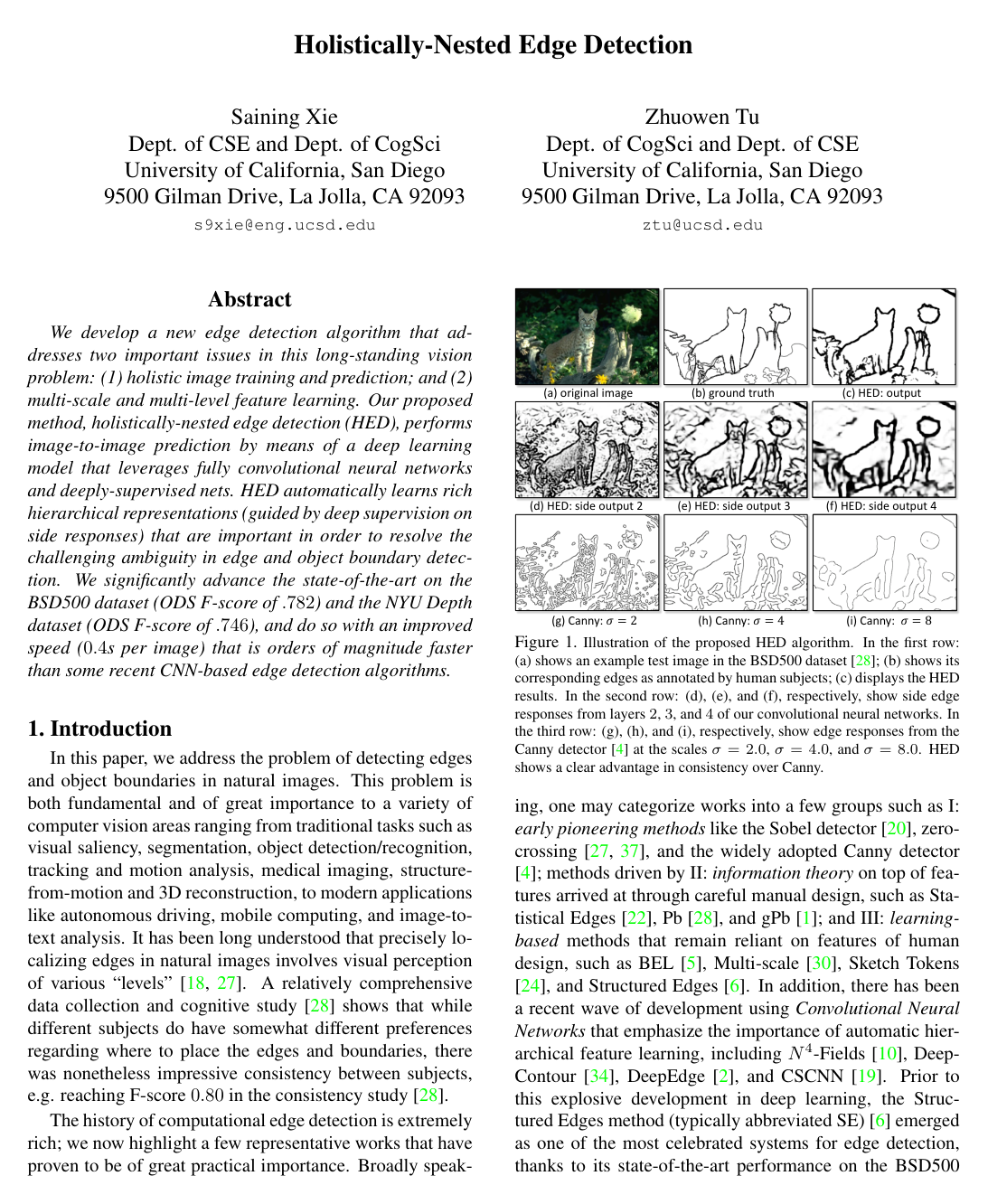
We develop a new edge detection algorithm that tackles two important issues in this long-standing vision problem: (1) holistic image training and prediction; and (2) multi-scale and multi-level feature learning. Our proposed method, holistically-nested edge detection (HED), performs image-to-image prediction by means of a deep learning model that leverages fully convolutional neural networks and deeply-supervised nets. HED automatically learns rich hierarchical representations (guided by deep supervision on side responses) that are important in order to approach the human ability resolve the challenging ambiguity in edge and object boundary detection. We significantly advance the state-of-the-art on the BSD500 dataset (ODS F-score of .782) and the NYU Depth dataset (ODS F-score of .746), and do so with an improved speed (0.4 second per image) that is orders of magnitude faster than some recent CNN-based edge detection algorithms.
Added
2026-09-11