
Built independently by an author, for readers. Read the story and support ChapterPal

keyword

black-box APIs

A black-box API is an application programming interface that provides access to a software system or machine learning model without revealing its internal mechanisms, source code, training data, or architecture. Users interact with the service strictly by submitting inputs and receiving outputs, remaining unable to inspect the underlying decision-making process or adjust the internal model parameters. Commonly deployed in commercial artificial intelligence and cloud platforms, these interfaces allow developers to integrate complex functionalities such as text analysis, predictive scoring, and classification without having to manage the underlying model design or infrastructure. However, because the hosting provider can retrain, modify, or update the underlying algorithms without full external transparency, black-box APIs can introduce challenges related to interpretability, auditability, and the long-term reproducibility of results across different evaluation periods.

1 item
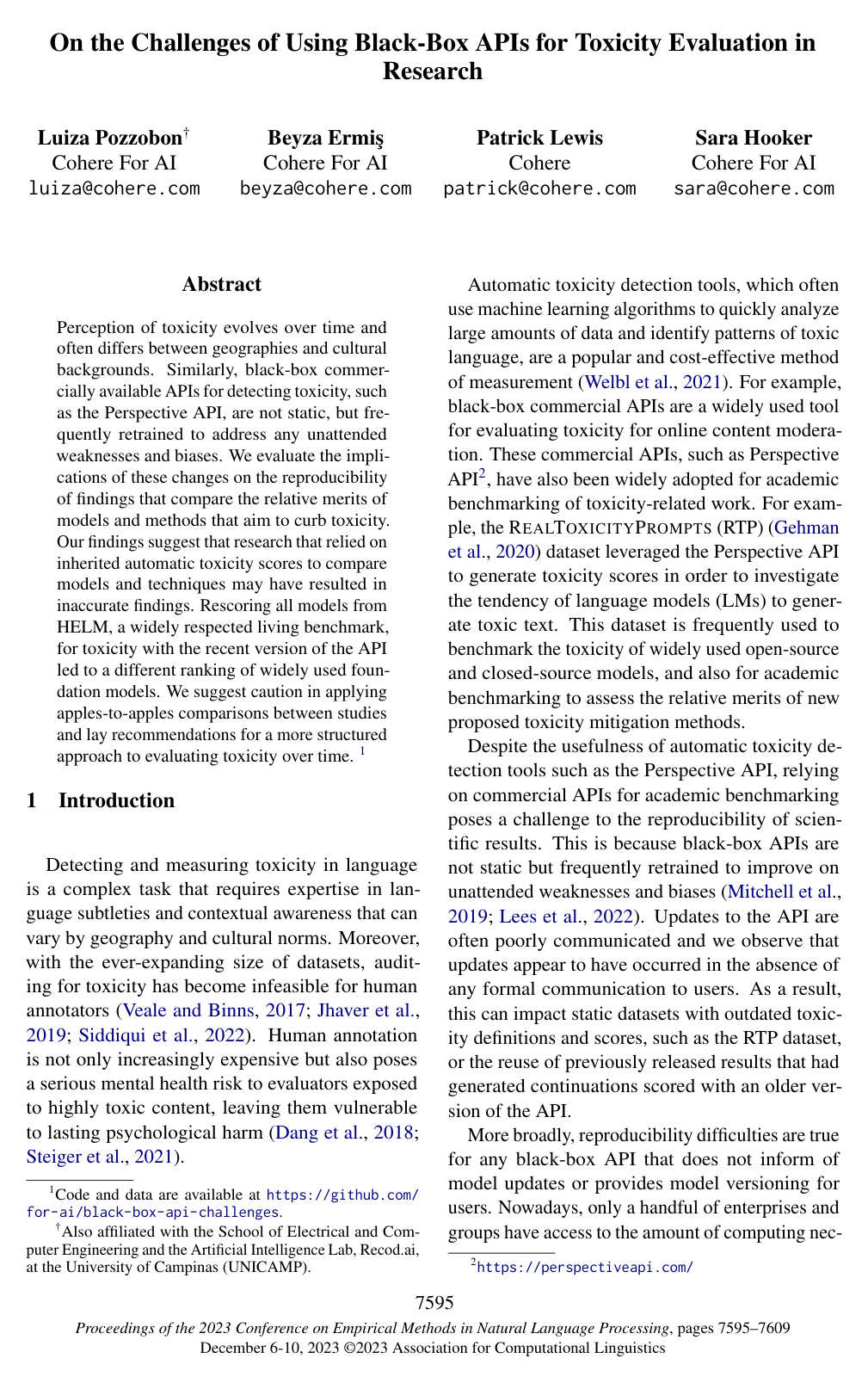
On the Challenges of Using Black-Box APIs for Toxicity Evaluation in Research

On the Challenges of Using Black-Box APIs for Toxicity Evaluation in Research

Luiza Pozzobon, Beyza Ermis, Patrick Lewis, Sara Hooker

OrganizationsCohereRecod.aiSchool of Electrical and Computer EngineeringUniversity of Campinas

Why you should read this

Reveals how unannounced updates to commercial toxicity evaluation APIs like Perspective alter benchmark leaderboards and invalidate prior research conclusions, while establishing concrete guidelines to ensure reproducible evaluations over time.

Perception of toxicity evolves over time and often differs between geographies and cultural backgrounds. Similarly, black-box commercially available APIs for detecting toxicity, such as the Perspective API, are not static, but frequently retrained to address any unattended weaknesses and biases. We evaluate the implications of these changes on the reproducibility of findings that compare the relative merits of models and methods that aim to curb toxicity. Our findings suggest that research that relied on inherited automatic toxicity scores to compare models and techniques may have resulted in inaccurate findings. Rescoring all models from HELM, a widely respected living benchmark, for toxicity with the recent version of the API led to a different ranking of widely used foundation models. We suggest caution in applying apples-to-apples comparisons between studies and lay recommendations for a more structured approach to evaluating toxicity over time. 1

Added

2026-09-26