
keyword
BIG-bench tasks
BIG-bench tasks are individual language-model evaluation problems drawn from BIG-Bench, a broad benchmark designed to test performance across diverse capabilities. They range from standard language tasks to challenging problems involving skills such as reasoning, and are evaluated using measures such as accuracy.
6 items
Large Language Models as Optimizers
Chengrun Yang, Xuezhi Wang, Yifeng Lu, Hanxiao Liu, Quoc V. Le, Denny Zhou, Xinyun Chen
Why you should read this
Introduces Optimization by PROmpting (OPRO), a technique that uses large language models as gradient-free optimizers to iteratively generate solutions, discovering prompts that outperform human-engineered instructions by up to 50% on Big-Bench Hard.
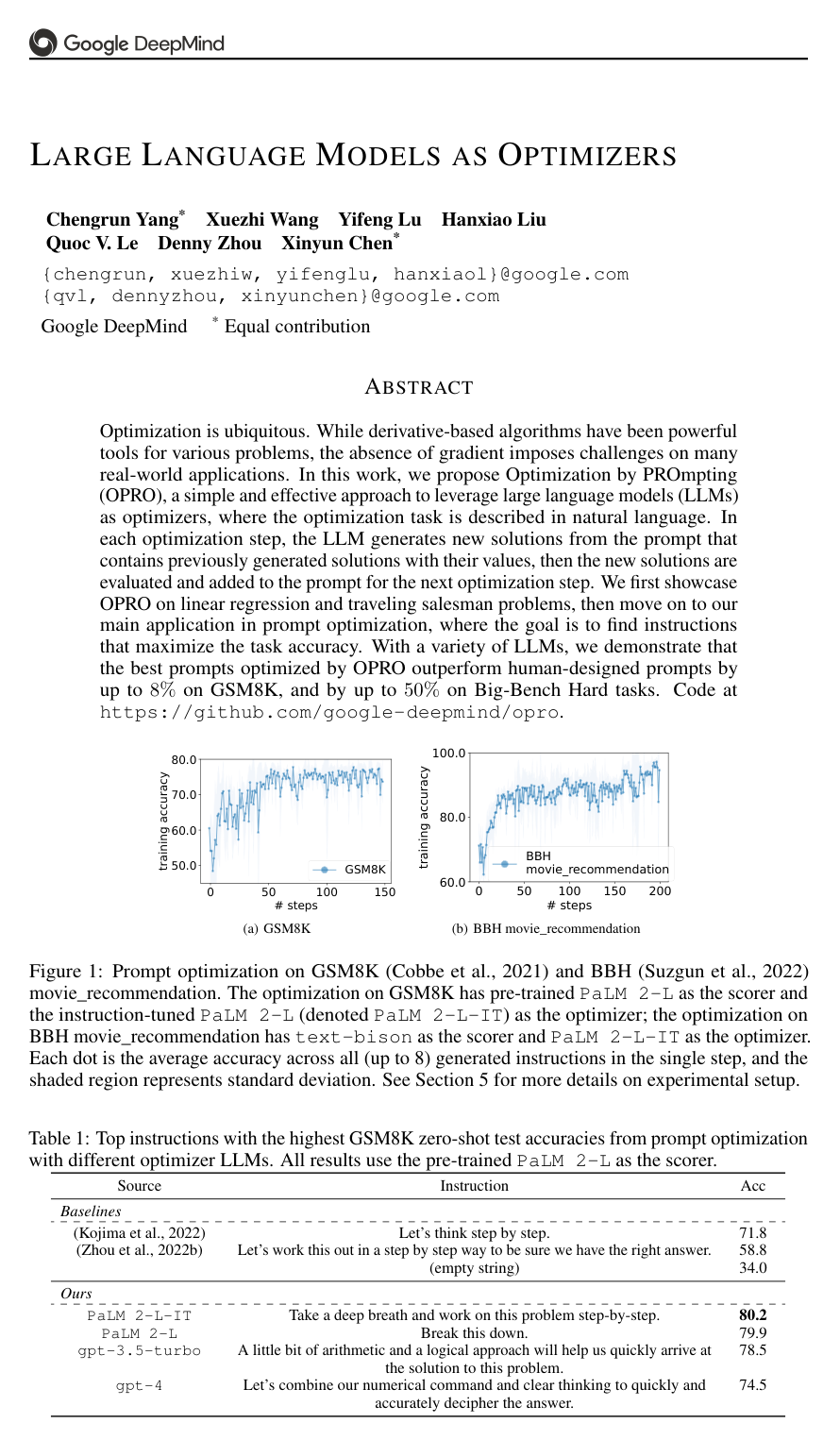
Optimization is ubiquitous. While derivative-based algorithms have been powerful tools for various problems, the absence of gradient imposes challenges on many real-world applications. In this work, we propose Optimization by PROmpting (OPRO), a simple and effective approach to leverage large language models (LLMs) as optimizers, where the optimization task is described in natural language. In each optimization step, the LLM generates new solutions from the prompt that contains previously generated solutions with their values, then the new solutions are evaluated and added to the prompt for the next optimization step. We first showcase OPRO on linear regression and traveling salesman problems, then move on to our main application in prompt optimization, where the goal is to find instructions that maximize the task accuracy. With a variety of LLMs, we demonstrate that the best prompts optimized by OPRO outperform human-designed prompts by up to 8% on GSM8K, and by up to 50% on Big-Bench Hard tasks. Code at this https URL.
Added
2026-10-04
Transcending Scaling Laws with 0.1% Extra Compute
Yi Tay, Jason Wei, Hyung Won Chung, Vinh Q. Tran, David R. So, Siamak Shakeri, Xavier Garcia, Huaixiu Steven Zheng, Jinfeng Rao, Aakanksha Chowdhery, Denny Zhou, Donald Metzler, Slav Petrov, Neil Houlsby, Quoc V. Le, Mostafa Dehghani
Why you should read this
Demonstrates that continuing to train pretrained large language models on UL2's mixture-of-denoisers objective with roughly 0.1% additional compute dramatically improves scaling curves, achieving up to a 2x compute savings and triggering emergent reasoning capabilities at smaller model scales.
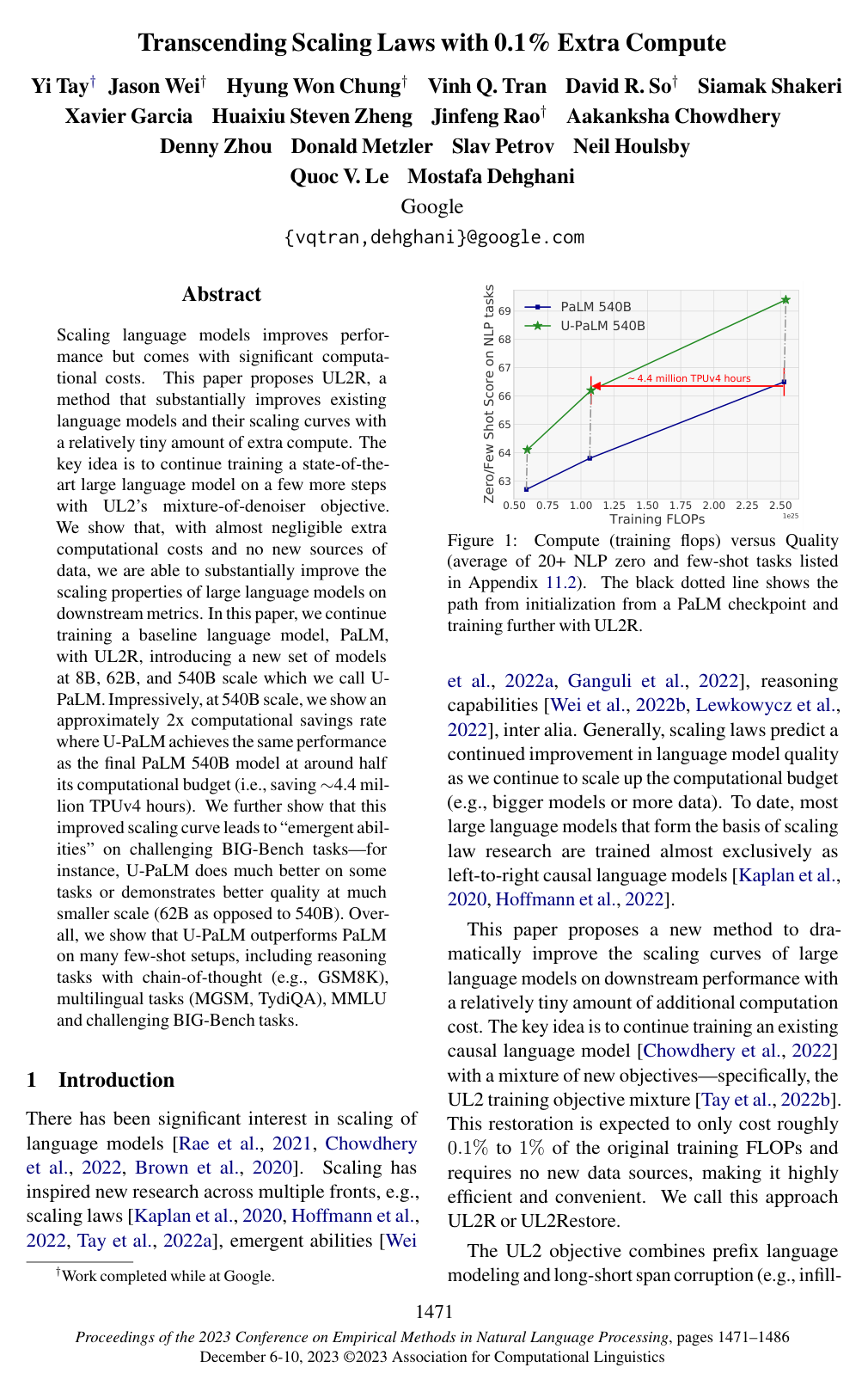
Scaling language models improves performance but comes with significant computational costs. This paper proposes UL2R, a method that substantially improves existing language models and their scaling curves with a relatively tiny amount of extra compute. The key idea is to continue training a state-of-the-art large language model on a few more steps with UL2’s mixture-of-denoiser objective. We show that, with almost negligible extra computational costs and no new sources of data, we are able to substantially improve the scaling properties of large language models on downstream metrics. In this paper, we continue training a baseline language model, PaLM, with UL2R, introducing a new set of models at 8B, 62B, and 540B scale which we call U-PaLM. Impressively, at 540B scale, we show an approximately 2x computational savings rate where U-PaLM achieves the same performance as the final PaLM 540B model at around half its computational budget (i.e., saving ∼4.4 million TPUv4 hours). We further show that this improved scaling curve leads to “emergent abilities” on challenging BIG-Bench tasks—for instance, U-PaLM does much better on some tasks or demonstrates better quality at much smaller scale (62B as opposed to 540B). Overall, we show that U-PaLM outperforms PaLM on many few-shot setups, including reasoning tasks with chain-of-thought (e.g., GSM8K), multilingual tasks (MGSM, TydiQA), MMLU and challenging BIG-Bench tasks.
Added
2026-10-02
Inverse Scaling Can Become U-Shaped
Jason Wei, Najoung Kim, Yi Tay, Quoc V. Le
Why you should read this
Demonstrates that tasks previously thought to exhibit inverse scaling often become U-shaped or positive when evaluated on larger models up to 540B parameters or paired with chain-of-thought prompting, showing that performance degradation at intermediate scales is frequently temporary rather than a permanent failure mode of model scale.
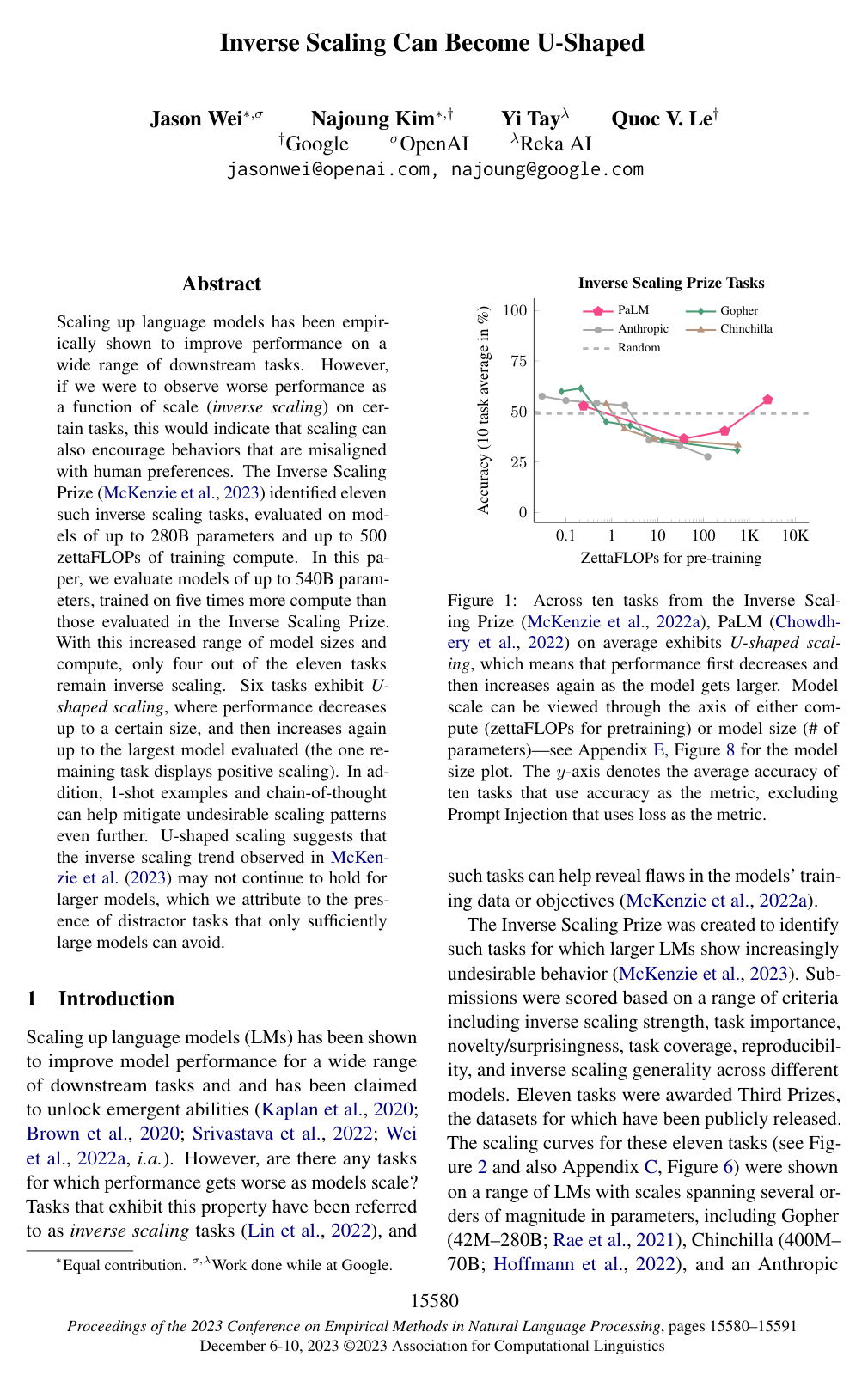
Scaling up language models has been empirically shown to improve performance on a wide range of downstream tasks. However, if we were to observe worse performance as a function of scale (inverse scaling) on certain tasks, this would indicate that scaling can also encourage behaviors that are misaligned with human preferences. The Inverse Scaling Prize (McKenzie et al., 2023) identified eleven such inverse scaling tasks, evaluated on models of up to 280B parameters and up to 500 zettaFLOPs of training compute. In this paper, we evaluate models of up to 540B parameters, trained on five times more compute than those evaluated in the Inverse Scaling Prize. With this increased range of model sizes and compute, only four out of the eleven tasks remain inverse scaling. Six tasks exhibit U-shaped scaling, where performance decreases up to a certain size, and then increases again up to the largest model evaluated (the one remaining task displays positive scaling). In addition, 1-shot examples and chain-of-thought can help mitigate undesirable scaling patterns even further. U-shaped scaling suggests that the inverse scaling trend observed in McKenzie et al. (2023) may not continue to hold for larger models, which we attribute to the presence of distractor tasks that only sufficiently large models can avoid.
Added
2026-09-26
Program of Thoughts Prompting: Disentangling Computation from Reasoning for Numerical Reasoning Tasks
Wenhu Chen, Xueguang Ma, Xinyi Wang, William W. Cohen
Why you should read this
Proposes Program of Thoughts prompting to disentangle reasoning from computation by offloading code execution to an external interpreter, consistently outperforming Chain-of-Thought prompting across diverse mathematical and financial reasoning benchmarks.
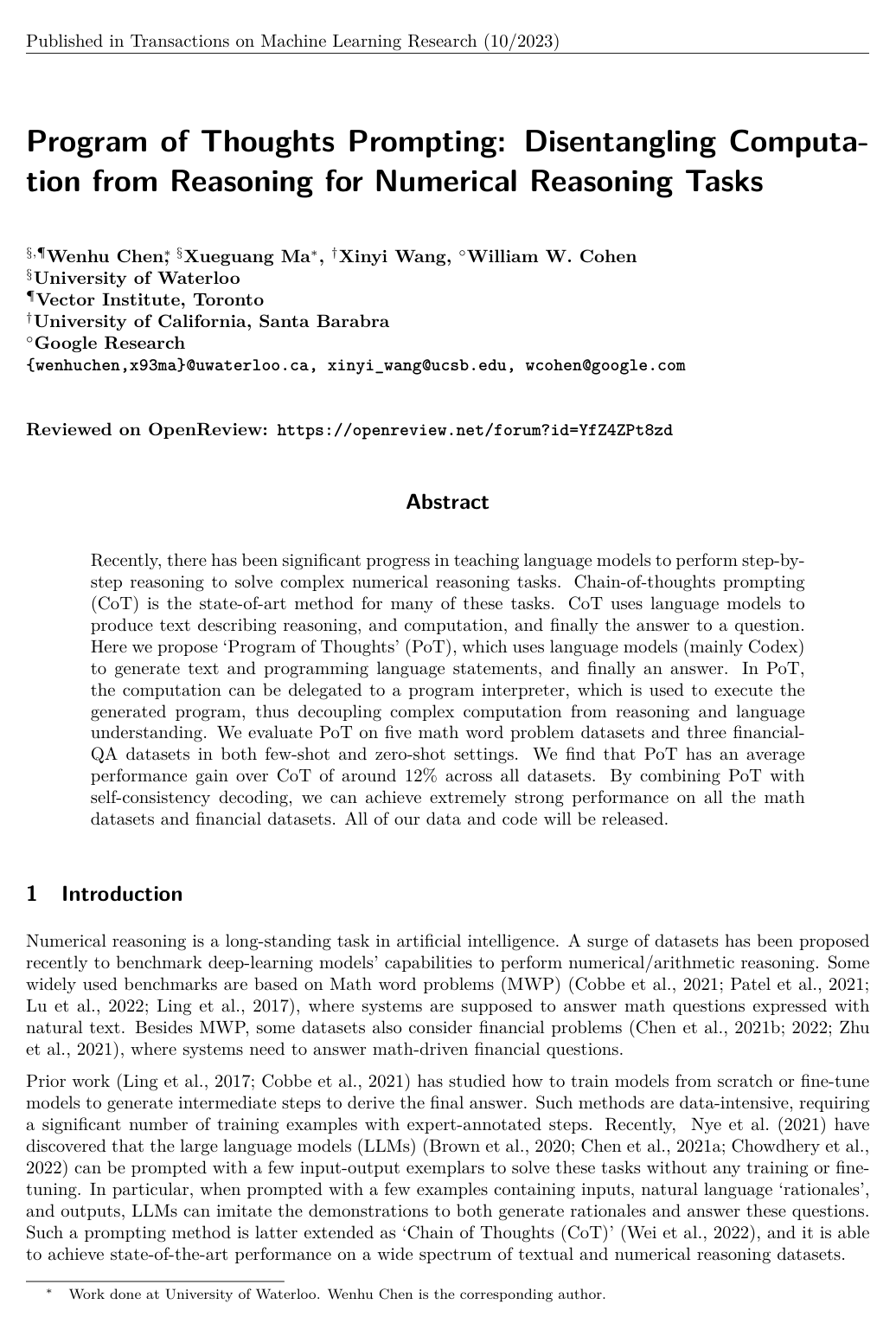
Recently, there has been significant progress in teaching language models to perform step-by-step reasoning to solve complex numerical reasoning tasks. Chain-of-thoughts prompting (CoT) is by far the state-of-art method for these tasks. CoT uses language models to perform both reasoning and computation in the multi-step `thought' process. To disentangle computation from reasoning, we propose `Program of Thoughts' (PoT), which uses language models (mainly Codex) to express the reasoning process as a program. The computation is relegated to an external computer, which executes the generated programs to derive the answer. We evaluate PoT on five math word problem datasets (GSM, AQuA, SVAMP, TabMWP, MultiArith) and three financial-QA datasets (FinQA, ConvFinQA, TATQA) for both few-shot and zero-shot setups. Under both few-shot and zero-shot settings, PoT can show an average performance gain over CoT by around 12\% across all the evaluated datasets. By combining PoT with self-consistency decoding, we can achieve SoTA performance on all math problem datasets and near-SoTA performance on financial datasets. All of our data and code are released in Github this https URL
Added
2026-09-25
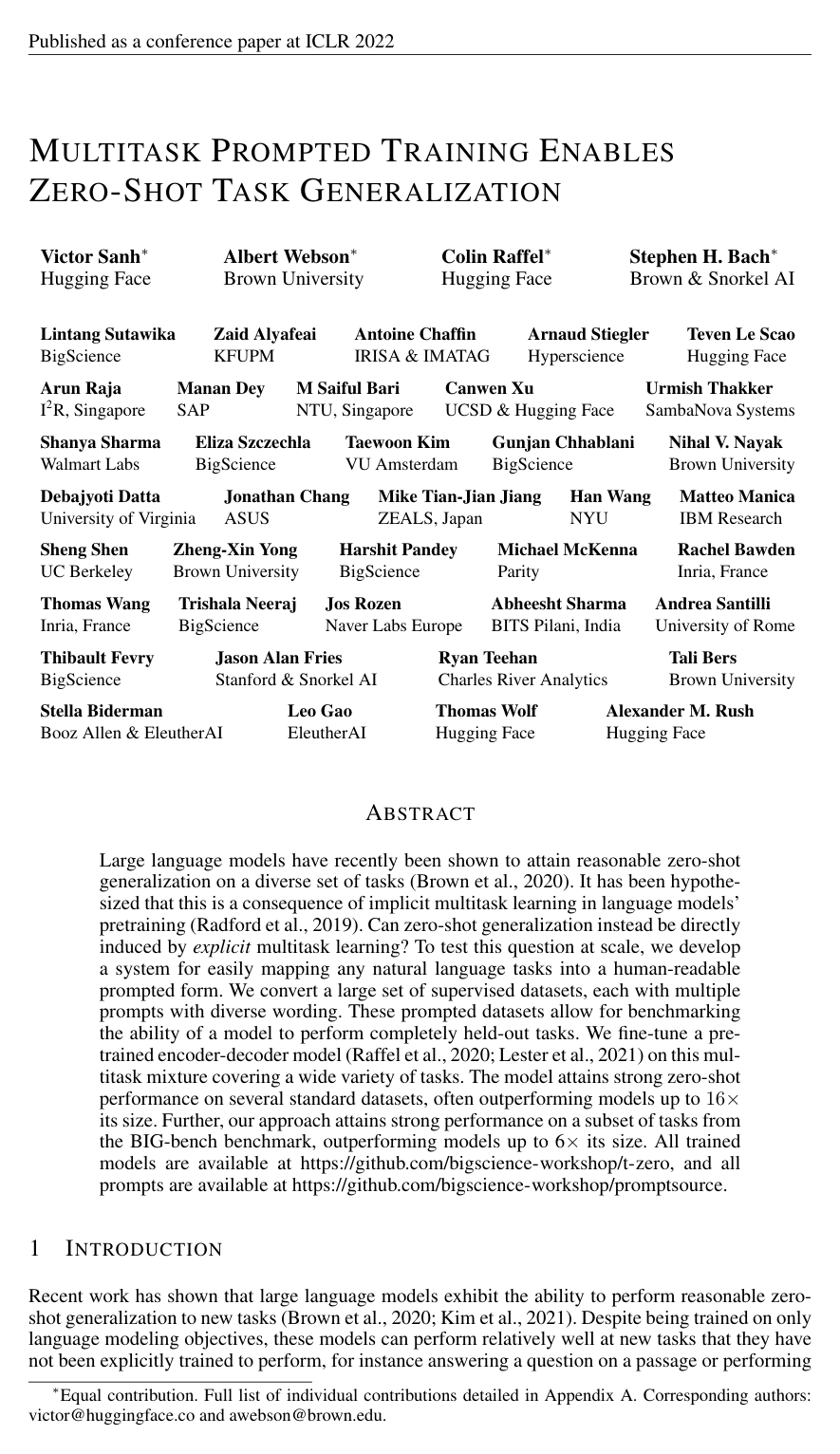
Multitask Prompted Training Enables Zero-Shot Task Generalization
Victor Sanh, Albert Webson, Colin Raffel, Stephen H. Bach, Lintang Sutawika, Zaid Alyafeai, Antoine Chaffin, Arnaud Stiegler, Teven Le Scao, Arun Raja, Manan Dey, Mehwish Bari, Canwen Xu, Urmish Thakker, Shanya Sharma, Eliza Szczechla, Taewoon Kim, Gunjan Chhablani, Nihal V. Nayak, Debajyoti Datta, Jonathan D. Chang, Mike Tian-Jian Jiang, Han Wang, Matteo Manica, Sheng Shen, Zheng-Xin Yong, Harshit Pandey, Rachel Bawden, Thomas Wang, Trishala Neeraj, Jos Rozen, Abheesht Sharma, Andrea Santilli, Thibault Févry, Jason Alan Fries, Ryan Teehan, Stella Biderman, Leo Gao, Tali Bers, Thomas Wolf, Alexander M. Rush
Why you should read this
Demonstrates that fine-tuning pretrained language models on a large mixture of supervised datasets framed as natural language prompts induces strong zero-shot generalization to unseen tasks, outperforming models up to sixteen times larger.
Large language models have recently been shown to attain reasonable zero-shot generalization on a diverse set of tasks (Brown et al., 2020). It has been hypothesized that this is a consequence of implicit multitask learning in language models' pretraining (Radford et al., 2019). Can zero-shot generalization instead be directly induced by explicit multitask learning? To test this question at scale, we develop a system for easily mapping any natural language tasks into a human-readable prompted form. We convert a large set of supervised datasets, each with multiple prompts with diverse wording. These prompted datasets allow for benchmarking the ability of a model to perform completely held-out tasks. We fine-tune a pretrained encoder-decoder model (Raffel et al., 2020; Lester et al., 2021) on this multitask mixture covering a wide variety of tasks. The model attains strong zero-shot performance on several standard datasets, often outperforming models up to 16x its size. Further, our approach attains strong performance on a subset of tasks from the BIG-bench benchmark, outperforming models up to 6x its size. All trained models are available at this https URL and all prompts are available at this https URL.
Added
2026-09-18
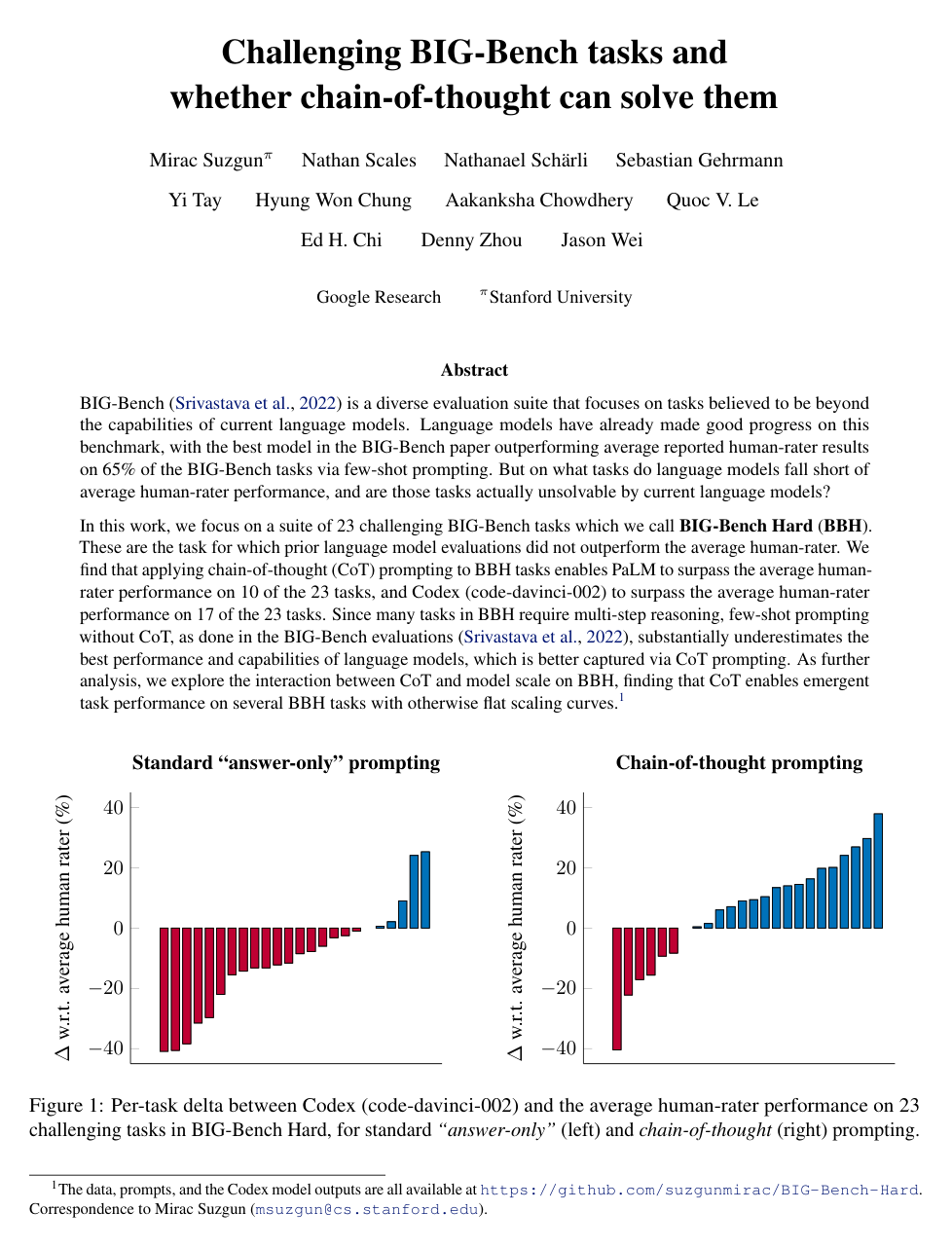
Challenging BIG-Bench Tasks and Whether Chain-of-Thought Can Solve Them
Mirac Suzgun, Nathan Scales, Nathanael Schärli, Sebastian Gehrmann, Yi Tay, Hyung Won Chung, Aakanksha Chowdhery, Quoc V. Le, Ed H. Chi, Denny Zhou, Jason Wei
Why you should read this
Demonstrates that chain-of-thought prompting allows large language models to surpass human-level performance on BIG-Bench Hard, a suite of 23 multi-step reasoning tasks where standard prompting previously failed.
BIG-Bench (Srivastava et al., 2022) is a diverse evaluation suite that focuses on tasks believed to be beyond the capabilities of current language models. Language models have already made good progress on this benchmark, with the best model in the BIG-Bench paper outperforming average reported human-rater results on 65% of the BIG-Bench tasks via few-shot prompting. But on what tasks do language models fall short of average human-rater performance, and are those tasks actually unsolvable by current language models? In this work, we focus on a suite of 23 challenging BIG-Bench tasks which we call BIG-Bench Hard (BBH). These are the task for which prior language model evaluations did not outperform the average human-rater. We find that applying chain-of-thought (CoT) prompting to BBH tasks enables PaLM to surpass the average human-rater performance on 10 of the 23 tasks, and Codex (code-davinci-002) to surpass the average human-rater performance on 17 of the 23 tasks. Since many tasks in BBH require multi-step reasoning, few-shot prompting without CoT, as done in the BIG-Bench evaluations (Srivastava et al., 2022), substantially underestimates the best performance and capabilities of language models, which is better captured via CoT prompting. As further analysis, we explore the interaction between CoT and model scale on BBH, finding that CoT enables emergent task performance on several BBH tasks with otherwise flat scaling curves.
Added
2026-09-16