
keyword
benchmark datasets
A benchmark dataset is a standardized, reference collection of curated data used to objectively evaluate, test, and compare the performance of different algorithms, machine learning models, or computational systems under consistent and reproducible conditions. These datasets provide a shared baseline across research and development fields, enabling practitioners to track progress, diagnose model strengths and limitations, and validate new methodologies against established solutions. By pairing fixed input examples with target ground-truth annotations and predefined evaluation metrics, benchmark datasets ensure transparent, fair comparisons across diverse technological approaches.
3 items
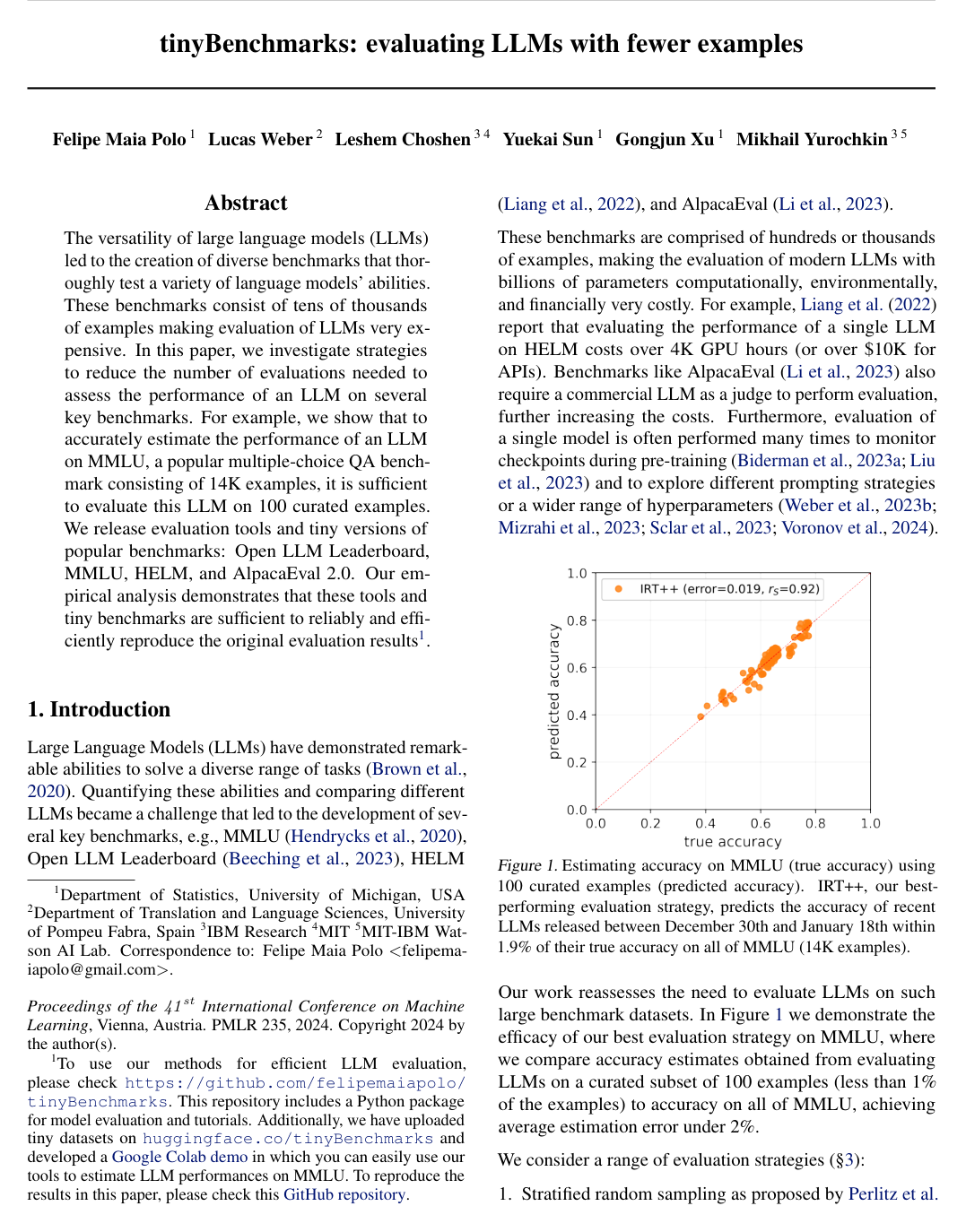
tinyBenchmarks: evaluating LLMs with fewer examples
Felipe Maia Polo, Lucas Weber, Leshem Choshen, Yuekai Sun, Gongjun Xu, Mikhail Yurochkin
Why you should read this
Proposes Item Response Theory and clustering techniques to drastically cut large language model evaluation costs by estimating full benchmark performance on datasets like MMLU and HELM using only 100 representative examples per scenario within an average 2% error margin.
The versatility of large language models (LLMs) led to the creation of diverse benchmarks that thoroughly test a variety of language models’ abilities. These benchmarks consist of tens of thousands of examples making evaluation of LLMs very expensive. In this paper, we investigate strategies to reduce the number of evaluations needed to assess the performance of an LLM on several key benchmarks. For example, we show that to accurately estimate the performance of an LLM on MMLU, a popular multiple-choice QA benchmark consisting of 14K examples, it is sufficient to evaluate this LLM on 100 curated examples. We release evaluation tools and tiny versions of popular benchmarks: Open LLM Leaderboard, MMLU, HELM, and AlpacaEval 2.0. Our empirical analysis demonstrates that these tools and tiny benchmarks are sufficient to reliably and efficiently reproduce the original evaluation results¹.
Added
2026-09-26
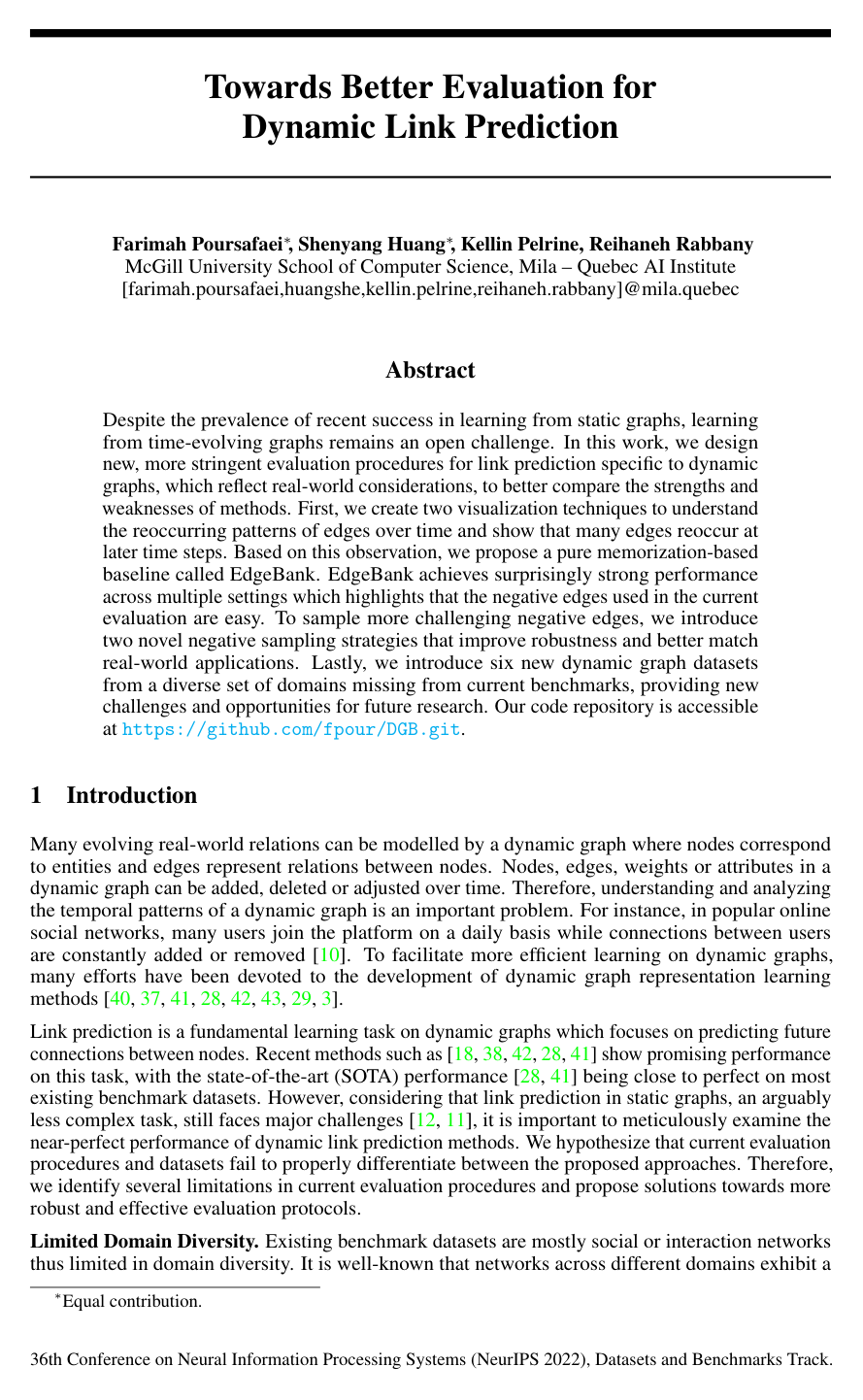
Towards Better Evaluation for Dynamic Link Prediction
Farimah Poursafaei, Shenyang Huang, Kellin Pelrine, Reihaneh Rabbany
Why you should read this
Exposes critical flaws in dynamic link prediction evaluations by introducing the surprisingly competitive memorization baseline EdgeBank, two harder negative sampling strategies, and six diverse dynamic graph benchmarks to enable meaningful model comparison.
Despite the prevalence of recent success in learning from static graphs, learning from time-evolving graphs remains an open challenge. In this work, we design new, more stringent evaluation procedures for link prediction specific to dynamic graphs, which reflect real-world considerations, to better compare the strengths and weaknesses of methods. First, we create two visualization techniques to understand the reoccurring patterns of edges over time and show that many edges reoccur at later time steps. Based on this observation, we propose a pure memorization-based baseline called EdgeBank. EdgeBank achieves surprisingly strong performance across multiple settings which highlights that the negative edges used in the current evaluation are easy. To sample more challenging negative edges, we introduce two novel negative sampling strategies that improve robustness and better match real-world applications. Lastly, we introduce six new dynamic graph datasets from a diverse set of domains missing from current benchmarks, providing new challenges and opportunities for future research. Our code repository is accessible at https://github.com/fpour/DGB.git.
Added
2026-09-26
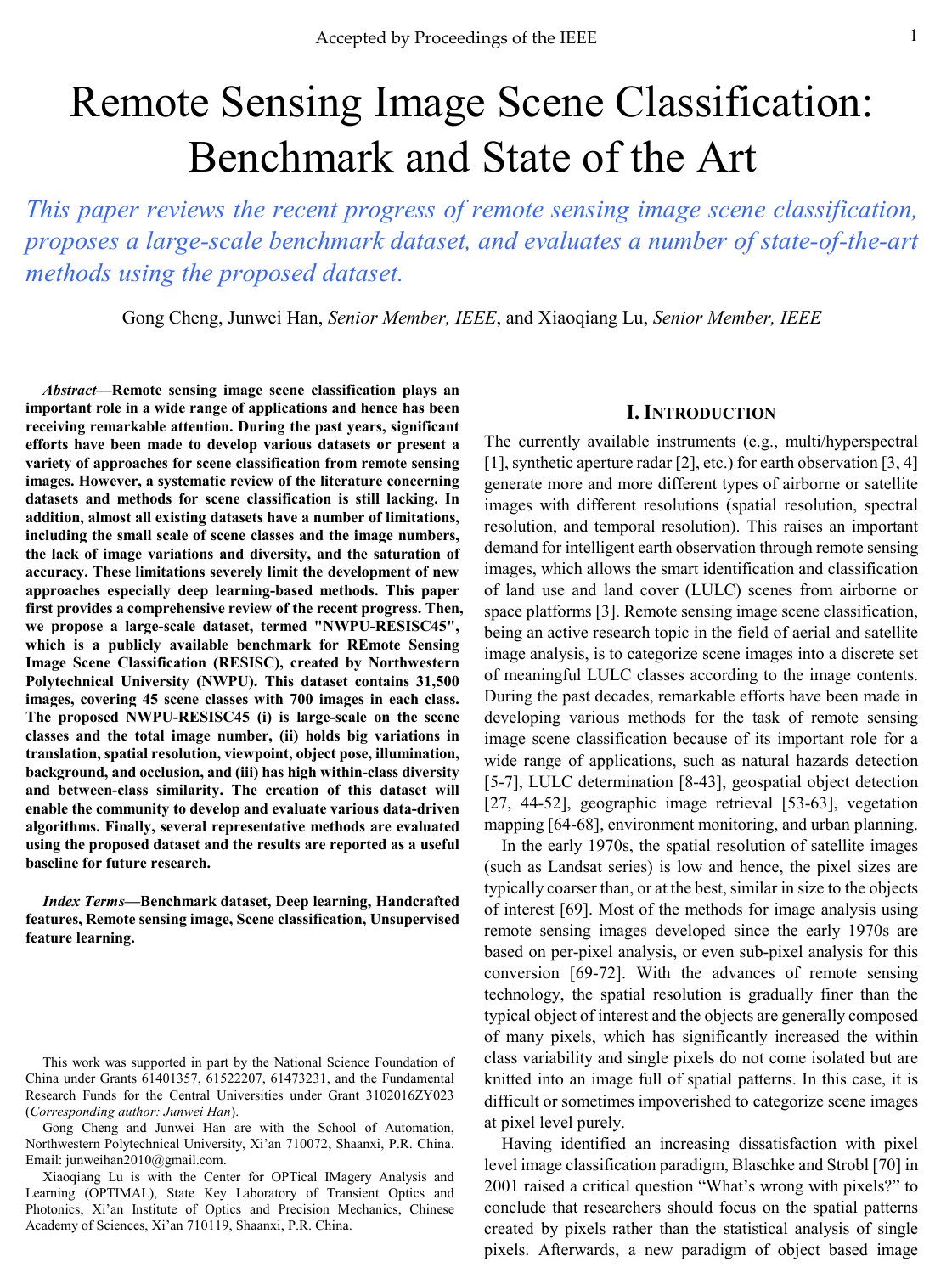
Remote Sensing Image Scene Classification: Benchmark and State of the Art
Gong Cheng, Junwei Han, Xiaoqiang Lu
Why you should read this
Introduces NWPU-RESISC45, a large-scale benchmark dataset of 31,500 images across 45 classes, paired with comprehensive baseline evaluations and a systematic survey to overcome data diversity and scale limitations in remote sensing scene classification.
Remote sensing image scene classification plays an important role in a wide range of applications and hence has been receiving remarkable attention. During the past years, significant efforts have been made to develop various datasets or present a variety of approaches for scene classification from remote sensing images. However, a systematic review of the literature concerning datasets and methods for scene classification is still lacking. In addition, almost all existing datasets have a number of limitations, including the small scale of scene classes and the image numbers, the lack of image variations and diversity, and the saturation of accuracy. These limitations severely limit the development of new approaches especially deep learning-based methods. This paper first provides a comprehensive review of the recent progress. Then, we propose a large-scale dataset, termed "NWPU-RESISC45", which is a publicly available benchmark for REmote Sensing Image Scene Classification (RESISC), created by Northwestern Polytechnical University (NWPU). This dataset contains 31,500 images, covering 45 scene classes with 700 images in each class. The proposed NWPU-RESISC45 (i) is large-scale on the scene classes and the total image number, (ii) holds big variations in translation, spatial resolution, viewpoint, object pose, illumination, background, and occlusion, and (iii) has high within-class diversity and between-class similarity. The creation of this dataset will enable the community to develop and evaluate various data-driven algorithms. Finally, several representative methods are evaluated using the proposed dataset and the results are reported as a useful baseline for future research.
Added
2026-09-14