Built independently by an author, for readers. Read the story and support ChapterPal

keyword

belief state

A belief state is an entity's internal mental representation of the world, reflecting what that individual perceives, assumes, or knows to be true at a given point in time. In cognitive science and artificial intelligence, modeling a belief state captures an agent's subjective perspective, which can include incomplete information or false beliefs that diverge from objective reality. These mental representations can operate at a first-order level, describing direct perceptions of the environment, or at higher-order levels, describing recursive inferences about the mental states of other individuals. Representing and tracking belief states is fundamental to social reasoning and theory of mind, enabling systems to interpret, predict, and explain human behavior, communication, and decision-making.

1 item

Minding Language Models' (Lack of) Theory of Mind: A Plug-and-Play Multi-Character Belief Tracker

Minding Language Models' (Lack of) Theory of Mind: A Plug-and-Play Multi-Character Belief Tracker

Melanie Sclar, Sachin Kumar, Peter West, Alane Suhr, Yejin Choi, Yulia Tsvetkov

OrganizationsAllen Institute for AICarnegie Mellon UniversityUniversity of Washington

Why you should read this

Introduces SYMBOLICTOM, a training-free decoding algorithm that tracks multi-character belief states using explicit symbolic graphs to dramatically boost the zero-shot theory-of-mind reasoning capabilities of off-the-shelf language models.

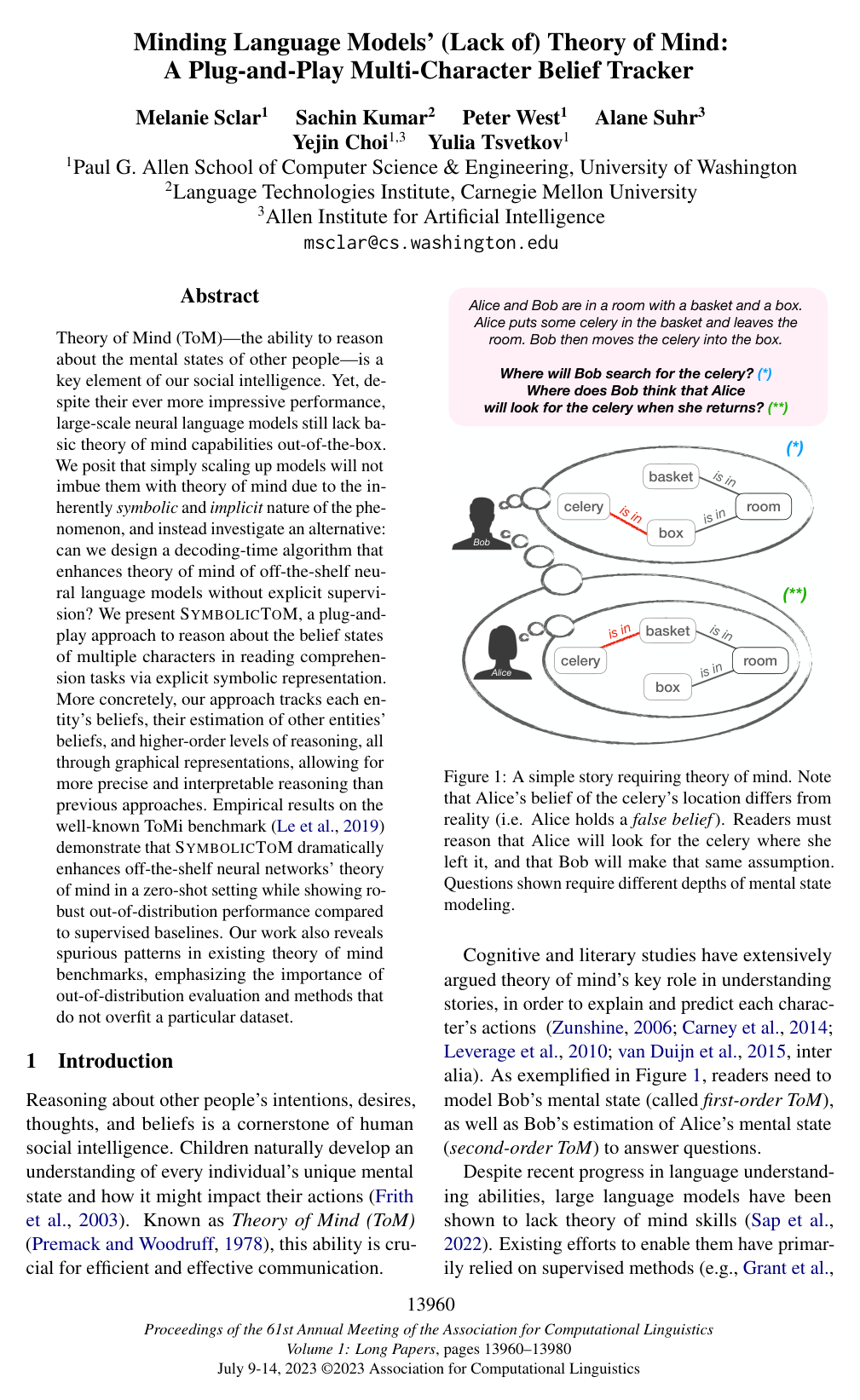
Theory of Mind (ToM)—the ability to reason about the mental states of other people—is a key element of our social intelligence. Yet, despite their ever more impressive performance, large-scale neural language models still lack basic theory of mind capabilities out-of-the-box. We posit that simply scaling up models will not imbue them with theory of mind due to the inherently symbolic and implicit nature of the phenomenon, and instead investigate an alternative: can we design a decoding-time algorithm that enhances theory of mind of off-the-shelf neural language models without explicit supervision? We present SYMBOLICTOM, a plug-and-play approach to reason about the belief states of multiple characters in reading comprehension tasks via explicit symbolic representation. More concretely, our approach tracks each entity’s beliefs, their estimation of other entities’ beliefs, and higher-order levels of reasoning, all through graphical representations, allowing for more precise and interpretable reasoning than previous approaches. Empirical results on the well-known ToMi benchmark (Le et al., 2019) demonstrate that SYMBOLICTOM dramatically enhances off-the-shelf neural networks’ theory of mind in a zero-shot setting while showing robust out-of-distribution performance compared to supervised baselines. Our work also reveals spurious patterns in existing theory of mind benchmarks, emphasizing the importance of out-of-distribution evaluation and methods that do not overfit a particular dataset.

Added

2026-09-26