
keyword
behavioral cloning
Behavioral cloning is an imitation learning method in machine learning and robotics where an artificial agent learns to perform a task by directly mimicking expert demonstrations through supervised learning. In this framework, a policy is trained to map observed states to corresponding expert actions by modeling the conditional probability distribution of actions given states, without relying on environment interactions or explicit reward signals during training. While it offers simplicity and computational efficiency by framing policy acquisition as a standard regression or classification problem, behavioral cloning can be vulnerable to compounding errors and covariate shift, where small deviations during execution lead the agent into unfamiliar states not covered by the training demonstrations.
4 items
Diffusion Model-Augmented Behavioral Cloning
Shang-Fu Chen, Hsiang-Chun Wang, Ming-Hao Hsu, Chun-Mao Lai, Shao-Hua Sun
Why you should read this
Proposes Diffusion Model-Augmented Behavioral Cloning (DBC), an imitation learning framework that overcomes policy generalization failures while maintaining fast inference by combining conditional behavioral cloning with a diffusion model trained over expert state-action pairs.
Imitation learning addresses the challenge of learning by observing an expert’s demonstrations without access to reward signals from environments. Most existing imitation learning methods that do not require interacting with environments either model the expert distribution as the conditional probability p(a|s) (e.g., behavioral cloning, BC) or the joint probability p(s, a). Despite the simplicity of modeling the conditional probability with BC, it usually struggles with generalization. While modeling the joint probability can improve generalization performance, the inference procedure is often time-consuming, and the model can suffer from manifold overfitting. This work proposes an imitation learning framework that benefits from modeling both the conditional and joint probability of the expert distribution. Our proposed Diffusion Model-Augmented Behavioral Cloning (DBC) employs a diffusion model trained to model expert behaviors and learns a policy to optimize both the BC loss (conditional) and our proposed diffusion model loss (joint). DBC outperforms baselines in various continuous control tasks in navigation, robot arm manipulation, dexterous manipulation, and locomotion. We design additional experiments to verify the limitations of modeling either the conditional probability or the joint probability of the expert distribution, as well as compare different generative models. Ablation studies justify the effectiveness of our design choices.
Added
2026-10-04
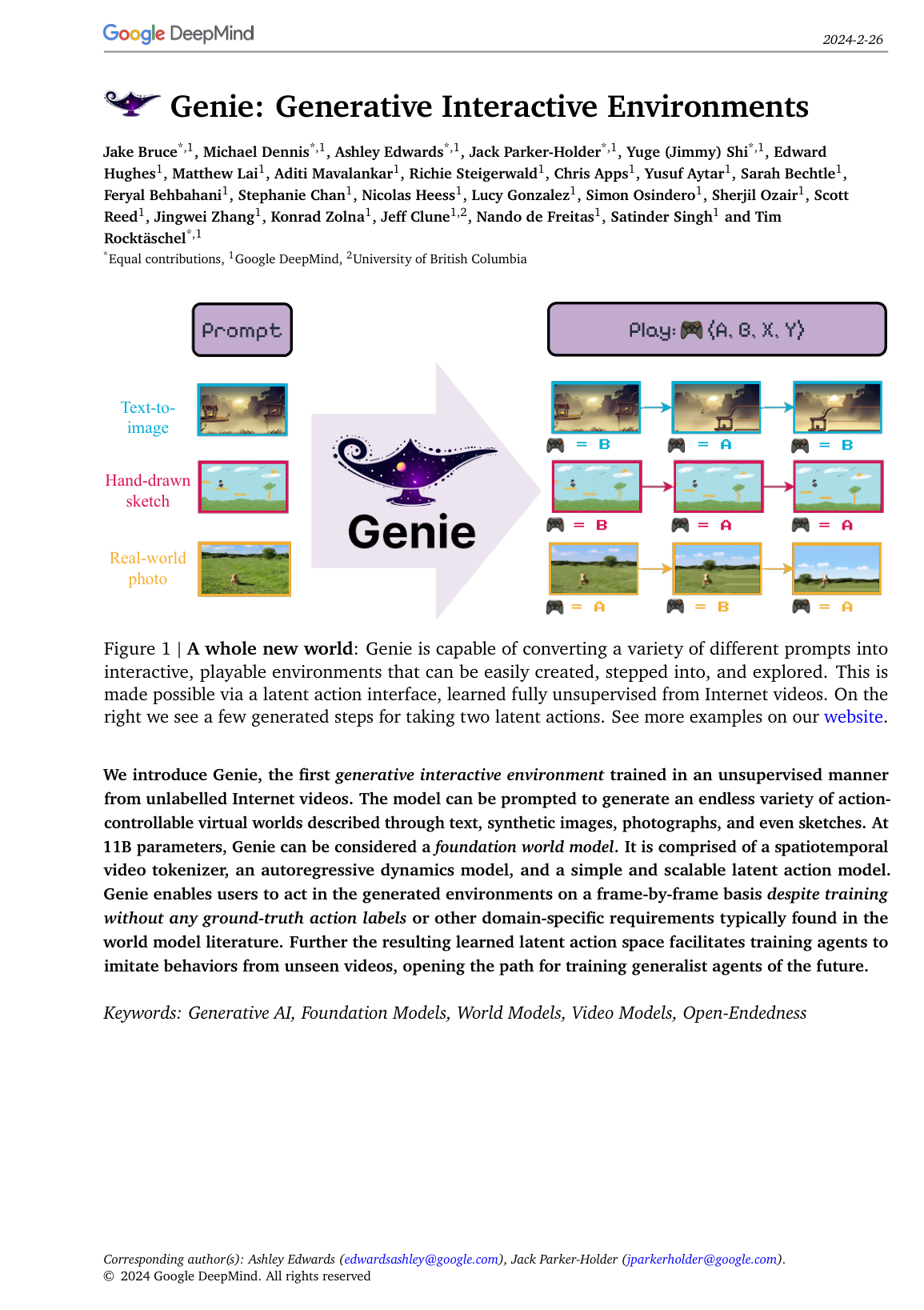
Genie: Generative Interactive Environments
Jake Bruce, Michael D. Dennis, Ashley Edwards, Jack Parker-Holder, Yuge Shi, Edward Hughes, Matthew Lai, Aditi Mavalankar, Richie Steigerwald, Chris Apps, Yusuf Aytar, Sarah Bechtle, Feryal M. P. Behbahani, Stephanie C. Y. Chan, Nicolas Heess, Lucy Gonzalez, Simon Osindero, Sherjil Ozair, Scott E. Reed, Jingwei Zhang, Konrad Zolna, Jeff Clune, Nando de Freitas, Satinder Singh, Tim Rocktäschel
Why you should read this
Presents Genie, an 11-billion-parameter foundation world model that learns controllable interactive environments and latent actions directly from unlabeled internet video, enabling users to generate and play virtual worlds from prompts as simple as a single image or sketch.
We introduce Genie, the first generative interactive environment trained in an unsupervised manner from unlabelled Internet videos. The model can be prompted to generate an endless variety of action-controllable virtual worlds described through text, synthetic images, photographs, and even sketches. At 11B parameters, Genie can be considered a foundation world model. It is comprised of a spatiotemporal video tokenizer, an autoregressive dynamics model, and a simple and scalable latent action model. Genie enables users to act in the generated environments on a frame-by-frame basis despite training without any ground-truth action labels or other domain-specific requirements typically found in the world model literature. Further the resulting learned latent action space facilitates training agents to imitate behaviors from unseen videos, opening the path for training generalist agents of the future.
Added
2026-09-28
LIBERO: Benchmarking Knowledge Transfer for Lifelong Robot Learning
Bo Liu, Yifeng Zhu, Chongkai Gao, Yihao Feng, Qian Liu, Yuke Zhu, Peter Stone
Why you should read this
Introduces a standardized robot manipulation benchmark with 130 procedurally generated tasks and human demonstrations to evaluate lifelong decision-making, revealing unexpected trade-offs in knowledge transfer, policy architectures, and pretraining strategies.
Lifelong learning offers a promising paradigm of building a generalist agent that learns and adapts over its lifespan. Unlike traditional lifelong learning problems in image and text domains, which primarily involve the transfer of declarative knowledge of entities and concepts, lifelong learning in decision-making (LLDM) also necessitates the transfer of procedural knowledge, such as actions and behaviors. To advance research in LLDM, we introduce LIBERO, a novel benchmark of lifelong learning for robot manipulation. Specifically, LIBERO highlights five key research topics in LLDM: 1) how to efficiently transfer declarative knowledge, procedural knowledge, or the mixture of both; 2) how to design effective policy architectures and 3) effective algorithms for LLDM; 4) the robustness of a lifelong learner with respect to task ordering; and 5) the effect of model pretraining for LLDM. We develop an extendible procedural generation pipeline that can in principle generate infinitely many tasks. For benchmarking purpose, we create four task suites (130 tasks in total) that we use to investigate the above-mentioned research topics. To support sample-efficient learning, we provide high-quality human-teleoperated demonstration data for all tasks. Our extensive experiments present several insightful or even unexpected discoveries: sequential finetuning outperforms existing lifelong learning methods in forward transfer, no single visual encoder architecture excels at all types of knowledge transfer, and naive supervised pretraining can hinder agents' performance in the subsequent LLDM. Check the website at this https URL for the code and the datasets.
Added
2026-09-24
Generative Adversarial Imitation Learning
Jonathan Ho, Stefano Ermon
Why you should read this
Proposes a model-free imitation learning framework that bypasses the computational bottleneck of inverse reinforcement learning by directly matching expert state-action distributions using generative adversarial training.
Consider learning a policy from example expert behavior, without interaction with the expert or access to reinforcement signal. One approach is to recover the expert's cost function with inverse reinforcement learning, then extract a policy from that cost function with reinforcement learning. This approach is indirect and can be slow. We propose a new general framework for directly extracting a policy from data, as if it were obtained by reinforcement learning following inverse reinforcement learning. We show that a certain instantiation of our framework draws an analogy between imitation learning and generative adversarial networks, from which we derive a model-free imitation learning algorithm that obtains significant performance gains over existing model-free methods in imitating complex behaviors in large, high-dimensional environments.
Added
2026-09-11