Built independently by an author, for readers. Read the story and support ChapterPal

keyword

batch edits

Batch edits refer to the simultaneous modification of multiple specific pieces of knowledge, facts, or targeted behaviors within a trained machine learning model in a single update step. Instead of altering a model sequentially one correction at a time, batch editing applies optimization algorithms to incorporate large groups of updates concurrently into the model parameters or internal representations. This process is designed to improve computational efficiency and scalability when rectifying outdated or incorrect information, while aiming to preserve the model general capabilities and prevent collateral damage or performance degradation on unrelated knowledge.

1 item

Editing Large Language Models: Problems, Methods, and Opportunities

Editing Large Language Models: Problems, Methods, and Opportunities

Yunzhi Yao, Peng Wang, Bozhong Tian, Siyuan Cheng, Zhoubo Li, Shumin Deng, Huajun Chen, Ningyu Zhang

OrganizationsDonghai LaboratoryNational University of SingaporeNUS-NCS Joint LabZhejiang UniversityZhejiang University - Ant Group Joint Laboratory of Knowledge Graph

Why you should read this

Presents a unified taxonomy and empirical evaluation of large language model editing techniques across multiple architectures and settings, providing a standardized benchmark to assess reliability, generalization, locality, and computational efficiency.

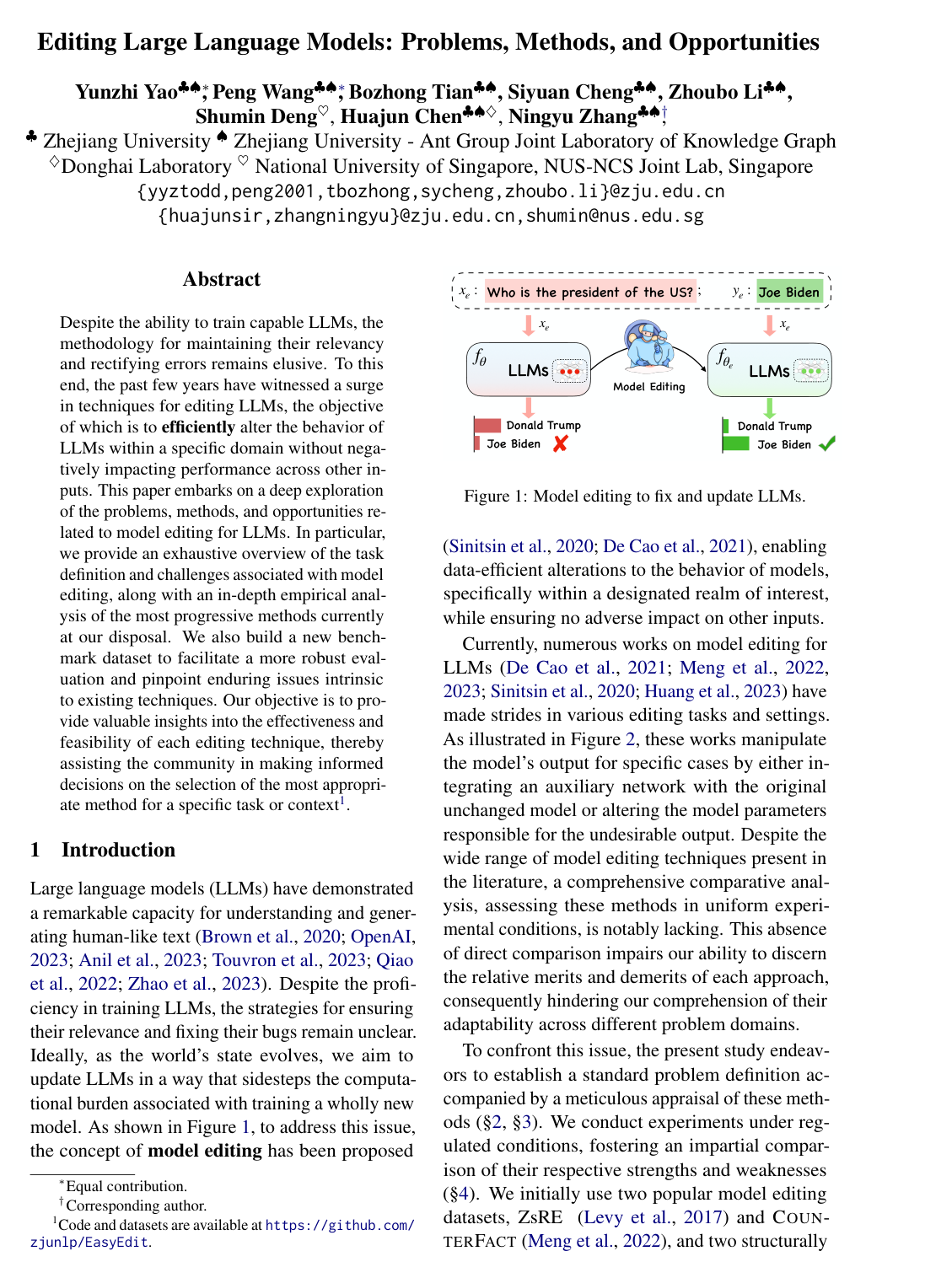
Despite the ability to train capable LLMs, the methodology for maintaining their relevancy and rectifying errors remains elusive. To this end, the past few years have witnessed a surge in techniques for editing LLMs, the objective of which is to efficiently alter the behavior of LLMs within a specific domain without negatively impacting performance across other inputs. This paper embarks on a deep exploration of the problems, methods, and opportunities related to model editing for LLMs. In particular, we provide an exhaustive overview of the task definition and challenges associated with model editing, along with an in-depth empirical analysis of the most progressive methods currently at our disposal. We also build a new benchmark dataset to facilitate a more robust evaluation and pinpoint enduring issues intrinsic to existing techniques. Our objective is to provide valuable insights into the effectiveness and feasibility of each editing technique, thereby assisting the community in making informed decisions on the selection of the most appropriate method for a specific task or context¹.

Added

2026-09-29