
Built independently by an author, for readers. Read the story and support ChapterPal

keyword

backdoor removal methods

Backdoor removal methods are machine learning security techniques designed to eliminate hidden malicious triggers and behaviors from compromised neural networks while preserving their standard performance on benign data. When an artificial intelligence model is poisoned during training, it can function normally on standard inputs yet produce attacker-specified outputs whenever a specific trigger pattern is present. Backdoor removal methods sanitize these infected models post-training using strategies such as fine-tuning, machine unlearning, knowledge distillation, trigger inversion, and neuron pruning to detect and deactivate backdoor-related parameters. By repairing the network weights and architecture using a limited set of verified clean data, these defenses restore model safety and integrity without the need to retrain the entire network from scratch.

1 item
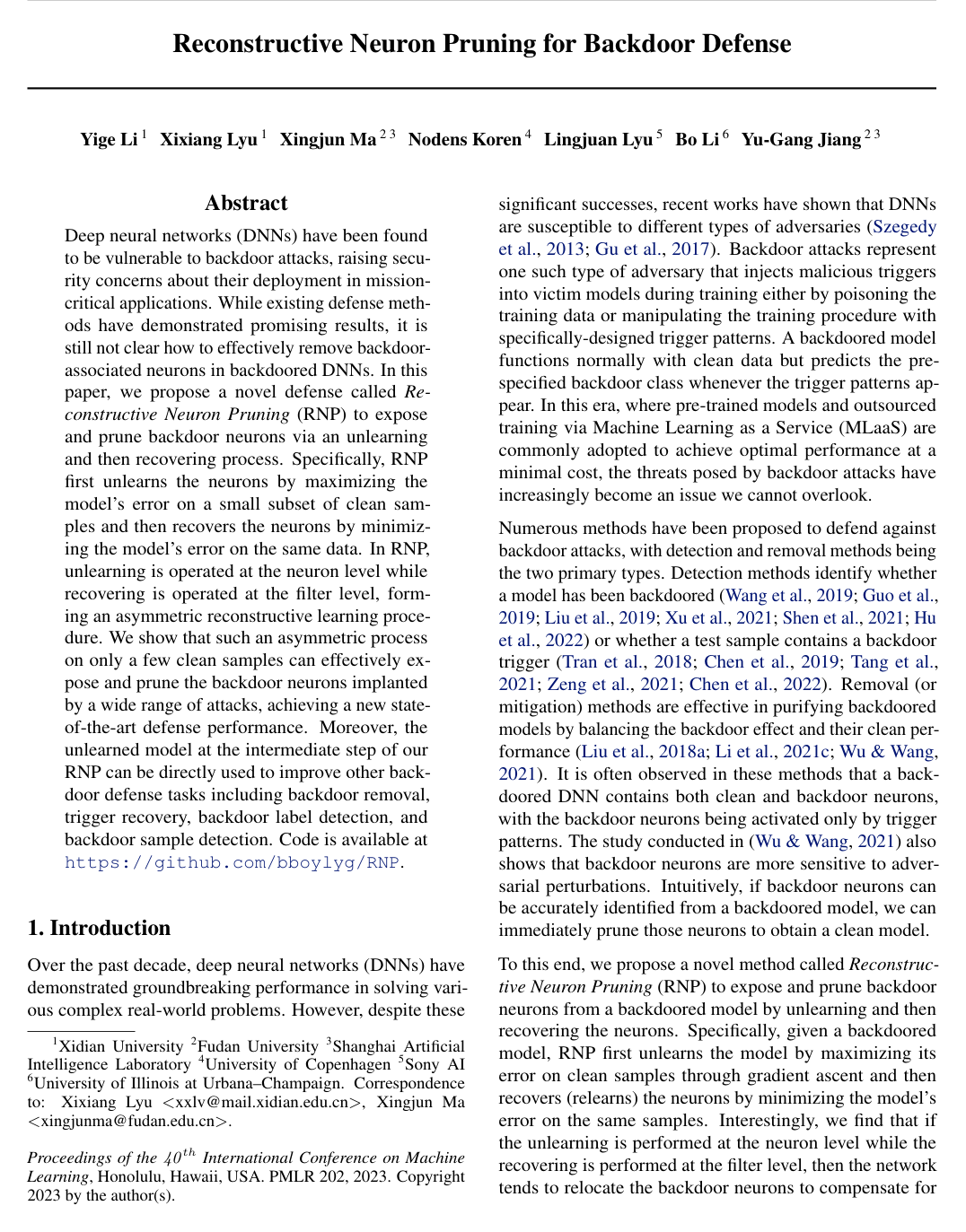
Reconstructive Neuron Pruning for Backdoor Defense

Reconstructive Neuron Pruning for Backdoor Defense

Yige Li, Xixiang Lyu, Xingjun Ma, Nodens Koren, Lingjuan Lyu, Bo Li, Yu-Gang Jiang

OrganizationsFudan UniversityShanghai Artificial Intelligence LaboratorySony CorporationUniversity of CopenhagenUniversity of Illinois Urbana-ChampaignXidian University

Why you should read this

Proposes an asymmetric unlearning and filter-recovery framework that exposes and prunes backdoor neurons using only a small set of clean data, effectively purifying backdoored models across diverse attacks without sacrificing clean classification accuracy.

Deep neural networks (DNNs) have been found to be vulnerable to backdoor attacks, raising security concerns about their deployment in mission-critical applications. While existing defense methods have demonstrated promising results, it is still not clear how to effectively remove backdoor-associated neurons in backdoored DNNs. In this paper, we propose a novel defense called Reconstructive Neuron Pruning (RNP) to expose and prune backdoor neurons via an unlearning and then recovering process. Specifically, RNP first unlearns the neurons by maximizing the model’s error on a small subset of clean samples and then recovers the neurons by minimizing the model’s error on the same data. In RNP, unlearning is operated at the neuron level while recovering is operated at the filter level, forming an asymmetric reconstructive learning procedure. We show that such an asymmetric process on only a few clean samples can effectively expose and prune the backdoor neurons implanted by a wide range of attacks, achieving a new state-of-the-art defense performance. Moreover, the unlearned model at the intermediate step of our RNP can be directly used to improve other backdoor defense tasks including backdoor removal, trigger recovery, backdoor label detection, and backdoor sample detection. Code is available at https://github.com/bboylyg/RNP.

Added

2026-09-26