
Built independently by an author, for readers. Read the story and support ChapterPal

keyword

automatic factuality assessment

Automatic factuality assessment is the computational process of evaluating whether computer-generated or transformed text remains factually accurate and faithful to an underlying source or established reference. In natural language processing tasks such as text summarization, simplification, and dialogue generation, automated models frequently risk generating hallucinations, contradictions, or unsupported claims. To detect these inconsistencies without relying on time-consuming human review, automatic factuality assessment employs algorithmic techniques—such as natural language inference, question generation and answering, and specialized consistency metrics—to measure the degree of semantic and factual alignment between the generated output and the original input. This evaluation is critical for ensuring the reliability, truthfulness, and safety of automated language technologies across high-stakes domains like healthcare, journalism, and education.

1 item
Evaluating Factuality in Text Simplification

Evaluating Factuality in Text Simplification

Ashwin Devaraj, William Sheffield, Byron C. Wallace, Junyi Jessy Li

OrganizationsComputer ScienceLinguisticsMathematicsNortheastern UniversityUniversity of Texas at Austin

Why you should read this

Presents a taxonomy of factual errors in text simplification, revealing that standard evaluation metrics fail to detect frequent information insertions, deletions, and substitutions in both benchmark datasets and model outputs.

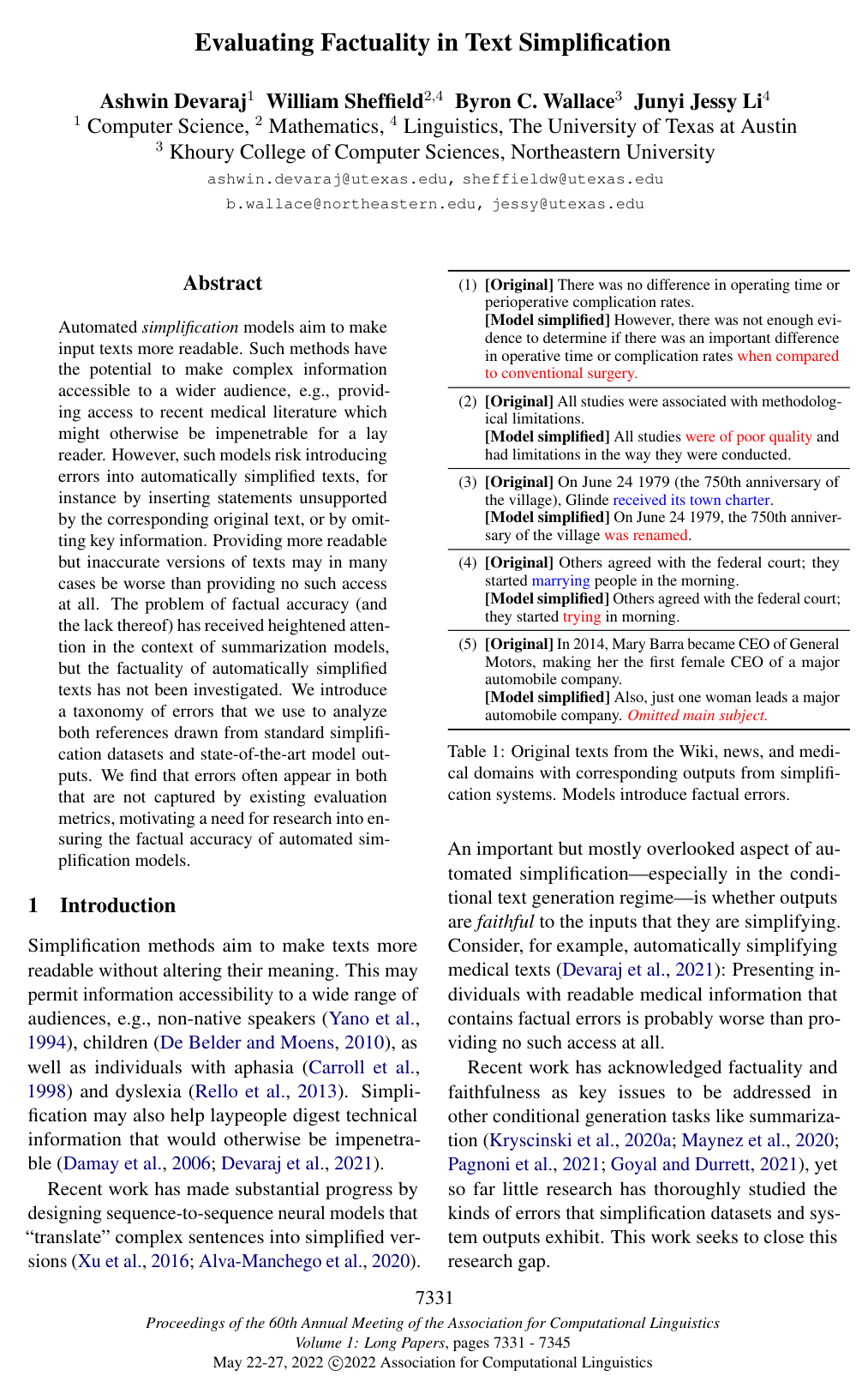
Automated simplification models aim to make input texts more readable. Such methods have the potential to make complex information accessible to a wider audience, e.g., providing access to recent medical literature which might otherwise be impenetrable for a lay reader. However, such models risk introducing errors into automatically simplified texts, for instance by inserting statements unsupported by the corresponding original text, or by omitting key information. Providing more readable but inaccurate versions of texts may in many cases be worse than providing no such access at all. The problem of factual accuracy (and the lack thereof) has received heightened attention in the context of summarization models, but the factuality of automatically simplified texts has not been investigated. We introduce a taxonomy of errors that we use to analyze both references drawn from standard simplification datasets and state-of-the-art model outputs. We find that errors often appear in both that are not captured by existing evaluation metrics, motivating a need for research into ensuring the factual accuracy of automated simplification models.

Added

2026-10-03