
keyword
Audio Retrieval
Audio retrieval is the process and computational task of searching, identifying, and extracting relevant audio recordings or sound segments from a database based on a user query. Queries can be provided in diverse formats, including natural language text descriptions, audio samples, acoustic tags, or multimodal inputs combining text, video, and speech. Modern audio retrieval systems commonly employ deep learning techniques, feature extraction, and joint representation models to map acoustic signals and query representations into a shared embedding space, allowing the system to measure semantic or acoustic similarity and rank results effectively. This technology supports a wide range of applications, including music search, sound event identification, multimedia content cataloging, and automated media indexing.
2 items
Pengi: An Audio Language Model for Audio Tasks
Soham Deshmukh, Benjamin Elizalde, Rita Singh, Huaming Wang
Why you should read this
Introduces Pengi, an audio language model that unifies diverse audio tasks into a text-generation framework by prompting a frozen language model with audio and text embeddings, achieving state-of-the-art performance across 22 benchmarks without task-specific fine-tuning.
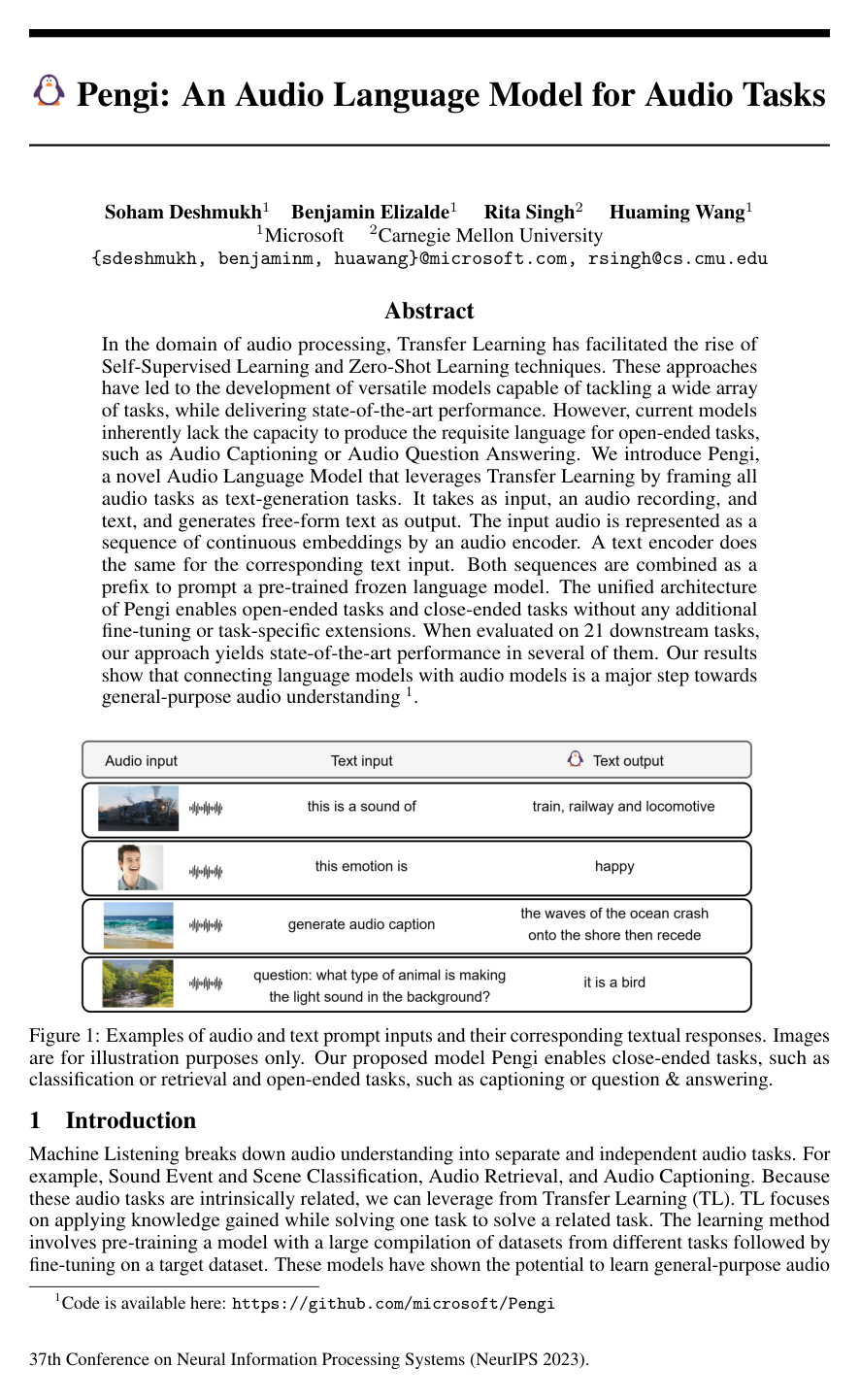
In the domain of audio processing, Transfer Learning has facilitated the rise of Self-Supervised Learning and Zero-Shot Learning techniques. These approaches have led to the development of versatile models capable of tackling a wide array of tasks, while delivering state-of-the-art performance. However, current models inherently lack the capacity to produce the requisite language for open-ended tasks, such as Audio Captioning or Audio Question & Answering. We introduce Pengi, a novel Audio Language Model that leverages Transfer Learning by framing all audio tasks as text-generation tasks. It takes as input, an audio recording, and text, and generates free-form text as output. The input audio is represented as a sequence of continuous embeddings by an audio encoder. A text encoder does the same for the corresponding text input. Both sequences are combined as a prefix to prompt a pre-trained frozen language model. The unified architecture of Pengi enables open-ended tasks and close-ended tasks without any additional fine-tuning or task-specific extensions. When evaluated on 22 downstream tasks, our approach yields state-of-the-art performance in several of them. Our results show that connecting language models with audio models is a major step towards general-purpose audio understanding
Added
2026-09-26
VAST: A Vision-Audio-Subtitle-Text Omni-Modality Foundation Model and Dataset
Sihan Chen, Handong Li, Qunbo Wang, Zijia Zhao, Mingzhen Sun, Xinxin Zhu, Jing Liu
Why you should read this
Presents VAST-27M, an automatically generated 27-million-clip omni-modality video caption dataset, along with a unified foundation model capable of processing vision, audio, subtitles, and text across diverse retrieval, captioning, and question-answering tasks.
Vision and text have been fully explored in contemporary video-text foudational models, while other modalities such as audio and subtitles in videos have not received sufficient attention. In this paper, we resort to establish connections between multi-modality video tracks, including Vision, Audio, and Subtitle, and Text by exploring an automatically generated large-scale omni-modality video caption dataset called VAST-27M. Specifically, we first collect 27 million open-domain video clips and separately train a vision and an audio captioner to generate vision and audio captions. Then, we employ an off-the-shelf Large Language Model (LLM) to integrate the generated captions, together with subtitles and instructional prompts into omni-modality captions. Based on the proposed VAST-27M dataset, we train an omni-modality video-text foundational model named VAST, which can perceive and process vision, audio, and subtitle modalities from video, and better support various tasks including vision-text, audio-text, and multi-modal video-text tasks (retrieval, captioning and QA). Extensive experiments have been conducted to demonstrate the effectiveness of our proposed VAST-27M corpus and VAST foundation model. VAST achieves 22 new state-of-the-art results on various cross-modality benchmarks. Code, model and dataset will be released at https://github.com/TXH-mercury/VAST.
Added
2026-09-26