
keyword
attribute-based classification
Attribute-based classification is a machine learning paradigm that categorizes data instances by first predicting an intermediate set of high-level semantic properties or descriptive characteristics rather than directly mapping low-level input features to class labels. In this framework, a model learns to detect shared traits, such as physical parts, colors, shapes, or behaviors, across various categories. Final class assignments are determined by matching these detected traits against predefined attribute profiles corresponding to each class. By decoupling feature extraction from specific class identities, this approach enables systems to recognize novel or previously unseen classes based solely on descriptive signatures, making it a foundational technique in transfer learning and zero-shot learning.
2 items
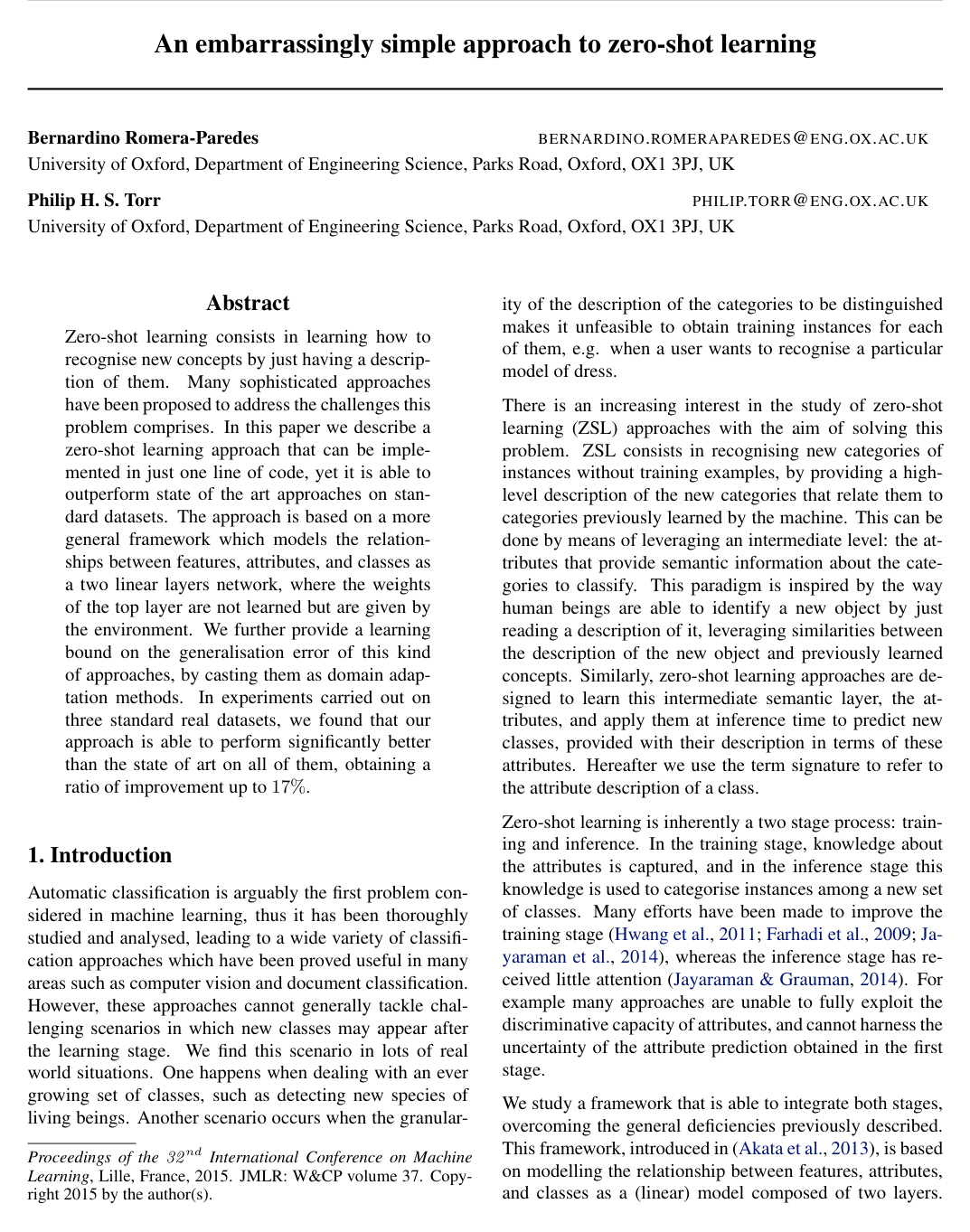
An embarrassingly simple approach to zero-shot learning
Bernardino Romera-Paredes, Philip H. S. Torr
Why you should read this
Proposes a two-layer linear framework for zero-shot learning that is implementable in a single line of code, establishes theoretical generalization bounds through domain adaptation, and surpasses complex state-of-the-art methods across standard benchmarks by up to 17%.
Zero-shot learning consists in learning how to recognise new concepts by just having a description of them. Many sophisticated approaches have been proposed to address the challenges this problem comprises. In this paper we describe a zero-shot learning approach that can be implemented in just one line of code, yet it is able to outperform state of the art approaches on standard datasets. The approach is based on a more general framework which models the relationships between features, attributes, and classes as a two linear layers network, where the weights of the top layer are not learned but are given by the environment. We further provide a learning bound on the generalisation error of this kind of approaches, by casting them as domain adaptation methods. In experiments carried out on three standard real datasets, we found that our approach is able to perform significantly better than the state of art on all of them, obtaining a ratio of improvement up to 17%.
Added
2026-09-25
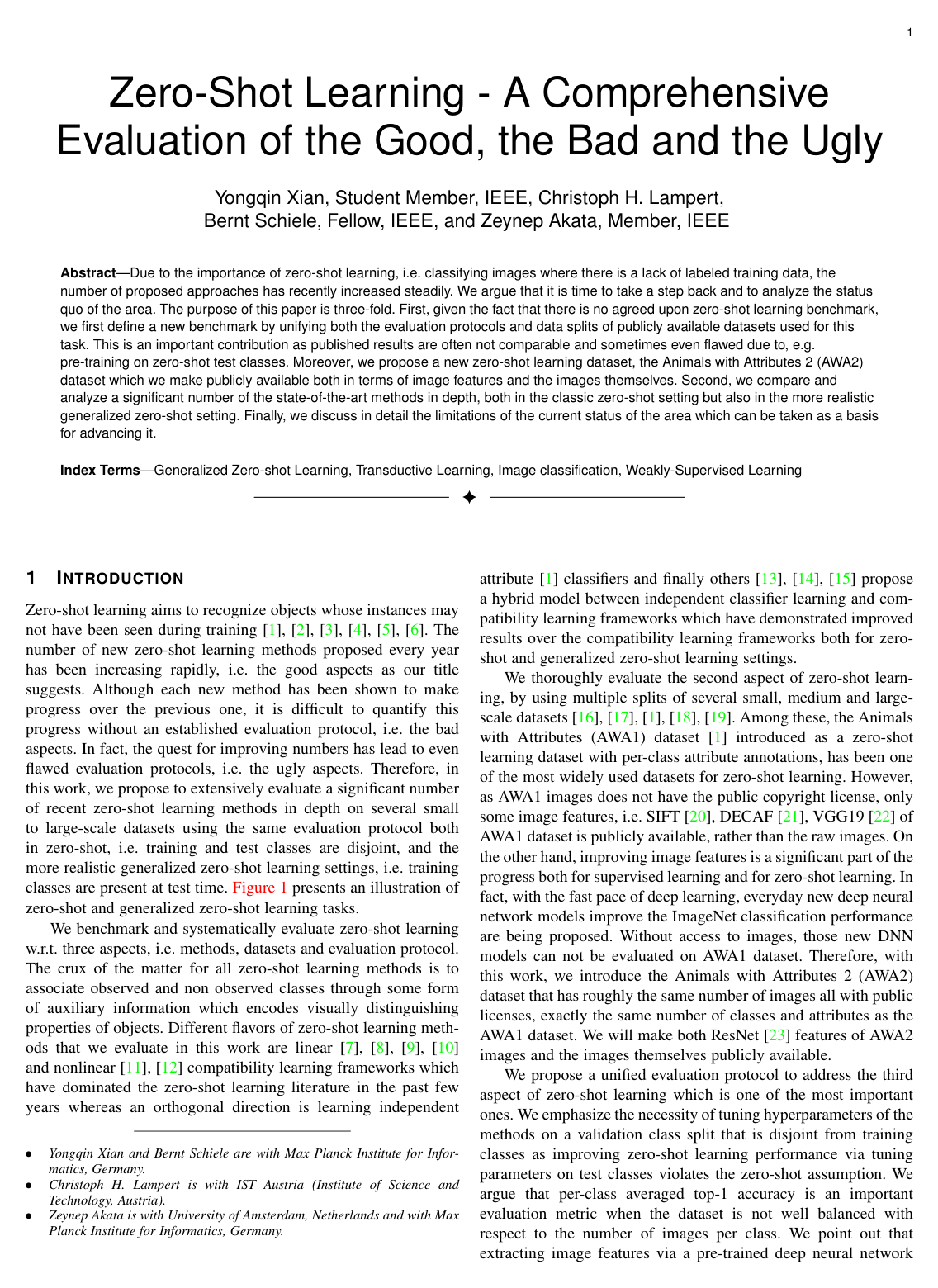
Zero-Shot Learning—A Comprehensive Evaluation of the Good, the Bad and the Ugly
Yongqin Xian, Christoph H. Lampert, Bernt Schiele, Zeynep Akata
Why you should read this
Establishes a unified evaluation benchmark and standardized data splits to resolve widespread test-set overlap in zero-shot learning, while introducing the Animals with Attributes 2 (AWA2) dataset and systematically comparing leading methods under both standard and generalized settings.
Due to the importance of zero-shot learning, i.e. classifying images where there is a lack of labeled training data, the number of proposed approaches has recently increased steadily. We argue that it is time to take a step back and to analyze the status quo of the area. The purpose of this paper is three-fold. First, given the fact that there is no agreed upon zero-shot learning benchmark, we first define a new benchmark by unifying both the evaluation protocols and data splits of publicly available datasets used for this task. This is an important contribution as published results are often not comparable and sometimes even flawed due to, e.g. pre-training on zero-shot test classes. Moreover, we propose a new zero-shot learning dataset, the Animals with Attributes 2 (AWA2) dataset which we make publicly available both in terms of image features and the images themselves. Second, we compare and analyze a significant number of the state-of-the-art methods in depth, both in the classic zero-shot setting but also in the more realistic generalized zero-shot setting. Finally, we discuss in detail the limitations of the current status of the area which can be taken as a basis for advancing it.
Added
2026-09-18