
keyword
attention sinks
Attention sinks refer to an emergent phenomenon in transformer-based autoregressive language models where the self-attention mechanism consistently assigns disproportionately high attention scores to the initial tokens of an input sequence regardless of their semantic importance. Because the softmax normalization across attention heads requires all attention weights to sum to one, the earliest sequence positions naturally absorb excess or unneeded attention mass across multiple layers, serving as numerical baselines or storage sinks for residual probability. Retaining the key-value cache representations of these initial sink tokens is essential in long-context and streaming architectures, as evicting them from sliding-window attention mechanisms disrupts internal activation distributions and severely impairs generation stability and coherence.
11 items
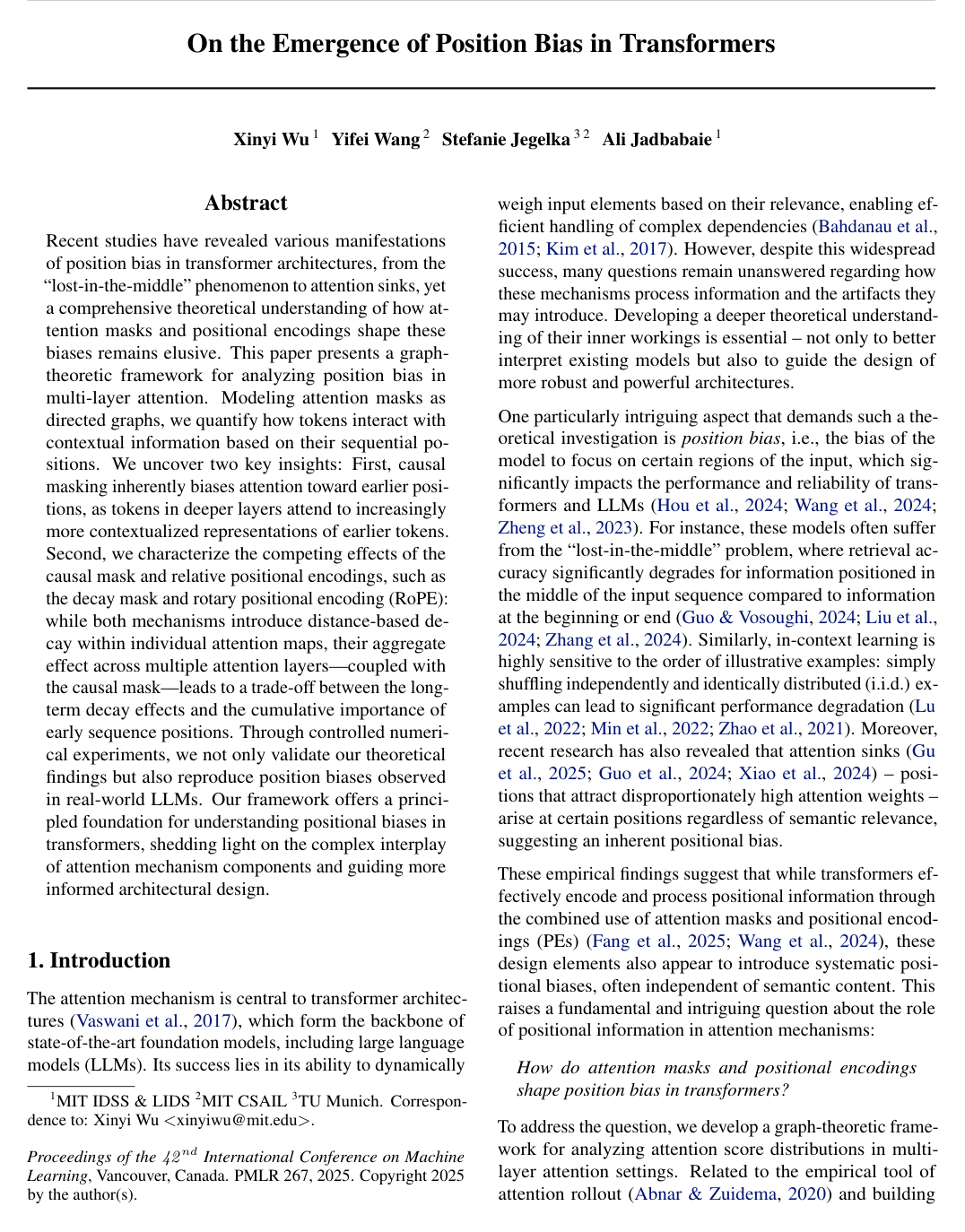
On the Emergence of Position Bias in Transformers
Xinyi Wu, Yifei Wang, Stefanie Jegelka, Ali Jadbabaie
Why you should read this
Develops a graph-theoretic framework that mathematically explains how multi-layer causal masking and relative positional encodings interact across depth to produce systematic position biases such as attention sinks and the lost-in-the-middle effect in transformers.
Recent studies have revealed various manifestations of position bias in transformer architectures, from the “lost-in-the-middle” phenomenon to attention sinks, yet a comprehensive theoretical understanding of how attention masks and positional encodings shape these biases remains elusive. This paper presents a graph-theoretic framework for analyzing position bias in multi-layer attention. Modeling attention masks as directed graphs, we quantify how tokens interact with contextual information based on their sequential positions. We uncover two key insights: First, causal masking inherently biases attention toward earlier positions, as tokens in deeper layers attend to increasingly more contextualized representations of earlier tokens. Second, we characterize the competing effects of the causal mask and relative positional encodings, such as the decay mask and rotary positional encoding (RoPE): while both mechanisms introduce distance-based decay within individual attention maps, their aggregate effect across multiple attention layers—coupled with the causal mask—leads to a trade-off between the long-term decay effects and the cumulative importance of early sequence positions. Through controlled numerical experiments, we not only validate our theoretical findings but also reproduce position biases observed in real-world LLMs. Our framework offers a principled foundation for understanding positional biases in transformers, shedding light on the complex interplay of attention mechanism components and guiding more informed architectural design.
Added
2026-10-05
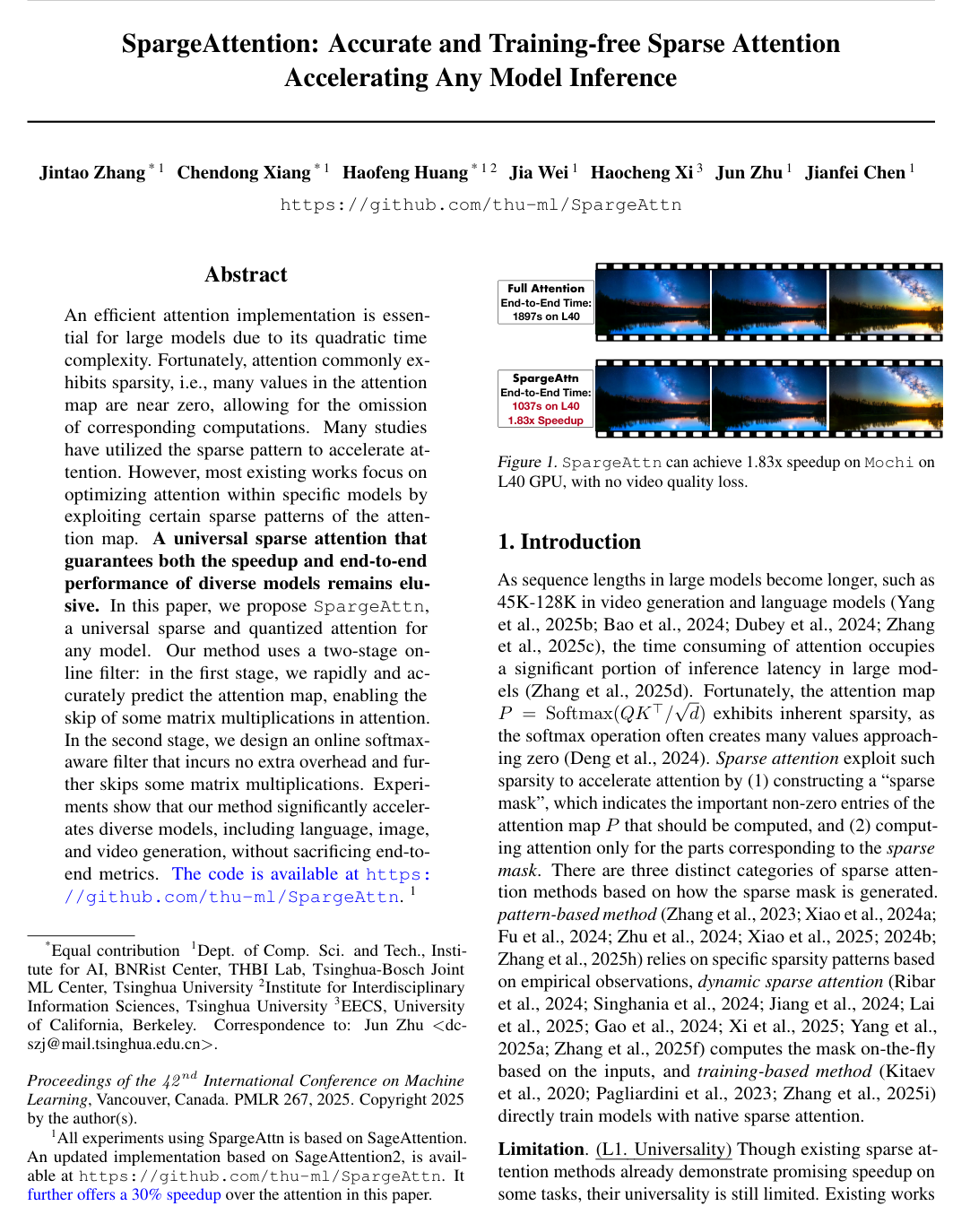
SpargeAttention: Accurate and Training-free Sparse Attention Accelerating Any Model Inference
Jintao Zhang, Chendong Xiang, Haofeng Huang, Jia Wei, Haocheng Xi, Jun Zhu, Jianfei Chen
Why you should read this
Proposes SpargeAttn, a training-free sparse attention mechanism that uses a two-stage online filter to accelerate inference across language, image, and video models without degrading output quality.
An efficient attention implementation is essential for large models due to its quadratic time complexity. Fortunately, attention commonly exhibits sparsity, i.e., many values in the attention map are near zero, allowing for the omission of corresponding computations. Many studies have utilized the sparse pattern to accelerate attention. However, most existing works focus on optimizing attention within specific models by exploiting certain sparse patterns of the attention map. A universal sparse attention that guarantees both the speedup and end-to-end performance of diverse models remains elusive. In this paper, we propose SpargeAttn, a universal sparse and quantized attention for any model. Our method uses a two-stage online filter: in the first stage, we rapidly and accurately predict the attention map, enabling the skip of some matrix multiplications in attention. In the second stage, we design an online softmax-aware filter that incurs no extra overhead and further skips some matrix multiplications. Experiments show that our method significantly accelerates diverse models, including language, image, and video generation, without sacrificing end-to-end metrics. The code is available at https://github.com/thu-ml/SpargeAttn.
Added
2026-10-02
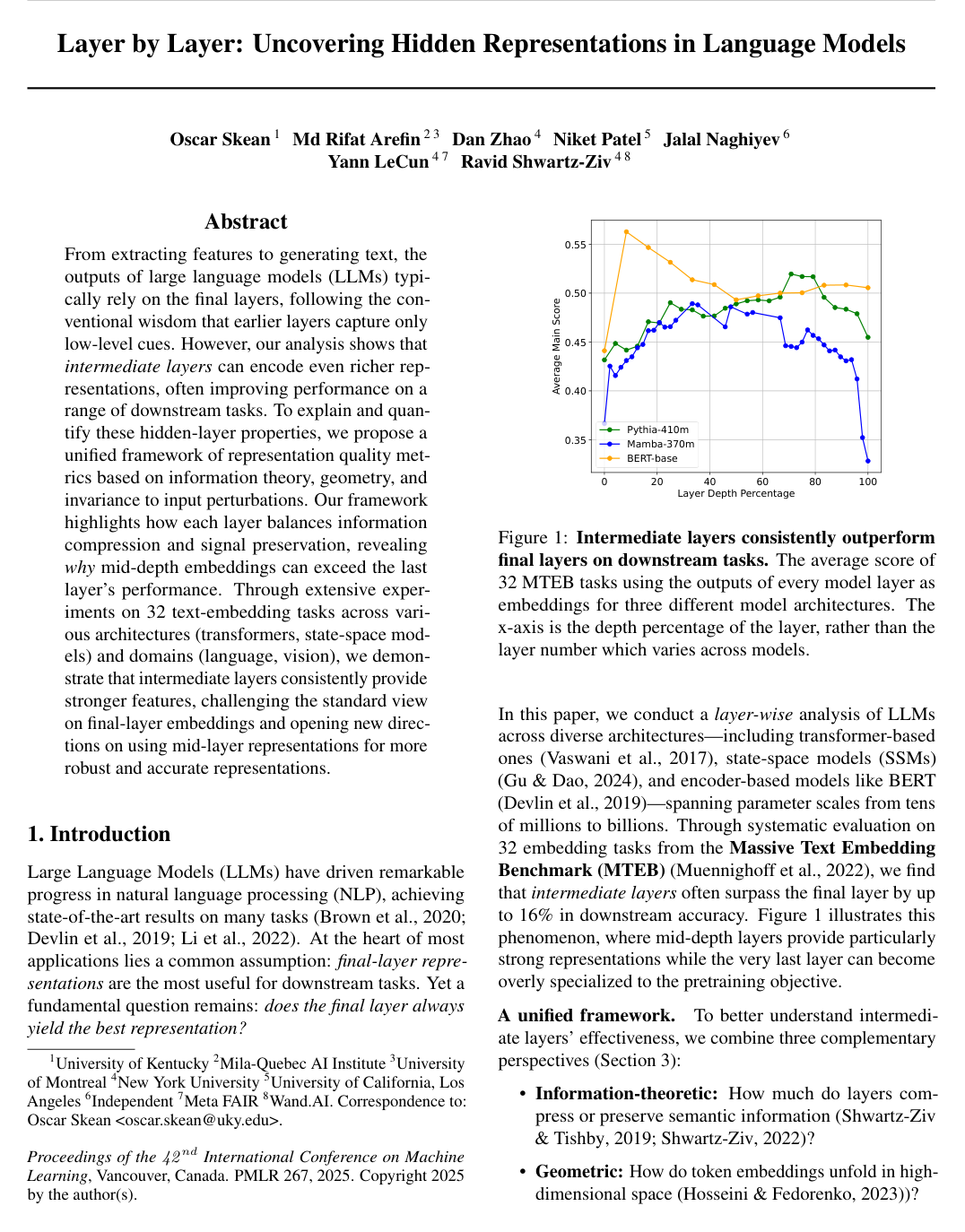
Layer by Layer: Uncovering Hidden Representations in Language Models
Oscar Skean, Md Rifat Arefin, Dan Zhao, Niket Patel, Jalal Naghiyev, Yann LeCun, Ravid Shwartz-Ziv
Why you should read this
Demonstrates that intermediate layers in language models consistently produce richer representations than the final layer, introducing a geometric and information-theoretic framework that explains why mid-depth embeddings achieve superior performance across diverse downstream tasks.
From extracting features to generating text, the outputs of large language models (LLMs) typically rely on the final layers, following the conventional wisdom that earlier layers capture only low-level cues. However, our analysis shows that intermediate layers can encode even richer representations, often improving performance on a range of downstream tasks. To explain and quantify these hidden-layer properties, we propose a unified framework of representation quality metrics based on information theory, geometry, and invariance to input perturbations. Our framework highlights how each layer balances information compression and signal preservation, revealing why mid-depth embeddings can exceed the last layer's performance. Through extensive experiments on 32 text-embedding tasks across various architectures (transformers, state-space models) and domains (language, vision), we demonstrate that intermediate layers consistently provide stronger features, challenging the standard view on final-layer embeddings and opening new directions on using mid-layer representations for more robust and accurate representations.
Added
2026-09-28
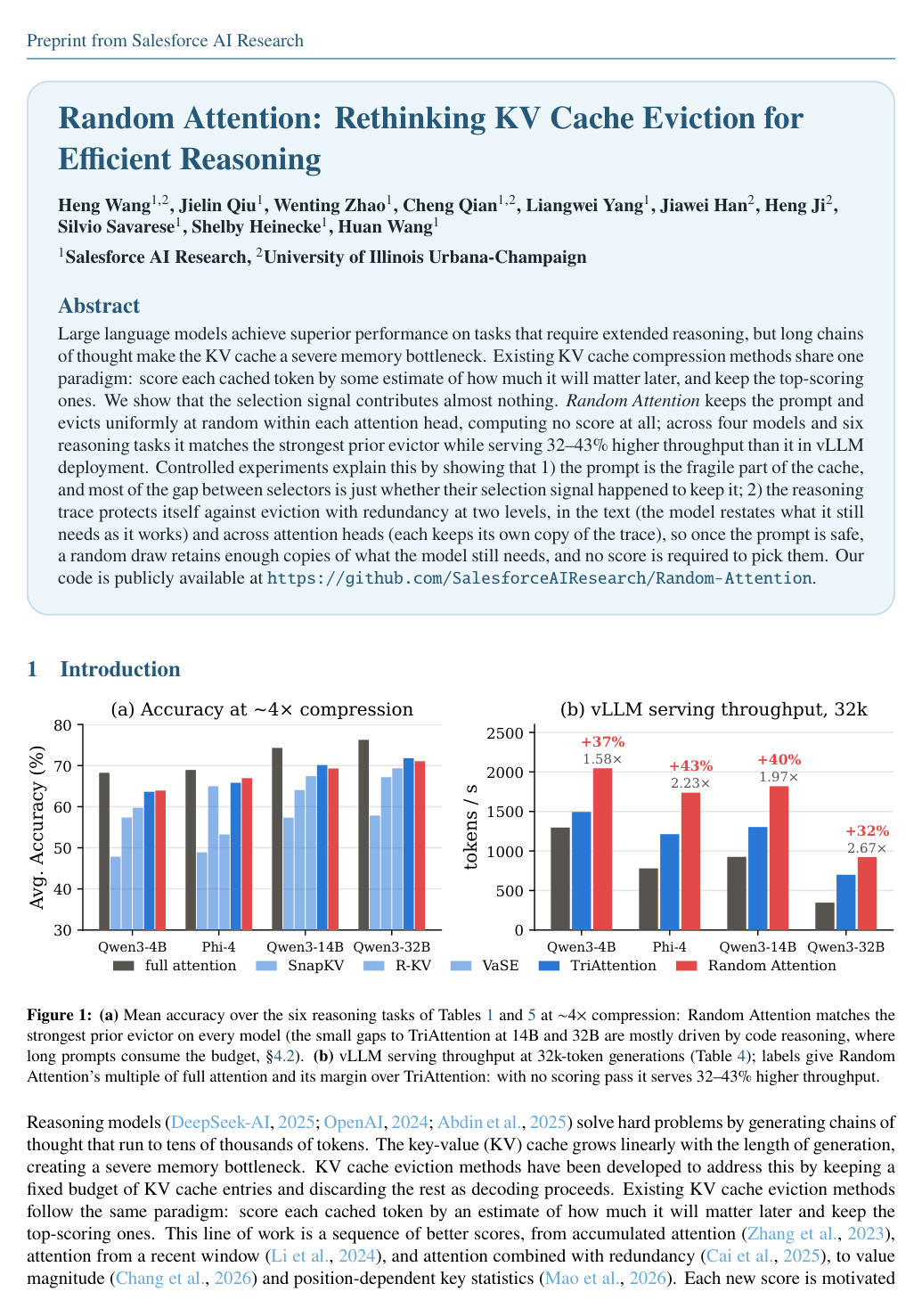
Random Attention: Rethinking KV Cache Eviction for Efficient Reasoning
Heng Wang, Jielin Qiu, Wenting Zhao, Cheng Qian, Liangwei Yang, Jiawei Han, Heng Ji, Silvio Savarese, Shelby Heinecke, Huan Wang
Why you should read this
Demonstrates that complex token scoring in key-value cache eviction is unnecessary for large language model reasoning, showing that retaining the prompt and evicting cached tokens uniformly at random preserves accuracy due to inherent trace redundancy while increasing serving throughput by 32–43%.
Large language models achieve superior performance on tasks that require extended reasoning, but long chains of thought make the KV cache a severe memory bottleneck. Existing KV cache compression methods share one paradigm: score each cached token by some estimate of how much it will matter later, and keep the top-scoring ones. We show that the selection signal contributes almost nothing. Random Attention keeps the prompt and evicts uniformly at random within each attention head, computing no score at all; across four models and six reasoning tasks it matches the strongest prior evictor while serving 32-43% higher throughput than it in vLLM deployment. Controlled experiments explain this by showing that 1) the prompt is the fragile part of the cache, and most of the gap between selectors is just whether their selection signal happened to keep it; 2) the reasoning trace protects itself against eviction with redundancy at two levels, in the text (the model restates what it still needs as it works) and across attention heads (each keeps its own copy of the trace), so once the prompt is safe, a random draw retains enough copies of what the model still needs, and no score is required to pick them. Our code is publicly available at this https URL.
Added
2026-09-24

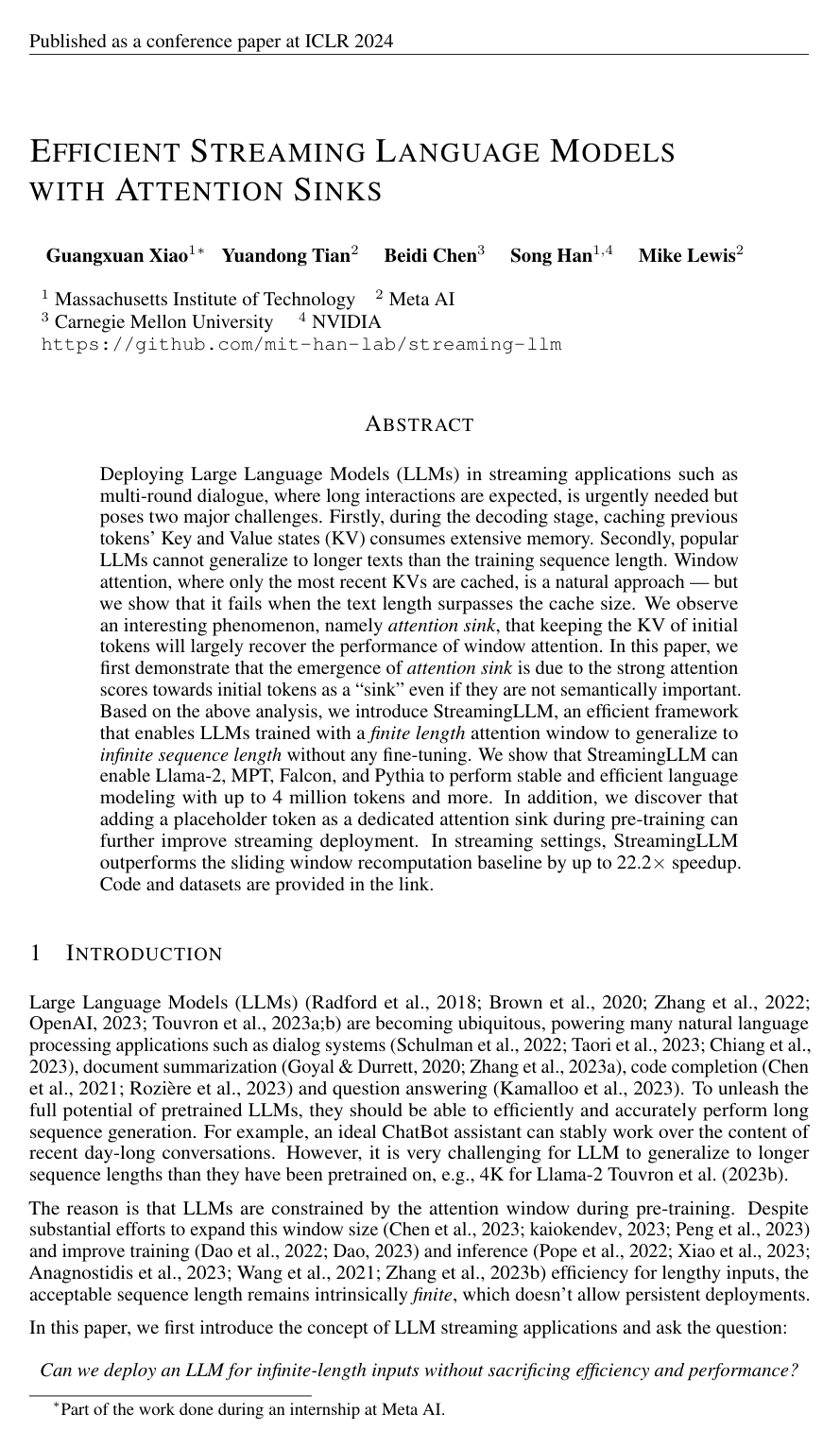
Efficient Streaming Language Models with Attention Sinks
Guangxuan Xiao, Yuandong Tian, Beidi Chen, Song Han, Mike Lewis
Why you should read this
Introduces StreamingLLM, an efficient framework that exploits the attention sink phenomenon to enable pre-trained large language models to generalize to infinite sequence lengths without fine-tuning while achieving up to a 22.2x speedup over sliding-window recomputation.
Deploying Large Language Models (LLMs) in streaming applications such as multi-round dialogue, where long interactions are expected, is urgently needed but poses two major challenges. Firstly, during the decoding stage, caching previous tokens' Key and Value states (KV) consumes extensive memory. Secondly, popular LLMs cannot generalize to longer texts than the training sequence length. Window attention, where only the most recent KVs are cached, is a natural approach -- but we show that it fails when the text length surpasses the cache size. We observe an interesting phenomenon, namely attention sink, that keeping the KV of initial tokens will largely recover the performance of window attention. In this paper, we first demonstrate that the emergence of attention sink is due to the strong attention scores towards initial tokens as a "sink" even if they are not semantically important. Based on the above analysis, we introduce StreamingLLM, an efficient framework that enables LLMs trained with a finite length attention window to generalize to infinite sequence lengths without any fine-tuning. We show that StreamingLLM can enable Llama-2, MPT, Falcon, and Pythia to perform stable and efficient language modeling with up to 4 million tokens and more. In addition, we discover that adding a placeholder token as a dedicated attention sink during pre-training can further improve streaming deployment. In streaming settings, StreamingLLM outperforms the sliding window recomputation baseline by up to 22.2x speedup. Code and datasets are provided at this https URL.
Added
2026-09-14
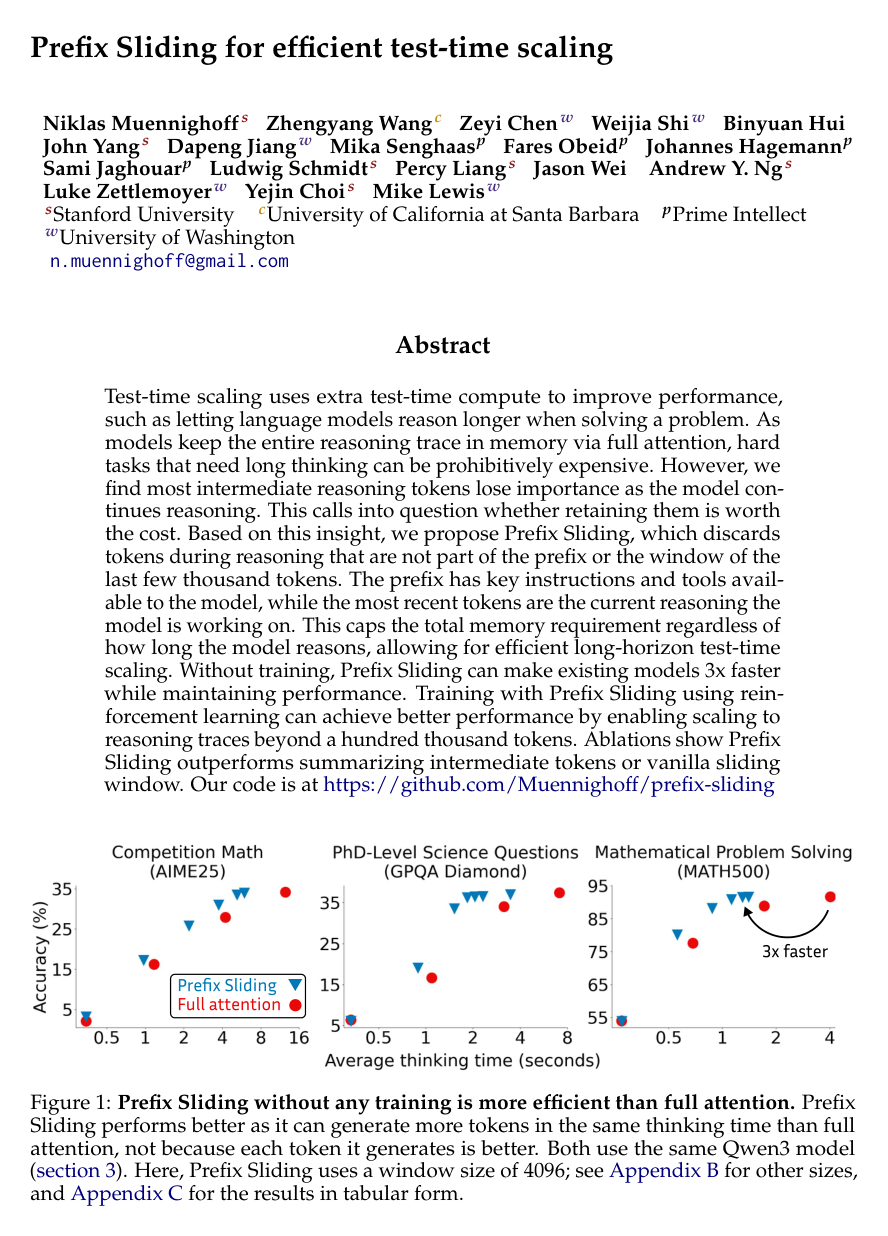
Prefix Sliding for efficient test-time scaling
Niklas Muennighoff, Zhengyang Wang, Zeyi Chen, Weijia Shi, Binyuan Hui, John Yang, Dapeng Jiang, Mika Senghaas, Fares Obeid, Johannes Hagemann, Sami Jaghouar, Ludwig Schmidt, Percy Liang, Jason Wei, Andrew Y. Ng, Luke Zettlemoyer, Yejin Choi, Mike Lewis
Why you should read this
Introduces Prefix Sliding, an attention mechanism that retains only prompt instructions and recent reasoning tokens to bound memory growth, achieving a 3x speedup in test-time reasoning without training while enabling language models to scale thinking traces beyond 100,000 tokens.
Test-time scaling uses extra test-time compute to improve performance, such as letting language models reason longer when solving a problem. As models keep the entire reasoning trace in memory via full attention, hard tasks that need long thinking can be prohibitively expensive. However, we find most intermediate reasoning tokens lose importance as the model continues reasoning. This calls into question whether retaining them is worth the cost. Based on this insight, we propose Prefix Sliding, which discards tokens during reasoning that are not part of the prefix or the window of the last few thousand tokens. The prefix has key instructions and tools available to the model, while the most recent tokens are the current reasoning the model is working on. This caps the total memory requirement regardless of how long the model reasons, allowing for efficient long-horizon test-time scaling. Without training, Prefix Sliding can make existing models 3x faster while maintaining performance. Training with Prefix Sliding using reinforcement learning can achieve better performance by enabling scaling to reasoning traces beyond a hundred thousand tokens. Ablations show Prefix Sliding outperforms summarizing intermediate tokens or vanilla sliding window. Our code is at this https URL
Added
2026-09-07
License
Published with permission
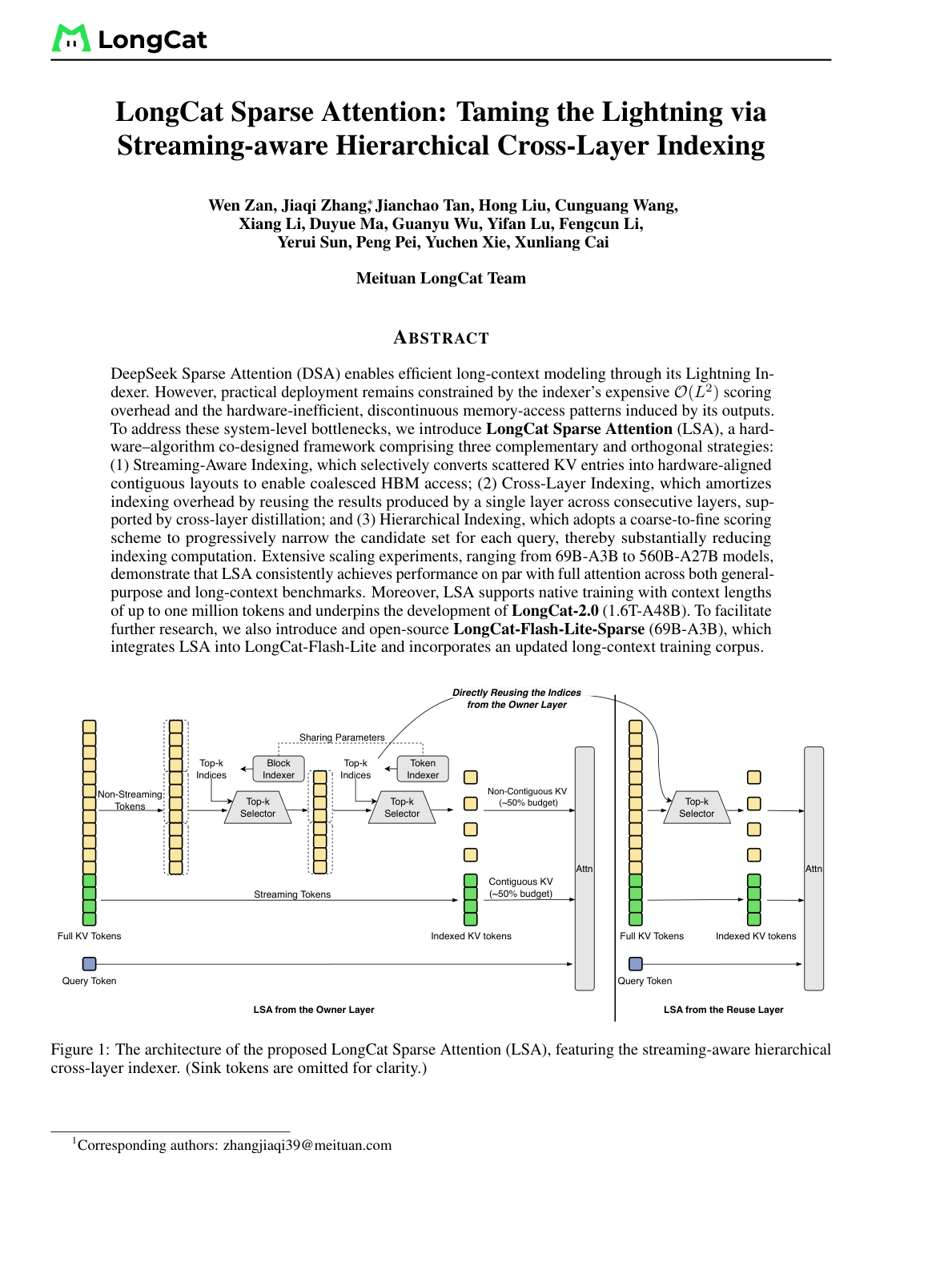
LongCat Sparse Attention: Taming the Lightning via Streaming-aware Hierarchical Cross-Layer Indexing
Wen Zan, Jiaqi Zhang, Jianchao Tan, Hong Liu, Cunguang Wang, Xiang Li, Duyue Ma, Guanyu Wu, Yifan Lu, Fengcun Li, Yerui Sun, Peng Pei, Yuchen Xie, Xunliang Cai
DeepSeek Sparse Attention (DSA) enables efficient long-context modeling through its Lightning Indexer. However, practical deployment remains constrained by the indexer's expensive scoring overhead and the hardware-inefficient, discontinuous memory-access patterns induced by its outputs. To address these system-level bottlenecks, we introduce LongCat Sparse Attention (LSA), a hardware-algorithm co-designed framework comprising three complementary and orthogonal strategies: (1) Streaming-Aware Indexing, which selectively converts scattered KV entries into hardware-aligned contiguous layouts to enable coalesced HBM access; (2) Cross-Layer Indexing, which amortizes indexing overhead by reusing the results produced by a single layer across consecutive layers, supported by cross-layer distillation; and (3) Hierarchical Indexing, which adopts a coarse-to-fine scoring scheme to progressively narrow the candidate set for each query, thereby substantially reducing indexing computation. Extensive scaling experiments, ranging from 69B-A3B to 560B-A27B models, demonstrate that LSA consistently achieves performance on par with full attention across both general-purpose and long-context benchmarks. Moreover, LSA supports native training with context lengths of up to one million tokens and underpins the development of LongCat-2.0 (1.6T-A48B). To facilitate further research, we also introduce and open-source LongCat-Flash-Lite-Sparse (69B-A3B), which integrates LSA into LongCat-Flash-Lite and incorporates an updated long-context training corpus.
Added
2026-09-03
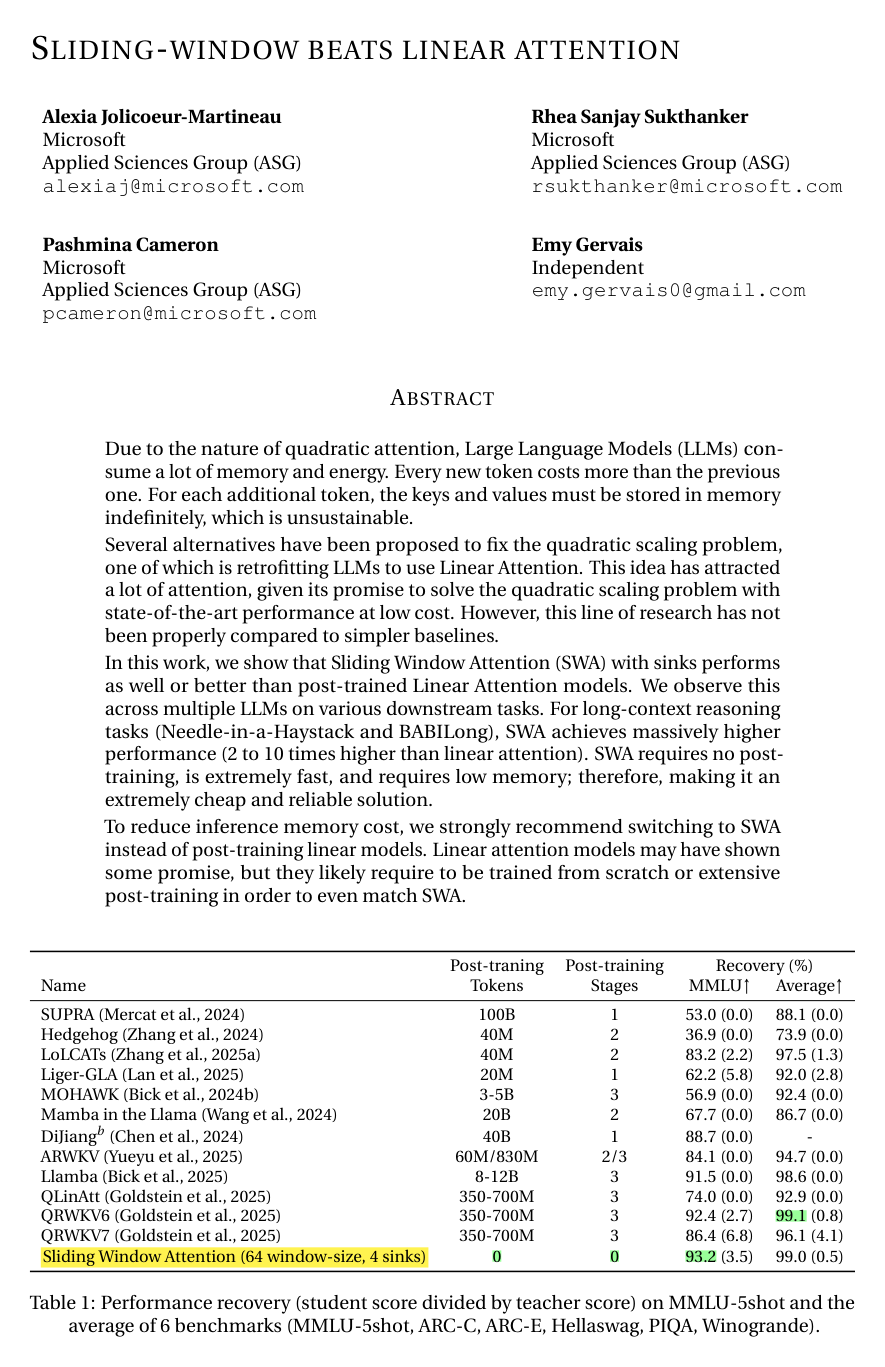
Sliding-window beats linear attention
Alexia Jolicoeur-Martineau, Rhea Sanjay Sukthanker, Pashmina Cameron, Emy Gervais
Why you should read this
Demonstrates that simple sliding window attention with attention sinks matches or exceeds post-trained linear attention models on standard benchmarks while outperforming them by up to ten times on long-context reasoning without requiring any post-training.
Due to the nature of quadratic attention, Large Language Models (LLMs) consume a lot of memory and energy. Every new token costs more than the previous one. For each additional token, the keys and values must be stored in memory indefinitely, which is unsustainable. Several alternatives have been proposed to fix the quadratic scaling problem, one of which is retrofitting LLMs to use Linear Attention. This idea has attracted a lot of attention, given its promise to solve the quadratic scaling problem with state-of-the-art performance at low cost. However, this line of research has not been properly compared to simpler baselines. In this work, we show that Sliding Window Attention (SWA) with sinks performs as well or better than post-trained Linear Attention models. We observe this across multiple LLMs on various downstream tasks. For long-context reasoning tasks (Needle-in-a-Haystack and BABILong), SWA achieves massively higher performance (2 to 10 times higher than linear attention). SWA requires no post-training, is extremely fast, and requires low memory; therefore, making it an extremely cheap and reliable solution. To reduce inference memory cost, we strongly recommend switching to SWA instead of post-training linear models. Linear attention models may have shown some promise, but they likely require to be trained from scratch or extensive post-training in order to even match SWA.
Added
2026-09-02
License
Published with permission
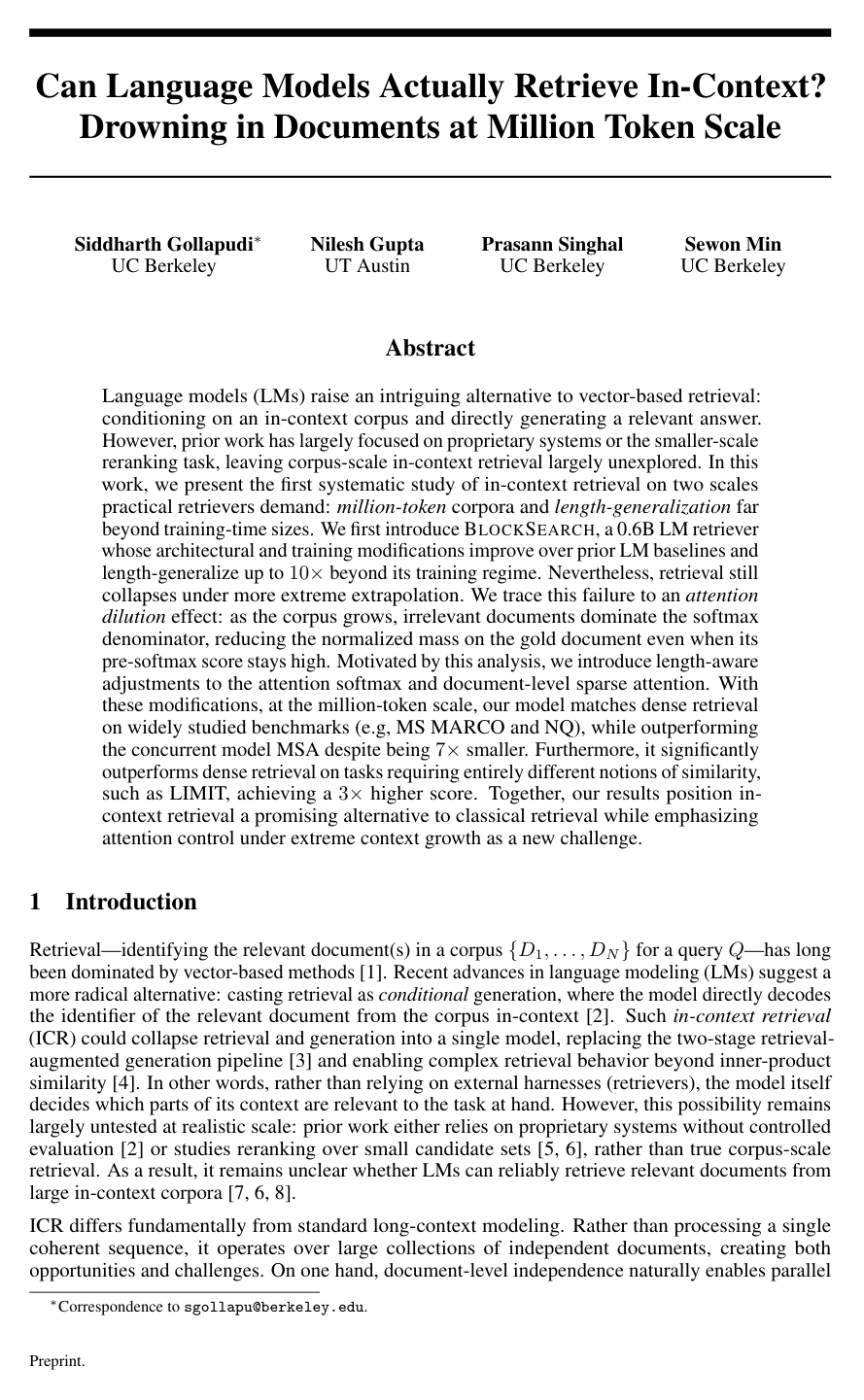
Can Language Models Actually Retrieve In-Context? Drowning in Documents at Million Token Scale
Siddharth Gollapudi, Nilesh Gupta, Prasann Singhal, Sewon Min
Why you should read this
Demonstrates that language models can achieve competitive and superior retrieval performance on million-token scale corpora by mitigating attention dilution through novel architectural and training modifications.
Language models (LMs) raise an intriguing alternative to vector-based retrieval: conditioning on an in-context corpus and directly generating a relevant answer. However, prior work has largely focused on proprietary systems or the smaller-scale reranking task, leaving corpus-scale in-context retrieval largely unexplored. In this work, we present the first systematic study of in-context retrieval on two scales practical retrievers demand: million-token corpora and length-generalization far beyond training-time sizes. We first introduce BlockSearch, a 0.6B LM retriever whose architectural and training modifications improve over prior LM baselines and length-generalize up to 10 times beyond its training regime. Nevertheless, retrieval still collapses under more extreme extrapolation. We trace this failure to an attention dilution effect: as the corpus grows, irrelevant documents dominate the softmax denominator, reducing the normalized mass on the gold document even when its pre-softmax score stays high. Motivated by this analysis, we introduce length-aware adjustments to the attention softmax and document-level sparse attention. With these modifications, at the million-token scale, our model matches dense retrieval on widely studied benchmarks (e.g, MS MARCO and NQ), while outperforming the concurrent model MSA despite being 7 times smaller. Furthermore, it significantly outperforms dense retrieval on tasks requiring entirely different notions of similarity, such as LIMIT, achieving a 3 times higher score. Together, our results position in-context retrieval a promising alternative to classical retrieval while emphasizing attention control under extreme context growth as a new challenge.
Added
2026-07-13
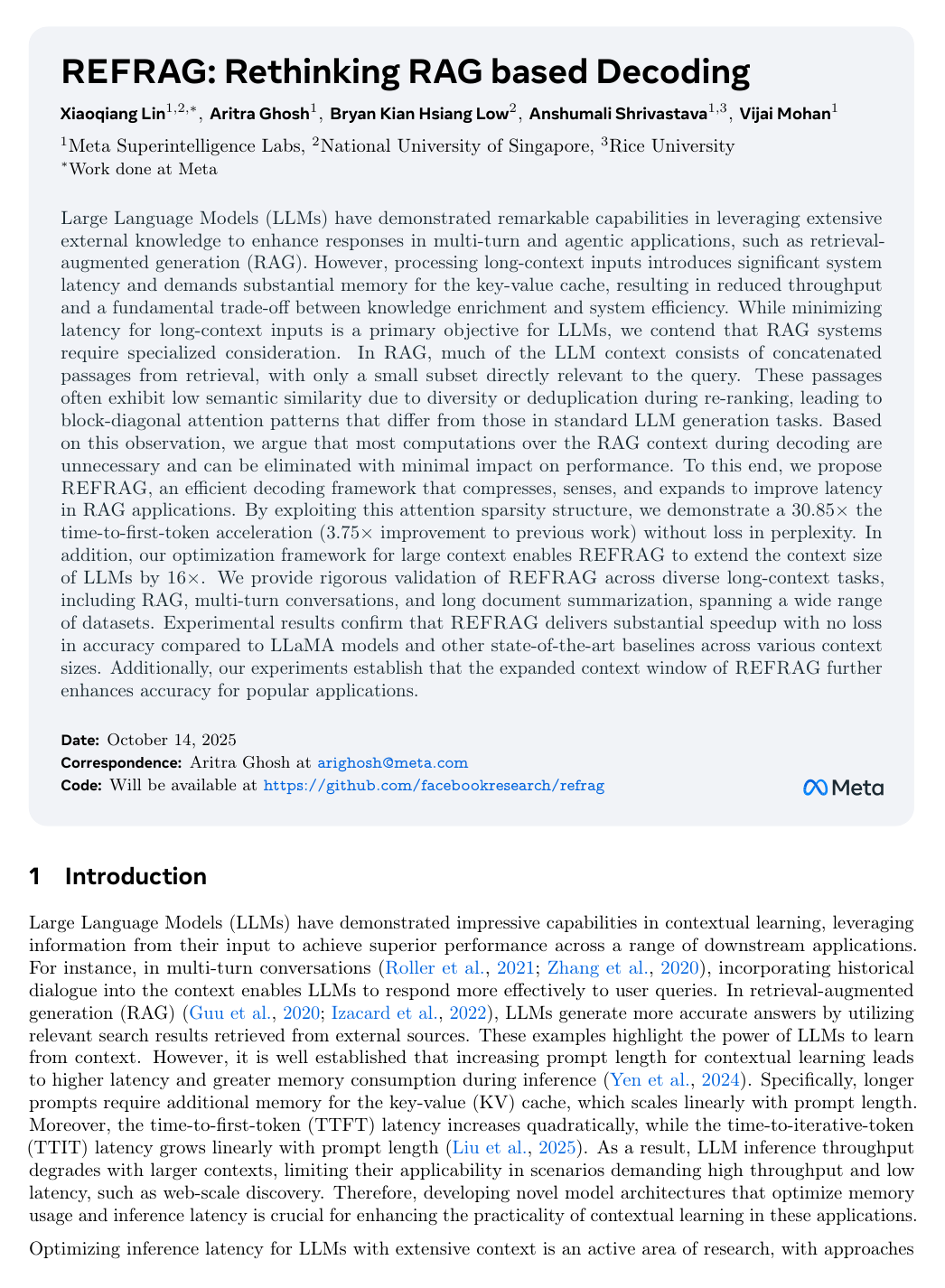
REFRAG: Rethinking RAG based Decoding
Xiaoqiang Lin, Aritra Ghosh, Bryan Kian Hsiang Low, Anshumali Shrivastava, Vijai Mohan
Why you should read this
Develops REFRAG, an efficient decoding framework that dramatically accelerates time-to-first-token in RAG applications by 30.85x and extends LLM context size by 16x without sacrificing accuracy, effectively resolving the trade-off between knowledge enrichment and system efficiency.
Large Language Models (LLMs) have demonstrated remarkable capabilities in leveraging extensive external knowledge to enhance responses in multi-turn and agentic applications, such as retrieval-augmented generation (RAG). However, processing long-context inputs introduces significant system latency and demands substantial memory for the key-value cache, resulting in reduced throughput and a fundamental trade-off between knowledge enrichment and system efficiency. While minimizing latency for long-context inputs is a primary objective for LLMs, we contend that RAG require specialized consideration. In RAG, much of the LLM context consists of concatenated passages from retrieval, with only a small subset directly relevant to the query. These passages often exhibit low semantic similarity due to diversity or deduplication during re-ranking, leading to block-diagonal attention patterns that differ from those in standard LLM generation tasks. Based on this observation, we argue that most computations over the RAG context during decoding are unnecessary and can be eliminated with minimal impact on performance. To this end, we propose REFRAG, an efficient decoding framework that compresses, senses, and expands to improve latency in RAG applications. By exploiting the sparsity structure, we demonstrate a 30.85 the time-to-first-token acceleration (3.75 improvement to previous work) without loss in perplexity. In addition, our optimization framework for large context enables REFRAG to extend the context size of LLMs by 16. We provide rigorous validation of REFRAG across diverse long-context tasks, including RAG, multi-turn conversations, and long document summarization, spanning a wide range of datasets. Experimental results confirm that REFRAG delivers substantial speedup with no loss in accuracy compared to LLaMA models and other state-of-the-art baselines across various context sizes.
Added
2026-04-21
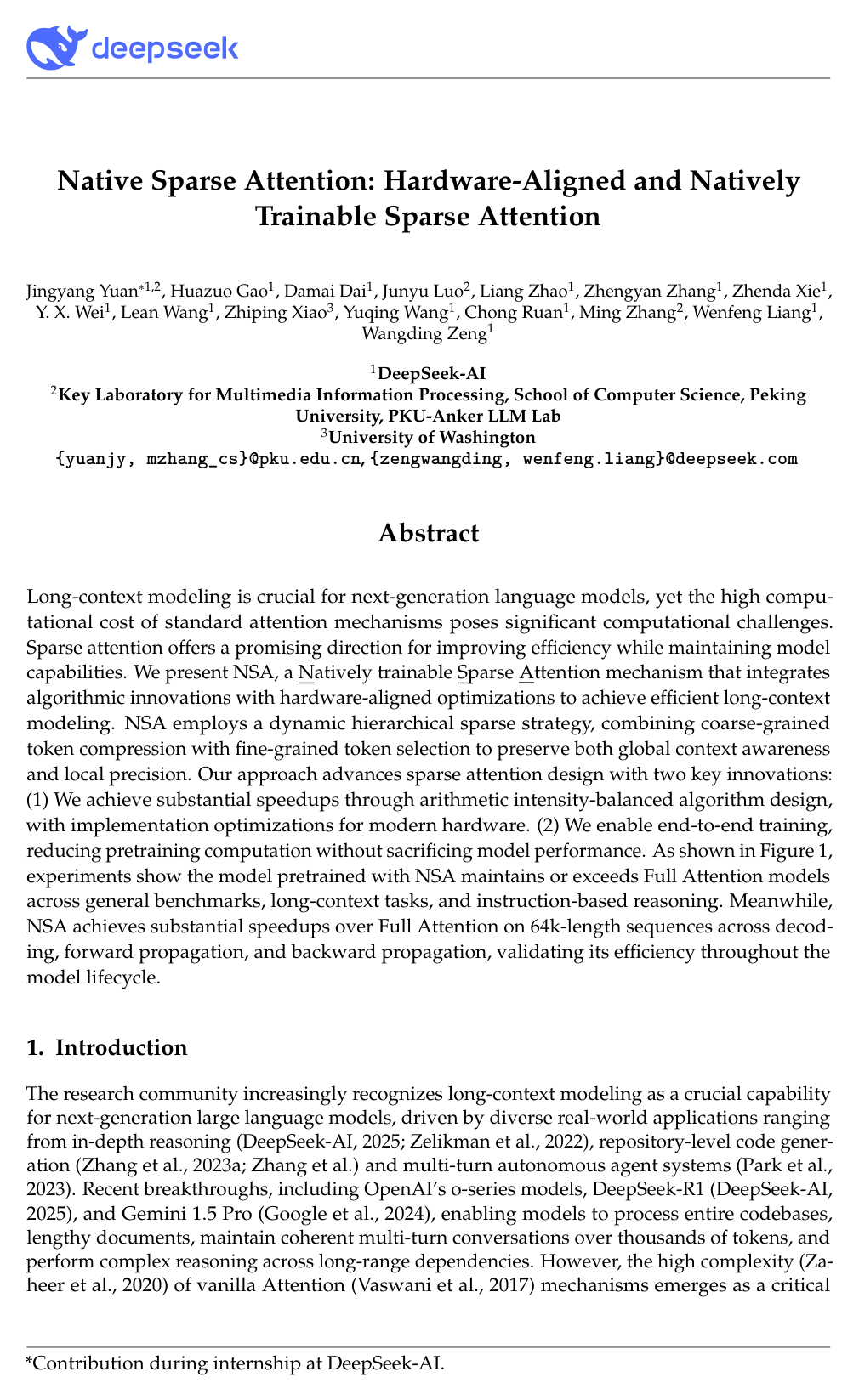
Native Sparse Attention: Hardware-Aligned and Natively Trainable Sparse Attention
Jingyang Yuan, Huazuo Gao, Damai Dai, Junyu Luo, Liang Zhao, Zhengyan Zhang, Zhenda Xie, Yuxing Wei, Lean Wang, Zhiping Xiao, Yuqing Wang, Chong Ruan, Ming Zhang, Wenfeng Liang, Wangding Zeng
Why you should read this
Presents a natively trainable sparse attention mechanism (NSA) that dramatically accelerates long-context language models by integrating algorithmic innovation with hardware-aligned optimizations, achieving significant speedups without sacrificing model performance across all stages of the model lifecycle.
Long-context modeling is crucial for next-generation language models, yet the high computational cost of standard attention mechanisms poses significant computational challenges. Sparse attention offers a promising direction for improving efficiency while maintaining model capabilities. We present NSA, a Natively trainable Sparse Attention mechanism that integrates algorithmic innovations with hardware-aligned optimizations to achieve efficient long-context modeling. NSA employs a dynamic hierarchical sparse strategy, combining coarse-grained token compression with fine-grained token selection to preserve both global context awareness and local precision. Our approach advances sparse attention design with two key innovations: (1) We achieve substantial speedups through arithmetic intensity-balanced algorithm design, with implementation optimizations for modern hardware. (2) We enable end-to-end training, reducing pretraining computation without sacrificing model performance. As shown in Figure 1, experiments show the model pretrained with NSA maintains or exceeds Full Attention models across general benchmarks, long-context tasks, and instruction-based reasoning. Meanwhile, NSA achieves substantial speedups over Full Attention on 64k-length sequences across decoding, forward propagation, and backward propagation, validating its efficiency throughout the model lifecycle.
Added
2026-04-18