
keyword
attention modules
Attention modules are specialized neural network components that dynamically assign varying levels of importance to different parts of an input signal, allowing models to focus computational processing on the most relevant information. Integrated into broader deep learning architectures, such as convolutional networks and transformers, these self-contained blocks compute attention weights across spatial dimensions, feature channels, or relational representations between distinct elements. By recalibrating intermediate feature maps according to contextual relevance, attention modules enhance the expressive power of neural networks, capture long-range dependencies, and improve overall feature selectivity without requiring additional supervision.
2 items
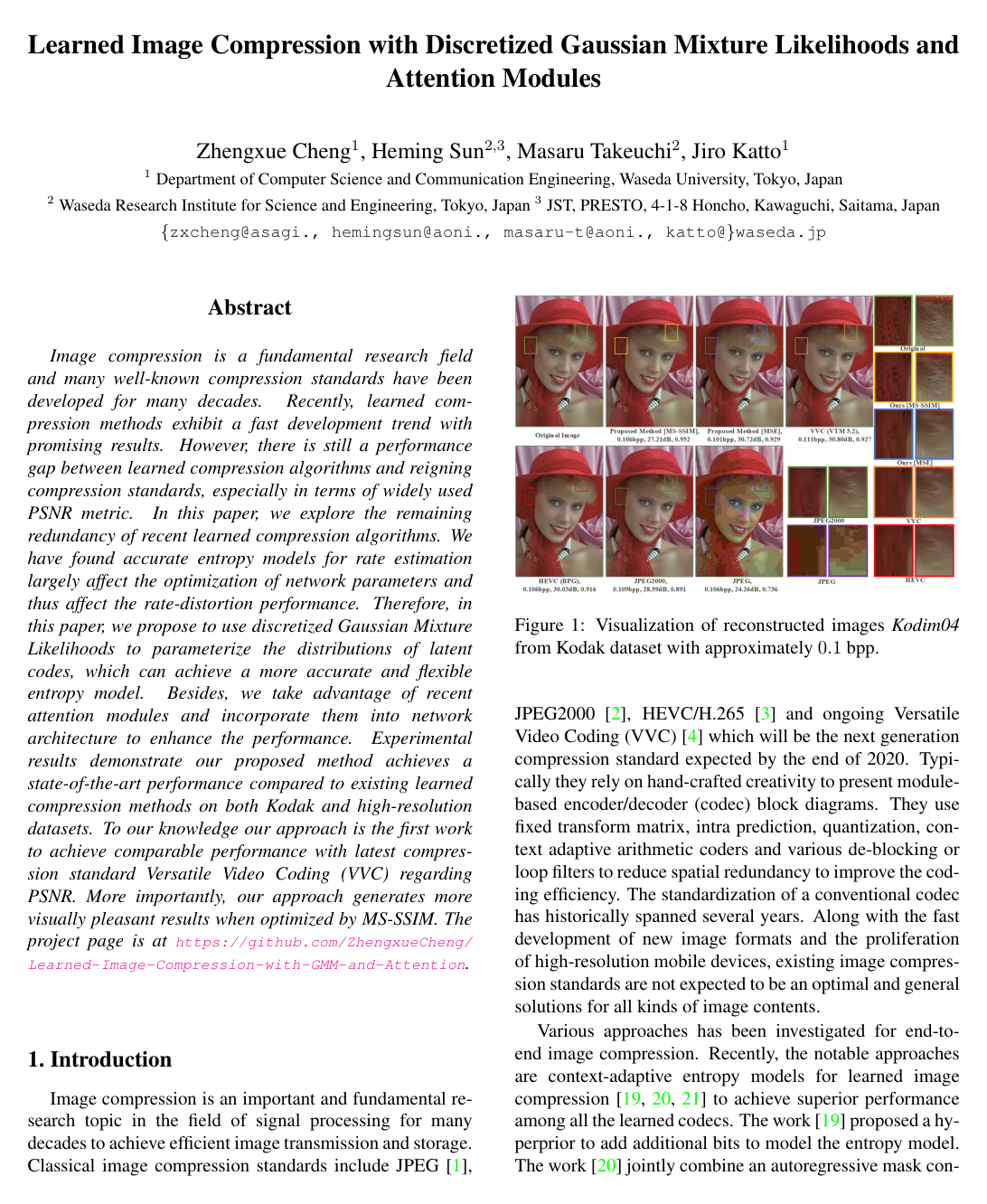
Learned Image Compression With Discretized Gaussian Mixture Likelihoods and Attention Modules
Zhengxue Cheng, Heming Sun, Masaru Takeuchi, Jiro Katto
Why you should read this
Introduces a neural image compression model using discretized Gaussian mixture likelihoods and attention mechanisms to achieve rate-distortion performance that matches the Versatile Video Coding (VVC) standard in PSNR.
Image compression is a fundamental research field and many well-known compression standards have been developed for many decades. Recently, learned compression methods exhibit a fast development trend with promising results. However, there is still a performance gap between learned compression algorithms and reigning compression standards, especially in terms of widely used PSNR metric. In this paper, we explore the remaining redundancy of recent learned compression algorithms. We have found accurate entropy models for rate estimation largely affect the optimization of network parameters and thus affect the rate-distortion performance. Therefore, in this paper, we propose to use discretized Gaussian Mixture Likelihoods to parameterize the distributions of latent codes, which can achieve a more accurate and flexible entropy model. Besides, we take advantage of recent attention modules and incorporate them into network architecture to enhance the performance. Experimental results demonstrate our proposed method achieves a state-of-the-art performance compared to existing learned compression methods on both Kodak and high-resolution datasets. To our knowledge our approach is the first work to achieve comparable performance with latest compression standard Versatile Video Coding (VVC) regarding PSNR. More importantly, our approach generates more visually pleasant results when optimized by MS-SSIM. This project page is at this https URL this https URL
Added
2026-09-25
Relation Networks for Object Detection
Han Hu, Jiayuan Gu, Zheng Zhang, Jifeng Dai, Yichen Wei
Why you should read this
Proposes a lightweight relation module that jointly models geometric and appearance interactions between objects, establishing the first fully end-to-end object detector with integrated duplicate removal.
Although it is well believed for years that modeling relations between objects would help object recognition, there has not been evidence that the idea is working in the deep learning era. All state-of-the-art object detection systems still rely on recognizing object instances individually, without exploiting their relations during learning. This work proposes an object relation module. It processes a set of objects simultaneously through interaction between their appearance feature and geometry, thus allowing modeling of their relations. It is lightweight and in-place. It does not require additional supervision and is easy to embed in existing networks. It is shown effective on improving object recognition and duplicate removal steps in the modern object detection pipeline. It verifies the efficacy of modeling object relations in CNN based detection. It gives rise to the first fully end-to-end object detector.
Source
https://openaccess.thecvf.com/content_cvpr_2018/papers/Hu_Relation_Networks_for_CVPR_2018_paper.pdfAdded
2026-09-25