
keyword
artificial general intelligence
Artificial general intelligence is a hypothetical AI system capable of learning, adapting, and performing effectively across a broad range of tasks and domains, rather than being limited to specialized tasks; definitions differ on whether it must match human ability across most or all cognitive tasks.
7 items
Plan, Verify and Switch: Integrated Reasoning with Diverse X-of-Thoughts
Tengxiao Liu, Qipeng Guo, Yuqing Yang, Xiangkun Hu, Yue Zhang, Xipeng Qiu, Zheng Zhang
Why you should read this
Introduces an iterative problem-solving framework that combines diverse prompting strategies like natural language reasoning, code execution, and equation solving with active verification to dynamically switch methods when errors occur, substantially boosting large language model accuracy across mathematical and logical tasks.
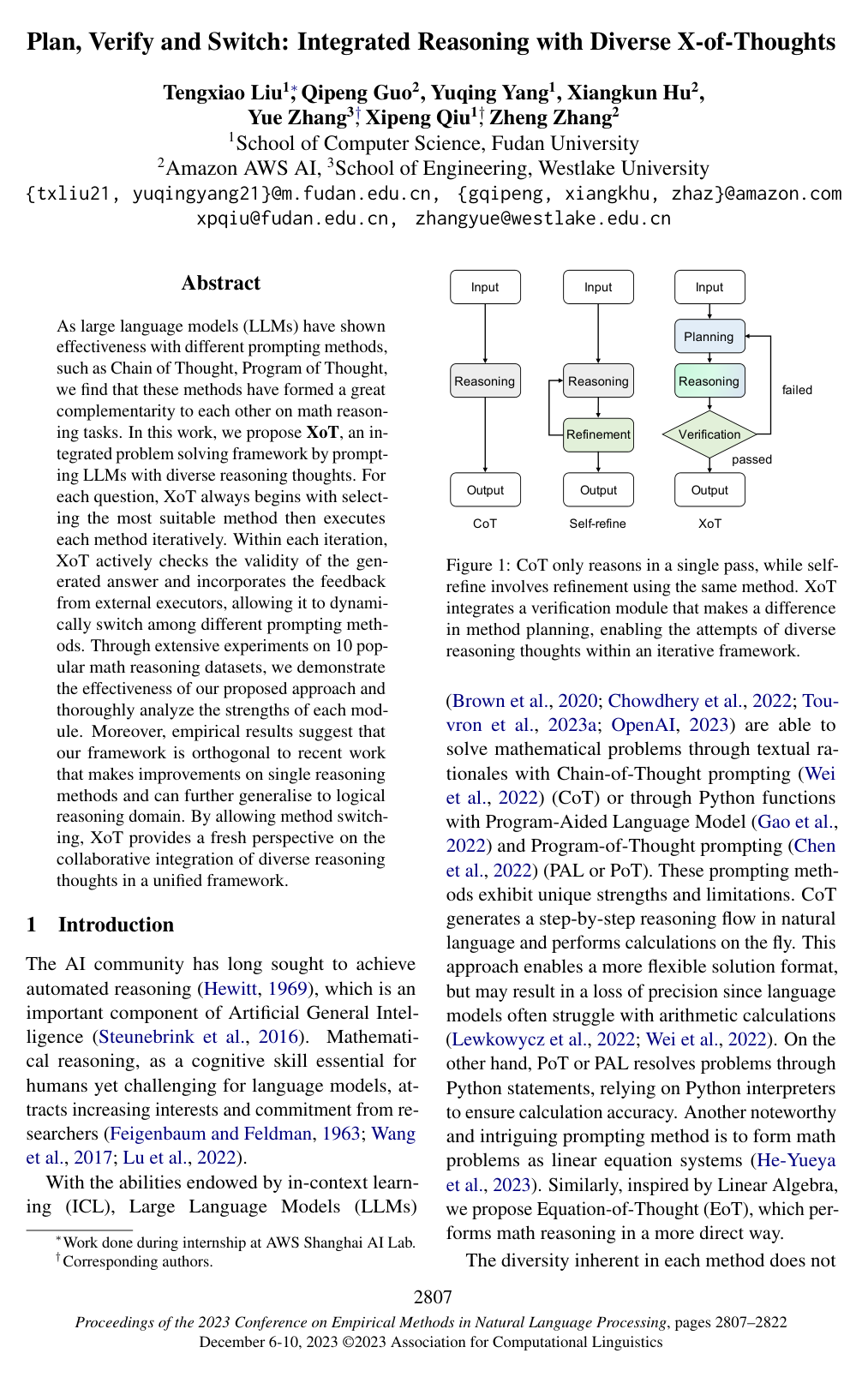
As large language models (LLMs) have shown effectiveness with different prompting methods, such as Chain of Thought, Program of Thought, we find that these methods have formed a great complementarity to each other on math reasoning tasks. In this work, we propose XoT, an integrated problem solving framework by prompting LLMs with diverse reasoning thoughts. For each question, XoT always begins with selecting the most suitable method then executes each method iteratively. Within each iteration, XoT actively checks the validity of the generated answer and incorporates the feedback from external executors, allowing it to dynamically switch among different prompting methods. Through extensive experiments on 10 popular math reasoning datasets, we demonstrate the effectiveness of our proposed approach and thoroughly analyze the strengths of each module. Moreover, empirical results suggest that our framework is orthogonal to recent work that makes improvements on single reasoning methods and can further generalise to logical reasoning domain. By allowing method switching, XoT provides a fresh perspective on the collaborative integration of diverse reasoning thoughts in a unified framework.
Added
2026-10-05
General Scales Unlock AI Evaluation with Explanatory and Predictive Power
Lexin Zhou, Lorenzo Pacchiardi, Fernando Martínez-Plumed, Katherine M. Collins, Yael Moros-Daval, Seraphina Zhang, Qinlin Zhao, Yitian Huang, Luning Sun, Jonathan E. Prunty, Zongqian Li, Pablo Sánchez-García, Kexin Jiang Chen, Pablo A. M. Casares, Jiyun Zu, John Burden, Behzad Mehrbakhsh, David Stillwell, Manuel Cebrian, Jindong Wang, Peter Henderson, Sherry Tongshuang Wu, Patrick C. Kyllonen, Lucy Cheke, Xing Xie, José Hernández-Orallo
Why you should read this
Introduces a rubric-based measurement framework that maps task demands onto non-saturating general scales, enabling researchers to interpret common benchmarks and accurately predict large language model performance on novel, out-of-distribution tasks.
Ensuring safe and effective use of AI requires understanding and anticipating its performance on novel tasks, from advanced scientific challenges to transformed workplace activities. So far, benchmarking has guided progress in AI, but it has offered limited explanatory and predictive power for general-purpose AI systems, given the low transferability across diverse tasks. In this paper, we introduce general scales for AI evaluation that can explain what common AI benchmarks really measure, extract ability profiles of AI systems, and predict their performance for new task instances, in- and out-of-distribution. Our fully-automated methodology builds on 18 newly-crafted rubrics that place instance demands on general scales that do not saturate. Illustrated for 15 large language models and 63 tasks, high explanatory power is unleashed from inspecting the demand and ability profiles, bringing insights on the sensitivity and specificity exhibited by different benchmarks, and how knowledge, metacognition and reasoning are affected by model size, chain-of-thought and distillation. Surprisingly, high predictive power at the instance level becomes possible using these demand levels, providing superior estimates over black-box baseline predictors based on embeddings or finetuning, especially in out-of-distribution settings (new tasks and new benchmarks). The scales, rubrics, battery, techniques and results presented here represent a major step for AI evaluation, underpinning the reliable deployment of AI in the years ahead. (Collaborative platform: this https URL.)
Added
2026-09-30
Position: Levels of AGI for Operationalizing Progress on the Path to AGI
Meredith Ringel Morris, Jascha Sohl-Dickstein, Noah Fiedel, Tris Warkentin, Allan Dafoe, Aleksandra Faust, Clément Farabet, Shane Legg
Why you should read this
Establishes a structured framework that classifies artificial general intelligence across distinct tiers of capability, generality, and autonomy, providing clear criteria to evaluate current models and safely track progress toward human-level systems.
We propose a framework for classifying the capabilities and behavior of Artificial General Intelligence (AGI) models and their precursors. This framework introduces levels of AGI performance, generality, and autonomy, providing a common language to compare models, assess risks, and measure progress along the path to AGI. To develop our framework, we analyze existing definitions of AGI, and distill six principles that a useful ontology for AGI should satisfy. With these principles in mind, we propose “Levels of AGI” based on depth (performance) and breadth (generality) of capabilities, and reflect on how current systems fit into this ontology. We discuss the challenging requirements for future benchmarks that quantify the behavior and capabilities of AGI models against these levels. Finally, we discuss how these levels of AGI interact with deployment considerations such as autonomy and risk, and emphasize the importance of carefully selecting Human-AI Interaction paradigms for responsible and safe deployment of highly capable AI systems.
Added
2026-09-26
HuggingGPT: Solving AI Tasks with ChatGPT and its Friends in Hugging Face
Yongliang Shen, Kaitao Song, Xu Tan, Dongsheng Li, Weiming Lu, Yueting Zhuang
Why you should read this
Proposes HuggingGPT, a framework that uses large language models as central controllers to plan tasks and orchestrate specialized models from Hugging Face across text, vision, and audio.
Solving complicated AI tasks with different domains and modalities is a key step toward artificial general intelligence. While there are numerous AI models available for various domains and modalities, they cannot handle complicated AI tasks autonomously. Considering large language models (LLMs) have exhibited exceptional abilities in language understanding, generation, interaction, and reasoning, we advocate that LLMs could act as a controller to manage existing AI models to solve complicated AI tasks, with language serving as a generic interface to empower this. Based on this philosophy, we present HuggingGPT, an LLM-powered agent that leverages LLMs (e.g., ChatGPT) to connect various AI models in machine learning communities (e.g., Hugging Face) to solve AI tasks. Specifically, we use ChatGPT to conduct task planning when receiving a user request, select models according to their function descriptions available in Hugging Face, execute each subtask with the selected AI model, and summarize the response according to the execution results. By leveraging the strong language capability of ChatGPT and abundant AI models in Hugging Face, HuggingGPT can tackle a wide range of sophisticated AI tasks spanning different modalities and domains and achieve impressive results in language, vision, speech, and other challenging tasks, which paves a new way towards the realization of artificial general intelligence.
Added
2026-09-25
License
Published with permission
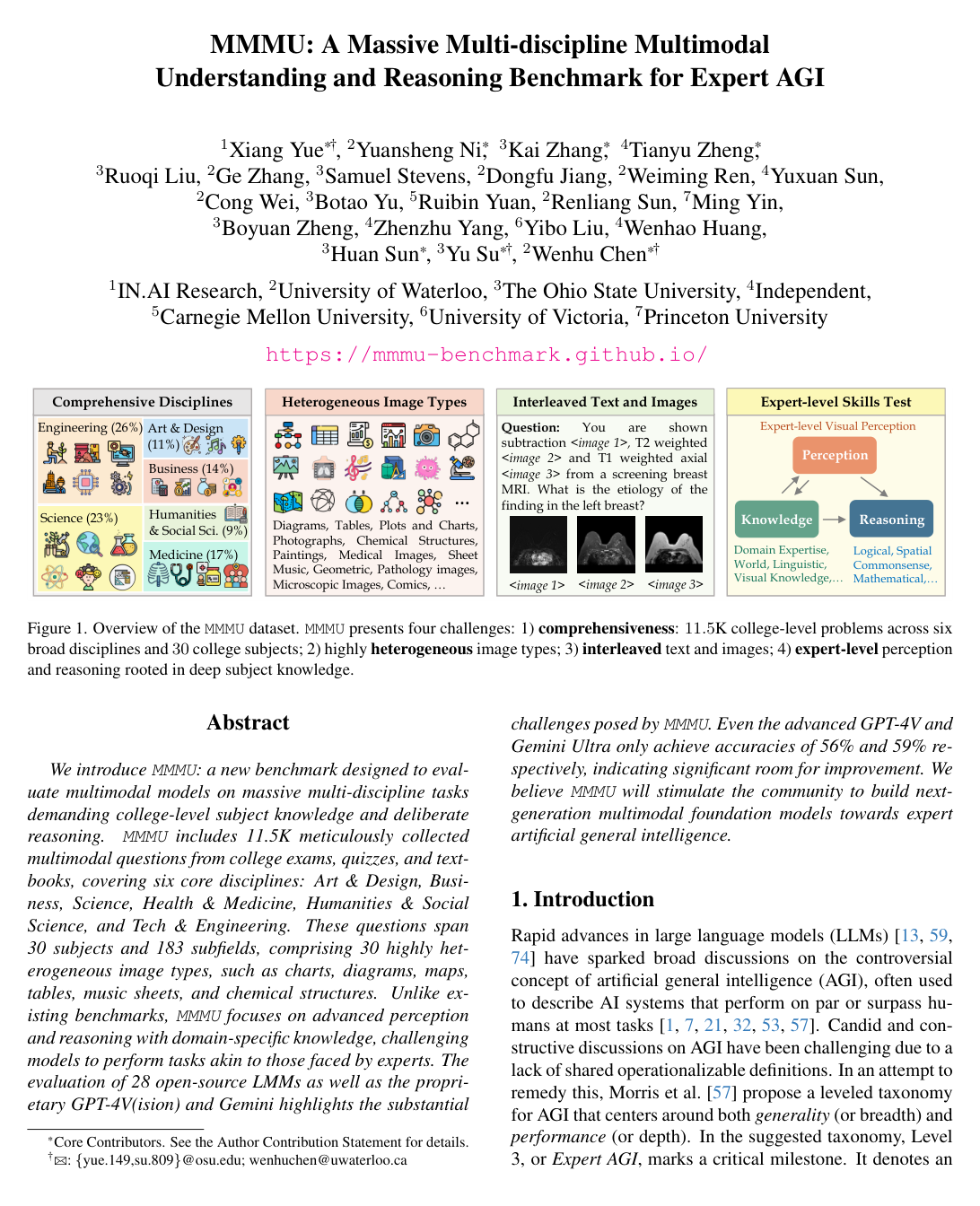
MMMU: A Massive Multi-Discipline Multimodal Understanding and Reasoning Benchmark for Expert AGI
Xiang Yue, Yuansheng Ni, Kai Zhang, Tianyu Zheng, Ruoqi Liu, Ge Zhang, Samuel Stevens, Dongfu Jiang, Weiming Ren, Yuxuan Sun, Cong Wei, Botao Yu, Ruibin Yuan, Renliang Sun, Ming Yin, Boyuan Zheng, Zhenzhu Yang, Yibo Liu, Wenhao Huang, Huan Sun, Yu Su, Wenhu Chen
Why you should read this
Establishes a college-level benchmark of 11,500 multidisciplinary visual problems across thirty image formats, exposing severe reasoning limitations in frontier multimodal models like GPT-4V and Gemini.
We introduce MMMU: a new benchmark designed to evaluate multimodal models on massive multi-discipline tasks demanding college-level subject knowledge and deliberate reasoning. MMMU includes 11.5K meticulously collected multimodal questions from college exams, quizzes, and textbooks, covering six core disciplines: Art & Design, Business, Science, Health & Medicine, Humanities & Social Science, and Tech & Engineering. These questions span 30 subjects and 183 subfields, comprising 30 highly heterogeneous image types, such as charts, diagrams, maps, tables, music sheets, and chemical structures. Unlike existing benchmarks, MMMU focuses on advanced perception and reasoning with domain-specific knowledge, challenging models to perform tasks akin to those faced by experts. The evaluation of 14 open-source LMMs as well as the proprietary GPT-4V(ision) and Gemini highlights the substantial challenges posed by MMMU. Even the advanced GPT-4V and Gemini Ultra only achieve accuracies of 56% and 59% respectively, indicating significant room for improvement. We believe MMMU will stimulate the community to build next-generation multimodal foundation models towards expert artificial general intelligence.
Added
2026-09-14
Sparks of Artificial General Intelligence: Early experiments with GPT-4
Sébastien Bubeck, Varun Chandrasekaran, Ronen Eldan, Johannes Gehrke, Eric Horvitz, Ece Kamar, Peter Lee, Yin Tat Lee, Yuanzhi Li, Scott Lundberg, Harsha Nori, Hamid Palangi, Marco Tulio Ribeiro, Yi Zhang
Why you should read this
Demonstrates that GPT-4 achieves near-human problem-solving performance across disciplines such as mathematics, software engineering, law, and medicine without specialized training, providing an empirical baseline for assessing artificial general intelligence and its algorithmic limits.
Artificial intelligence (AI) researchers have been developing and refining large language models (LLMs) that exhibit remarkable capabilities across a variety of domains and tasks, challenging our understanding of learning and cognition. The latest model developed by OpenAI, GPT-4, was trained using an unprecedented scale of compute and data. In this paper, we report on our investigation of an early version of GPT-4, when it was still in active development by OpenAI. We contend that (this early version of) GPT-4 is part of a new cohort of LLMs (along with ChatGPT and Google's PaLM for example) that exhibit more general intelligence than previous AI models. We discuss the rising capabilities and implications of these models. We demonstrate that, beyond its mastery of language, GPT-4 can solve novel and difficult tasks that span mathematics, coding, vision, medicine, law, psychology and more, without needing any special prompting. Moreover, in all of these tasks, GPT-4's performance is strikingly close to human-level performance, and often vastly surpasses prior models such as ChatGPT. Given the breadth and depth of GPT-4's capabilities, we believe that it could reasonably be viewed as an early (yet still incomplete) version of an artificial general intelligence (AGI) system. In our exploration of GPT-4, we put special emphasis on discovering its limitations, and we discuss the challenges ahead for advancing towards deeper and more comprehensive versions of AGI, including the possible need for pursuing a new paradigm that moves beyond next-word prediction. We conclude with reflections on societal influences of the recent technological leap and future research directions.
Added
2026-09-13
The Abstraction Fallacy: Why AI Can Simulate But Not Instantiate Consciousness
Alexander Lerchner
Why you should read this
Demonstrates that digital architectures are fundamentally incapable of achieving sentience because they rely on an extrinsic mapping process that cannot generate the subjective observer required for consciousness, thereby reframing AI safety to prioritize the concrete risks of anthropomorphism over unfounded concerns regarding machine welfare.
Computational functionalism dominates current debates on AI consciousness. This is the hypothesis that subjective experience emerges entirely from abstract causal topology, regardless of the underlying physical substrate. We argue this view fundamentally mischaracterizes how physics relates to information. We call this mistake the Abstraction Fallacy. Tracing the causal origins of abstraction reveals that symbolic computation is not an intrinsic physical process. Instead, it is a mapmaker-dependent description. It requires an active, experiencing cognitive agent to alphabetize continuous physics into a finite set of meaningful states. Consequently, we do not need a complete, finalized theory of consciousness to assess AI sentience—a demand that simply pushes the question beyond near-term resolution and deepens the AI welfare trap. What we actually need is a rigorous ontology of computation. The framework proposed here explicitly separates simulation (behavioral mimicry driven by vehicle causality) from instantiation (intrinsic physical constitution driven by content causality). Establishing this ontological boundary shows why algorithmic symbol manipulation is structurally incapable of instantiating experience. Crucially, this argument does not rely on biological exclusivity. If an artificial system were ever conscious, it would be because of its specific physical constitution, never its syntactic architecture. Ultimately, this framework offers a physically grounded refutation of computational functionalism to resolve the current uncertainty surrounding AI consciousness.
Added
2026-04-18
License
Published with permission