
keyword
approximate nearest neighbor search
Approximate nearest neighbor search is an algorithmic technique used to find data points in a metric space or high-dimensional dataset that are sufficiently close or similar to a given query point, trading guaranteed exactness for substantial gains in computational speed and memory efficiency. Unlike exact nearest neighbor search, which becomes computationally prohibitive on massive datasets due to the curse of dimensionality, approximate approaches prioritize rapid retrieval while maintaining high recall. These methods typically organize data using specialized index structures, such as proximity graphs, vector quantization, inverted files, or locality-sensitive hashing, allowing systems to prune large portions of the search space and achieve sublinear query times across applications like multimedia retrieval, vector similarity matching, and large-scale machine learning inference.
6 items
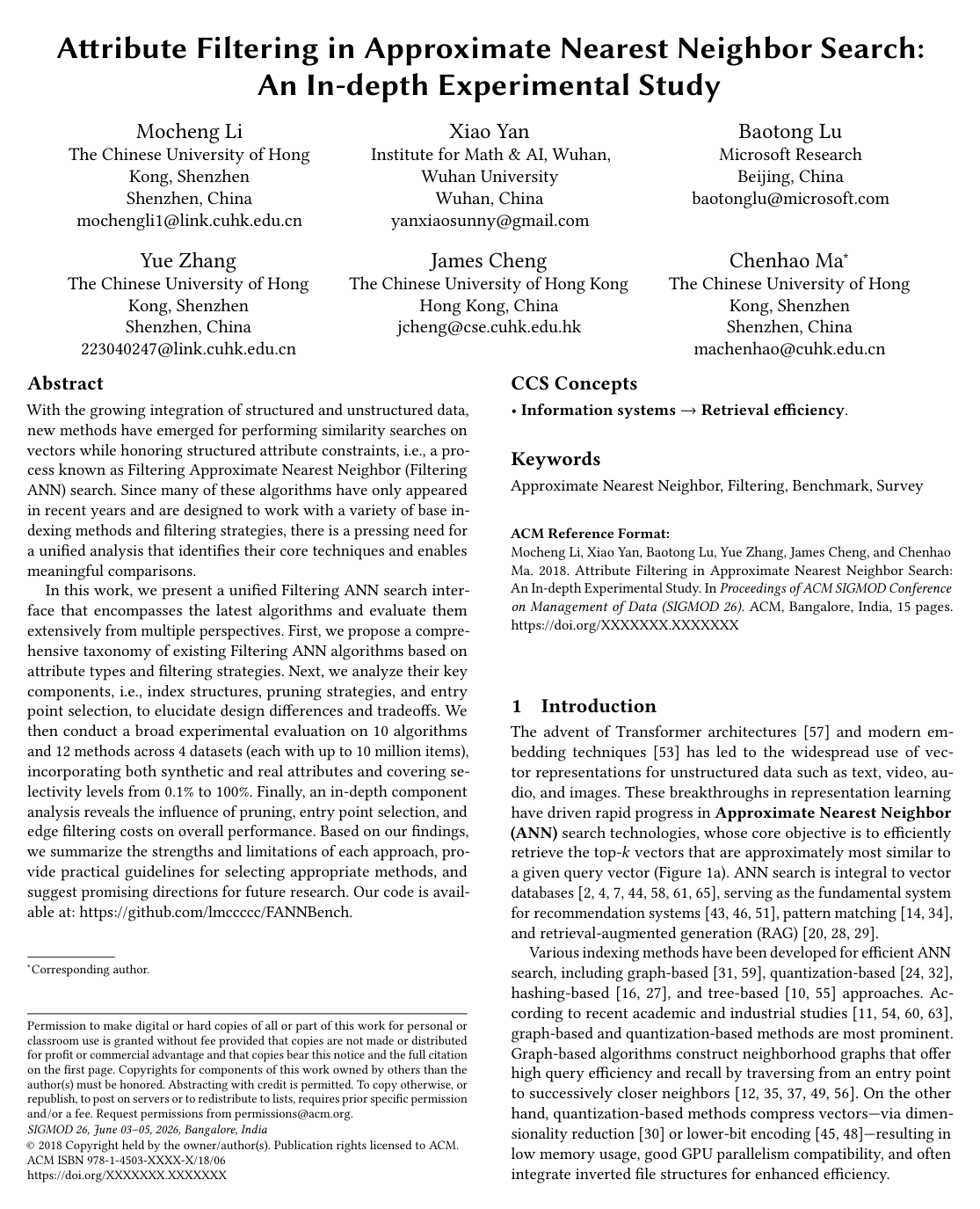
Attribute Filtering in Approximate Nearest Neighbor Search: An In-depth Experimental Study
Mocheng Li, Xiao Yan, Baotong Lu, Yue Zhang, James Cheng, Chenhao Ma
Why you should read this
Presents a unified taxonomy and large-scale experimental evaluation of filtered approximate nearest neighbor search algorithms across datasets with up to ten million vectors, delivering actionable guidelines on how indexing strategies and attribute selectivity govern retrieval performance.
With the growing integration of structured and unstructured data, new methods have emerged for performing similarity searches on vectors while honoring structured attribute constraints, i.e., a process known as Filtering Approximate Nearest Neighbor (Filtering ANN) search. Since many of these algorithms have only appeared in recent years and are designed to work with a variety of base indexing methods and filtering strategies, there is a pressing need for a unified analysis that identifies their core techniques and enables meaningful comparisons. In this work, we present a unified Filtering ANN search interface that encompasses the latest algorithms and evaluate them extensively from multiple perspectives. First, we propose a comprehensive taxonomy of existing Filtering ANN algorithms based on attribute types and filtering strategies. Next, we analyze their key components, i.e., index structures, pruning strategies, and entry point selection, to elucidate design differences and tradeoffs. We then conduct a broad experimental evaluation on 10 algorithms and 12 methods across 4 datasets (each with up to 10 million items), incorporating both synthetic and real attributes and covering selectivity levels from 0.1% to 100%. Finally, an in-depth component analysis reveals the influence of pruning, entry point selection, and edge filtering costs on overall performance. Based on our findings, we summarize the strengths and limitations of each approach, provide practical guidelines for selecting appropriate methods, and suggest promising directions for future research. Our code is available at: this https URL.
Added
2026-09-30
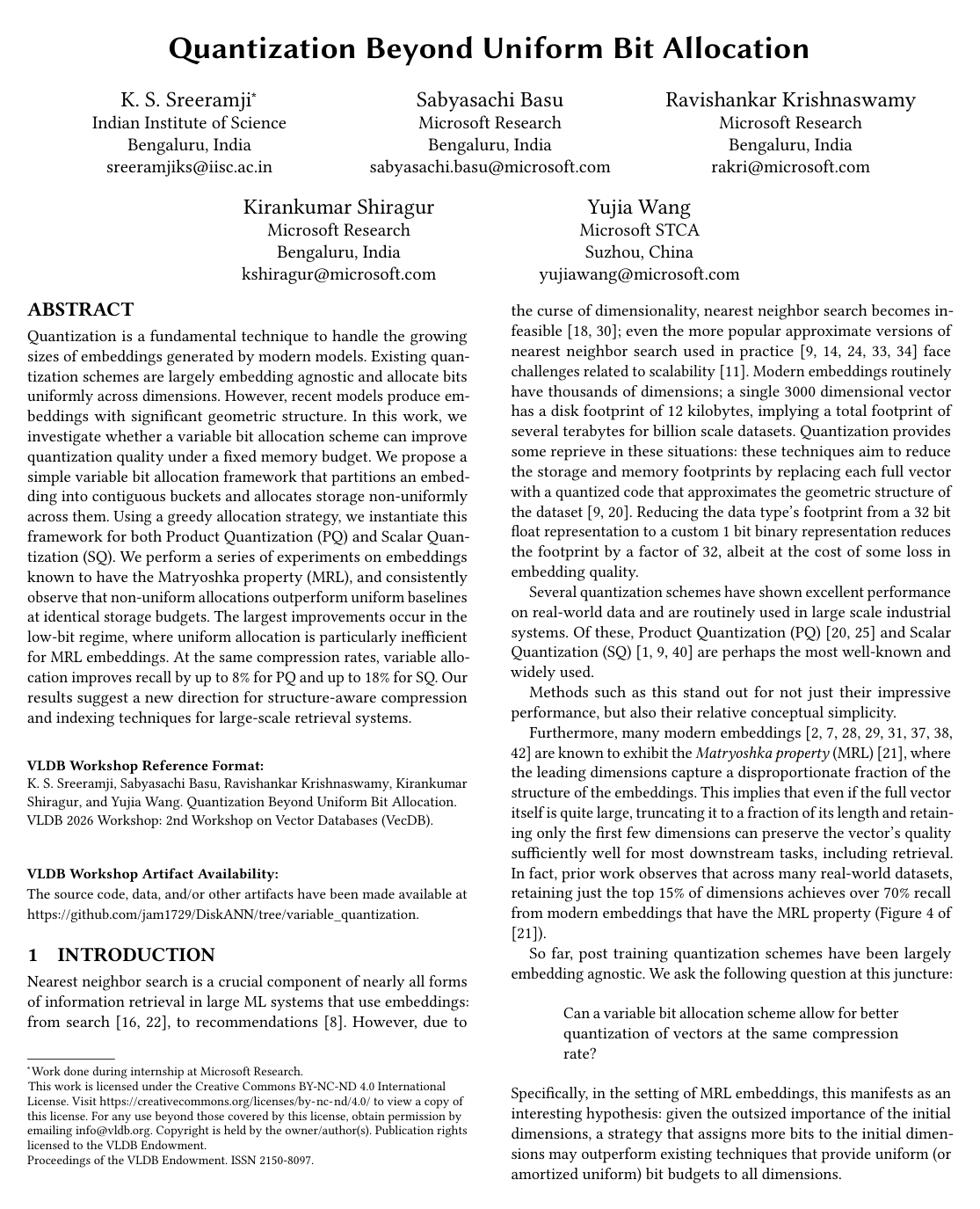
Quantization Beyond Uniform Bit Allocation
K. S. Sreeramji, Sabyasachi Basu, Ravishankar Krishnaswamy, Kirankumar Shiragur, Yujia Wang
Why you should read this
Introduces a variable bit allocation framework that exploits the structural properties of Matryoshka embeddings to improve retrieval recall by up to 18% over standard uniform quantization under fixed memory budgets.
Quantization is a fundamental technique to handle the growing sizes of embeddings generated by modern models. Existing quantization schemes are largely embedding agnostic and allocate bits uniformly across dimensions. However, recent models produce embeddings with significant geometric structure. In this work, we investigate whether a variable bit allocation scheme can improve quantization quality under a fixed memory budget. We propose a simple variable bit allocation framework that partitions an embedding into contiguous buckets and allocates storage non-uniformly across them. Using a greedy allocation strategy, we instantiate this framework for both Product Quantization (PQ) and Scalar Quantization (SQ). We perform a series of experiments on embeddings known to have the Matryoshka property (MRL), and consistently observe that non-uniform allocations outperform uniform baselines at identical storage budgets. The largest improvements occur in the low-bit regime, where uniform allocation is particularly inefficient for MRL embeddings. At the same compression rates, variable allocation improves recall by up to 8\% for PQ and up to 18\% for SQ. Our results suggest a new direction for structure-aware compression and indexing techniques for large-scale retrieval systems.
Added
2026-09-29
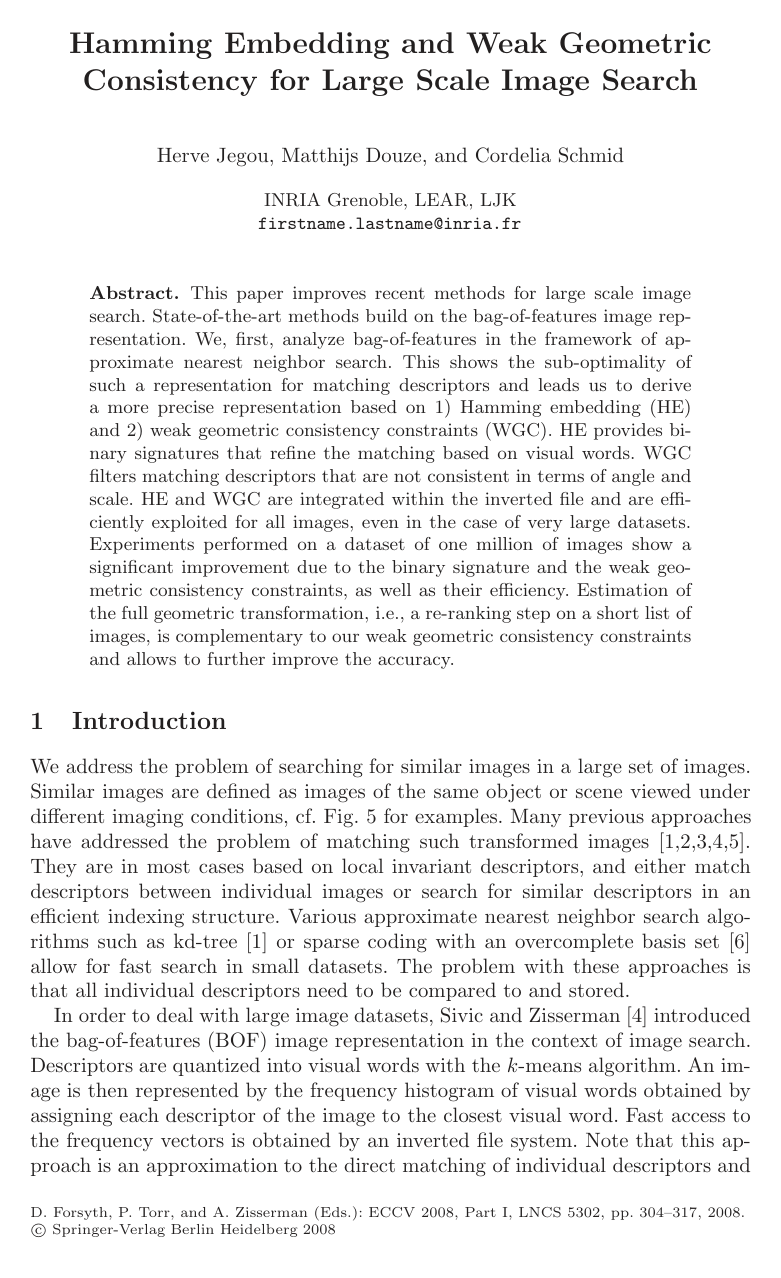
Hamming Embedding and Weak Geometric Consistency for Large Scale Image Search
Hervé Jégou, Matthijs Douze, Cordelia Schmid
Why you should read this
Presents Hamming embedding and weak geometric consistency to refine visual-word descriptor matching and filter geometrically inconsistent features directly within an inverted file, substantially increasing retrieval accuracy on million-scale image databases.
This paper improves recent methods for large scale image search. State-of-the-art methods build on the bag-of-features image representation. We, first, analyze bag-of-features in the framework of approximate nearest neighbor search. This shows the sub-optimality of such a representation for matching descriptors and leads us to derive a more precise representation based on 1) Hamming embedding (HE) and 2) weak geometric consistency constraints (WGC). HE provides binary signatures that refine the matching based on visual words. WGC filters matching descriptors that are not consistent in terms of angle and scale. HE and WGC are integrated within the inverted file and are efficiently exploited for all images, even in the case of very large datasets. Experiments performed on a dataset of one million of images show a significant improvement due to the binary signature and the weak geometric consistency constraints, as well as their efficiency. Estimation of the full geometric transformation, i.e., a re-ranking step on a short list of images, is complementary to our weak geometric consistency constraints and allows to further improve the accuracy.
Added
2026-09-16
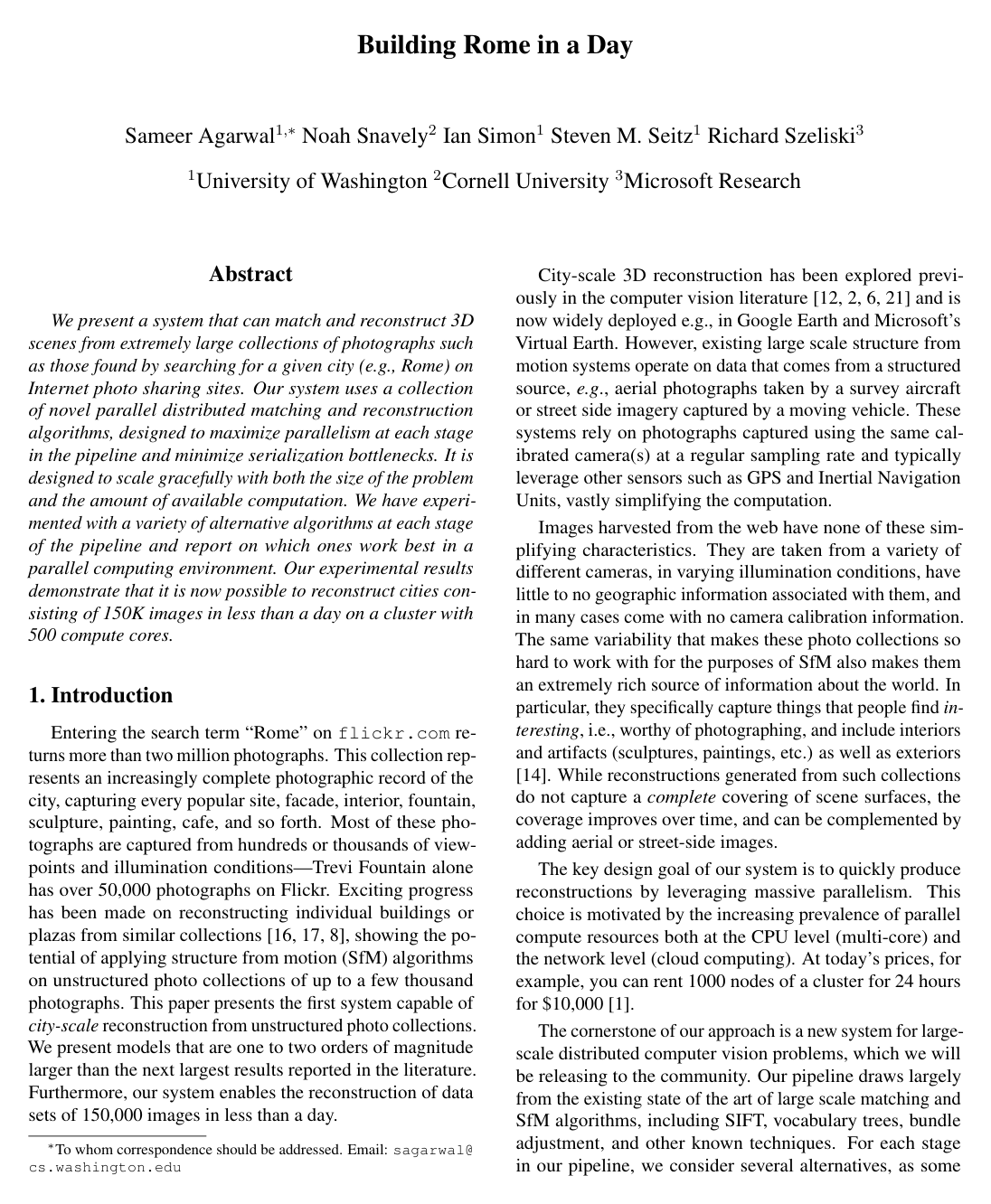
Building Rome in a day
Sameer Agarwal, Noah Snavely, Ian Simon, Steven M. Seitz, Richard Szeliski
Why you should read this
Demonstrates a highly parallel structure-from-motion pipeline that reconstructs city-scale 3D models from 150,000 Internet photos in under a day.
We present a system that can match and reconstruct 3D scenes from extremely large collections of photographs such as those found by searching for a given city (e.g., Rome) on Internet photo sharing sites. Our system uses a collection of novel parallel distributed matching and reconstruction algorithms, designed to maximize parallelism at each stage in the pipeline and minimize serialization bottlenecks. It is designed to scale gracefully with both the size of the problem and the amount of available computation. We have experimented with a variety of alternative algorithms at each stage of the pipeline and report on which ones work best in a parallel computing environment. Our experimental results demonstrate that it is now possible to reconstruct cities consisting of 150K images in less than a day on a cluster with 500 compute cores.
Added
2026-09-14
Accelerating Large-Scale Inference with Anisotropic Vector Quantization
Ruiqi Guo, Philip Sun, Erik Lindgren, Quan Geng, David Simcha, Felix Chern, Sanjiv Kumar
Why you should read this
Develops an anisotropic vector quantization approach that significantly improves large-scale maximum inner product search by prioritizing reconstruction accuracy for higher-scoring database points, achieving state-of-the-art results on public benchmarks.
Quantization based techniques are the current state-of-the-art for scaling maximum inner product search to massive databases. Traditional approaches to quantization aim to minimize the reconstruction error of the database points. Based on the observation that for a given query, the database points that have the largest inner products are more relevant, we develop a family of anisotropic quantization loss functions. Under natural statistical assumptions, we show that quantization with these loss functions leads to a new variant of vector quantization that more greatly penalizes the parallel component of a datapoint's residual relative to its orthogonal component. The proposed approach achieves state-of-the-art results on the public benchmarks available at \url{this http URL}.
Added
2026-05-04

Efficient and robust approximate nearest neighbor search using Hierarchical Navigable Small World graphs
Yu. A. Malkov, D. A. Yashunin
Why you should read this
Details the foundational graph based indexing algorithm that enables ultra fast vector similarity search across billions of high dimensional embeddings in modern industrial retrieval systems.
We present a new approach for the approximate K-nearest neighbor search based on navigable small world graphs with controllable hierarchy (Hierarchical NSW, HNSW). The proposed solution is fully graph-based, without any need for additional search structures, which are typically used at the coarse search stage of the most proximity graph techniques. Hierarchical NSW incrementally builds a multi-layer structure consisting from hierarchical set of proximity graphs (layers) for nested subsets of the stored elements. The maximum layer in which an element is present is selected randomly with an exponentially decaying probability distribution. This allows producing graphs similar to the previously studied Navigable Small World (NSW) structures while additionally having the links separated by their characteristic distance scales. Starting search from the upper layer together with utilizing the scale separation boosts the performance compared to NSW and allows a logarithmic complexity scaling. Additional employment of a heuristic for selecting proximity graph neighbors significantly increases performance at high recall and in case of highly clustered data. Performance evaluation has demonstrated that the proposed general metric space search index is able to strongly outperform previous opensource state-of-the-art vector-only approaches. Similarity of the algorithm to the skip list structure allows straightforward balanced distributed implementation.
Added
2026-05-03