
keyword
answer-set programming
Answer-set programming is a declarative form of logic programming in which a problem is described with logical rules and constraints, and solutions are represented by the rules’ stable models, called answer sets. It is used to express knowledge and search problems, including those involving defaults or exceptions, while a solver computes the answer sets.
2 items
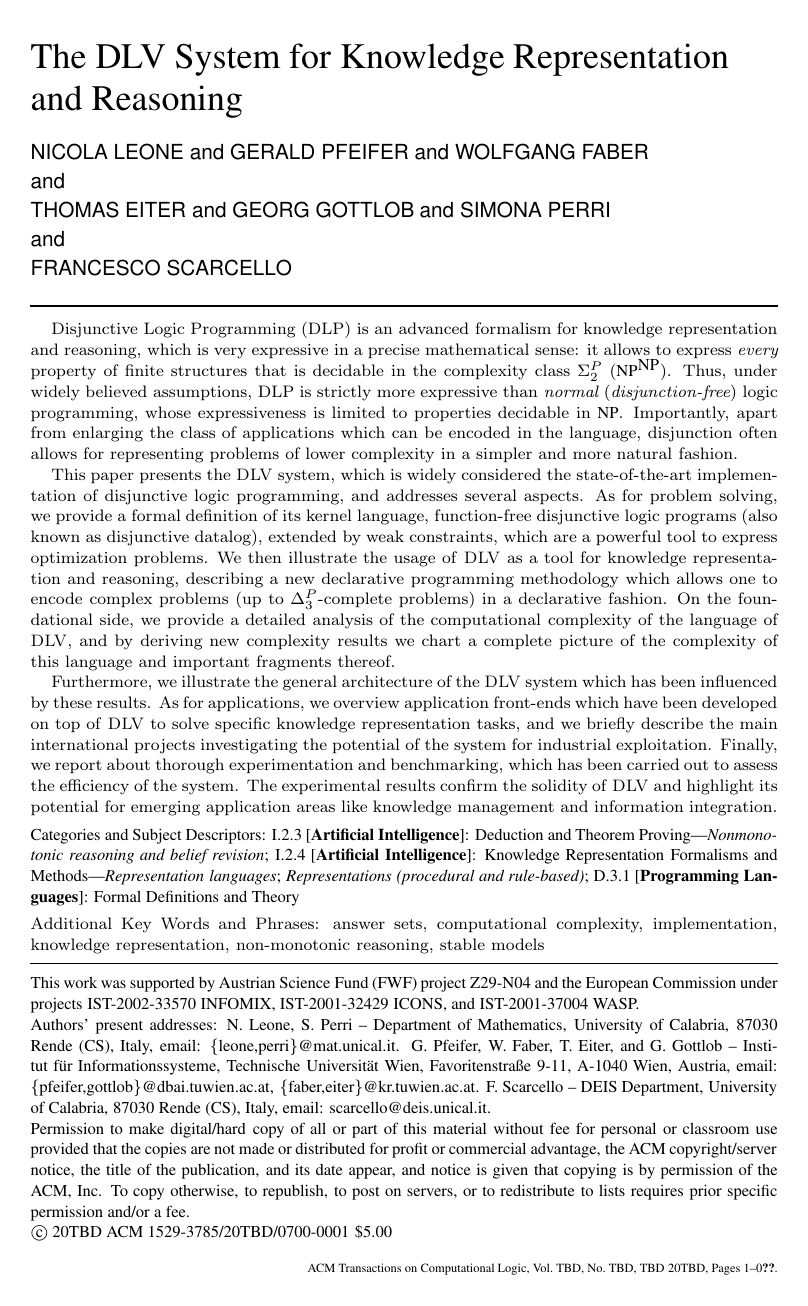
The DLV system for knowledge representation and reasoning
Nicola Leone, Gerald Pfeifer, Wolfgang Faber, Thomas Eiter, Georg Gottlob, Simona Perri, Francesco Scarcello
Why you should read this
Presents the DLV system, detailing the formal foundations, computational complexity, and architectural design of a leading disjunctive logic programming engine capable of solving complex declarative knowledge representation and optimization problems up to -completeness.
This paper presents the DLV system, which is widely considered the state-of-the-art implementation of disjunctive logic programming, and addresses several aspects. As for problem solving, we provide a formal definition of its kernel language, function-free disjunctive logic programs (also known as disjunctive datalog), extended by weak constraints, which are a powerful tool to express optimization problems. We then illustrate the usage of DLV as a tool for knowledge representation and reasoning, describing a new declarative programming methodology which allows one to encode complex problems (up to -complete problems) in a declarative fashion. On the foundational side, we provide a detailed analysis of the computational complexity of the language of DLV, and by deriving new complexity results we chart a complete picture of the complexity of this language and important fragments thereof. Furthermore, we illustrate the general architecture of the DLV system which has been influenced by these results. As for applications, we overview application front-ends which have been developed on top of DLV to solve specific knowledge representation tasks, and we briefly describe the main international projects investigating the potential of the system for industrial exploitation. Finally, we report about thorough experimentation and benchmarking, which has been carried out to assess the efficiency of the system. The experimental results confirm the solidity of DLV and highlight its potential for emerging application areas like knowledge management and information integration.
Added
2026-09-25
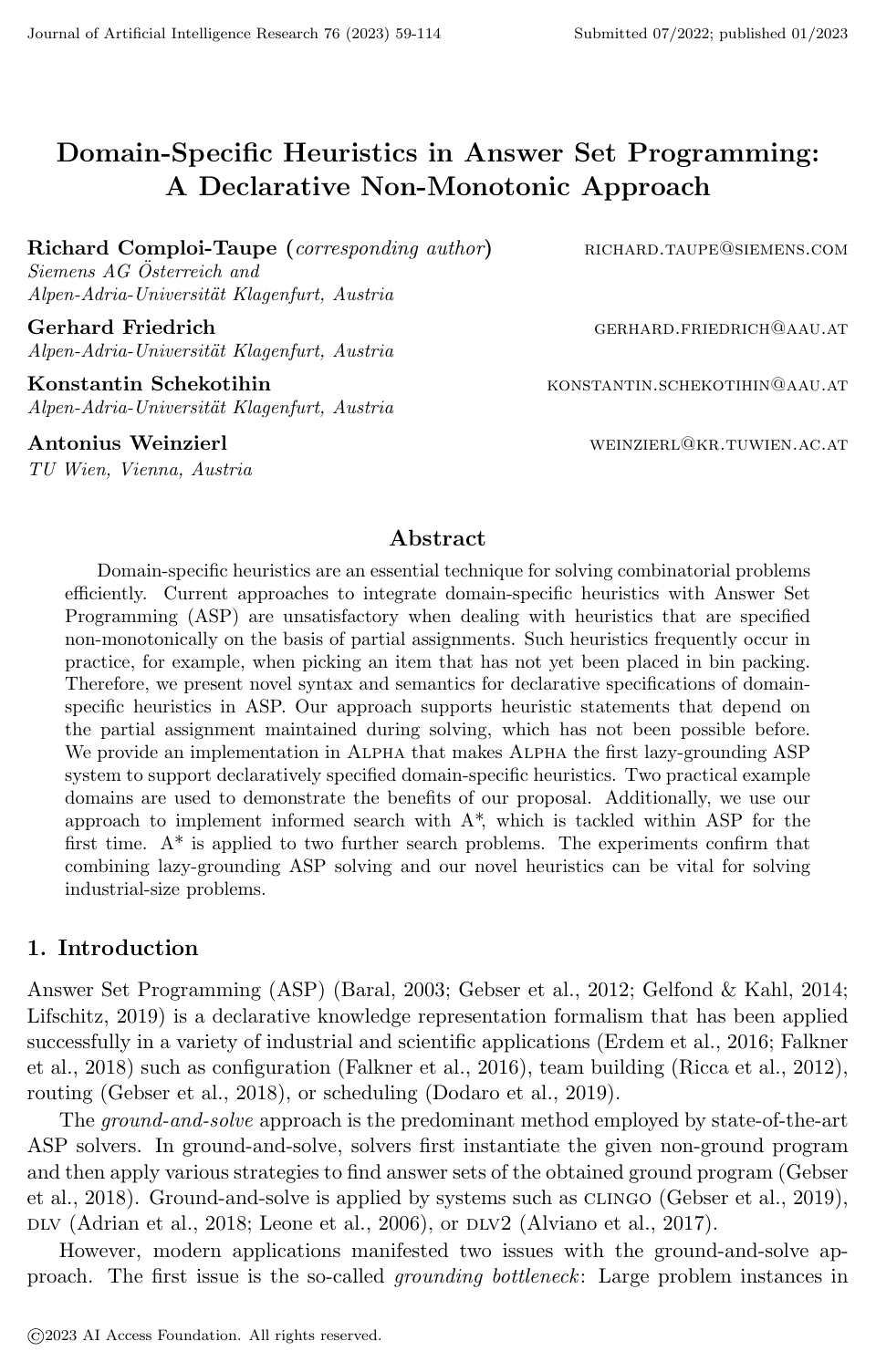
Domain-Specific Heuristics in Answer Set Programming: A Declarative Non-Monotonic Approach
Richard Comploi-Taupe, Gerhard Friedrich, Konstantin Schekotihin, Antonius Weinzierl
Why you should read this
Presents a novel declarative framework for domain-specific heuristics in Answer Set Programming that enables non-monotonic reasoning over partial assignments within the lazy-grounding solver Alpha, facilitating the first implementation of informed search with A* to solve industrial-scale combinatorial problems.
Domain-specific heuristics are an essential technique for solving combinatorial problems efficiently. Current approaches to integrate domain-specific heuristics with Answer Set Programming (ASP) are unsatisfactory when dealing with heuristics that are specified non-monotonically on the basis of partial assignments. Such heuristics frequently occur in practice, for example, when picking an item that has not yet been placed in bin packing. Therefore, we present novel syntax and semantics for declarative specifications of domain-specific heuristics in ASP. Our approach supports heuristic statements that depend on the partial assignment maintained during solving, which has not been possible before. We provide an implementation in ALPHA that makes ALPHA the first lazy-grounding ASP system to support declaratively specified domain-specific heuristics. Two practical example domains are used to demonstrate the benefits of our proposal. Additionally, we use our approach to implement informed search with A*, which is tackled within ASP for the first time. A* is applied to two further search problems. The experiments confirm that combining lazy-grounding ASP solving and our novel heuristics can be vital for solving industrial-size problems.
Added
2026-04-10