Built independently by an author, for readers. Read the story and support ChapterPal

keyword

annotation guidelines

Annotation guidelines are standardized instructions and rules that direct human annotators or automated tools on how to systematically label, categorize, and structure raw data for machine learning and computational tasks. These documents define the target label taxonomy, provide explicit definitions and examples for each category, and establish criteria for handling edge cases and ambiguous instances. By outlining clear decision-making procedures and boundaries, annotation guidelines minimize individual subjectivity, maximize inter-annotator agreement, and ensure high levels of consistency, quality, and reproducibility across the resulting dataset.

1 item

BRIGHTER: BRIdging the Gap in Human-Annotated Textual Emotion Recognition Datasets for 28 Languages

BRIGHTER: BRIdging the Gap in Human-Annotated Textual Emotion Recognition Datasets for 28 Languages

Shamsuddeen Hassan Muhammad, Nedjma Ousidhoum, Idris Abdulmumin, Jan Philip Wahle, Terry Ruas, Meriem Beloucif, Christine de Kock, Nirmal Surange, Daniela Teodorescu, Ibrahim Said Ahmad, David Ifeoluwa Adelani, Alham Fikri Aji, Felermino D. M. A. Ali, Ilseyar Alimova, Vladimir Araujo, Nikolay Babakov, Naomi Baes, Ana-Maria Bucur, Andiswa Bukula, Guanqun Cao, Rodrigo Tufio Cardenas, Rendi Chevi, Chiamaka Ijeoma Chukwuneke, Alexandra Ciobotaru, Daryna Dementieva, Murja Sani Gadanya, Robert Geislinger, Bela Gipp, Oumaima Hourrane, Oana Ignat, Falalu Ibrahim Lawan, Rooweither Mabuya, Rahmad Mahendra, Vukosi Marivate, Alexander Panchenko, Andrew Piper, Charles Henrique Porto Ferreira, Vitaly Protasov, Samuel Rutunda, Manish Shrivastava, Aura Cristina Udrea, Lilian Diana Awuor Wanzare, Sophie Wu, Florian Valentin Wunderlich, Hanif Muhammad Zhafran, Tianhui Zhang, Yi Zhou, Saif M. Mohammad

Why you should read this

Presents BRIGHTER, a benchmark of nearly 100,000 human-annotated examples spanning 28 typologically diverse, predominantly low-resource languages, providing multi-label emotion and intensity annotations to expose and address cross-lingual performance gaps in large language models.

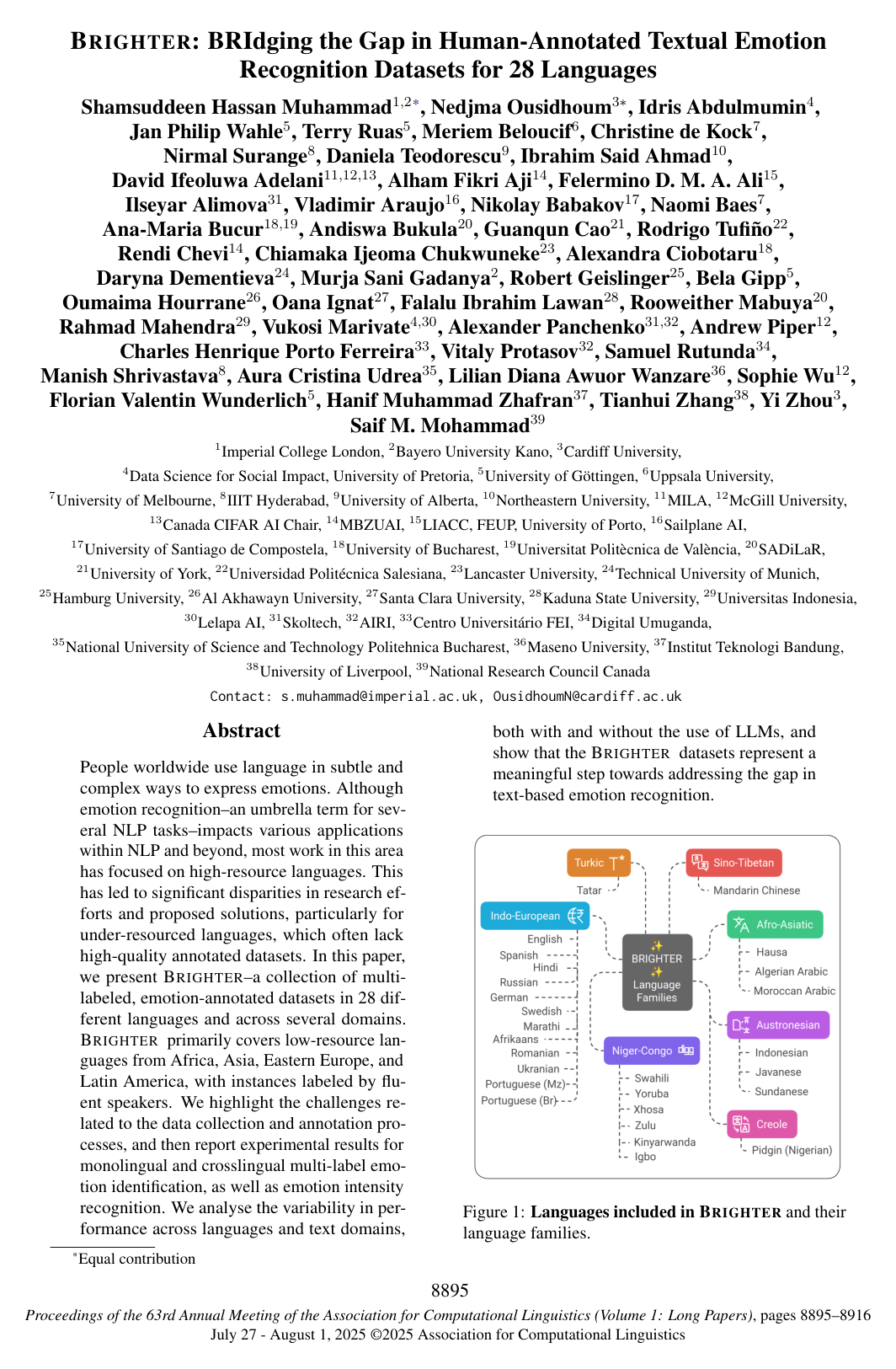
People worldwide use language in subtle and complex ways to express emotions. Although emotion recognition—an umbrella term for several NLP tasks—impacts various applications within NLP and beyond, most work in this area has focused on high-resource languages. This has led to significant disparities in research efforts and proposed solutions, particularly for under-resourced languages, which often lack high-quality annotated datasets. In this paper, we present BRIGHTER—a collection of multi-labeled, emotion-annotated datasets in 28 different languages and across several domains. BRIGHTER primarily covers low-resource languages from Africa, Asia, Eastern Europe, and Latin America, with instances labeled by fluent speakers. We highlight the challenges related to the data collection and annotation processes, and then report experimental results for monolingual and crosslingual multi-label emotion identification, as well as emotion intensity recognition. We analyse the variability in performance across languages and text domains, both with and without the use of LLMs, and show that the BRIGHTER datasets represent a meaningful step towards addressing the gap in text-based emotion recognition.

Added

2026-09-26