
keyword
anchor-based detector
An anchor-based detector is a computer vision object detection model that uses predefined reference bounding boxes, commonly called anchors or anchor boxes, placed systematically across an image to locate and classify target objects. These preset boxes are predefined with varying scales and aspect ratios to serve as initial templates distributed across different spatial locations on a feature map. Rather than predicting absolute bounding box coordinates from scratch, the detector classifies each anchor and calculates relative coordinate offsets to adjust the anchor dimensions and positions so they tightly enclose the detected objects. This mechanism provides standardized geometric priors to handle diverse object sizes and shapes during training and inference, distinguishing anchor-based architectures from anchor-free detectors that estimate object boundaries or center points directly without predefined box templates.
3 items
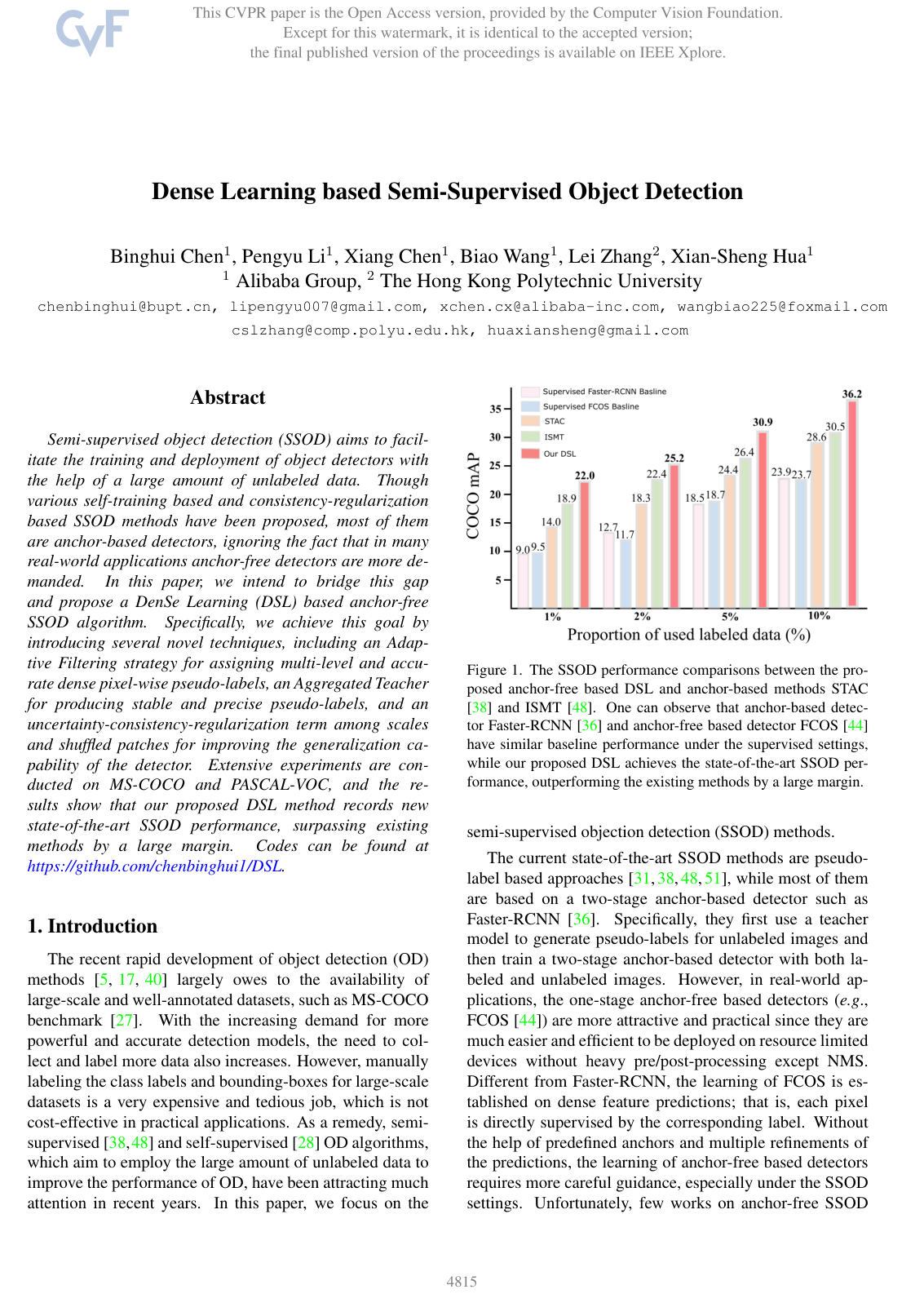
Dense Learning based Semi-Supervised Object Detection
Binghui Chen, Pengyu Li, Xiang Chen, Biao Wang, Lei Zhang, Xian-Sheng Hua
Why you should read this
Proposes an anchor-free semi-supervised object detection framework that assigns dense pixel-level pseudo-labels via adaptive filtering and scale-consistent regularization to substantially outperform anchor-based methods on limited labeled data.
Semi-supervised object detection (SSOD) aims to facilitate the training and deployment of object detectors with the help of a large amount of unlabeled data. Though various self-training based and consistency-regularization based SSOD methods have been proposed, most of them are anchor-based detectors, ignoring the fact that in many real-world applications anchor-free detectors are more demanded. In this paper, we intend to bridge this gap and propose a DenSe Learning (DSL) based anchor-free SSOD algorithm. Specifically, we achieve this goal by introducing several novel techniques, including an Adaptive Filtering strategy for assigning multi-level and accurate dense pixel-wise pseudo-labels, an Aggregated Teacher for producing stable and precise pseudo-labels, and an uncertainty-consistency-regularization term among scales and shuffled patches for improving the generalization capability of the detector. Extensive experiments are conducted on MS-COCO and PASCAL-VOC, and the results show that our proposed DSL method records new state-of-the-art SSOD performance, surpassing existing methods by a large margin. Codes can be found at https://github.com/chenbinghui1/DSL.
Added
2026-09-26
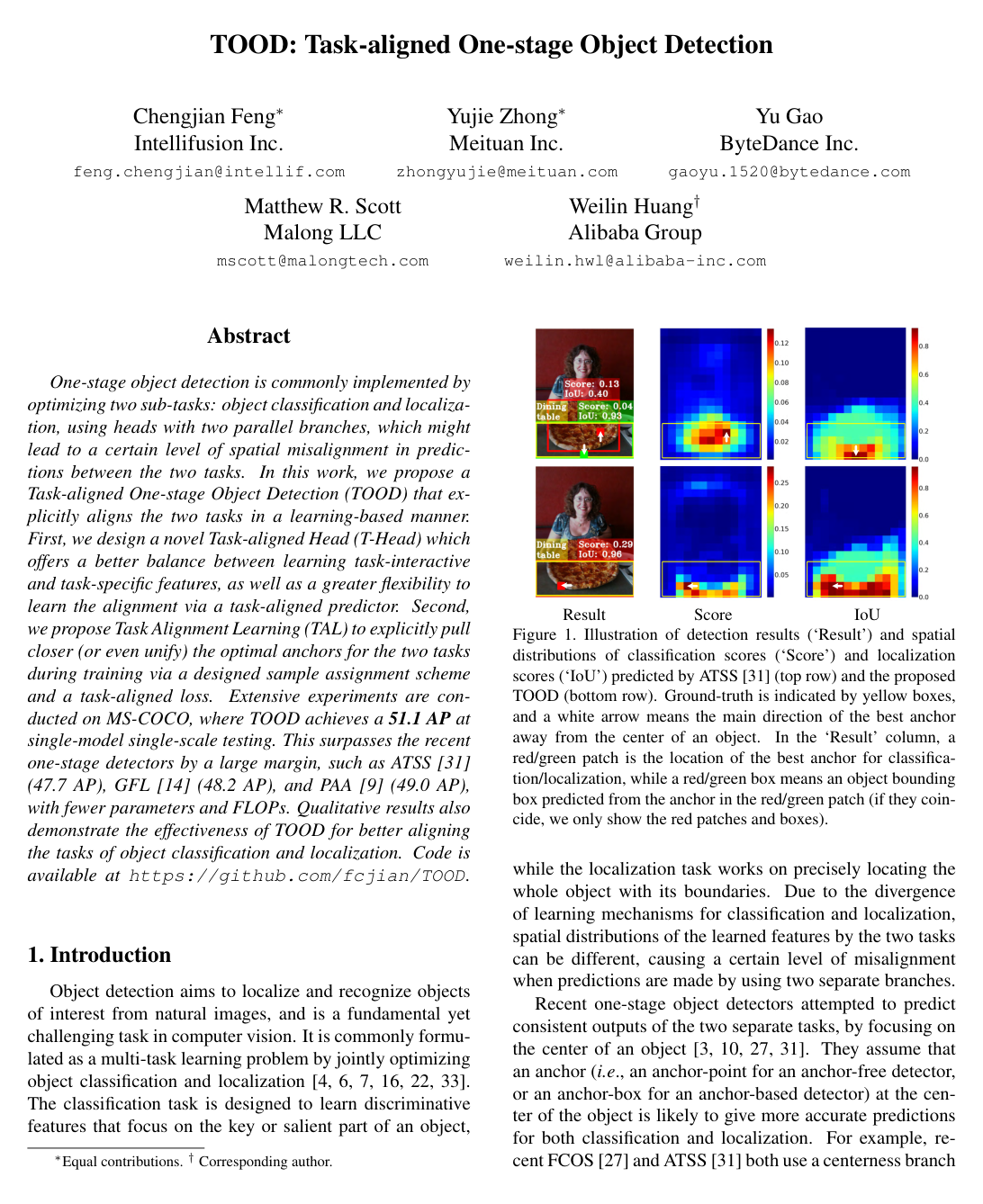
TOOD: Task-aligned One-stage Object Detection
Chengjian Feng, Yujie Zhong, Yu Gao, Matthew R. Scott, Weilin Huang
Why you should read this
Proposes a task-aligned one-stage object detection framework that resolves spatial misalignment between classification and localization features via an interactive prediction head and alignment-based sample assignment, achieving 51.1 AP on MS-COCO with fewer parameters and FLOPs than existing detectors.
One-stage object detection is commonly implemented by optimizing two sub-tasks: object classification and localization, using heads with two parallel branches, which might lead to a certain level of spatial misalignment in predictions between the two tasks. In this work, we propose a Task-aligned One-stage Object Detection (TOOD) that explicitly aligns the two tasks in a learning-based manner. First, we design a novel Task-aligned Head (T-Head) which offers a better balance between learning task-interactive and task-specific features, as well as a greater flexibility to learn the alignment via a task-aligned predictor. Second, we propose Task Alignment Learning (TAL) to explicitly pull closer (or even unify) the optimal anchors for the two tasks during training via a designed sample assignment scheme and a task-aligned loss. Extensive experiments are conducted on MS-COCO, where TOOD achieves a 51.1 AP at single-model single-scale testing. This surpasses the recent one-stage detectors by a large margin, such as ATSS (47.7 AP), GFL (48.2 AP), and PAA (49.0 AP), with fewer parameters and FLOPs. Qualitative results also demonstrate the effectiveness of TOOD for better aligning the tasks of object classification and localization. Code is available at this https URL.
Added
2026-09-25
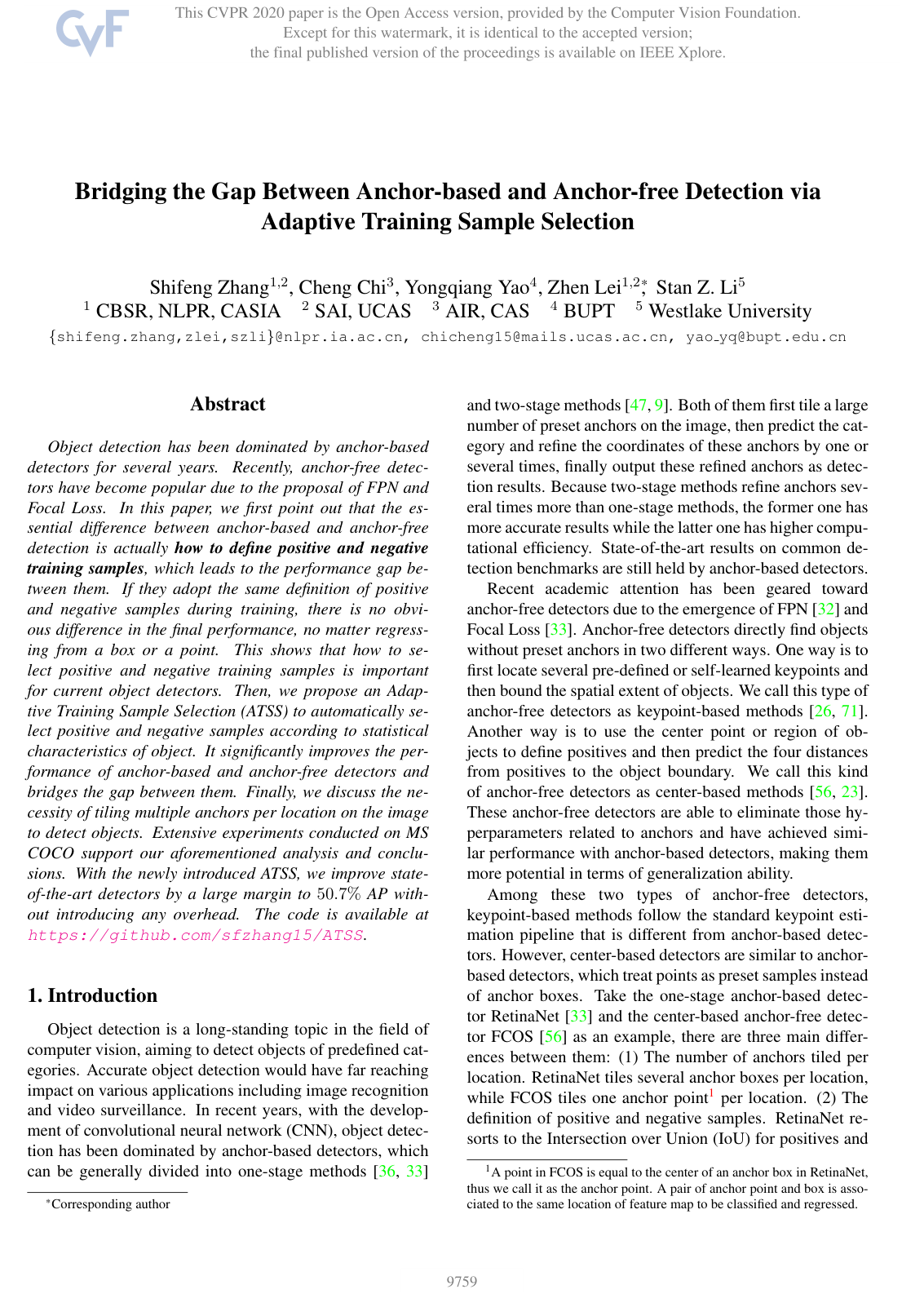
Bridging the Gap Between Anchor-Based and Anchor-Free Detection via Adaptive Training Sample Selection
Shifeng Zhang, Cheng Chi, Yongqiang Yao, Zhen Lei, Stan Z. Li
Why you should read this
Reveals that positive and negative sample selection is the essential difference between anchor-based and anchor-free object detectors, introducing an Adaptive Training Sample Selection (ATSS) strategy that unifies both paradigms and boosts detection accuracy without added overhead.
Object detection has been dominated by anchor-based detectors for several years. Recently, anchor-free detectors have become popular due to the proposal of FPN and Focal Loss. In this paper, we first point out that the essential difference between anchor-based and anchor-free detection is actually how to define positive and negative training samples, which leads to the performance gap between them. If they adopt the same definition of positive and negative samples during training, there is no obvious difference in the final performance, no matter regressing from a box or a point. This shows that how to select positive and negative training samples is important for current object detectors. Then, we propose an Adaptive Training Sample Selection (ATSS) to automatically select positive and negative samples according to statistical characteristics of object. It significantly improves the performance of anchor-based and anchor-free detectors and bridges the gap between them. Finally, we discuss the necessity of tiling multiple anchors per location on the image to detect objects. Extensive experiments conducted on MS COCO support our aforementioned analysis and conclusions. With the newly introduced ATSS, we improve state-of-the-art detectors by a large margin to AP without introducing any overhead. The code is available at this https URL
Added
2026-09-16