
keyword
analogy tasks
Analogy tasks are benchmark evaluation methods in natural language processing and machine learning designed to test a computational model ability to recognize relational similarities between pairs of words or concepts, typically structured in the proportional form of A is to B as C is to D. In vector space models and word embedding frameworks, these tasks evaluate whether linguistic relationships are captured as linear transformations or directional offsets by using vector arithmetic, such as adding the difference between one pair of word vectors to a third word vector to predict the missing fourth term. These evaluations commonly encompass both semantic relations, such as geographic associations and family relationships, and syntactic relations, such as verb tenses and grammatical inflections, providing a standardized intrinsic measure of the structural quality and relational reasoning capacity of learned representations.
2 items
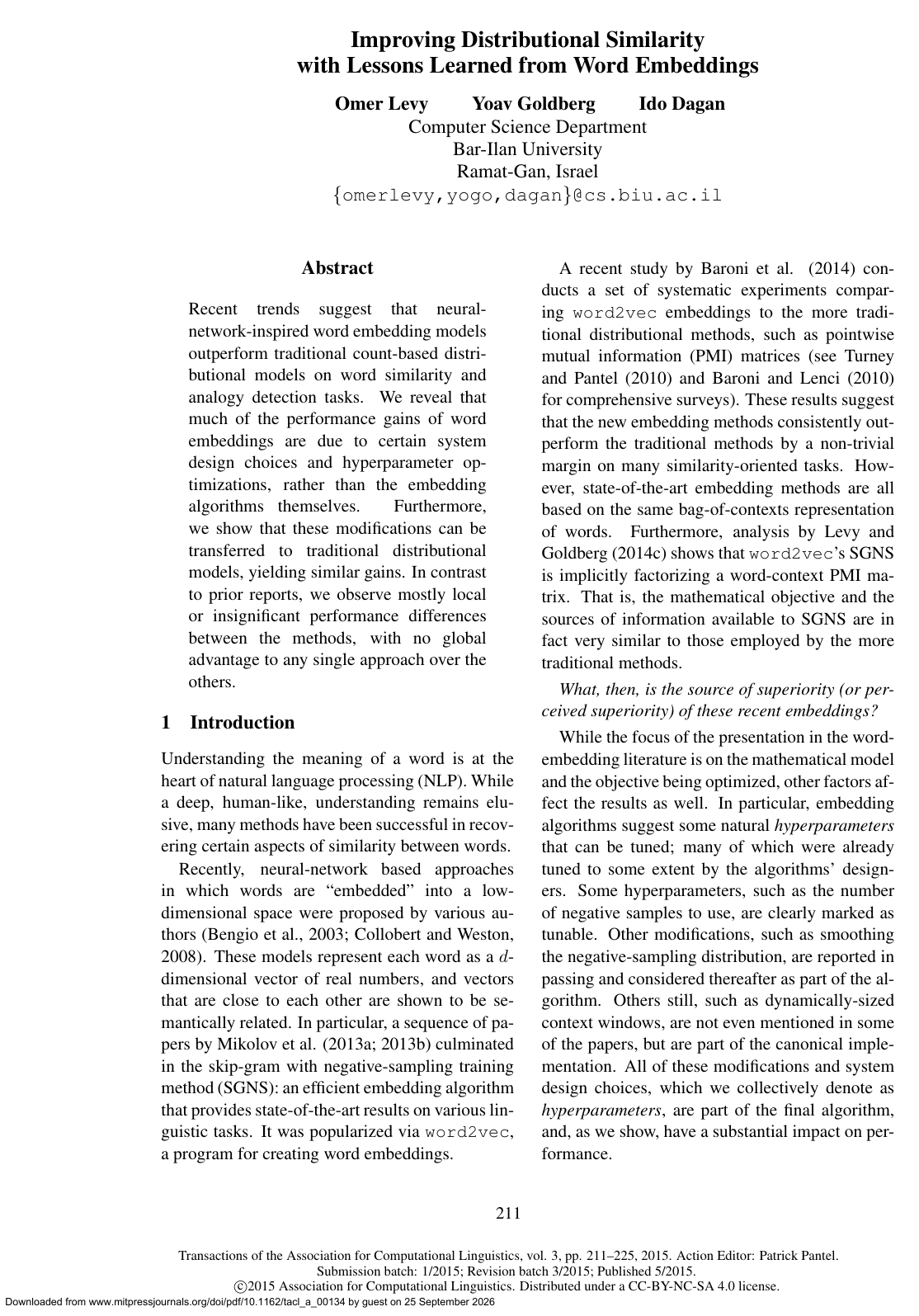
Improving Distributional Similarity with Lessons Learned from Word Embeddings
Omer Levy, Yoav Goldberg, Ido Dagan
Why you should read this
Demonstrates that the superior performance of neural word embeddings over traditional count-based models stems from hyperparameter optimizations rather than algorithmic differences, proving that applying these same tuning strategies to count-based methods eliminates the performance gap across semantic benchmarks.
Recent trends suggest that neural-network-inspired word embedding models outperform traditional count-based distributional models on word similarity and analogy detection tasks. We reveal that much of the performance gains of word embeddings are due to certain system design choices and hyperparameter optimizations, rather than the embedding algorithms themselves. Furthermore, we show that these modifications can be transferred to traditional distributional models, yielding similar gains. In contrast to prior reports, we observe mostly local or insignificant performance differences between the methods, with no global advantage to any single approach over the others.
Added
2026-09-25
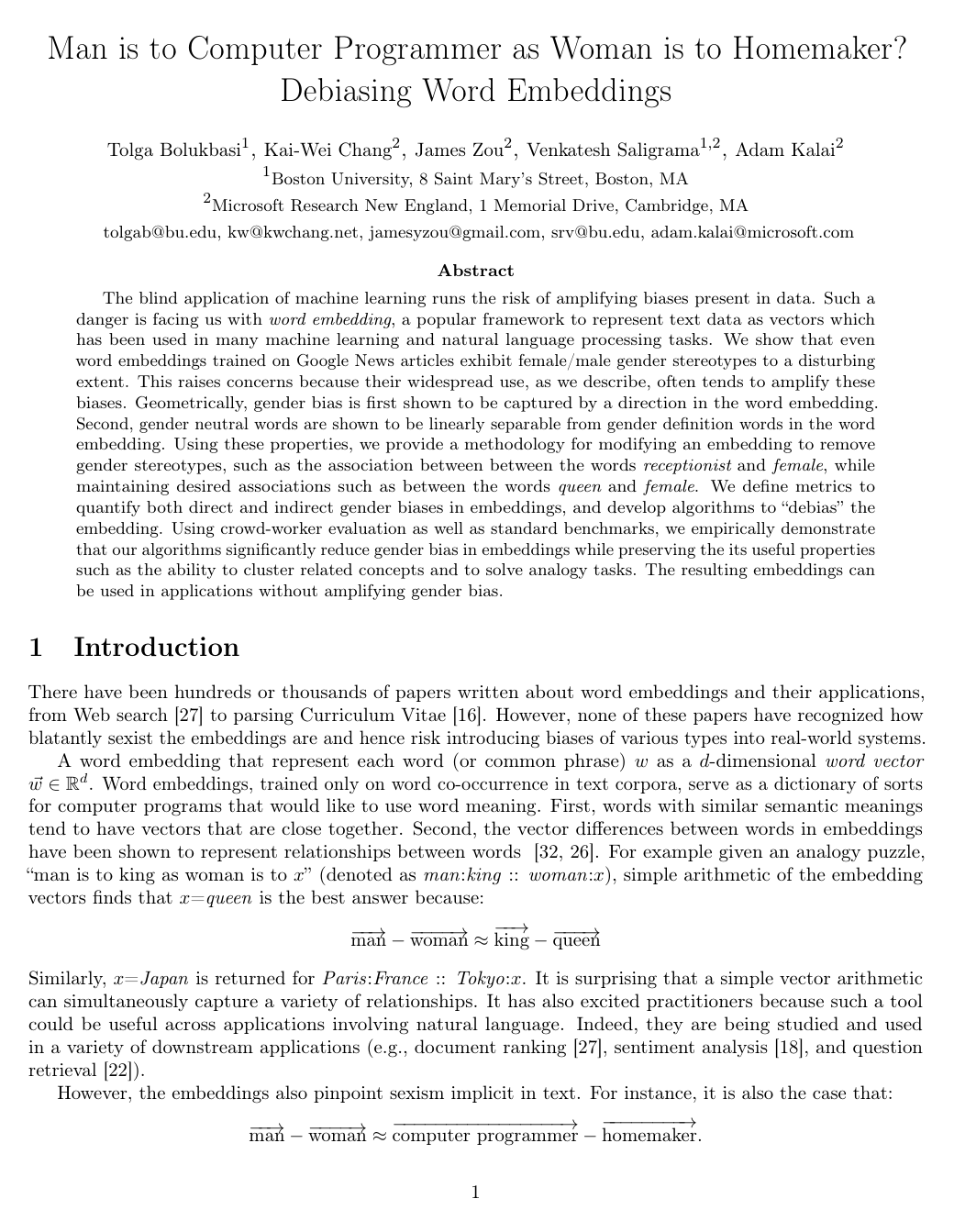
Man is to Computer Programmer as Woman is to Homemaker? Debiasing Word Embeddings
Tolga Bolukbasi, Kai-Wei Chang, James Zou, Venkatesh Saligrama, Adam Kalai
Why you should read this
Exposes pervasive gender stereotypes encoded in standard word embeddings and introduces geometric algorithms to eliminate these biases while preserving core semantic relationships and analogy performance.
The blind application of machine learning runs the risk of amplifying biases present in data. Such a danger is facing us with word embedding, a popular framework to represent text data as vectors which has been used in many machine learning and natural language processing tasks. We show that even word embeddings trained on Google News articles exhibit female/male gender stereotypes to a disturbing extent. This raises concerns because their widespread use, as we describe, often tends to amplify these biases. Geometrically, gender bias is first shown to be captured by a direction in the word embedding. Second, gender neutral words are shown to be linearly separable from gender definition words in the word embedding. Using these properties, we provide a methodology for modifying an embedding to remove gender stereotypes, such as the association between between the words receptionist and female, while maintaining desired associations such as between the words queen and female. We define metrics to quantify both direct and indirect gender biases in embeddings, and develop algorithms to "debias" the embedding. Using crowd-worker evaluation as well as standard benchmarks, we empirically demonstrate that our algorithms significantly reduce gender bias in embeddings while preserving the its useful properties such as the ability to cluster related concepts and to solve analogy tasks. The resulting embeddings can be used in applications without amplifying gender bias.
Added
2026-09-11
License
Published with permission