
keyword
aleatoric uncertainty
Aleatoric uncertainty refers to the inherent randomness, variability, or noise present in an observation, measurement, or underlying data-generating process. Unlike epistemic uncertainty, which arises from a model lacking knowledge and can be reduced by collecting more data, aleatoric uncertainty represents an irreducible property of the phenomenon being observed. In machine learning and statistical modeling, it typically stems from factors such as sensor precision limits, subjective labeling, task ambiguity, or natural environmental stochasticity, meaning that even a model with infinite data and optimal parameters cannot eliminate the variability inherent in the outcome.
9 items
Hybrid Uncertainty Quantification for Selective Text Classification in Ambiguous Tasks
Artem Vazhentsev, Gleb Kuzmin, Akim Tsvigun, Alexander Panchenko, Maxim Panov, Mikhail Burtsev, Artem Shelmanov
Why you should read this
Proposes a hybrid uncertainty quantification method that unites epistemic and aleatoric measures to reliably identify prediction errors and improve selective classification in subjective natural language processing tasks like toxicity detection.
Many text classification tasks are inherently ambiguous, which results in automatic systems having a high risk of making mistakes, in spite of using advanced machine learning models. For example, toxicity detection in user-generated content is a subjective task, and notions of toxicity can be annotated according to a variety of definitions that can be in conflict with one another. Instead of relying solely on automatic solutions, moderation of the most difficult and ambiguous cases can be delegated to human workers. Potential mistakes in automated classification can be identified by using uncertainty estimation (UE) techniques. Although UE is a rapidly growing field within natural language processing, we find that state-of-the-art UE methods estimate only epistemic uncertainty and show poor performance, or under-perform trivial methods for ambiguous tasks such as toxicity detection. We argue that in order to create robust uncertainty estimation methods for ambiguous tasks it is necessary to account also for aleatoric uncertainty. In this paper, we propose a new uncertainty estimation method that combines epistemic and aleatoric UE methods. We show that by using our hybrid method, we can outperform state-of-the-art UE methods for toxicity detection and other ambiguous text classification tasks¹.
Added
2026-10-05

Uncertainty Quantification for In-Context Learning of Large Language Models
Chen Ling, Xujiang Zhao, Xuchao Zhang, Wei Cheng, Yanchi Liu, Yiyou Sun, Mika Oishi, Takao Osaki, Katsushi Matsuda, Jie Ji, Guangji Bai, Liang Zhao, Haifeng Chen
Why you should read this
Presents a Bayesian framework that decomposes predictive uncertainty in large language model in-context learning into prompt-induced aleatoric and model-induced epistemic components, enabling unsupervised diagnostic evaluation of output reliability across both white-box and black-box settings.
In-context learning has emerged as a ground-breaking ability of Large Language Models (LLMs) and revolutionized various fields by providing a few task-relevant demonstrations in the prompt. However, trustworthy issues with LLM’s response, such as hallucination, have also been actively discussed. Existing works have been devoted to quantifying the uncertainty in LLM’s response, but they often overlook the complex nature of LLMs and the uniqueness of in-context learning. In this work, we delve into the predictive uncertainty of LLMs associated with in-context learning, highlighting that such uncertainties may stem from both the provided demonstrations (aleatoric uncertainty) and ambiguities tied to the model’s configurations (epistemic uncertainty). We propose a novel formulation and corresponding estimation method to quantify both types of uncertainties. The proposed method offers an unsupervised way to understand the prediction of in-context learning in a plug-and-play fashion. Extensive experiments are conducted to demonstrate the effectiveness of the decomposition. The code and data are available at: https://github.com/lingchen0331/UQ_ICL.
Added
2026-10-03
Uncertainty Estimation of Transformer Predictions for Misclassification Detection
Artem Vazhentsev, Gleb Kuzmin, Artem Shelmanov, Akim Tsvigun, Evgenii Tsymbalov, Kirill Fedyanin, Maxim Panov, Alexander Panchenko, Gleb Gusev, Mikhail Burtsev, Manvel Avetisian, Leonid Zhukov
Why you should read this
Develops computationally efficient uncertainty estimation methods for Transformer models in text classification and named entity recognition, demonstrating that a spectral-normalized Mahalanobis distance approach can rival or exceed heavy deep ensembles at detecting misclassifications.
Uncertainty estimation (UE) of model predictions is a crucial step for a variety of tasks such as active learning, misclassification detection, adversarial attack detection, out-of-distribution detection, etc. Most of the works on modeling the uncertainty of deep neural networks evaluate these methods on image classification tasks. Little attention has been paid to UE in natural language processing. To fill this gap, we perform a vast empirical investigation of state-of-the-art UE methods for Transformer models on misclassification detection in named entity recognition and text classification tasks and propose two computationally efficient modifications, one of which approaches or even outperforms computationally intensive methods1.
Added
2026-10-03
Decomposing Uncertainty for Large Language Models through Input Clarification Ensembling
Bairu Hou, Yujian Liu, Kaizhi Qian, Jacob Andreas, Shiyu Chang, Yang Zhang
Why you should read this
Proposes input clarification ensembling, a practical framework that separates large language model uncertainty into input ambiguity and model knowledge deficits without modifying model parameters or training procedures.
Uncertainty decomposition refers to the task of decomposing the total uncertainty of a predictive model into aleatoric (data) uncertainty, resulting from inherent randomness in the data-generating process, and epistemic (model) uncertainty, resulting from missing information in the model’s training data. In large language models (LLMs) specifically, identifying sources of uncertainty is an important step toward improving reliability, trustworthiness, and interpretability, but remains an important open research question. In this paper, we introduce an uncertainty decomposition framework for LLMs, called input clarification ensembling, which can be applied to any pre-trained LLM. Our approach generates a set of clarifications for the input, feeds them into an LLM, and ensembles the corresponding predictions. We show that, when aleatoric uncertainty arises from ambiguity or under-specification in LLM inputs, this approach makes it possible to factor an (un-clarified) LLM’s predictions into separate aleatoric and epistemic terms, using a decomposition similar to the one employed by Bayesian neural networks. Empirical evaluations demonstrate that input clarification ensembling provides accurate and reliable uncertainty quantification on several language processing tasks. Code and data are available at https://github.com/UCSB-NLP-Chang/llm_uncertainty.
Added
2026-10-01
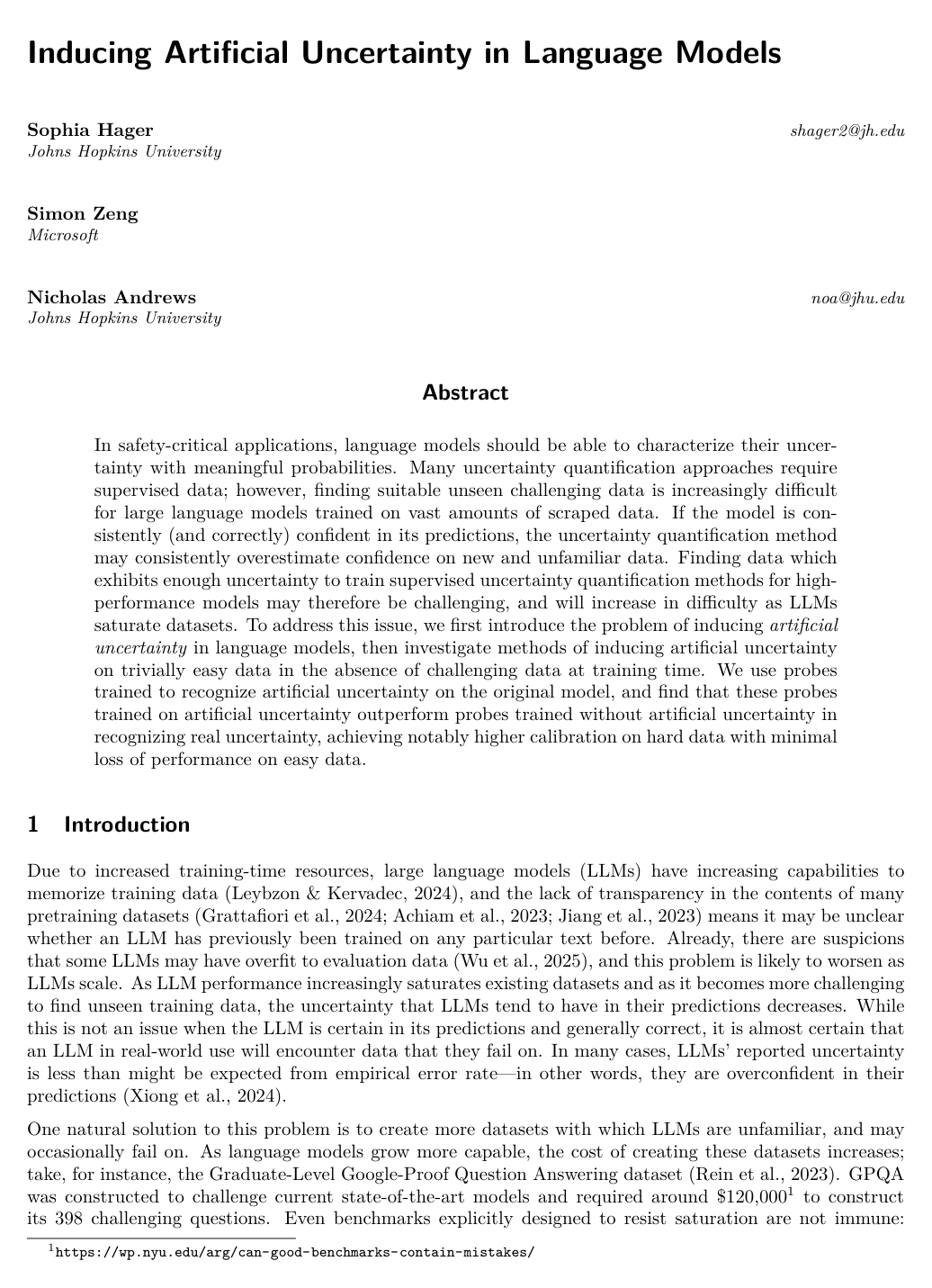
Inducing Artificial Uncertainty in Language Models
Sophia Hager, Simon Zeng, Nicholas Andrews
Why you should read this
Demonstrates that training uncertainty probes on artificially induced uncertainty in language models significantly improves confidence calibration on difficult tasks where naturally challenging training data is scarce.
In safety-critical applications, language models should be able to characterize their uncertainty with meaningful probabilities. Many uncertainty quantification approaches require supervised data; however, finding suitable unseen challenging data is increasingly difficult for large language models trained on vast amounts of scraped data. If the model is consistently (and correctly) confident in its predictions, the uncertainty quantification method may consistently overestimate confidence on new and unfamiliar data. Finding data which exhibits enough uncertainty to train supervised uncertainty quantification methods for high-performance models may therefore be challenging, and will increase in difficulty as LLMs saturate datasets. To address this issue, we first introduce the problem of inducing artificial uncertainty in language models, then investigate methods of inducing artificial uncertainty on trivially easy data in the absence of challenging data at training time. We use probes trained to recognize artificial uncertainty on the original model, and find that these probes trained on artificial uncertainty outperform probes trained without artificial uncertainty in recognizing real uncertainty, achieving notably higher calibration on hard data with minimal loss of performance on easy data.
Added
2026-09-29
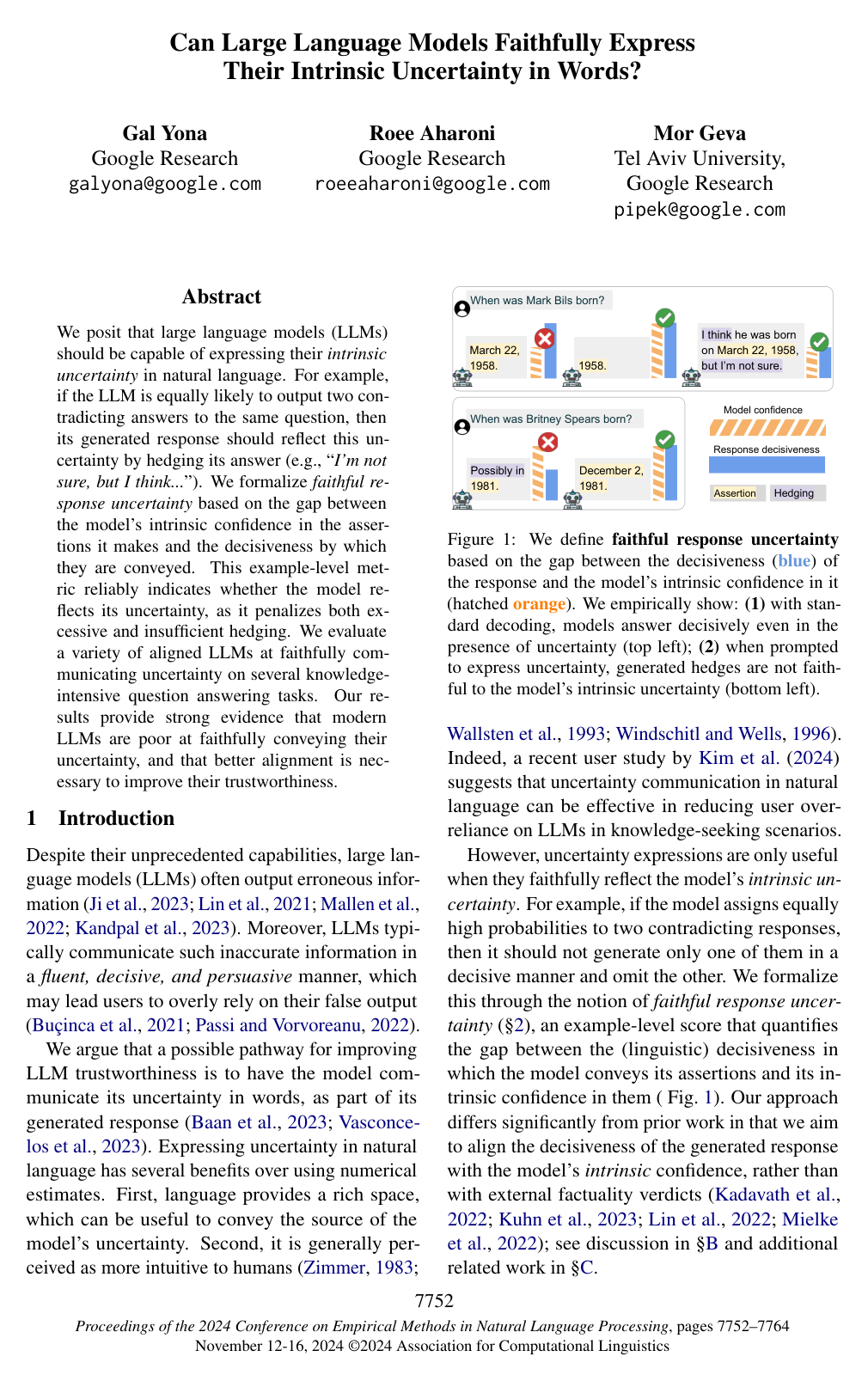
Can Large Language Models Faithfully Express Their Intrinsic Uncertainty in Words?
Gal Yona, Roee Aharoni, Mor Geva
Why you should read this
Reveals that leading large language models consistently fail to faithfully communicate their intrinsic confidence in natural language, exposing critical limitations in how models express certainty and hedge their answers on knowledge-intensive tasks.
We posit that large language models (LLMs) should be capable of expressing their intrinsic uncertainty in natural language. For example, if the LLM is equally likely to output two contradicting answers to the same question, then its generated response should reflect this uncertainty by hedging its answer (e.g., “I’m not sure, but I think…”). We formalize faithful response uncertainty based on the gap between the model’s intrinsic confidence in the assertions it makes and the decisiveness by which they are conveyed. This example-level metric reliably indicates whether the model reflects its uncertainty, as it penalizes both excessive and insufficient hedging. We evaluate a variety of aligned LLMs at faithfully communicating uncertainty on several knowledge-intensive question answering tasks. Our results provide strong evidence that modern LLMs are poor at faithfully conveying their uncertainty, and that better alignment is necessary to improve their trustworthiness.
Added
2026-09-26
A survey of uncertainty in deep neural networks
Jakob Gawlikowski, Cedrique Rovile Njieutcheu Tassi, Mohsin Ali, Jongseok Lee, Matthias Humt, Jianxiang Feng, Anna Kruspe, Rudolph Triebel, Peter Jung, Ribana Roscher, Muhammad Shahzad, Wen Yang, Richard Bamler, Xiao Xiang Zhu
Why you should read this
Synthesizes uncertainty estimation methods in deep learning across Bayesian networks, ensembles, deterministic models, and test-time augmentation while detailing calibration techniques and deployment challenges in safety-critical applications.
Due to their increasing spread, confidence in neural network predictions became more and more important. However, basic neural networks do not deliver certainty estimates or suffer from over or under confidence. Many researchers have been working on understanding and quantifying uncertainty in a neural network's prediction. As a result, different types and sources of uncertainty have been identified and a variety of approaches to measure and quantify uncertainty in neural networks have been proposed. This work gives a comprehensive overview of uncertainty estimation in neural networks, reviews recent advances in the field, highlights current challenges, and identifies potential research opportunities. It is intended to give anyone interested in uncertainty estimation in neural networks a broad overview and introduction, without presupposing prior knowledge in this field. A comprehensive introduction to the most crucial sources of uncertainty is given and their separation into reducible model uncertainty and not reducible data uncertainty is presented. The modeling of these uncertainties based on deterministic neural networks, Bayesian neural networks, ensemble of neural networks, and test-time data augmentation approaches is introduced and different branches of these fields as well as the latest developments are discussed. For a practical application, we discuss different measures of uncertainty, approaches for the calibration of neural networks and give an overview of existing baselines and implementations. Different examples from the wide spectrum of challenges in different fields give an idea of the needs and challenges regarding uncertainties in practical applications. Additionally, the practical limitations of current methods for mission- and safety-critical real world applications are discussed and an outlook on the next steps towards a broader usage of such methods is given.
Added
2026-09-21
Aleatoric and epistemic uncertainty in machine learning: an introduction to concepts and methods
Eyke Hüllermeier, Willem Waegeman
Why you should read this
Clarifies the critical distinction between irreducible data randomness and reducible model ignorance, providing a comprehensive framework for quantifying both aleatoric and epistemic uncertainty to build safer, more reliable machine learning systems.
The notion of uncertainty is of major importance in machine learning and constitutes a key element of machine learning methodology. In line with the statistical tradition, uncertainty has long been perceived as almost synonymous with standard probability and probabilistic predictions. Yet, due to the steadily increasing relevance of machine learning for practical applications and related issues such as safety requirements, new problems and challenges have recently been identified by machine learning scholars, and these problems may call for new methodological developments. In particular, this includes the importance of distinguishing between (at least) two different types of uncertainty, often referred to as aleatoric and epistemic. In this paper, we provide an introduction to the topic of uncertainty in machine learning as well as an overview of attempts so far at handling uncertainty in general and formalizing this distinction in particular.
Added
2026-09-16
What Uncertainties Do We Need in Bayesian Deep Learning for Computer Vision?
Alex Kendall, Yarin Gal
Why you should read this
Develops a unified Bayesian deep learning framework that separates aleatoric and epistemic uncertainties to create noise-attenuating loss functions, improving accuracy and confidence estimation across core computer vision tasks like semantic segmentation and depth regression.
There are two major types of uncertainty one can model. Aleatoric uncertainty captures noise inherent in the observations. On the other hand, epistemic uncertainty accounts for uncertainty in the model -- uncertainty which can be explained away given enough data. Traditionally it has been difficult to model epistemic uncertainty in computer vision, but with new Bayesian deep learning tools this is now possible. We study the benefits of modeling epistemic vs. aleatoric uncertainty in Bayesian deep learning models for vision tasks. For this we present a Bayesian deep learning framework combining input-dependent aleatoric uncertainty together with epistemic uncertainty. We study models under the framework with per-pixel semantic segmentation and depth regression tasks. Further, our explicit uncertainty formulation leads to new loss functions for these tasks, which can be interpreted as learned attenuation. This makes the loss more robust to noisy data, also giving new state-of-the-art results on segmentation and depth regression benchmarks.
Added
2026-09-08