
keyword
affinity prediction
Affinity prediction refers to the computational estimation of the strength and stability with which a small molecule or drug candidate binds to a specific biological target, such as a protein receptor. This measurement reflects the thermodynamic favorability of the intermolecular interaction and is commonly quantified using metrics such as the dissociation constant, inhibition constant, or half-maximal inhibitory concentration. By applying physics-based scoring functions, molecular docking simulations, or machine learning models trained on chemical and structural data, affinity prediction evaluates how effectively a compound can modulate a target protein. It is a critical component of computer-aided drug discovery and structural biology, enabling high-throughput virtual screening and lead optimization while reducing the time and resources required for physical laboratory experiments.
3 items
EquiBind: Geometric Deep Learning for Drug Binding Structure Prediction
Hannes Stärk, Octavian Ganea, Lagnajit Pattanaik, Regina Barzilay, Tommi S. Jaakkola
Why you should read this
Introduces EquiBind, an SE(3)-equivariant neural network that achieves fast, direct-shot prediction of both receptor binding pockets and 3D ligand poses, replacing computationally heavy candidate sampling to accelerate virtual drug screening.
Predicting how a drug-like molecule binds to a specific protein target is a core problem in drug discovery. An extremely fast computational binding method would enable key applications such as fast virtual screening or drug engineering. Existing methods are computationally expensive as they rely on heavy candidate sampling coupled with scoring, ranking, and fine-tuning steps. We challenge this paradigm with EquiBind, an SE(3)-equivariant geometric deep learning model performing direct-shot prediction of both i) the receptor binding location (blind docking) and ii) the ligand's bound pose and orientation. EquiBind achieves significant speed-ups and better quality compared to traditional and recent baselines. Further, we show extra improvements when coupling it with existing fine-tuning techniques at the cost of increased running time. Finally, we propose a novel and fast fine-tuning model that adjusts torsion angles of a ligand's rotatable bonds based on closed-form global minima of the von Mises angular distance to a given input atomic point cloud, avoiding previous expensive differential evolution strategies for energy minimization.
Added
2026-09-28
TANKBind: Trigonometry-Aware Neural NetworKs for Drug-Protein Binding Structure Prediction
Wei Lu, Qifeng Wu, Jixian Zhang, Jiahua Rao, Chengtao Li, Shuangjia Zheng
Why you should read this
Proposes a deep learning framework that incorporates physical geometric constraints and functional protein block segmentation to accurately predict drug-protein binding structures and affinities without extensive conformational sampling.
Illuminating interactions between proteins and small drug molecules is a long-standing challenge in the field of drug discovery. Despite the importance of understanding these interactions, most previous works are limited by hand-designed scoring functions and insufficient conformation sampling. The recently-proposed graph neural network-based methods provides alternatives to predict protein-ligand complex conformation in a one-shot manner. However, these methods neglect the geometric constraints of the complex structure and weaken the role of local functional regions. As a result, they might produce unreasonable conformations for challenging targets and generalize poorly to novel proteins. In this paper, we propose Trigonometry-Aware Neural networKs for binding structure prediction, TANKBind, that builds trigonometry constraint as a vigorous inductive bias into the model and explicitly attends to all possible binding sites for each protein by segmenting the whole protein into functional blocks. We construct novel contrastive losses with local region negative sampling to jointly optimize the binding interaction and affinity. Extensive experiments show substantial performance gains in comparison to state-of-the-art physics-based and deep learning-based methods on commonly-used benchmark datasets for both binding structure and affinity predictions with variant settings.
Added
2026-09-26
DrugOOD: Out-of-Distribution Dataset Curator and Benchmark for AI-Aided Drug Discovery - a Focus on Affinity Prediction Problems with Noise Annotations
Yuanfeng Ji, Lu Zhang, Jiaxiang Wu, Bingzhe Wu, Lanqing Li, Long-Kai Huang, Tingyang Xu, Yu Rong, Jie Ren, Ding Xue, Houtim Lai, Wei Liu, Junzhou Huang, Shuigeng Zhou, Ping Luo, Peilin Zhao, Yatao Bian
Why you should read this
Presents DrugOOD, an automated dataset generation pipeline and evaluation suite that enables researchers to build customized drug-target binding affinity benchmarks with realistic label noise and domain shifts to test the out-of-distribution generalization of graph neural networks.
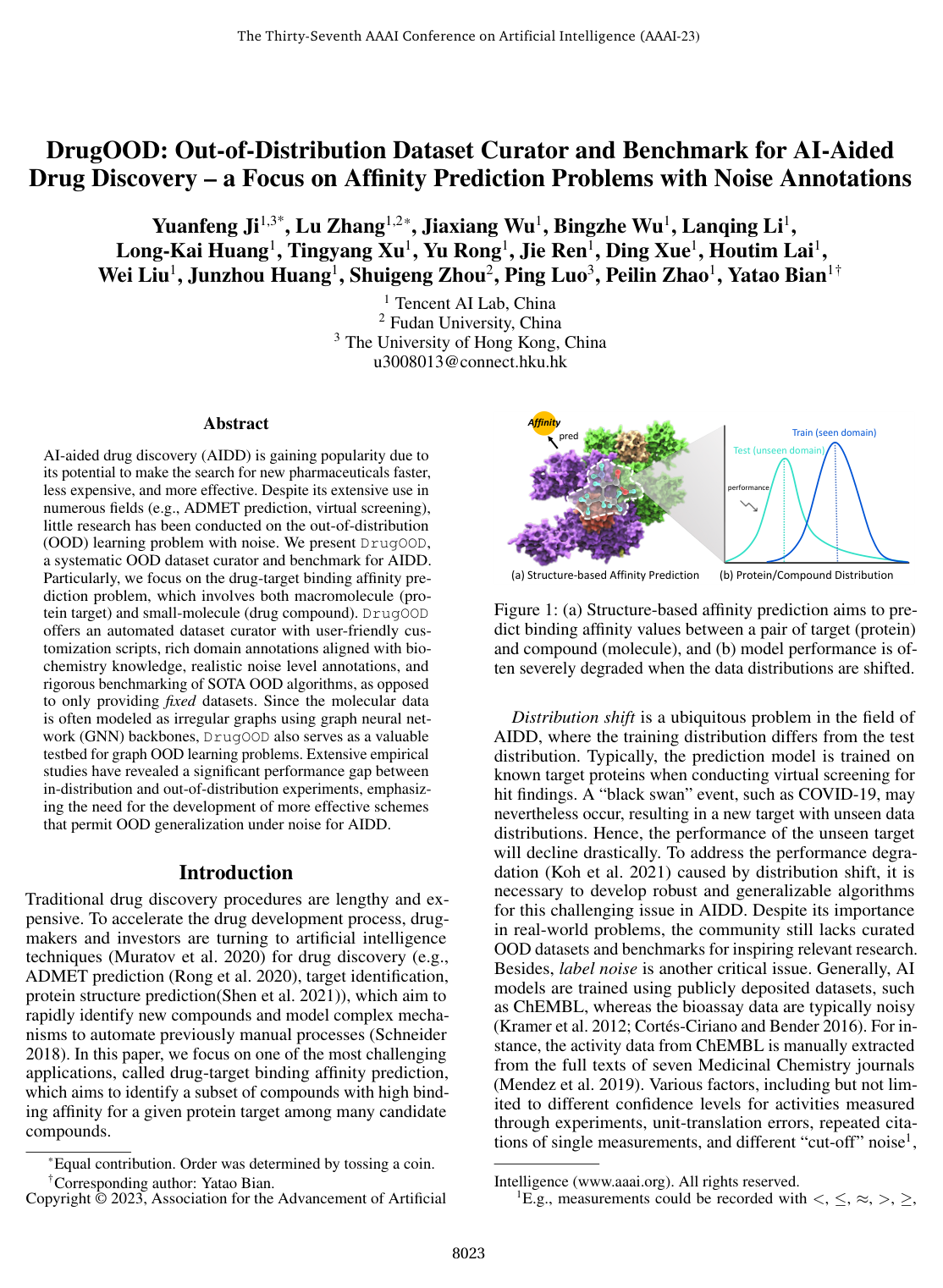
AI-aided drug discovery (AIDD) is gaining popularity due to its potential to make the search for new pharmaceuticals faster, less expensive, and more effective. Despite its extensive use in numerous fields (e.g., ADMET prediction, virtual screening), little research has been conducted on the out-of-distribution (OOD) learning problem with noise. We present DrugOOD, a systematic OOD dataset curator and benchmark for AIDD. Particularly, we focus on the drug-target binding affinity prediction problem, which involves both macromolecule (protein target) and small-molecule (drug compound). DrugOOD offers an automated dataset curator with user-friendly customization scripts, rich domain annotations aligned with biochemistry knowledge, realistic noise level annotations, and rigorous benchmarking of SOTA OOD algorithms, as opposed to only providing fixed datasets. Since the molecular data is often modeled as irregular graphs using graph neural network (GNN) backbones, DrugOOD also serves as a valuable testbed for graph OOD learning problems. Extensive empirical studies have revealed a significant performance gap between in-distribution and out-of-distribution experiments, emphasizing the need for the development of more effective schemes that permit OOD generalization under noise for AIDD.
Added
2026-09-26