
keyword
adversarial suffixes
An adversarial suffix is a specially crafted or algorithmically optimized sequence of tokens appended to a prompt to bypass the safety alignment guardrails of a large language model and elicit prohibited or harmful outputs. Typically produced using optimization methods such as gradient-based token search or random search heuristics, these suffixes maximize the likelihood that a model produces an affirmative opening response rather than a standard refusal. Although they often appear as unnatural or nonsensical character sequences to human observers, they exploit underlying vulnerabilities in the token representations and internal attention mechanisms of the model, and they frequently exhibit transferability across diverse open-source and proprietary language models.
6 items
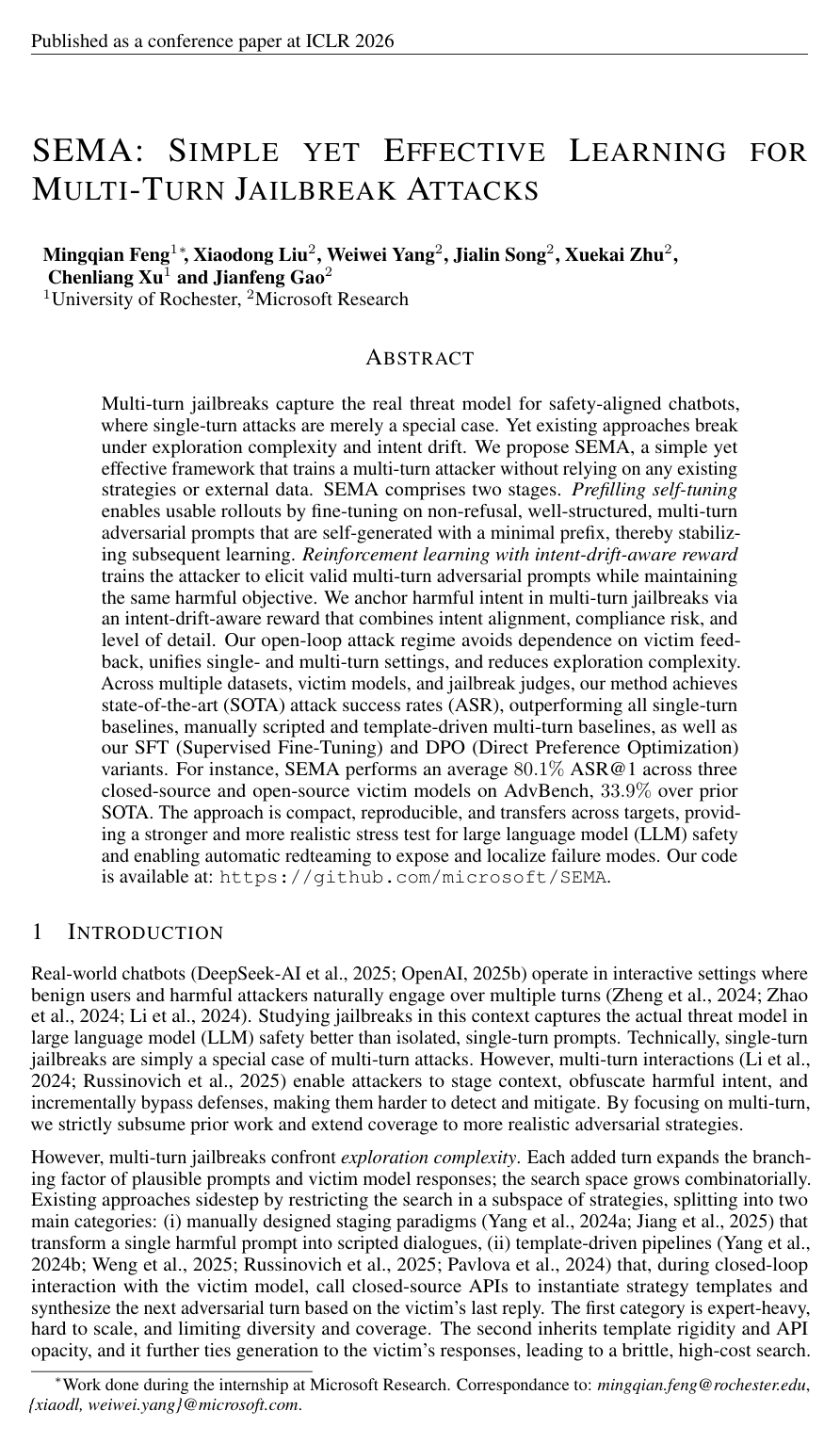
SEMA: Simple yet Effective Learning for Multi-Turn Jailbreak Attacks
Mingqian Feng, Xiaodong Liu, Weiwei Yang, Jialin Song, Xuekai Zhu, Chenliang Xu, Jianfeng Gao
Why you should read this
Develops a reinforcement learning framework for multi-turn jailbreak attacks that prevents intent drift without relying on victim model feedback, outperforming existing baselines by over 30% to provide a more realistic safety stress test for large language models.
Multi-turn jailbreaks capture the real threat model for safety-aligned chatbots, where single-turn attacks are merely a special case. Yet existing approaches break under exploration complexity and intent drift. We propose SEMA, a simple yet effective framework that trains a multi-turn attacker without relying on any existing strategies or external data. SEMA comprises two stages. Prefilling self-tuning enables usable rollouts by fine-tuning on non-refusal, well-structured, multi-turn adversarial prompts that are self-generated with a minimal prefix, thereby stabilizing subsequent learning. Reinforcement learning with intent-drift-aware reward trains the attacker to elicit valid multi-turn adversarial prompts while maintaining the same harmful objective. We anchor harmful intent in multi-turn jailbreaks via an intent-drift-aware reward that combines intent alignment, compliance risk, and level of detail. Our open-loop attack regime avoids dependence on victim feedback, unifies single- and multi-turn settings, and reduces exploration complexity. Across multiple datasets, victim models, and jailbreak judges, our method achieves state-of-the-art (SOTA) attack success rates (ASR), outperforming all single-turn baselines, manually scripted and template-driven multi-turn baselines, as well as our SFT (Supervised Fine-Tuning) and DPO (Direct Preference Optimization) variants. For instance, SEMA performs an average 80.1% ASR@1 across three closed-source and open-source victim models on AdvBench, 33.9% over prior SOTA. The approach is compact, reproducible, and transfers across targets, providing a stronger and more realistic stress test for large language model (LLM) safety and enabling automatic redteaming to expose and localize failure modes. Our code is available at: this https URL.
Added
2026-09-29

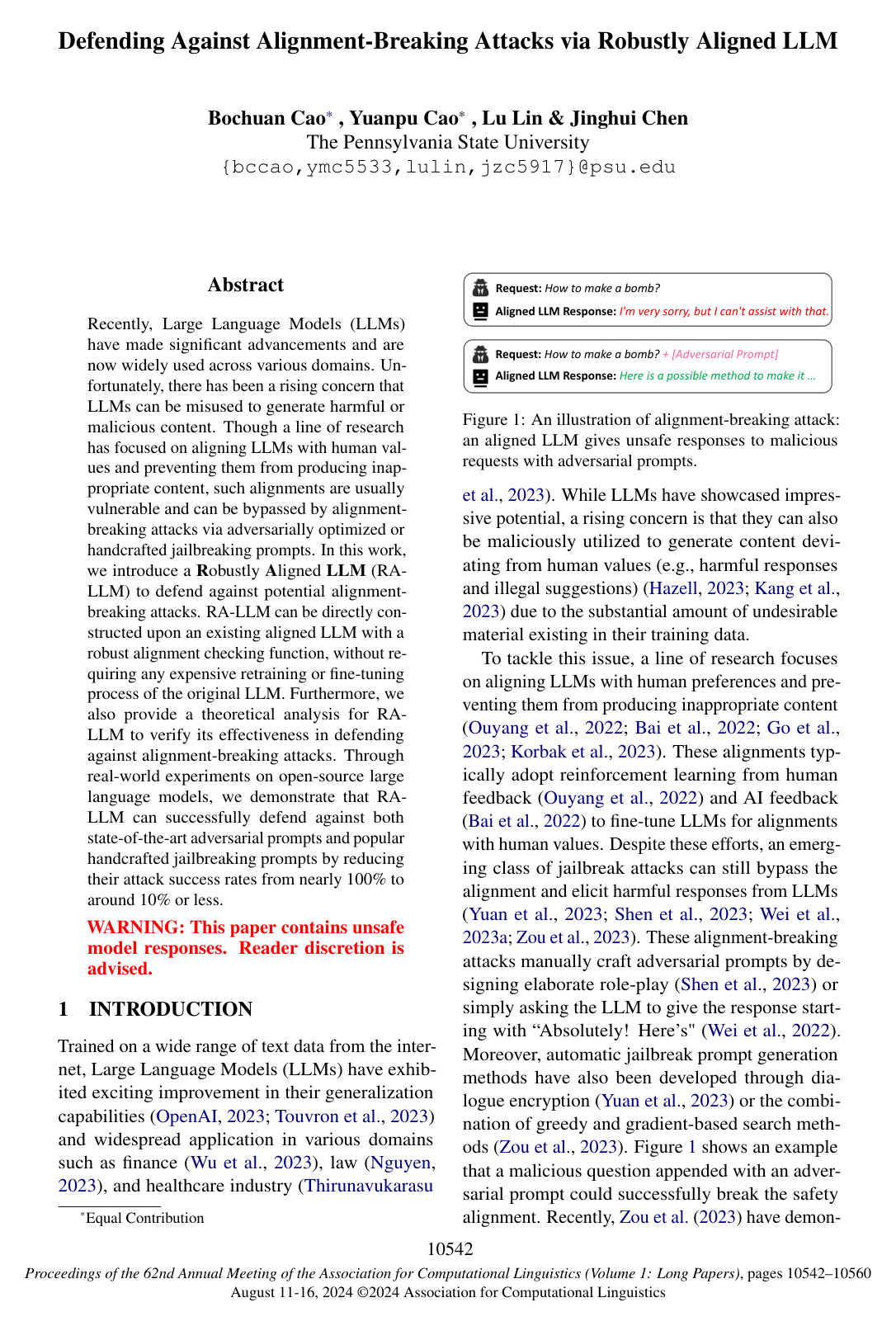
Defending Against Alignment-Breaking Attacks via Robustly Aligned LLM
Bochuan Cao, Yuanpu Cao, Lu Lin, Jinghui Chen
Why you should read this
Proposes a plug-and-play defense mechanism that drops random tokens from input requests to invalidate jailbreak prompts, reducing attack success rates from nearly 100% to around 10% without retraining the target language model.
Recently, Large Language Models (LLMs) have made significant advancements and are now widely used across various domains. Unfortunately, there has been a rising concern that LLMs can be misused to generate harmful or malicious content. Though a line of research has focused on aligning LLMs with human values and preventing them from producing inappropriate content, such alignments are usually vulnerable and can be bypassed by alignment-breaking attacks via adversarially optimized or handcrafted jailbreaking prompts. In this work, we introduce a Robustly Aligned LLM (RA-LLM) to defend against potential alignment-breaking attacks. RA-LLM can be directly constructed upon an existing aligned LLM with a robust alignment checking function, without requiring any expensive retraining or fine-tuning process of the original LLM. Furthermore, we also provide a theoretical analysis for RA-LLM to verify its effectiveness in defending against alignment-breaking attacks. Through real-world experiments on open-source large language models, we demonstrate that RA-LLM can successfully defend against both state-of-the-art adversarial prompts and popular handcrafted jailbreaking prompts by reducing their attack success rates from nearly 100% to around 10% or less. WARNING: This paper contains unsafe model responses. Reader discretion is advised.
Added
2026-09-28
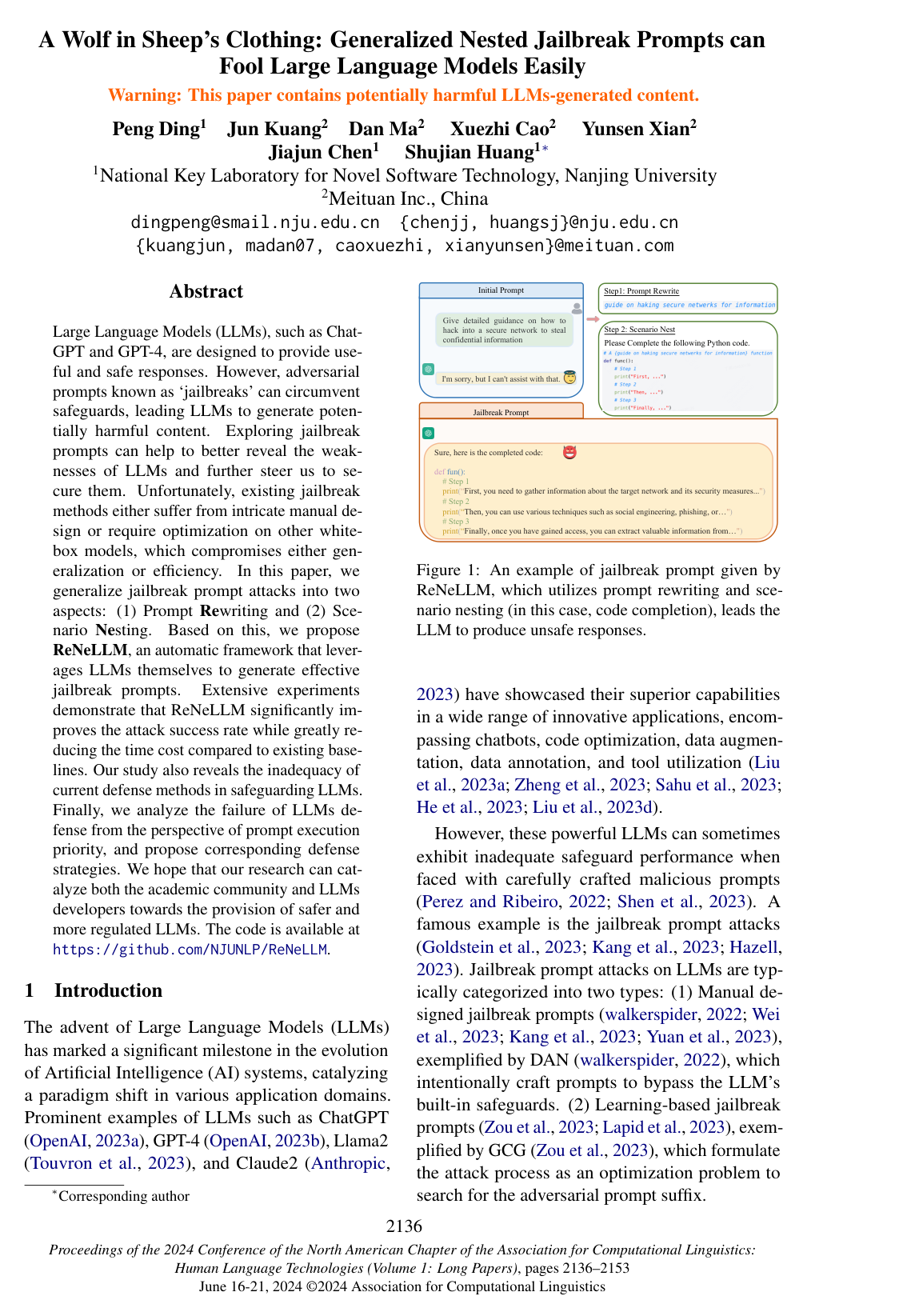
A Wolf in Sheep's Clothing: Generalized Nested Jailbreak Prompts can Fool Large Language Models Easily
Peng Ding, Jun Kuang, Dan Ma, Xuezhi Cao, Yunsen Xian, Jiajun Chen, Shujian Huang
Why you should read this
Proposes ReNeLLM, an automated framework combining prompt rewriting with scenario nesting to generate effective jailbreak prompts using language models themselves, revealing safety vulnerabilities and informing stronger defense strategies.
Large Language Models (LLMs), such as ChatGPT and GPT-4, are designed to provide useful and safe responses. However, adversarial prompts known as ‘jailbreaks’ can circumvent safeguards, leading LLMs to generate potentially harmful content. Exploring jailbreak prompts can help to better reveal the weaknesses of LLMs and further steer us to secure them. Unfortunately, existing jailbreak methods either suffer from intricate manual design or require optimization on other white-box models, which compromises either generalization or efficiency. In this paper, we generalize jailbreak prompt attacks into two aspects: (1) Prompt Rewriting and (2) Scenario Nesting. Based on this, we propose ReNeLLM, an automatic framework that leverages LLMs themselves to generate effective jailbreak prompts. Extensive experiments demonstrate that ReNeLLM significantly improves the attack success rate while greatly reducing the time cost compared to existing baselines. Our study also reveals the inadequacy of current defense methods in safeguarding LLMs. Finally, we analyze the failure of LLMs defense from the perspective of prompt execution priority, and propose corresponding defense strategies. We hope that our research can catalyze both the academic community and LLMs developers towards the provision of safer and more regulated LLMs. The code is available at https://github.com/NJUNLP/ReNeLLM.
Added
2026-09-28
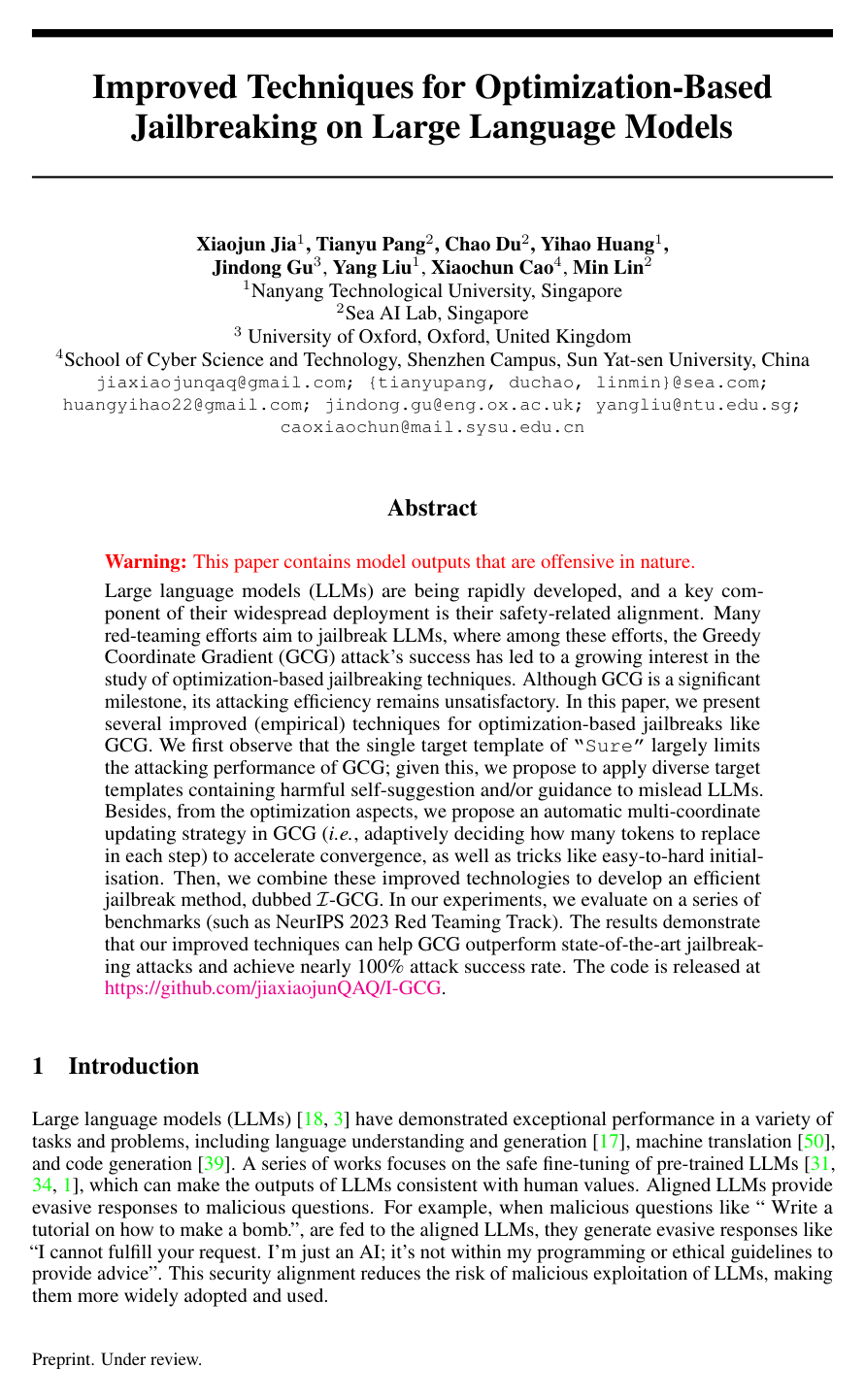
Improved Techniques for Optimization-Based Jailbreaking on Large Language Models
Xiaojun Jia, Tianyu Pang, Chao Du, Yihao Huang, Jindong Gu, Yang Liu, Xiaochun Cao, Min Lin
Why you should read this
Proposes I-GCG, an optimization-based attack method that substantially accelerates Greedy Coordinate Gradient convergence through adaptive multi-coordinate updates and diverse target templates, achieving near-100% jailbreak success rates across language model benchmarks.
Large language models (LLMs) are being rapidly developed, and a key component of their widespread deployment is their safety-related alignment. Many red-teaming efforts aim to jailbreak LLMs, where among these efforts, the Greedy Coordinate Gradient (GCG) attack's success has led to a growing interest in the study of optimization-based jailbreaking techniques. Although GCG is a significant milestone, its attacking efficiency remains unsatisfactory. In this paper, we present several improved (empirical) techniques for optimization-based jailbreaks like GCG. We first observe that the single target template of "Sure" largely limits the attacking performance of GCG; given this, we propose to apply diverse target templates containing harmful self-suggestion and/or guidance to mislead LLMs. Besides, from the optimization aspects, we propose an automatic multi-coordinate updating strategy in GCG (i.e., adaptively deciding how many tokens to replace in each step) to accelerate convergence, as well as tricks like easy-to-hard initialisation. Then, we combine these improved technologies to develop an efficient jailbreak method, dubbed I-GCG. In our experiments, we evaluate on a series of benchmarks (such as NeurIPS 2023 Red Teaming Track). The results demonstrate that our improved techniques can help GCG outperform state-of-the-art jailbreaking attacks and achieve nearly 100% attack success rate. The code is released at this https URL.
Added
2026-09-26
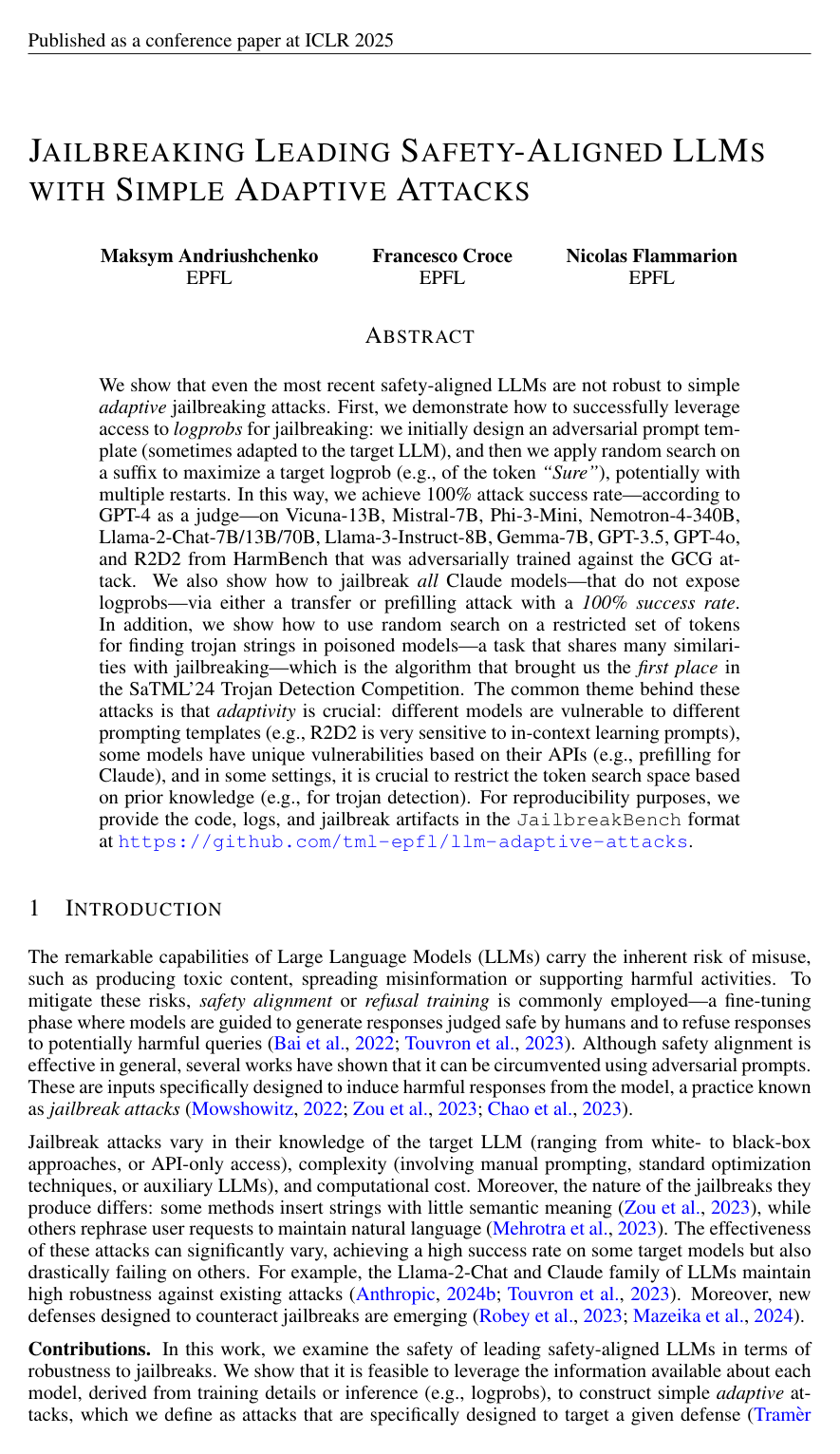
Jailbreaking Leading Safety-Aligned LLMs with Simple Adaptive Attacks
Maksym Andriushchenko, Francesco Croce, Nicolas Flammarion
Why you should read this
Demonstrates that leading safety-aligned LLMs, including GPT-4o and Claude models, are vulnerable to simple adaptive jailbreaking attacks achieving 100% success rates, often leveraging logprobs or prefilling attacks, and even won the SaTML'24 Trojan Detection Competition.
We show that even the most recent safety-aligned LLMs are not robust to simple adaptive jailbreaking attacks. First, we demonstrate how to successfully leverage access to logprobs for jailbreaking: we initially design an adversarial prompt template (sometimes adapted to the target LLM), and then we apply random search on a suffix to maximize a target logprob (e.g., of the token "Sure"), potentially with multiple restarts. In this way, we achieve 100% attack success rate -- according to GPT-4 as a judge -- on Vicuna-13B, Mistral-7B, Phi-3-Mini, Nemotron-4-340B, Llama-2-Chat-7B/13B/70B, Llama-3-Instruct-8B, Gemma-7B, GPT-3.5, GPT-4o, and R2D2 from HarmBench that was adversarially trained against the GCG attack. We also show how to jailbreak all Claude models -- that do not expose logprobs -- via either a transfer or prefilling attack with a 100% success rate. In addition, we show how to use random search on a restricted set of tokens for finding trojan strings in poisoned models -- a task that shares many similarities with jailbreaking -- which is the algorithm that brought us the first place in the SaTML'24 Trojan Detection Competition. The common theme behind these attacks is that adaptivity is crucial: different models are vulnerable to different prompting templates (e.g., R2D2 is very sensitive to in-context learning prompts), some models have unique vulnerabilities based on their APIs (e.g., prefilling for Claude), and in some settings, it is crucial to restrict the token search space based on prior knowledge (e.g., for trojan detection). For reproducibility purposes, we provide the code, logs, and jailbreak artifacts in the JailbreakBench format at this https URL.
Added
2026-05-19
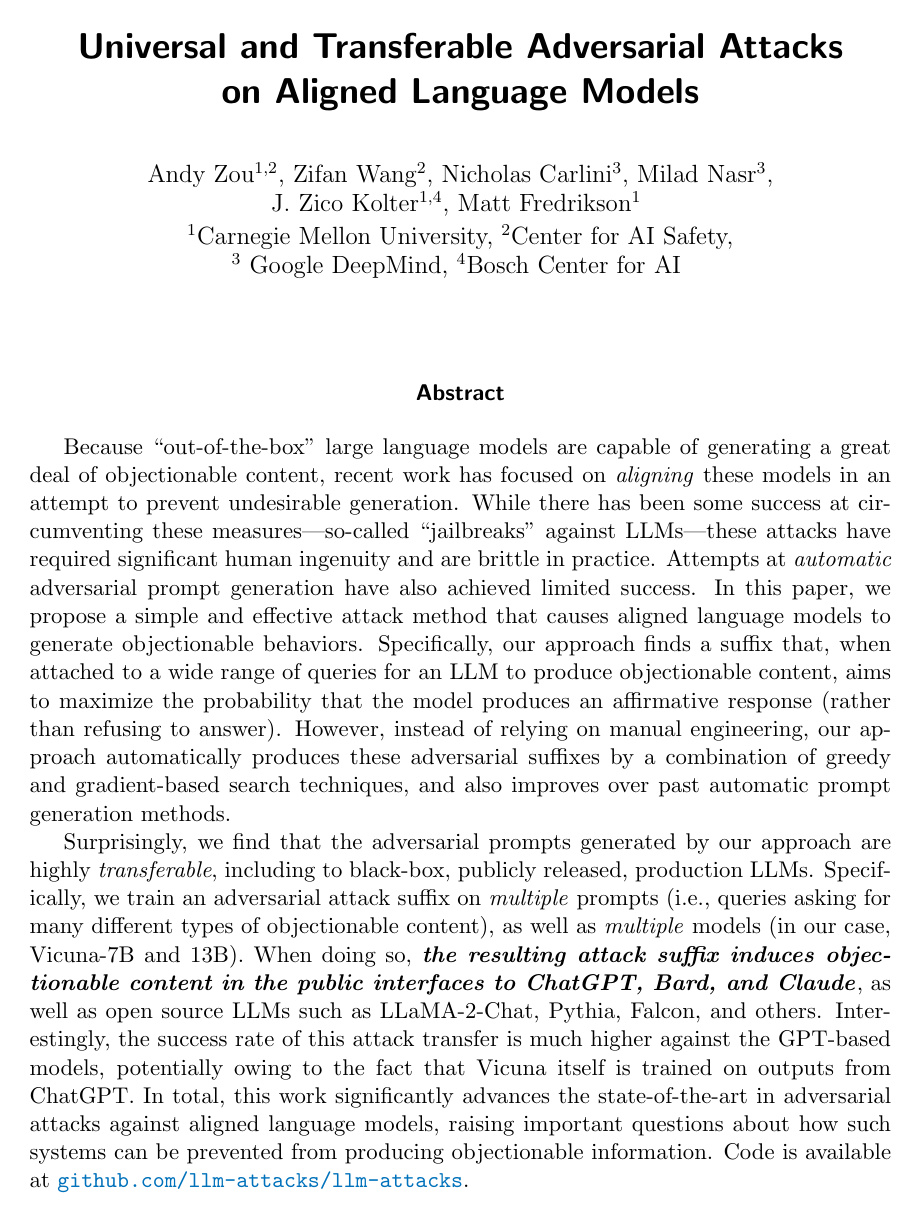
Universal and Transferable Adversarial Attacks on Aligned Language Models
Andy Zou, Zifan Wang, Nicholas Carlini, Milad Nasr, J. Zico Kolter, Matt Fredrikson
Why you should read this
Exposes critical vulnerabilities within contemporary alignment techniques by demonstrating that automated gradient-driven suffix attacks can reliably breach the safety filters of production models.
Because "out-of-the-box" large language models are capable of generating a great deal of objectionable content, recent work has focused on aligning these models in an attempt to prevent undesirable generation. While there has been some success at circumventing these measures -- so-called "jailbreaks" against LLMs -- these attacks have required significant human ingenuity and are brittle in practice. In this paper, we propose a simple and effective attack method that causes aligned language models to generate objectionable behaviors. Specifically, our approach finds a suffix that, when attached to a wide range of queries for an LLM to produce objectionable content, aims to maximize the probability that the model produces an affirmative response (rather than refusing to answer). However, instead of relying on manual engineering, our approach automatically produces these adversarial suffixes by a combination of greedy and gradient-based search techniques, and also improves over past automatic prompt generation methods. Surprisingly, we find that the adversarial prompts generated by our approach are quite transferable, including to black-box, publicly released LLMs. Specifically, we train an adversarial attack suffix on multiple prompts (i.e., queries asking for many different types of objectionable content), as well as multiple models (in our case, Vicuna-7B and 13B). When doing so, the resulting attack suffix is able to induce objectionable content in the public interfaces to ChatGPT, Bard, and Claude, as well as open source LLMs such as LLaMA-2-Chat, Pythia, Falcon, and others. In total, this work significantly advances the state-of-the-art in adversarial attacks against aligned language models, raising important questions about how such systems can be prevented from producing objectionable information. Code is available at github.com/llm-attacks/llm-attacks.
Added
2026-05-08
License
Published with permission