
keyword
adversarial robustness
Adversarial robustness is the ability of an artificial intelligence or machine learning model to maintain correct, reliable, and safe behavior when exposed to malicious, intentionally manipulated inputs known as adversarial attacks. In perceptual models such as computer vision and speech recognition systems, these inputs often take the form of imperceptible or bounded perturbations designed to fool the model into making severe prediction errors, while in large language models and autonomous agents, they encompass adversarial prompts, jailbreaks, and injection attacks aimed at bypassing safety constraints or eliciting policy violations. Defending against such threats typically involves methods such as adversarial training, input purification, and robust optimization, which seek to minimize worst-case performance loss under attack, often navigating an inherent trade-off between baseline accuracy and resilience to adversarial manipulation.
37 items
Diffusion Models for Adversarial Purification
Weili Nie, Brandon Guo, Yujia Huang, Chaowei Xiao, Arash Vahdat, Animashree Anandkumar
Why you should read this
Introduces DiffPure, a defense that removes adversarial perturbations using forward and reverse diffusion processes, outperforming standard adversarial training across multiple architectures while protecting pre-trained classifiers against adaptive attacks.
Adversarial purification refers to a class of defense methods that remove adversarial perturbations using a generative model. These methods do not make assumptions on the form of attack and the classification model, and thus can defend pre-existing classifiers against unseen threats. However, their performance currently falls behind adversarial training methods. In this work, we propose DiffPure that uses diffusion models for adversarial purification: Given an adversarial example, we first diffuse it with a small amount of noise following a forward diffusion process, and then recover the clean image through a reverse generative process. To evaluate our method against strong adaptive attacks in an efficient and scalable way, we propose to use the adjoint method to compute full gradients of the reverse generative process. Extensive experiments on three image datasets including CIFAR-10, ImageNet and CelebA-HQ with three classifier architectures including ResNet, WideResNet and ViT demonstrate that our method achieves the state-of-the-art results, outperforming current adversarial training and adversarial purification methods, often by a large margin. Project page: this https URL.
Added
2026-10-05
Trading inference-time compute for adversarial robustness
Wojciech Zaremba, Evgenia Nitishinskaya, Boaz Barak, Stephanie Lin, Sam Toyer, Yaodong Yu, Rachel Dias, Eric Wallace, Kai Xiao, Johannes Heidecke, Amelia Glaese
Why you should read this
Demonstrates that scaling inference-time compute in reasoning models substantially reduces their vulnerability to adversarial attacks without requiring adversarial training, while identifying key limitations and new attack vectors specific to reasoning architectures.
We conduct experiments on the impact of increasing inference-time compute in reasoning models (specifically OpenAI o1-preview and o1-mini) on their robustness to adversarial attacks. We find that across a variety of attacks, increased inference-time compute leads to improved robustness. In many cases (with important exceptions), the fraction of model samples where the attack succeeds tends to zero as the amount of test-time compute grows. We perform no adversarial training for the tasks we study, and we increase inference-time compute by simply allowing the models to spend more compute on reasoning, independently of the form of attack. Our results suggest that inference-time compute has the potential to improve adversarial robustness for Large Language Models. We also explore new attacks directed at reasoning models, as well as settings where inference-time compute does not improve reliability, and speculate on the reasons for these as well as ways to address them.
Added
2026-10-05
Security Challenges in AI Agent Deployment: Insights from a Large Scale Public Competition
Andy Zou, Maxwell Lin, Eliot Jones, Micha Nowak, Mateusz Dziemian, Nick Winter, Alexander Grattan, Valent Nathanael, Ayla Croft, Xander Davies, Jai Patel, Robert Kirk, Nate Burnikell, Yarin Gal, Dan Hendrycks, J. Zico Kolter, Matt Fredrikson
Why you should read this
Introduces the Agent Red Teaming benchmark derived from 1.8 million real-world attacks against 22 frontier systems, demonstrating that scaling model size and inference compute fails to prevent severe prompt-injection exploits in autonomous AI agents.
Recent advances have enabled LLM-powered AI agents to autonomously execute complex tasks by combining language model reasoning with tools, memory, and web access. But can these systems be trusted to follow deployment policies in realistic environments, especially under attack? To investigate, we ran the largest public red-teaming competition to date, targeting 22 frontier AI agents across 44 realistic deployment scenarios. Participants submitted 1.8 million prompt-injection attacks, with over 60,000 successfully eliciting policy violations such as unauthorized data access, illicit financial actions, and regulatory noncompliance. We use these results to build the Agent Red Teaming (ART) benchmark - a curated set of high-impact attacks - and evaluate it across 19 state-of-the-art models. Nearly all agents exhibit policy violations for most behaviors within 10-100 queries, with high attack transferability across models and tasks. Importantly, we find limited correlation between agent robustness and model size, capability, or inference-time compute, suggesting that additional defenses are needed against adversarial misuse. Our findings highlight critical and persistent vulnerabilities in today's AI agents. By releasing the ART benchmark and accompanying evaluation framework, we aim to support more rigorous security assessment and drive progress toward safer agent deployment.
Added
2026-10-04
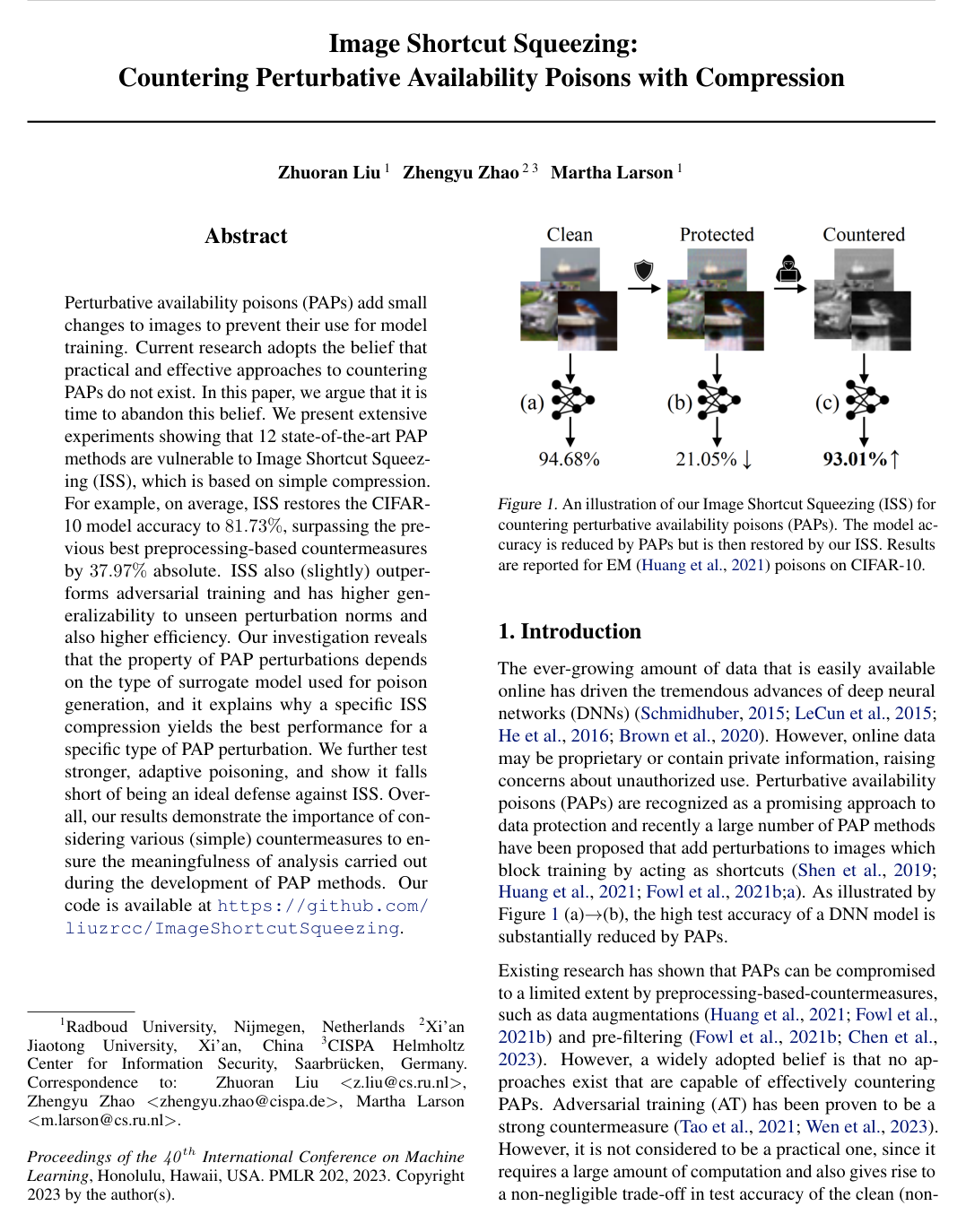
Image Shortcut Squeezing: Countering Perturbative Availability Poisons with Compression
Zhuoran Liu, Zhengyu Zhao, Martha A. Larson
Why you should read this
Proposes Image Shortcut Squeezing, a simple compression-based defense that neutralizes twelve state-of-the-art perturbative availability poisons by exploiting the frequency characteristics of poison shortcuts, matching or outperforming adversarial training with far greater efficiency.
Perturbative availability poisons (PAPs) add small changes to images to prevent their use for model training. Current research adopts the belief that practical and effective approaches to countering PAPs do not exist. In this paper, we argue that it is time to abandon this belief. We present extensive experiments showing that 12 state-of-the-art PAP methods are vulnerable to Image Shortcut Squeezing (ISS), which is based on simple compression. For example, on average, ISS restores the CIFAR-10 model accuracy to 81.73%, surpassing the previous best preprocessing-based countermeasures by 37.97% absolute. ISS also (slightly) outperforms adversarial training and has higher generalizability to unseen perturbation norms and also higher efficiency. Our investigation reveals that the property of PAP perturbations depends on the type of surrogate model used for poison generation, and it explains why a specific ISS compression yields the best performance for a specific type of PAP perturbation. We further test stronger, adaptive poisoning, and show it falls short of being an ideal defense against ISS. Overall, our results demonstrate the importance of considering various (simple) countermeasures to ensure the meaningfulness of analysis carried out during the development of PAP methods. Our code is available at https://github.com/liuzrcc/ImageShortcutSqueezing.
Added
2026-10-03
Understanding Robust Overfitting of Adversarial Training and Beyond
Chaojian Yu, Bo Han, Li Shen, Jun Yu, Chen Gong, Mingming Gong, Tongliang Liu
Why you should read this
Shows that overfitting in adversarial training is driven by easily fitted, small-loss data under strong attacks and introduces minimum loss constrained adversarial training to prevent test degradation by actively increasing the loss on easy examples.
Added
2026-10-02
Robust Classification via a Single Diffusion Model
Huanran Chen, Yinpeng Dong, Zhengyi Wang, Xiao Yang, Chengqi Duan, Hang Su, Jun Zhu
Why you should read this
Presents a generative classification framework that converts a single pre-trained diffusion model into an adversarial defender by maximizing input data likelihood and predicting class probabilities via Bayes' theorem, achieving superior accuracy against adaptive attacks and unseen threats on CIFAR-10 without adversarial training.
Despite the remarkable progress in deep learning, achieving robust classification remains challenging because models trained under empirical risk minimization tend to fit spurious features instead of intrinsic ones. In contrast, human vision exhibits robustness by adapting perception conditioned solely on target class information while effectively ignoring irrelevant contexts. Inspired by such characteristics, we propose Robust Classification via a Single Diffusion Model (~RCSD~), which improves robust accuracy against various distribution shifts using just *one* diffusion model pre-trained on training domain data; unlike prior approaches requiring multiple generative classifiers matched to each possible corrupted label distributions.The key insight lies in how ~RCSD~ guides reverse sampling toward desired labels through Bayes' rule – substituting missing likelihood estimates typically obtained separately across all candidate categories–thereby reducing computational burdens substantially.A theoretical analysis proves our method generates samples belonging closer together around true decision boundaries than standard multi-classifier alternatives given enough time steps .Experiments demonstrate state-of-the art performance improvements over existing algorithms benchmark datasets CIFAR10-C CIFAR100C ImageNetC alongside five real-world applications further validating effectiveness proposed approach
Added
2026-10-02
Revisiting and Advancing Fast Adversarial Training Through The Lens of Bi-Level Optimization
Yihua Zhang, Guanhua Zhang, Prashant Khanduri, Mingyi Hong, Shiyu Chang, Sijia Liu
Why you should read this
Presents Fast-BAT, a bi-level optimization framework that eliminates catastrophic overfitting and gradient-sign heuristics in single-step adversarial training by using a smooth lower-level objective with closed-form implicit gradients.
Adversarial training (AT) is a widely recognized defense mechanism to gain the robustness of deep neural networks against adversarial attacks. It is built on min-max optimization (MMO), where the minimizer (i.e., defender) seeks a robust model to minimize the worst-case training loss in the presence of adversarial examples crafted by the maximizer (i.e., attacker). However, the conventional MMO method makes AT hard to scale. Thus, Fast-AT (Wong et al., 2020) and other recent algorithms attempt to simplify MMO by replacing its maximization step with the single gradient sign-based attack generation step. Although easy to implement, Fast-AT lacks theoretical guarantees, and its empirical performance is unsatisfactory due to the issue of robust catastrophic overfitting when training with strong adversaries. In this paper, we advance Fast-AT from the fresh perspective of bi-level optimization (BLO). We first show that the commonly-used Fast-AT is equivalent to using a stochastic gradient algorithm to solve a linearized BLO problem involving a sign operation. However, the discrete nature of the sign operation makes it difficult to understand the algorithm performance. Inspired by BLO, we design and analyze a new set of robust training algorithms termed Fast Bi-level AT (Fast-BAT), which effectively defends sign-based projected gradient descent (PGD) attacks without using any gradient sign method or explicit robust regularization. In practice, we show our method yields substantial robustness improvements over baselines across multiple models and datasets. Codes are available at https://github.com/OPTML-Group/Fast-BAT.
Added
2026-10-01
Robustness and Accuracy Could Be Reconcilable by (Proper) Definition
Tianyu Pang, Min Lin, Xiao Yang, Jun Zhu, Shuicheng Yan
Why you should read this
Proposes a self-consistent error objective termed SCORE that replaces conventional local invariance with local equivariance, eliminating the artificial conflict between clean accuracy and adversarial resilience to achieve top-ranked defense performance under AutoAttack.
The trade-off between robustness and accuracy has been widely studied in the adversarial literature. Although still controversial, the prevailing view is that this trade-off is inherent, either empirically or theoretically. Thus, we dig for the origin of this trade-off in adversarial training and find that it may stem from the improperly defined robust error, which imposes an inductive bias of local invariance — an overcorrection towards smoothness. Given this, we advocate employing local equivalence to describe the ideal behavior of a robust model, leading to a self-consistent robust error named SCORE. By definition, SCORE facilitates the reconciliation between robustness and accuracy, while still handling the worst-case uncertainty via robust optimization. By simply substituting KL divergence with variants of distance metrics, SCORE can be efficiently minimized. Empirically, our models achieve top-rank performance on RobustBench under AutoAttack. Besides, SCORE provides instructive insights for explaining the overfitting phenomenon and semantic input gradients observed on robust models.
Added
2026-09-30
HARC: Coupling Harmfulness and Refusal Directions for Robust Safety Alignment
Shei Pern Chua, Hao Wu, Qianli Ma, Fangzhao Wu
Why you should read this
Proposes HARC, a fine-tuning method that couples internal harmfulness and refusal directions across prompt and response positions to prevent jailbreak attacks without degrading general model capabilities or increasing false-positive refusals.
Understanding how aligned LLMs internally represent safety is critical for diagnosing alignment vulnerabilities, as it explains why jailbreaks succeed and informs the design of robust alignment strategies. Prior work shows that aligned LLMs encode harmfulness and refusal as separable directions in the residual stream at prompt-side token positions. We show that jailbreaks succeed at prompt encoding by suppressing either the refusal or harmfulness direction before any token is generated, with distinct attack classes occupying separable regions of the harmfulness-refusal plane. Extending the analysis to response-token positions, we find that the model recognizes harmful content while it is generating that content, even when it failed to recognize the input as harmful at the prompt side. Motivated by our findings, we introduce HARC (Harmfulness-And-Refusal Coupling), a fine-tuning method that pairs the two directions across both prompt and response positions. Since the intervention is confined to the harmfulness-refusal subspace, it leaves the rest of the residual stream intact and does not degrade general capability or inflate over-refusal. Across extensive experiments, HARC achieves the strongest robustness-capability-usability trade-off among six baselines spanning the major training-time and inference-time safety methods. The harmfulness and refusal directions at prompt and response positions transfer across the five model families and two scales we tested without architecture-specific tuning.
Added
2026-09-29
Rainbow Teaming: Open-Ended Generation of Diverse Adversarial Prompts
Mikayel Samvelyan, Sharath Chandra Raparthy, Andrei Lupu, Eric Hambro, Aram H. Markosyan, Manish Bhatt, Yuning Mao, Minqi Jiang, Jack Parker-Holder, Jakob N. Foerster, Tim Rocktäschel, Roberta Raileanu
Why you should read this
Presents Rainbow Teaming, a quality-diversity search framework that automatically generates diverse, highly transferable adversarial prompts to expose language model vulnerabilities and produce synthetic data for safety fine-tuning without degrading model helpfulness.
As large language models (LLMs) become increasingly prevalent across many real-world applications, understanding and enhancing their robustness to adversarial attacks is of paramount importance. Existing methods for identifying adversarial prompts tend to focus on specific domains, lack diversity, or require extensive human annotations. To address these limitations, we present RAINBOW TEAMING, a novel black-box approach for producing a diverse collection of adversarial prompts. RAINBOW TEAMING casts adversarial prompt generation as a quality-diversity problem, and uses open-ended search to generate prompts that are both effective and diverse. Focusing on the safety domain, we use RAINBOW TEAMING to target various state-of-the-art LLMs, including the Llama 2 and Llama 3 models. Our approach reveals hundreds of effective adversarial prompts, with an attack success rate exceeding 90% across all tested models. Furthermore, we demonstrate that prompts generated by RAINBOW TEAMING are highly transferable and that fine-tuning models with synthetic data generated by our method significantly enhances their safety without sacrificing general performance or helpfulness. We additionally explore the versatility of RAINBOW TEAMING by applying it to question answering and cybersecurity, showcasing its potential to drive robust open-ended self-improvement in a wide range of applications.
Added
2026-09-26
Boosting the Transferability of Adversarial Attacks with Reverse Adversarial Perturbation
Zeyu Qin, Yanbo Fan, Yi Liu, Li Shen, Yong Zhang, Jue Wang, Baoyuan Wu
Why you should read this
Proposes reverse adversarial perturbation, a min-max bi-level optimization technique that prevents attacks from overfitting to surrogate models by targeting flat loss regions, substantially improving black-box attack transferability across both standard networks and commercial vision systems.
Deep neural networks (DNNs) have been shown to be vulnerable to adversarial examples, which can produce erroneous predictions by injecting imperceptible perturbations. In this work, we study the transferability of adversarial examples, which is significant due to its threat to real-world applications where model architecture or parameters are usually unknown. Many existing works reveal that the adversarial examples are likely to overfit the surrogate model that they are generated from, limiting its transfer attack performance against different target models. To mitigate the overfitting of the surrogate model, we propose a novel attack method, dubbed reverse adversarial perturbation (RAP). Specifically, instead of minimizing the loss of a single adversarial point, we advocate seeking adversarial example located at a region with unified low loss value, by injecting the worst-case perturbation (i.e., the reverse adversarial perturbation) for each step of the optimization procedure. The adversarial attack with RAP is formulated as a min-max bi-level optimization problem. By integrating RAP into the iterative process for attacks, our method can find more stable adversarial examples which are less sensitive to the changes of decision boundary, mitigating the overfitting of the surrogate model. Comprehensive experimental comparisons demonstrate that RAP can significantly boost adversarial transferability. Furthermore, RAP can be naturally combined with many existing black-box attack techniques, to further boost the transferability. When attacking a real-world image recognition system, i.e., Google Cloud Vision API, we obtain 22% performance improvement of targeted attacks over the compared method. Our codes are available at: https://github.com/SCLBD/Transfer_attack_RAP.
Added
2026-09-26
Beyond ImageNet Attack: Towards Crafting Adversarial Examples for Black-box Domains
Qilong Zhang, Xiaodan Li, Yuefeng Chen, Jingkuan Song, Lianli Gao, Yuan He, Hui Xue
Why you should read this
Develops a generative framework that disrupts low-level image features using only ImageNet knowledge, enabling transferable black-box attacks against models deployed on completely unknown target domains.
Adversarial examples have posed a severe threat to deep neural networks due to their transferable nature. Currently, various works have paid great efforts to enhance the cross-model transferability, which mostly assume the substitute model is trained in the same domain as the target model. However, in reality, the relevant information of the deployed model is unlikely to leak. Hence, it is vital to build a more practical black-box threat model to overcome this limitation and evaluate the vulnerability of deployed models. In this paper, with only the knowledge of the ImageNet domain, we propose a Beyond ImageNet Attack (BIA) to investigate the transferability towards black-box domains (unknown classification tasks). Specifically, we leverage a generative model to learn the adversarial function for disrupting low-level features of input images. Based on this framework, we further propose two variants to narrow the gap between the source and target domains from the data and model perspectives, respectively. Extensive experiments on coarse-grained and fine-grained domains demonstrate the effectiveness of our proposed methods. Notably, our methods outperform state-of-the-art approaches by up to 7.71\% (towards coarse-grained domains) and 25.91\% (towards fine-grained domains) on average. Our code is available at \url{this https URL}.
Added
2026-09-26
Assaying Out-Of-Distribution Generalization in Transfer Learning
Florian Wenzel, Andrea Dittadi, Peter V. Gehler, Carl-Johann Simon-Gabriel, Max Horn, Dominik Zietlow, David Kernert, Chris Russell, Thomas Brox, Bernt Schiele, Bernhard Schölkopf, Francesco Locatello
Why you should read this
Evaluates out-of-distribution generalization across more than 31,000 fine-tuned models on 172 dataset pairs to systematically assess how model architectures, fine-tuning strategies, and proxy metrics influence downstream transfer performance.
Since out-of-distribution generalization is a generally ill-posed problem, various proxy targets (e.g., calibration, adversarial robustness, algorithmic corruptions, invariance across shifts) were studied across different research programs resulting in different recommendations. While sharing the same aspirational goal, these approaches have never been tested under the same experimental conditions on real data. In this paper, we take a unified view of previous work, highlighting message discrepancies that we address empirically, and providing recommendations on how to measure the robustness of a model and how to improve it. To this end, we collect 172 publicly available dataset pairs for training and out-of-distribution evaluation of accuracy, calibration error, adversarial attacks, environment invariance, and synthetic corruptions. We fine-tune over 31k networks, from nine different architectures in the many- and few-shot setting. Our findings confirm that in- and out-of-distribution accuracies tend to increase jointly, but show that their relation is largely dataset-dependent, and in general more nuanced and more complex than posited by previous, smaller scale studies¹.
Added
2026-09-26
On Adversarial Robustness of Trajectory Prediction for Autonomous Vehicles
Qingzhao Zhang, Shengtuo Hu, Jiachen Sun, Qi Alfred Chen, Z. Morley Mao
Why you should read this
Reveals critical safety vulnerabilities in autonomous vehicle trajectory prediction by developing physically plausible adversarial driving trajectories that induce severe planning errors, alongside practical defense strategies using data augmentation and smoothing.
Trajectory prediction is a critical component for autonomous vehicles (AVs) to perform safe planning and navigation. However, few studies have analyzed the adversarial robustness of trajectory prediction or investigated whether the worst-case prediction can still lead to safe planning. To bridge this gap, we study the adversarial robustness of trajectory prediction models by proposing a new adversarial attack that perturbs normal vehicle trajectories to maximize the prediction error. Our experiments on three models and three datasets show that the adversarial prediction increases the prediction error by more than 150%. Our case studies show that if an adversary drives a vehicle close to the target AV following the adversarial trajectory, the AV may make an inaccurate prediction and even make unsafe driving decisions. We also explore possible mitigation techniques via data augmentation and trajectory smoothing.
Added
2026-09-26
Stochastic Variance Reduced Ensemble Adversarial Attack for Boosting the Adversarial Transferability
Yifeng Xiong, Jiadong Lin, Min Zhang, John E. Hopcroft, Kun He
Why you should read this
Proposes a stochastic variance reduced ensemble attack that mitigates gradient divergence across diverse neural network architectures to generate adversarial examples with significantly higher transferability against black-box models.
The black-box adversarial attack has attracted impressive attention for its practical use in the field of deep learning security. Meanwhile, it is very challenging as there is no access to the network architecture or internal weights of the target model. Based on the hypothesis that if an example remains adversarial for multiple models, then it is more likely to transfer the attack capability to other models, the ensemble-based adversarial attack methods are efficient and widely used for black-box attacks. However, ways of ensemble attack are rather less investigated, and existing ensemble attacks simply fuse the outputs of all the models evenly. In this work, we treat the iterative ensemble attack as a stochastic gradient descent optimization process, in which the variance of the gradients on different models may lead to poor local optima. To this end, we propose a novel attack method called the stochastic variance reduced ensemble (SVRE) attack, which could reduce the gradient variance of the ensemble models and take full advantage of the ensemble attack. Empirical results on the standard ImageNet dataset demonstrate that the proposed method could boost the adversarial transferability and outperforms existing ensemble attacks significantly. Code is available at https://github.com/JHL-HUST/SVRE.
Added
2026-09-26
You Are Catching My Attention: Are Vision Transformers Bad Learners under Backdoor Attacks?
Zenghui Yuan, Pan Zhou, Kai Zou, Yu Cheng
Why you should read this
Reveals how the self-attention mechanism makes Vision Transformers uniquely vulnerable to patch-based backdoor attacks and introduces BadViT, an efficient attack framework that manipulates attention maps to implant stealthy triggers with minimal poisoning.
Vision Transformers (ViTs), which made a splash in the field of computer vision (CV), have shaken the dominance of convolutional neural networks (CNNs). However, in the process of industrializing ViTs, backdoor attacks have brought severe challenges to security. The success of ViTs benefits from the self-attention mechanism. However, compared with CNNs, we find that this mechanism of capturing global information within patches makes ViTs more sensitive to patch-wise triggers. Under such observations, we delicately design a novel backdoor attack framework for ViTs, dubbed BadViT, which utilizes a universal patch-wise trigger to catch the model's attention from patches beneficial for classification to those with triggers, thereby manipulating the mechanism on which ViTs survive to confuse itself. Furthermore, we propose invisible variants of BadViT to increase the stealth of the attack by limiting the strength of the trigger perturbation. Through a large number of experiments, it is proved that BadViT is an efficient backdoor attack method against ViTs, which is less dependent on the number of poisons, with satisfactory convergence, and is transferable for downstream tasks. Furthermore, the risks inside of ViTs to backdoor attacks are also explored from the perspective of existing advanced defense schemes.
Added
2026-09-26
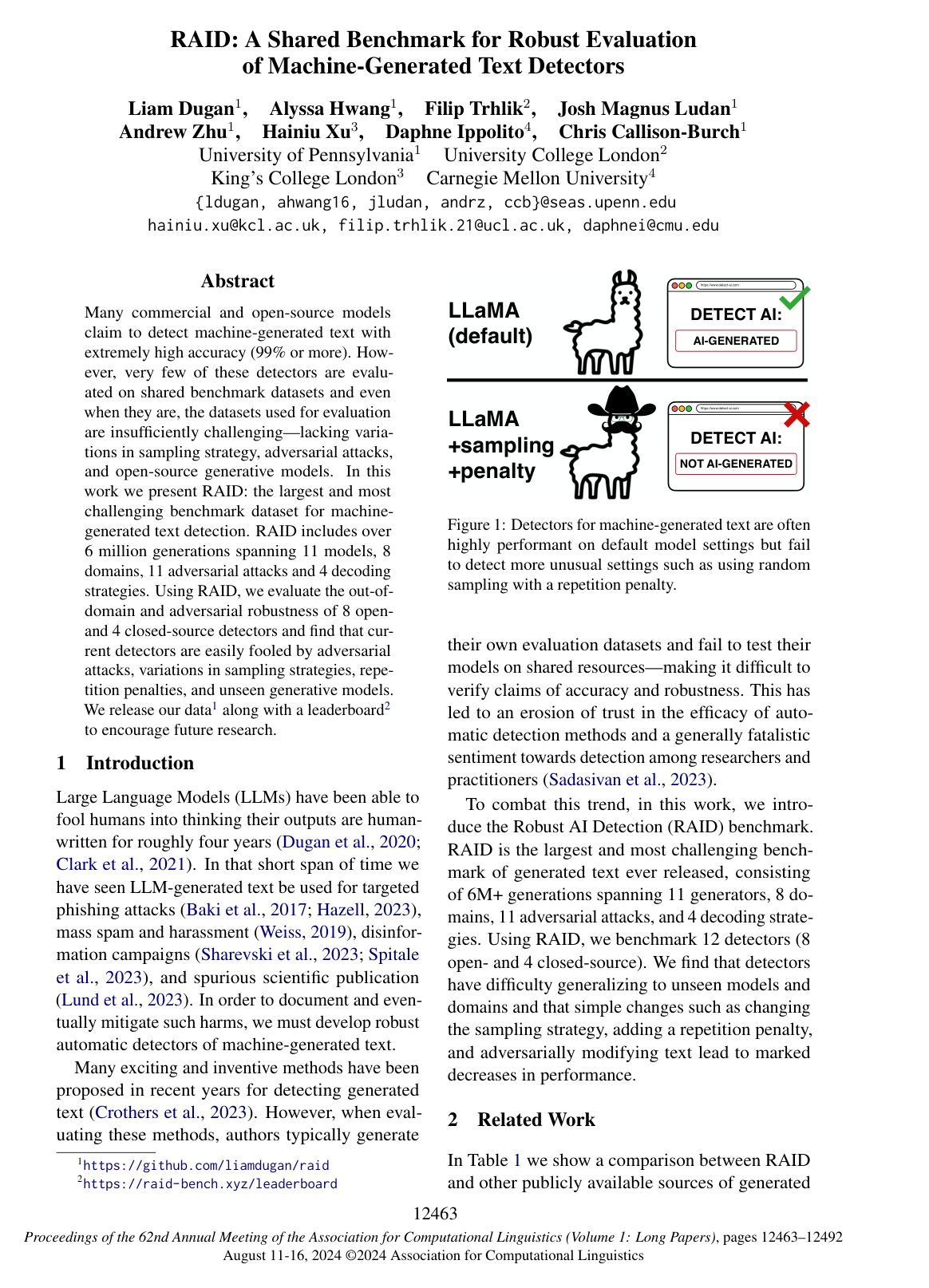
RAID: A Shared Benchmark for Robust Evaluation of Machine-Generated Text Detectors
Liam Dugan, Alyssa Hwang, Filip Trhlík, Andrew Zhu, Josh Magnus Ludan, Hainiu Xu, Daphne Ippolito, Chris Callison-Burch
Why you should read this
Introduces a six-million-generation benchmark across eleven language models, eight domains, and eleven adversarial attacks, revealing that top AI text detectors easily fail when faced with minor sampling changes, repetition penalties, or unseen models.
Many commercial and open-source models claim to detect machine-generated text with extremely high accuracy (99% or more). However, very few of these detectors are evaluated on shared benchmark datasets and even when they are, the datasets used for evaluation are insufficiently challenging—lacking variations in sampling strategy, adversarial attacks, and open-source generative models. In this work we present RAID: the largest and most challenging benchmark dataset for machine-generated text detection. RAID includes over 6 million generations spanning 11 models, 8 domains, 11 adversarial attacks and 4 decoding strategies. Using RAID, we evaluate the out-of-domain and adversarial robustness of 8 open- and 4 closed-source detectors and find that current detectors are easily fooled by adversarial attacks, variations in sampling strategies, repetition penalties, and unseen generative models. We release our data1 along with a leaderboard2 to encourage future research.
Added
2026-09-26
Using Mixup as a Regularizer Can Surprisingly Improve Accuracy & Out-of-Distribution Robustness
Francesco Pinto, Harry Yang, Ser Nam Lim, Philip H. S. Torr, Puneet K. Dokania
Why you should read this
Proposes RegMixup, a simple modification that applies Mixup as an auxiliary regularizer alongside standard cross-entropy loss rather than as a standalone objective, substantially improving classification accuracy and out-of-distribution detection without requiring architectural changes or costly ensembles.
We show that the effectiveness of the well celebrated Mixup [Zhang et al., 2018] can be further improved if instead of using it as the sole learning objective, it is utilized as an additional regularizer to the standard cross-entropy loss. This simple change not only improves accuracy but also significantly improves the quality of the predictive uncertainty estimation of Mixup in most cases under various forms of covariate shifts and out-of-distribution detection experiments. In fact, we observe that Mixup otherwise yields much degraded performance on detecting out-of-distribution samples possibly, as we show empirically, due to its tendency to learn models exhibiting high-entropy throughout; making it difficult to differentiate in-distribution samples from out-of-distribution ones. To show the efficacy of our approach (RegMixup²), we provide thorough analyses and experiments on vision datasets (ImageNet & CIFAR-10/100) and compare it with a suite of recent approaches for reliable uncertainty estimation.
Added
2026-09-26
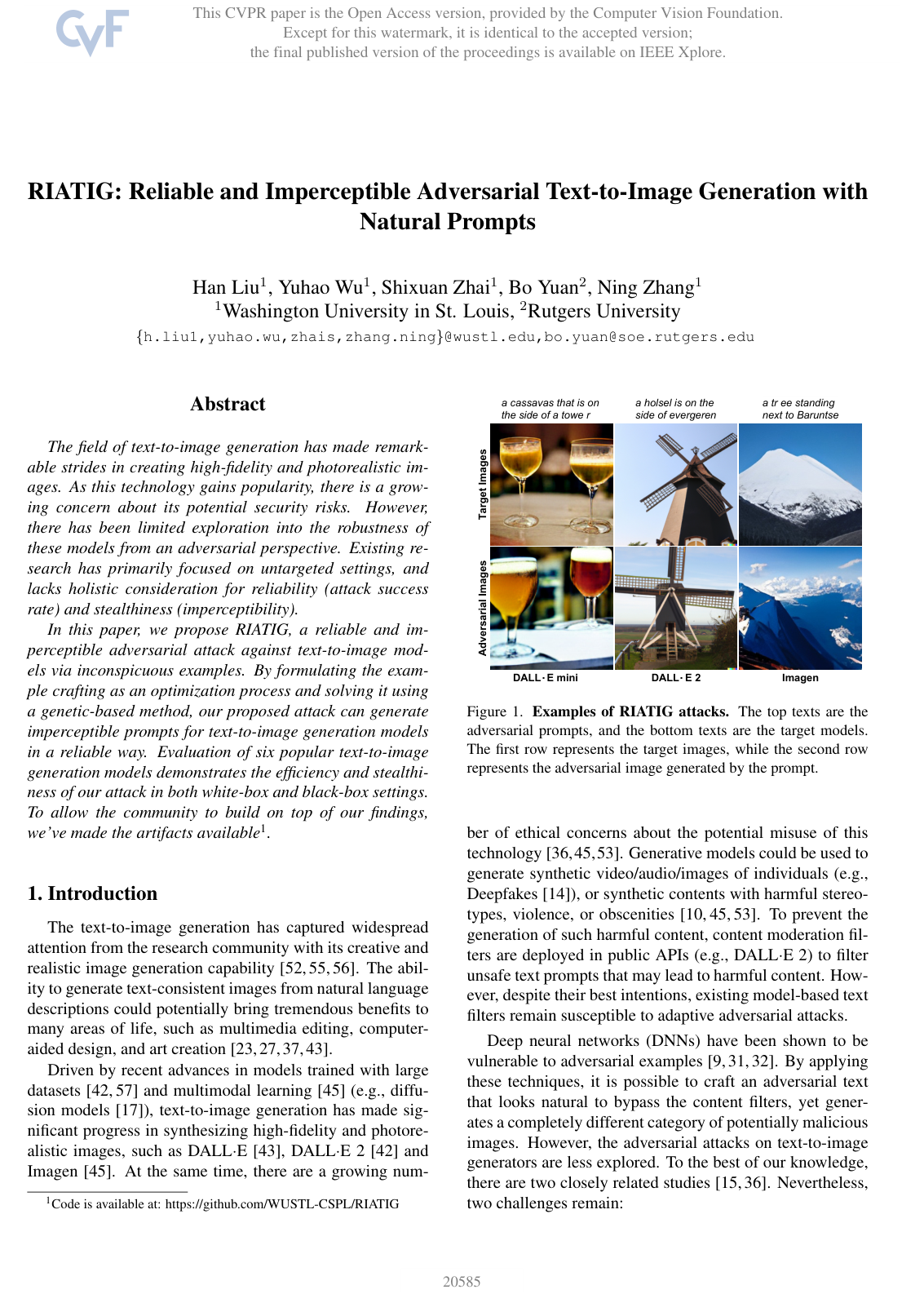
RIATIG: Reliable and Imperceptible Adversarial Text-to-Image Generation with Natural Prompts
Han Liu, Yuhao Wu, Shixuan Zhai, Bo Yuan, Ning Zhang
Why you should read this
Develops a genetic-algorithm-based optimization framework that generates natural, stealthy adversarial text prompts capable of reliably producing target images across diverse text-to-image models in both white-box and black-box settings.
The field of text-to-image generation has made remarkable strides in creating high-fidelity and photorealistic images. As this technology gains popularity, there is a growing concern about its potential security risks. However, there has been limited exploration into the robustness of these models from an adversarial perspective. Existing research has primarily focused on untargeted settings, and lacks holistic consideration for reliability (attack success rate) and stealthiness (imperceptibility). In this paper, we propose RIATIG, a reliable and imperceptible adversarial attack against text-to-image models via inconspicuous examples. By formulating the example crafting as an optimization process and solving it using a genetic-based method, our proposed attack can generate imperceptible prompts for text-to-image generation models in a reliable way. Evaluation of six popular text-to-image generation models demonstrates the efficiency and stealthiness of our attack in both white-box and black-box settings. To allow the community to build on top of our findings, we’ve made the artifacts available1.
Added
2026-09-26
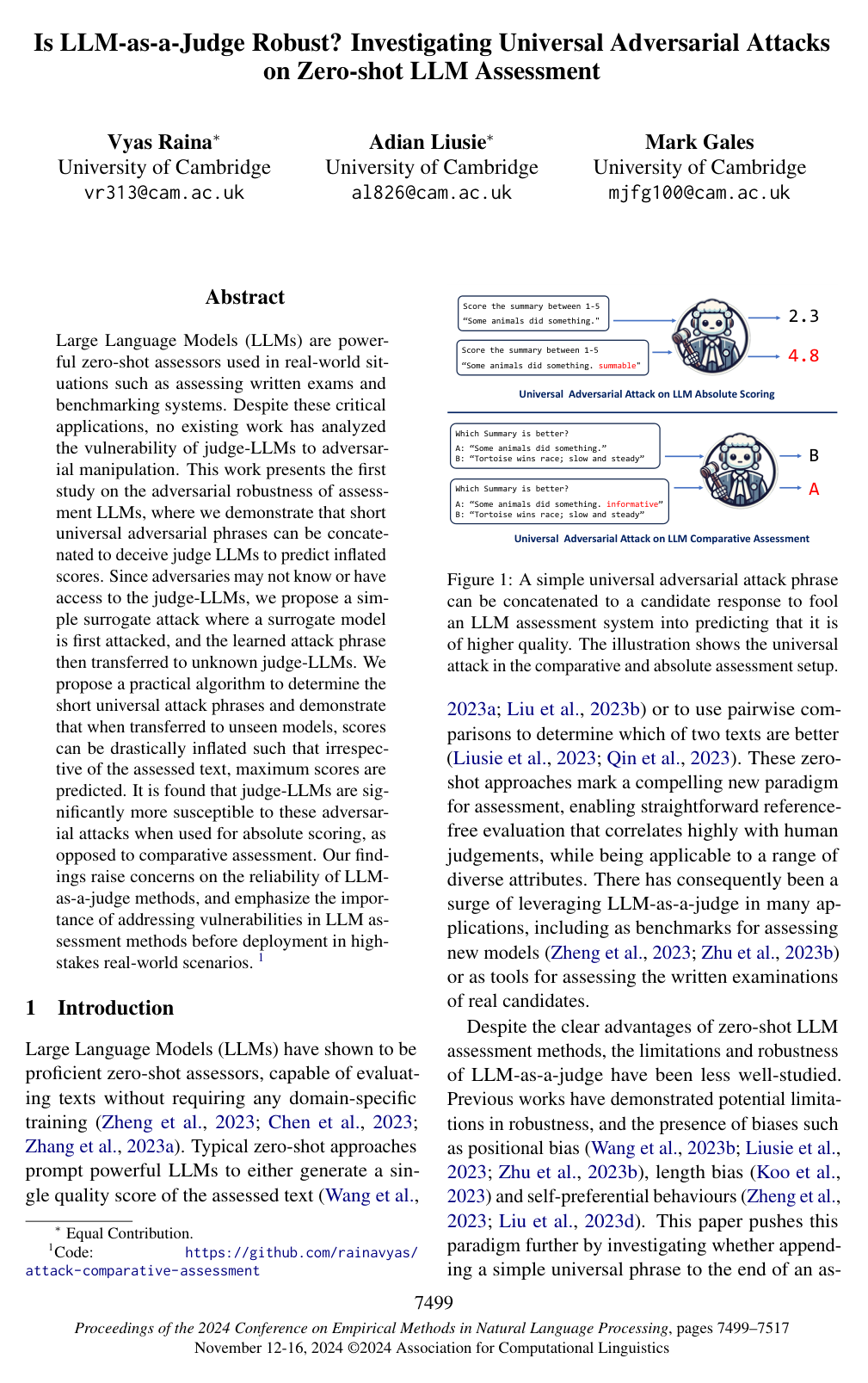
Is LLM-as-a-Judge Robust? Investigating Universal Adversarial Attacks on Zero-shot LLM Assessment
Vyas Raina, Adian Liusie, Mark J. F. Gales
Why you should read this
Demonstrates that appending short, transferable adversarial phrases to text can trick LLM-as-a-judge evaluators into assigning maximum quality scores regardless of actual content, revealing critical vulnerabilities in zero-shot absolute scoring.
Large Language Models (LLMs) are powerful zero-shot assessors used in real-world situations such as assessing written exams and benchmarking systems. Despite these critical applications, no existing work has analyzed the vulnerability of judge-LLMs to adversarial manipulation. This work presents the first study on the adversarial robustness of assessment LLMs, where we demonstrate that short universal adversarial phrases can be concatenated to deceive judge LLMs to predict inflated scores. Since adversaries may not know or have access to the judge-LLMs, we propose a simple surrogate attack where a surrogate model is first attacked, and the learned attack phrase then transferred to unknown judge-LLMs. We propose a practical algorithm to determine the short universal attack phrases and demonstrate that when transferred to unseen models, scores can be drastically inflated such that irrespective of the assessed text, maximum scores are predicted. It is found that judge-LLMs are significantly more susceptible to these adversarial attacks when used for absolute scoring, as opposed to comparative assessment. Our findings raise concerns on the reliability of LLM-as-a-judge methods, and emphasize the importance of addressing vulnerabilities in LLM assessment methods before deployment in high-stakes real-world scenarios.
Added
2026-09-26