
keyword
adaptive filtering
Adaptive filtering is a dynamic data-processing technique that adjusts its filtering criteria, thresholds, or operational parameters in response to changing input conditions, statistical properties, or score distributions. Unlike static filtering approaches that rely on fixed, predefined cutoff points across all instances, adaptive filtering continuously evaluates the characteristics of incoming data to separate relevant, high-quality information from noise, errors, or uninformative samples. By automatically tailoring selection boundaries to the specific context or distribution of each task, this technique balances precision and recall, enhances noise reduction, and improves the overall robustness and accuracy of information retrieval, machine learning, and automated decision-making systems.
2 items
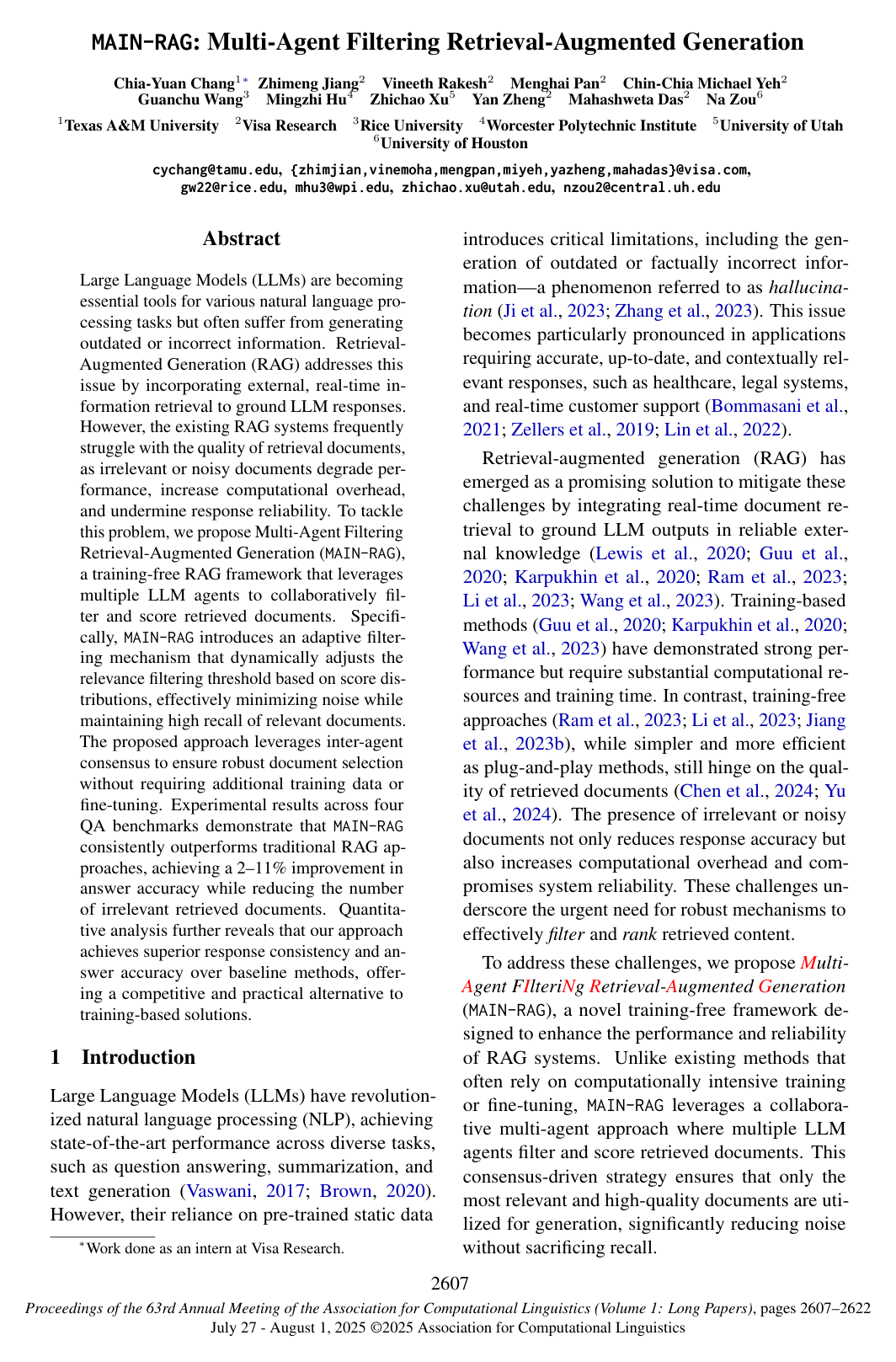
MAIN-RAG: Multi-Agent Filtering Retrieval-Augmented Generation
Chia-Yuan Chang, Zhimeng Jiang, Vineeth Rakesh, Menghai Pan, Chin-Chia Michael Yeh, Guanchu Wang, Mingzhi Hu, Zhichao Xu, Yan Zheng, Mahashweta Das, Na Zou
Why you should read this
Proposes a training-free multi-agent framework that uses dynamic score thresholds to filter out noisy retrieved documents, boosting question-answering accuracy by up to 11% without model fine-tuning.
Large Language Models (LLMs) are becoming essential tools for various natural language processing tasks but often suffer from generating outdated or incorrect information. Retrieval-Augmented Generation (RAG) addresses this issue by incorporating external, real-time information retrieval to ground LLM responses. However, the existing RAG systems frequently struggle with the quality of retrieval documents, as irrelevant or noisy documents degrade performance, increase computational overhead, and undermine response reliability. To tackle this problem, we propose Multi-Agent Filtering Retrieval-Augmented Generation (MAIN-RAG), a training-free RAG framework that leverages multiple LLM agents to collaboratively filter and score retrieved documents. Specifically, MAIN-RAG introduces an adaptive filtering mechanism that dynamically adjusts the relevance filtering threshold based on score distributions, effectively minimizing noise while maintaining high recall of relevant documents. The proposed approach leverages inter-agent consensus to ensure robust document selection without requiring additional training data or fine-tuning. Experimental results across four QA benchmarks demonstrate that MAIN-RAG consistently outperforms traditional RAG approaches, achieving a 2–11% improvement in answer accuracy while reducing the number of irrelevant retrieved documents. Quantitative analysis further reveals that our approach achieves superior response consistency and answer accuracy over baseline methods, offering a competitive and practical alternative to training-based solutions.
Added
2026-10-03
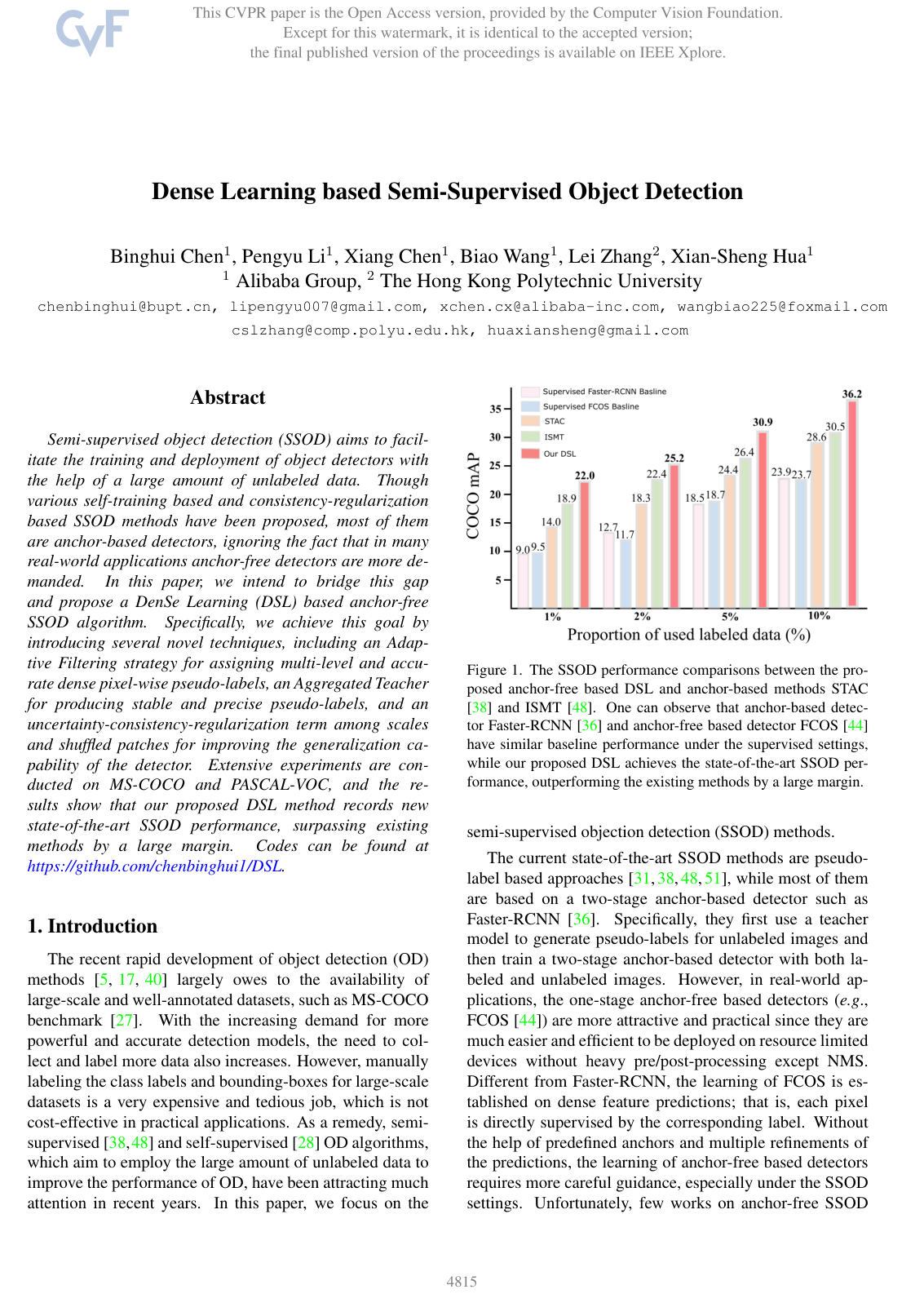
Dense Learning based Semi-Supervised Object Detection
Binghui Chen, Pengyu Li, Xiang Chen, Biao Wang, Lei Zhang, Xian-Sheng Hua
Why you should read this
Proposes an anchor-free semi-supervised object detection framework that assigns dense pixel-level pseudo-labels via adaptive filtering and scale-consistent regularization to substantially outperform anchor-based methods on limited labeled data.
Semi-supervised object detection (SSOD) aims to facilitate the training and deployment of object detectors with the help of a large amount of unlabeled data. Though various self-training based and consistency-regularization based SSOD methods have been proposed, most of them are anchor-based detectors, ignoring the fact that in many real-world applications anchor-free detectors are more demanded. In this paper, we intend to bridge this gap and propose a DenSe Learning (DSL) based anchor-free SSOD algorithm. Specifically, we achieve this goal by introducing several novel techniques, including an Adaptive Filtering strategy for assigning multi-level and accurate dense pixel-wise pseudo-labels, an Aggregated Teacher for producing stable and precise pseudo-labels, and an uncertainty-consistency-regularization term among scales and shuffled patches for improving the generalization capability of the detector. Extensive experiments are conducted on MS-COCO and PASCAL-VOC, and the results show that our proposed DSL method records new state-of-the-art SSOD performance, surpassing existing methods by a large margin. Codes can be found at https://github.com/chenbinghui1/DSL.
Added
2026-09-26