
Built independently by an author, for readers. Read the story and support ChapterPal

keyword

adaptive entropy

Adaptive entropy refers to the dynamic estimation and modeling of information entropy in data compression, where the assumed probability distribution of data symbols is continuously updated based on local statistical context rather than remaining fixed. By adjusting probability estimates in response to neighboring values, spatial relationships, or contextual priors, adaptive entropy frameworks more accurately capture non-stationary characteristics and localized redundancies within the data. This real-time adjustment allows entropy coding mechanisms to allocate optimal code lengths corresponding to the local variance and distribution of the input, thereby maximizing compression efficiency and rate-distortion performance in both traditional and learned compression architectures.

1 item
ELIC: Efficient Learned Image Compression with Unevenly Grouped Space-Channel Contextual Adaptive Coding

ELIC: Efficient Learned Image Compression with Unevenly Grouped Space-Channel Contextual Adaptive Coding

Dailan He, Ziming Yang, Weikun Peng, Rui Ma, Hongwei Qin, Yan Wang

OrganizationsSenseTimeTsinghua University

Why you should read this

Presents ELIC, a learned image compression architecture that combines uneven space-channel contextual coding with efficient transform design to achieve state-of-the-art rate-distortion performance alongside fast inference, preview decoding, and progressive decoding.

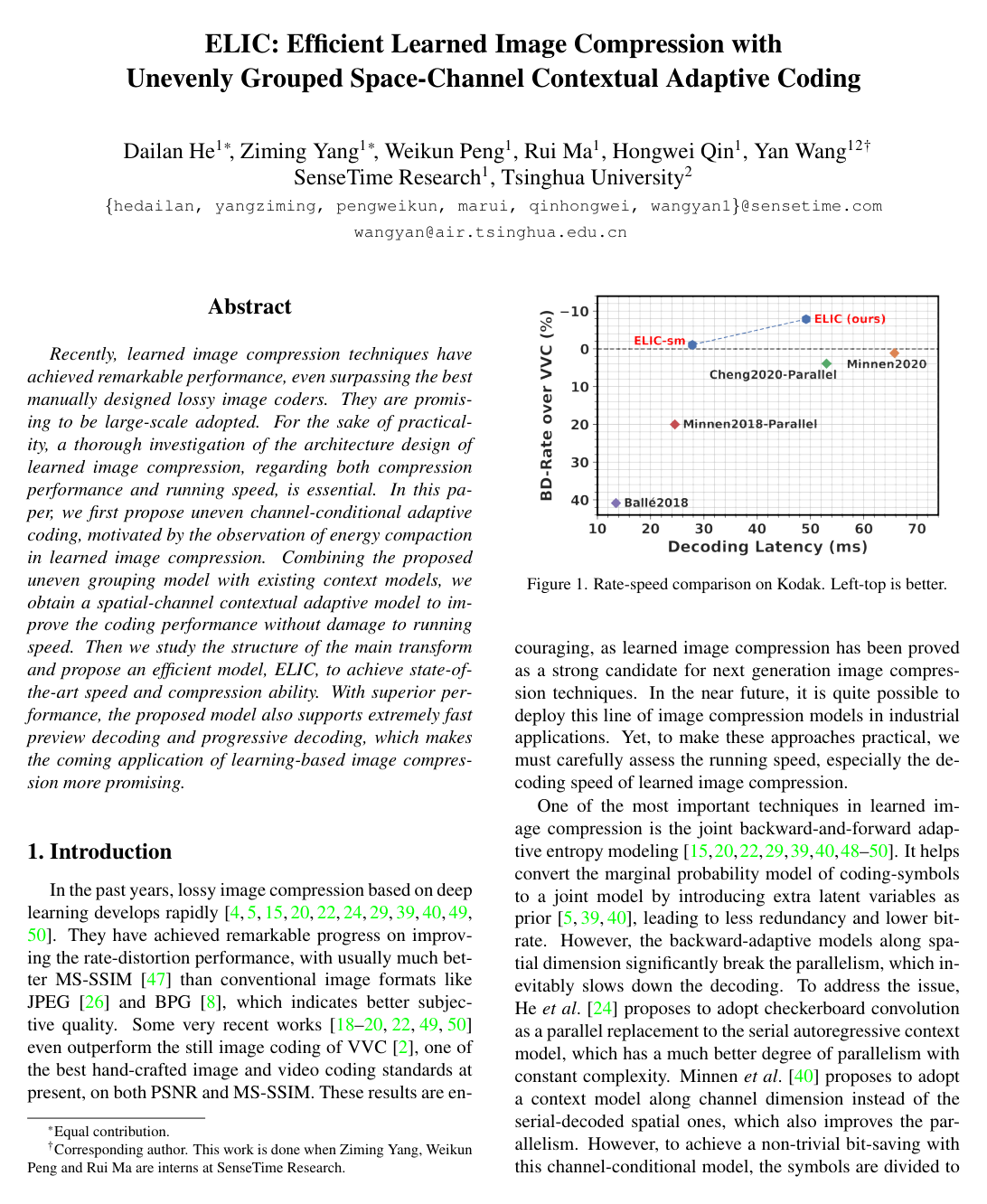
Recently, learned image compression techniques have achieved remarkable performance, even surpassing the best manually designed lossy image coders. They are promising to be large-scale adopted. For the sake of practicality, a thorough investigation of the architecture design of learned image compression, regarding both compression performance and running speed, is essential. In this paper, we first propose uneven channel-conditional adaptive coding, motivated by the observation of energy compaction in learned image compression. Combining the proposed uneven grouping model with existing context models, we obtain a spatial-channel contextual adaptive model to improve the coding performance without damage to running speed. Then we study the structure of the main transform and propose an efficient model, ELIC, to achieve state-of-the-art speed and compression ability. With superior performance, the proposed model also supports extremely fast preview decoding and progressive decoding, which makes the coming application of learning-based image compression more promising.

Added

2026-09-26