Built independently by an author, for readers. Read the story and support ChapterPal

keyword

Adaptive Conceptualization

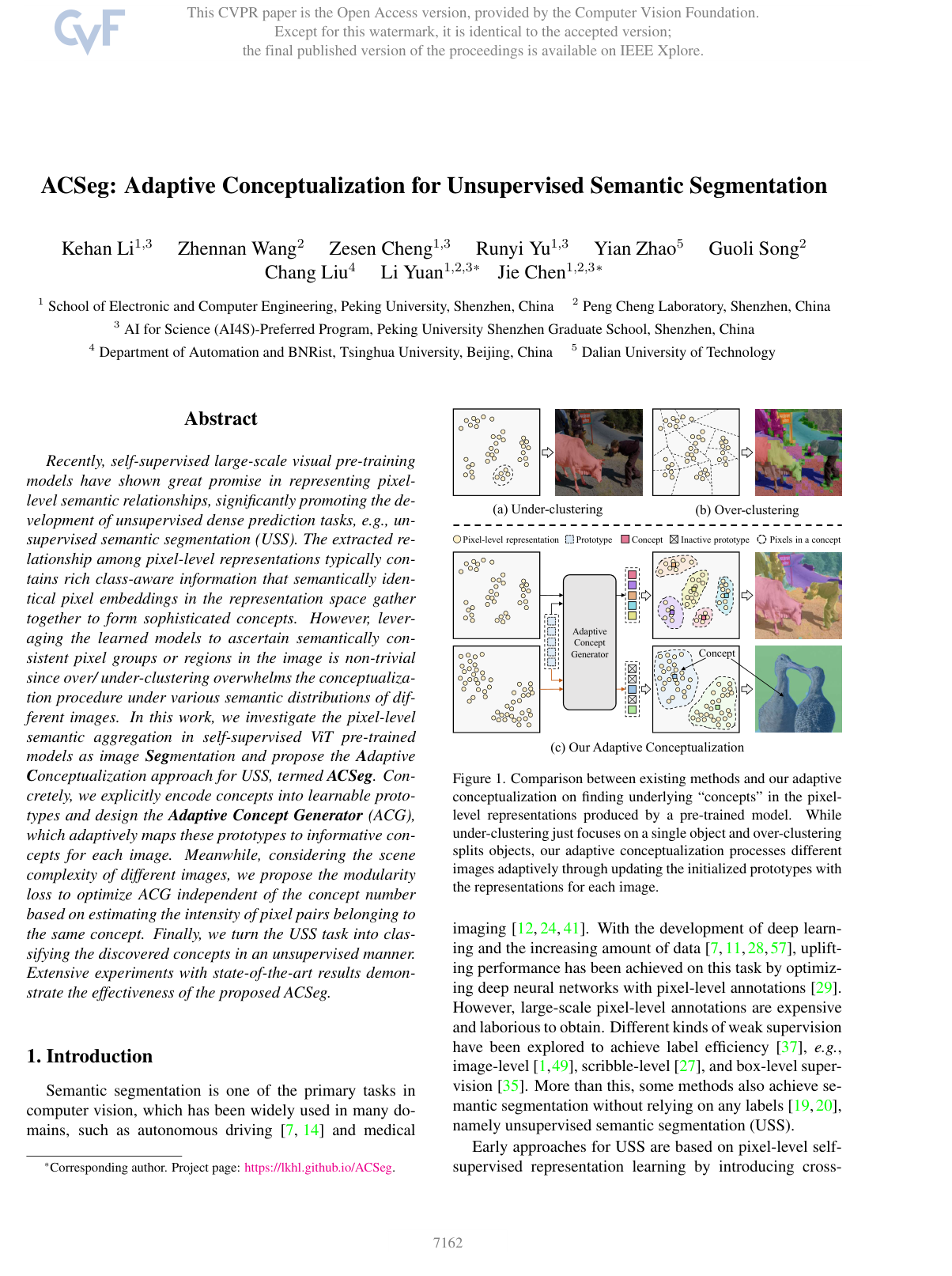
Adaptive conceptualization is a representation learning technique in computer vision that dynamically aggregates low-level visual features, such as pixel or patch embeddings, into discrete semantic concepts tailored to the specific content and complexity of each image. Rather than applying a fixed or uniform grouping across diverse scenes, this process adapts the granularity and allocation of semantic prototypes to match the unique distribution of visual elements within an individual input. By dynamically forming image-specific concepts, adaptive conceptualization mitigates common clustering failures such as over-segmentation and under-segmentation, enabling more accurate visual understanding in unsupervised dense prediction and semantic segmentation tasks.

1 item

ACSeg: Adaptive Conceptualization for Unsupervised Semantic Segmentation

ACSeg: Adaptive Conceptualization for Unsupervised Semantic Segmentation

Kehan Li, Zhennan Wang, Zesen Cheng, Runyi Yu, Yian Zhao, Guoli Song, Chang Liu, Li Yuan, Jie Chen

OrganizationsDalian University of TechnologyPeking UniversityPeng Cheng LaboratoryTsinghua University

Why you should read this

Proposes an unsupervised semantic segmentation framework that dynamically maps learnable prototypes into image-specific semantic concepts using attention mechanisms and a modularity loss, overcoming over- and under-clustering issues without requiring manual annotations.

Recently, self-supervised large-scale visual pre-training models have shown great promise in representing pixel-level semantic relationships, significantly promoting the development of unsupervised dense prediction tasks, e.g., unsupervised semantic segmentation (USS). The extracted relationship among pixel-level representations typically contains rich class-aware information that semantically identical pixel embeddings in the representation space gather together to form sophisticated concepts. However, leveraging the learned models to ascertain semantically consistent pixel groups or regions in the image is non-trivial since over/ under-clustering overwhelms the conceptualization procedure under various semantic distributions of different images. In this work, we investigate the pixel-level semantic aggregation in self-supervised ViT pre-trained models as image Segmentation and propose the Adaptive Conceptualization approach for USS, termed ACSeg. Concretely, we explicitly encode concepts into learnable prototypes and design the Adaptive Concept Generator (ACG), which adaptively maps these prototypes to informative concepts for each image. Meanwhile, considering the scene complexity of different images, we propose the modularity loss to optimize ACG independent of the concept number based on estimating the intensity of pixel pairs belonging to the same concept. Finally, we turn the USS task into classifying the discovered concepts in an unsupervised manner. Extensive experiments with state-of-the-art results demonstrate the effectiveness of the proposed ACSeg.

Added

2026-09-26