
keyword
accessibility barriers
Accessibility barriers are obstacles, conditions, or design shortcomings in physical, digital, social, or technological environments that prevent individuals with disabilities or diverse functional needs from independently accessing information, using services, or participating fully in activities. In digital systems and human-technology interaction, these barriers frequently arise when software, hardware, interfaces, or algorithmic tools are not designed to be compatible with assistive technologies such as screen readers or fail to support alternative sensory and cognitive modes of interaction. Such impediments can restrict user autonomy, diminish efficiency, and create inequities, highlighting the necessity of inclusive design principles, adaptable interfaces, and proactive accommodations that ensure equitable usability for all individuals.
2 items
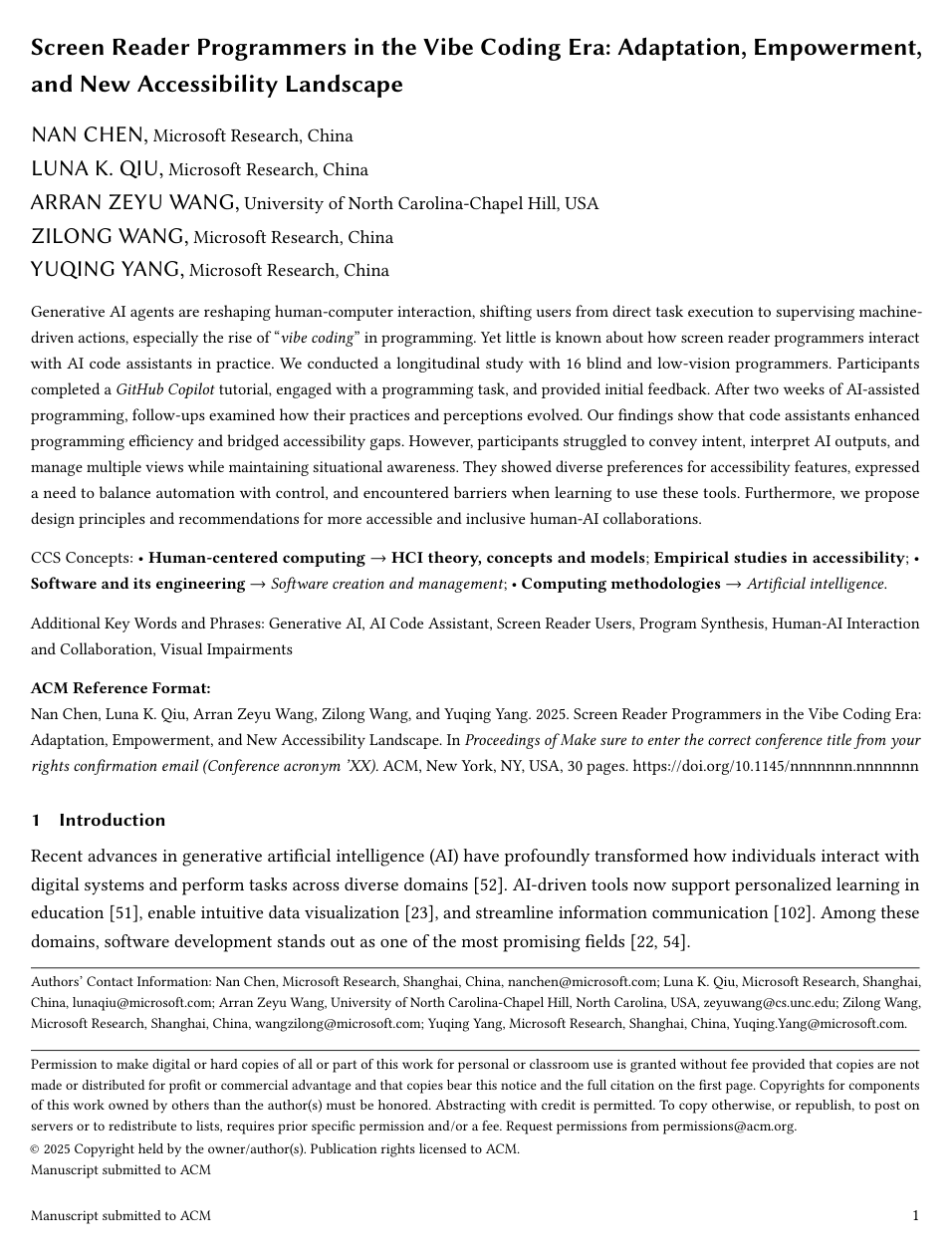
Screen Reader Programmers in the Vibe Coding Era: Adaptation, Empowerment, and New Accessibility Landscape
Nan Chen, Luna K. Qiu, Arran Zeyu Wang, Zilong Wang, Yuqing Yang
Why you should read this
Reveals how blind and low-vision developers interact with AI code assistants through a longitudinal study, identifying key accessibility barriers in interpreting machine-generated output and situational awareness while establishing actionable design principles for inclusive programming tools.
Generative AI agents are reshaping human-computer interaction, shifting users from direct task execution to supervising machine-driven actions, especially the rise of "vibe coding" in programming. Yet little is known about how screen reader programmers interact with AI code assistants in practice. We conducted a longitudinal study with 16 blind and low-vision programmers. Participants completed a GitHub Copilot tutorial, engaged with a programming task, and provided initial feedback. After two weeks of AI-assisted programming, follow-ups examined how their practices and perceptions evolved. Our findings show that code assistants enhanced programming efficiency and bridged accessibility gaps. However, participants struggled to convey intent, interpret AI outputs, and manage multiple views while maintaining situational awareness. They showed diverse preferences for accessibility features, expressed a need to balance automation with control, and encountered barriers when learning to use these tools. Furthermore, we propose design principles and recommendations for more accessible and inclusive human-AI collaborations.
Added
2026-09-29
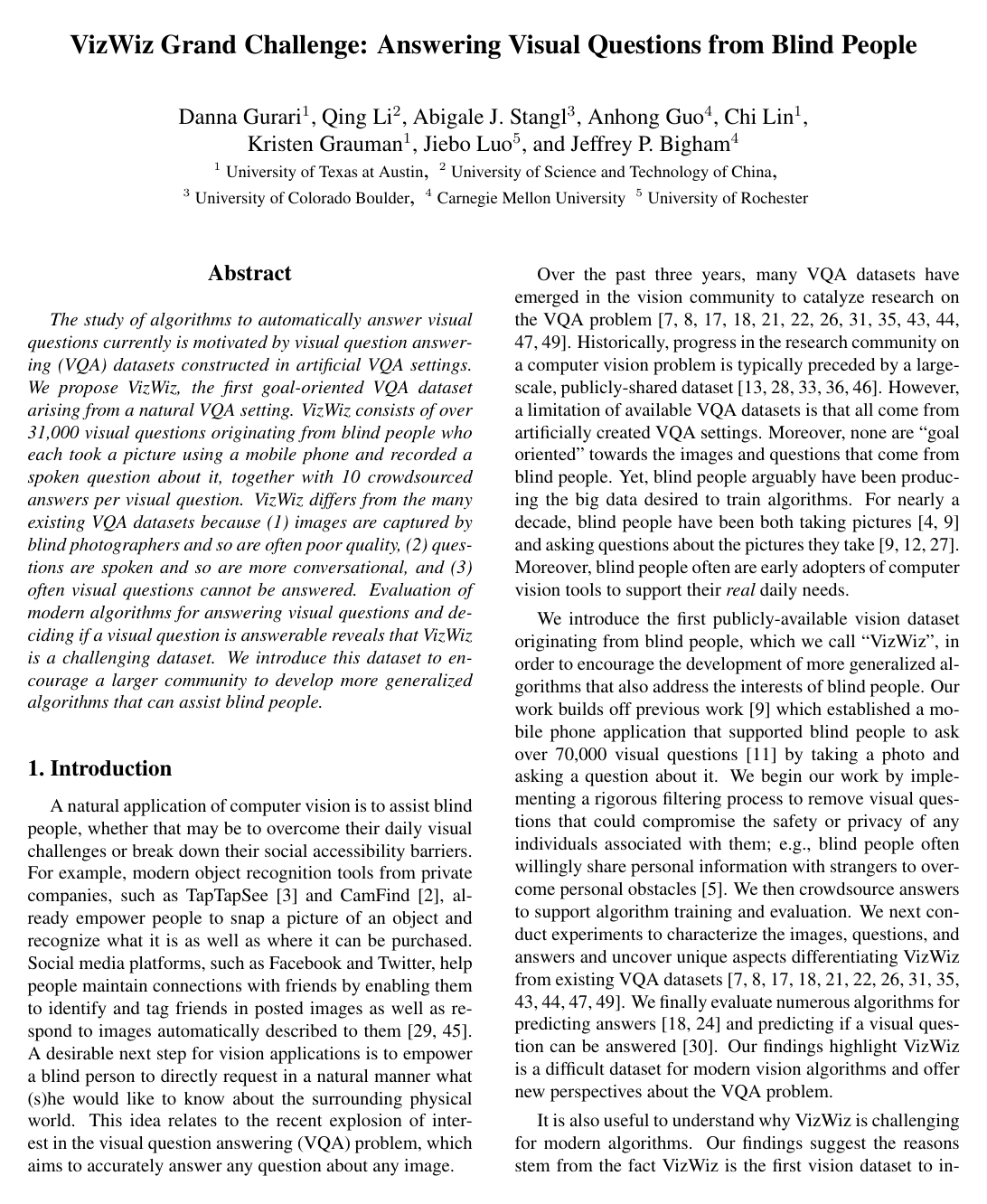
VizWiz Grand Challenge: Answering Visual Questions from Blind People
Danna Gurari, Qing Li, Abigale J. Stangl, Anhong Guo, Chi Lin, Kristen Grauman, Jiebo Luo, Jeffrey P. Bigham
Why you should read this
Introduces VizWiz, a dataset of over 31,000 real-world visual questions from blind users that challenges visual question answering models to handle conversational queries, imperfect mobile photos, and unanswerable prompts in genuine assistive settings.
The study of algorithms to automatically answer visual questions currently is motivated by visual question answering (VQA) datasets constructed in artificial VQA settings. We propose VizWiz, the first goal-oriented VQA dataset arising from a natural VQA setting. VizWiz consists of over 31,000 visual questions originating from blind people who each took a picture using a mobile phone and recorded a spoken question about it, together with 10 crowdsourced answers per visual question. VizWiz differs from the many existing VQA datasets because (1) images are captured by blind photographers and so are often poor quality, (2) questions are spoken and so are more conversational, and (3) often visual questions cannot be answered. Evaluation of modern algorithms for answering visual questions and deciding if a visual question is answerable reveals that VizWiz is a challenging dataset. We introduce this dataset to encourage a larger community to develop more generalized algorithms that can assist blind people.
Added
2026-09-25