
Built independently by an author, for readers. Read the story and support ChapterPal

keyword

3D morphable face model

A 3D morphable face model is a generative computational representation of three-dimensional human faces that parametrizes variations in shape, appearance, and expression within a continuous vector space. Built by establishing dense point-to-point correspondences across collections of three-dimensional facial scans, such models typically disentangle distinct facial attributes, such as identity-specific geometry, dynamic expressions, and surface texture, into separate lower-dimensional parameters. By manipulating these parameters, the model can synthesize novel realistic facial geometries, reconstruct detailed three-dimensional faces from two-dimensional images, and facilitate facial animation across various applications in computer vision and computer graphics.

1 item
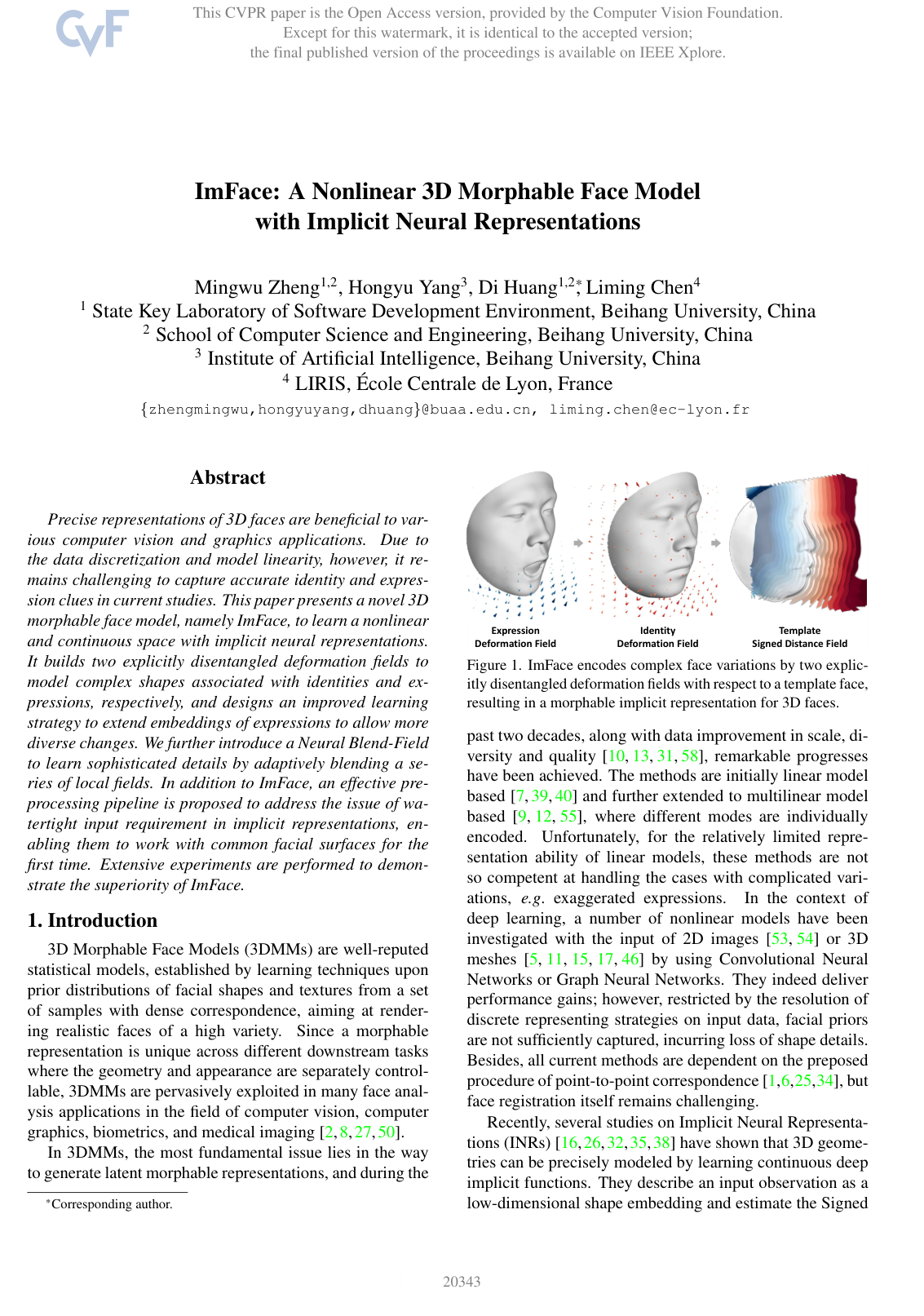
ImFace: A Nonlinear 3D Morphable Face Model with Implicit Neural Representations

ImFace: A Nonlinear 3D Morphable Face Model with Implicit Neural Representations

Mingwu Zheng, Hongyu Yang, Di Huang, Liming Chen

OrganizationsBeihang UniversityÉcole Centrale de LyonLIRIS

Why you should read this

Proposes a nonlinear 3D morphable face model based on implicit neural representations that explicitly disentangles identity and expression deformation fields, enabling high-fidelity face reconstruction and synthesis directly from non-watertight surfaces.

Precise representations of 3D faces are beneficial to various computer vision and graphics applications. Due to the data discretization and model linearity, however, it remains challenging to capture accurate identity and expression clues in current studies. This paper presents a novel 3D morphable face model, namely ImFace, to learn a nonlinear and continuous space with implicit neural representations. It builds two explicitly disentangled deformation fields to model complex shapes associated with identities and expressions, respectively, and designs an improved learning strategy to extend embeddings of expressions to allow more diverse changes. We further introduce a Neural Blend-Field to learn sophisticated details by adaptively blending a series of local fields. In addition to ImFace, an effective preprocessing pipeline is proposed to address the issue of watertight input requirement in implicit representations, enabling them to work with common facial surfaces for the first time. Extensive experiments are performed to demonstrate the superiority of ImFace.

Added

2026-09-26