📄 Executive Summary
This textbook is designed for advanced undergraduate and beginning graduate students in mathematics, physics, and applied sciences seeking a systematic treatment of asymptotic analysis and perturbation theory. The text presumes a working knowledge of multivariable calculus, ordinary differential equations, partial differential equations, and complex analysis. The book focuses on constructing formal asymptotic expansions for mathematical problems containing small or large parameters, providing analytical approximations when exact closed-form solutions are unavailable.
The curriculum progresses systematically from foundational asymptotic concepts to complex differential equations and physical systems. It begins by establishing the formal definitions of asymptotic orders, equivalence, and asymptotic series, complemented by classical results such as Borel's theorem on smooth functions with prescribed Taylor coefficients. The text then develops methods for estimating integrals with large parameters, detailing Laplace's method for exponential integrals, the stationary phase method for oscillatory integrals, and the method of steepest descent across complex integration paths, incorporating concepts from Morse theory and Newton polyhedra for higher-dimensional integrals.
Moving to differential equations, the book classifies ordinary differential equations in the complex domain into ordinary, regular singular, and irregular singular points, utilizing Frobenius series and indicial equations to determine local behaviors. It then investigates regular and singular perturbation problems for boundary and initial value problems in both ordinary and partial differential equations. To resolve non-uniform convergence, the book presents boundary layer theory, the method of matched asymptotic expansions across inner and outer zones, and multiple-scale analysis to eliminate secular terms in nonlinear oscillators such as the Rayleigh and Van der Pol models.
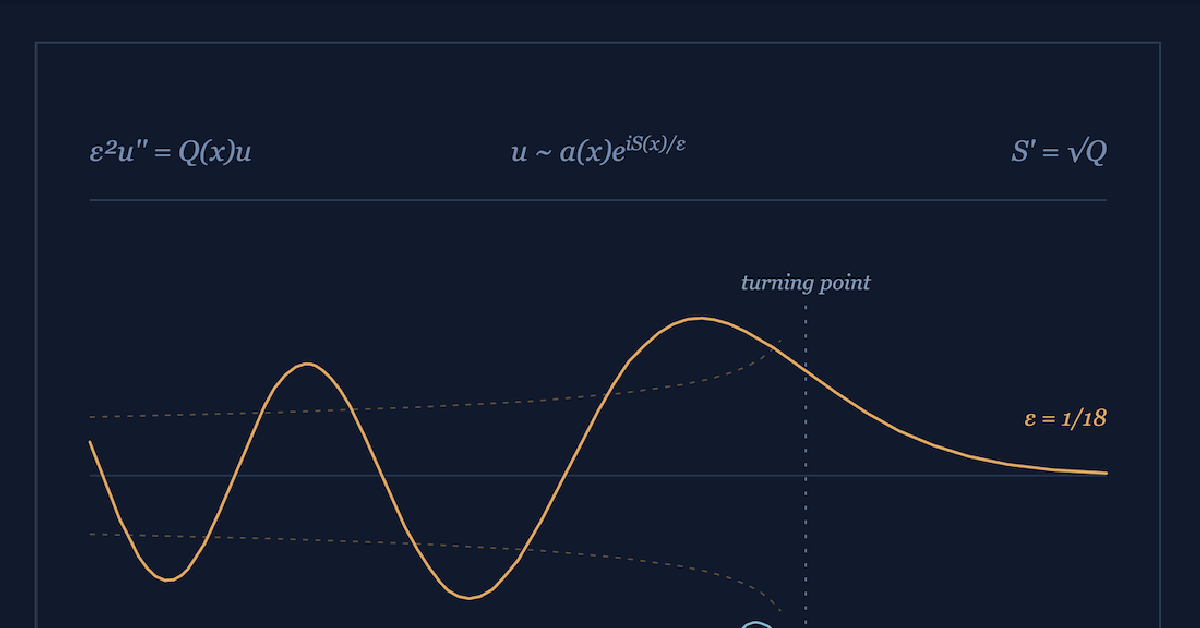
The text further expands into wave propagation, high-frequency asymptotics, and semiclassical approximations. It constructs geometric optics solutions through eikonal and transport equations for the wave equation, Maxwell's system, and isotropic elasticity, including the analysis of Rayleigh surface waves. The one-dimensional and multidimensional WKB approximations are formulated to analyze quantum Hamiltonians, connection formulas across turning points, and caustics such as folds and pleats using Airy and Pearcey canonical integrals. Additionally, the book covers nonlinear wave phenomena via Burgers' equation and shock formation, followed by Hamiltonian perturbation theory applied to celestial mechanics, orbital resonance, Earth's oblateness effects, and secular tidal dynamics.
After studying this book, readers will be equipped to construct asymptotic series, identify boundary layers, perform coordinate scaling and matching, track ray geometry and caustics, and analyze nonlinear Hamiltonian resonances. The presentation deliberately prioritizes the formal derivation and physical geometry of asymptotic solutions over real-analytic convergence proofs, leaving outside its scope the functional-analytic verification of remainder estimates, high-codimension caustic classifications, and boundary diffraction on non-smooth domains.